
 Worksheets
CREDIT FINAL
Total questions: 63
Worksheet time: 32mins
Name
Class
Date
1.
What should you do if you can’t pay your credit card bill?
a)
Ignore it and hope it goes away.
b)
Call the credit card company to discuss payment options.
c)
Use another credit card to pay it.
d)
Change your name and move to Pocatello, Idaho.
2.
What is the best way to use a credit card responsibly?
a)
Only buy things you can afford to pay back.
b)
Use it to buy as much as you want.
c)
Never pay the bill and keep borrowing money.
d)
Use as much credit as you can to increase our credit score.
3.
Which best describes the difference between secured and unsecured loans?
a)
Secured loans require collateral, while unsecured loans do not.
b)
Secured loans have a higher interest rate than unsecured loans.
c)
Secured loans are only available to individuals with good credit, while unsecured loans are available to anyone.
d)
Secured loans do not require a credit check, but unsecured loans do.
4.
Elliott renovates his home using a loan that requires him to sign over the title to his car if he doesn't pay as promised. What type of loan does Elliott have?
a)
Unsecured loan
b)
Auto loan
c)
Secured loan
d)
Payday loan
5.
Which type of financial aid is considered free money?
a)
Loans
b)
Grants
c)
Work-study
d)
Scholarships
6.
What is the main benefit of taking out a federal student loan instead of a private loan?
a)
Federal student loans offer lower interest rates and more flexible repayment options.
b)
Federal student loans do not need to be repaid after graduation.
c)
Federal student loans offer more money than private loans.
d)
You will have a higher interest rate for a federal student loan.
7.
What is the best way to stay out of debt?
a)
Continuously take out personal loans to cover expenses.
b)
Rely on credit cards for all of your purchases and pay them off at the end of the month.
c)
Spend only what you can afford and avoid using credit cards for unnecessary purchases.
d)
Borrow money from friends and family whenever you need it.
8.
Which of the following types of credit typically has the LOWEST interest rate?
a)
Payday Loan
b)
Auto Loan
c)
Buy Now, Pay Later
d)
Credit Cards
e)
Mortgage
9.
All of the following are ways to build your credit EXCEPT?
a)
Use a co-signer
b)
Become an authorized user
c)
Get credit for the bills you pay
d)
Practice good credit habits
e)
Use cash or debit and avoid credit
10.
The average APR for a payday loan is closest to …
a)
4%
b)
14%
c)
40%
d)
400%
11.
What is a "down payment" in the context of auto loans?
a)
Monthly fee charged by the dealership for maintenance.
b)
A portion of the vehicle's purchase price paid upfront.
c)
Additional charge for customizing the vehicle's features.
d)
Refundable deposit made to secure the loan.
e)
A percentage of the total loan paid in addition to the purchase price.
12.
A loan with a SHORTER term will have ______________ monthly payments & you will pay _________________ in total interest.
a)
higher, more
b)
lower, less
c)
higher, less
d)
lower, more
e)
lower, lower
13.
Which of the following will lower the overall cost of your auto loan?
a)
Choosing a longer loan term
b)
Obtaining a higher interest rate
c)
Making a larger down payment
d)
Applying for a loan with no credit history
14.
Why do dealerships tend to emphasize monthly payments over other loan factors?
a)
To make the purchasing process easier to understand.
b)
To shift focus away from total cost and interest rates.
c)
To showcase the variety of available vehicle options.
d)
To be able to sell cars at lower interest rates.
15.
What is a key difference between a loan and a lease when buying a car?
a)
Ownership: With a loan, you own the car at the end of the term, while with a lease, you return the car to the dealer.
b)
Duration: Loans usually have longer terms compared to leases.
c)
Maintenance Responsibility: With a lease, the dealer often covers maintenance costs, whereas with a loan, the owner is responsible for maintenance.
d)
Nothing: A lease and a loan are essentially the same thing.
16.
A loan with a LONGER term length will have __________ monthly payments, and you will pay __________ in total interest.
a)
higher, less
b)
higher, more
c)
lower, less
d)
lower, more
17.
What is a payday loan?
a)
A long-term installment loan
b)
A short-term, high-interest loan typically due on the borrower's next payday
c)
A government-sponsored financial aid program
d)
A no-interest loan provided by employers
18.
What is an outstanding balance?
a)
The amount you paid in your minimum payment
b)
The amount you spent in total
c)
The amount you still owe after you have made your most recent payment
d)
The amount you still have available in your line of credit
19.
Why is it more difficult to get out of debt when only paying the minimum payment?
a)
You pay such a small amount that the credit card company uses your payment for lunch.
b)
You pay such a small amount that your payment can't outpace the compounding interest on your debt.
c)
Your credit limit always resets, so you have a lot of spending power each month
d)
It's not. Paying only the minimum payment will help you pay off your credit cards faster.
20.
What does APR stand for?
a)
Annual Percentage Rate
b)
Amortization Premium Rate
c)
Always Prepare Records
d)
Affixed Percentage Rate
21.
The details of any loan will include the following 3 components:
a)
The principal, the interest rate, and the loan term
b)
The money you pay, the money the lender pays, and the principal
c)
The mortgage, the auto loan, and the small business loan
d)
The loan amount, the credit card payment, and the statement
e)
Credit score, income, and assets.
22.
What is a loan term?
a)
The amount of time you have to repay the loan
b)
The interest rate added to your loan
c)
The conditions for getting a loan
d)
The total amount paid by the borrower
e)
The fees added to the loan
23.
What is APR?
a)
A fixed amount paid each month on a loan
b)
The total amount you borrow before interest
c)
The minimum credit score required to get a loan
d)
The yearly cost of borrowing money, including fees and interest
e)
The grace period before a loan starts
24.
What is a credit report?
a)
A document that estimates how much money you’ll make
b)
A report card from your bank showing savings
c)
A summary of your taxes and income
d)
A detailed history of how you’ve used credit and paid debt
e)
A list of everything you bought in the last year
25.
Why do most borrowers only pay attention to the monthly payment?
a)
It shows exactly how much interest they’re paying
b)
They always choose the payment with the most rewards
c)
They don’t care how long the loan takes to pay off
d)
It’s easier to focus on the short-term cost than the total loan
e)
It’s the only number the lender is required to show
26.
The loans that are most profitable for lenders tended to have:
a)
Shorter terms and higher monthly payments
b)
Shorter terms and lower monthly payments
c)
Longer terms and lower monthly payments
d)
No interest and no fees
e)
Variable interest rates and low credit limits
27.
What is the biggest risk to a borrower in taking out an adjustable-rate loan?
a)
They must pay off the full loan before any interest is charged
b)
Their monthly payments can increase if interest rates go up
c)
They are never allowed to refinance
d)
They will not be able to get another loan in the future
e)
Their credit score automatically drops
28.
Which of these is an advantage of raising your credit score? CHECK ALL THAT APPLY
a)
Your taxes will automatically be lower
b)
You’ll never have to make a down payment again
c)
You may get approved more easily for loans or apartments
d)
You will receive better interest rates when you borrow money
e)
You can switch banks without fees
29.
What is a loan?
a)
A gift from a bank that you don’t need to repay
b)
Money you earn from interest
c)
Money you borrow with the promise to pay back, usually with interest
d)
A type of savings account
e)
A way to avoid paying for things up front permanently
30.
What is the loan "principal"?
a)
The total amount paid over the life of the loan
b)
The interest charged each month
c)
The payment due at the end of the loan
d)
The bank’s profit on the loan
e)
The original amount of money borrowed before interest
31.
What is the BIGGEST FACTOR in determining a credit score?
a)
Credit mix
b)
Amounts Owed
c)
Payment History
d)
Length of Credit History
e)
New Credit Applications
32.
What is the typical range for credit scores in the U.S.?
a)
300 to 850
b)
0 to 100
c)
100 to 800
d)
200 to 900
e)
1 to 1000
33.
Which of the following will likely have the longest term?
a)
Mortgage
b)
Auto Loan
c)
Buy Now, Pay Later
d)
Payday Loan
e)
Credit Card
34.
Which loan would I get if I wanted to purchase a home?
a)
Mortgage
b)
Student Loan
c)
Auto Loan
d)
Credit Card
e)
Buy Now, Pay Later
35.
Which of the following will likely have the highest interest rate?
a)
Student Loan
b)
Auto Loan
c)
Payday Loan
d)
Buy Now, Pay Later
e)
Credit Card
36.
What is the typical term for an auto loan?
a)
5 - 7 years
b)
500 dollars
c)
10-15 years
d)
automotive financial impact assessment term
e)
180 months
37.
What is the typical term for a mortgage?
a)
5 - 7 years
b)
500,000 dollars
c)
15-30 years
d)
house loan
e)
10 - 15 years
38.
Who gives student loans?
a)
only parents and grandparents
b)
the federal government or private institutions
c)
only the federal government
d)
only private institutions
e)
payday loan lenders
39.
Where would you likely find a "Buy Now, Pay Later" Loan?
a)
When making an online purchase.
b)
At a bank.
c)
At a gas station.
d)
At a public library.
e)
At payday loan lender.
40.
What is the "loan principal"?
a)
The total amount paid at the end of a loan, including interest and fees.
b)
The original amount borrowed before interest or fees are added.
c)
The total interest charged on a loan.
d)
The monthly payment required to pay off a loan.
41.
Which of the following is unique to a credit card and not typically associated with a debit card?
a)
Directly linked to a checking account
b)
Easily replaceable if lost.
c)
Involves pre-loaded funds for spending
d)
You pay interest on unpaid balances
42.
Which of the following statements comparing credit and debit cards is TRUE?
a)
Far more businesses accept credit cards than debit cards
b)
Credit cards pull money directly from your bank account, while debit cards get their money from Visa or Mastercard
c)
Credit card companies provide you with a monthly statement, while debit cards do not
d)
With debit cards, you're spending your own money at point of sale, but with credit cards, you're getting a loan that you need to pay back later
43.
What is an advantage of using a credit card?
a)
It will not affect your credit score or credit history
b)
Since it is tied directly to your checking account, it prevents you from spending money you do not have
c)
If you need to carry a balance, the interest rates are generally quite low (less than 5%)
d)
You can make an emergency purchase that you otherwise don’t have the money to pay for right now
44.
Select the statement below that accurately describes a characteristic of a credit card.
a)
You owe the same payment every month
b)
You must have money deposited into a checking account to use the credit card for purchases
c)
Making full payments on-time every month is the only way to avoid interest charges
d)
They do not charge interest
45.
Doc has a credit card with a $1000 credit limit. His outstanding balance is currently $800. What is the maximum amount he can now spend on this credit card?
a)
$200
b)
$800
c)
$1000
d)
$1800
46.
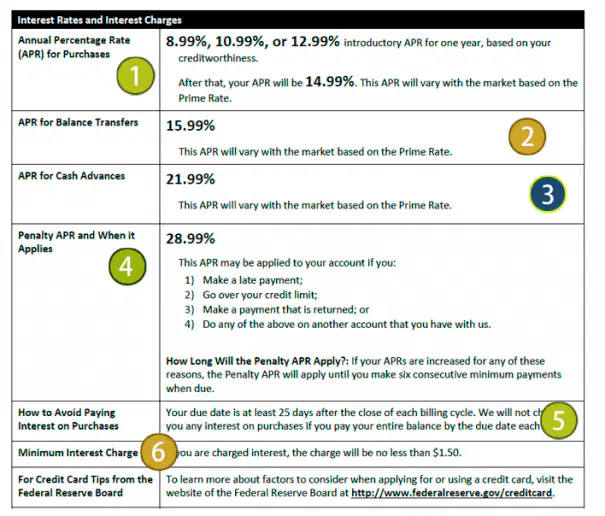
Which of the following statements is true about this Schumer Box?
a)
Depending on your creditworthiness, the APR for a borrower will always either be 8.99%, 10.99% or 12.99%
b)
There is an introductory APR that is valid only for 1 year, but then the permanent APR is lower than that at 8.99%.
c)
You will never be charged an APR higher than 14.99%
d)
A 28.99% APR may be applied to your account for late payment
47.
Why would credit card companies prefer that their cardholders make the minimum monthly payment every month rather than paying their total balance in full?
a)
This is required by federal law for tax purposes
b)
This allows the card holder to pay their bill quickly and close the card when they’re ready
c)
This enables the credit card company to make more money
d)
This helps cardholders develop financial independence
48.
What is the average interest rate on a credit card?
a)
5% - 10%
b)
10% - 15%
c)
16% - 24%
d)
25% - 35%
e)
400%
49.
Which of the following is unique to a debit card and not typically associated with a credit card?
a)
Annual fee for card usage
b)
Accumulation of reward points with every transaction
c)
Access to funds from the cardholder's account
d)
Borrowing money with interest charged
50.
Which of the following will help you to get a lower APR on your credit card?
a)
A higher credit score.
b)
A lower credit score.
c)
A deep, golden tan.
d)
A certificate of deposit.
51.
What is a grace period?
a)
The amount of time you have to pay off a debt without incurring interest or penalties.
b)
The total amount of money you owe on a credit card.
c)
The minimum payment required by a lender each month.
d)
The period when a credit card is temporarily inactive.
52.
Which best describes how a credit card works?
a)
The credit card company extends you a line of credit. You then pay a small percentage of the cost of those purchases in one annual payment.
b)
The credit card company extends you a line of credit. You purchase "stuff" and the purchase gets directly paid with funds in your checking account.
c)
The credit card company extends you a line of credit. This is free money that you can use to purchase the "stuff" that you need.
d)
The credit card company extends you a line of credit. You purchase "stuff" and then have the choice to pay the balance in full or a minimum payment each month.
53.
What is the average APR on a credit card?
a)
40 - 50%
b)
5 - 10%
c)
0 - 5%
d)
15 - 20%
54.
What is meant by the loan "term"?
a)
The total interest paid over the life of the loan
b)
The monthly payment amount
c)
The length of time agreed upon to repay the loan
d)
The credit score required to qualify for the loan
55.
Which of these credit payback strategies would lead to the HIGHEST overall cost?
a)
Paying off your credit card bill in full every month
b)
Paying 20% of your credit card balance every month on time
c)
Making the minimum payment (3% of your credit card balance) every month on time
d)
Making the minimum payment (3% of your credit card balance) every month with an occasional late payment
56.
Why are payday loans considered controversial?
a)
They offer low-interest rates
b)
They primarily target high-income individuals
c)
They often target vulnerable and low-income populations with high fees and interest rates
d)
They are supported by consumer advocacy groups
57.
All of the following contribute to your credit score EXCEPT?
a)
Your payment history.
b)
How much you owe (your unpaid debt).
c)
Length of credit history.
d)
Your credit mix.
e)
Your income level.
58.
What is "opportunity cost"?
a)
The benefits that we gain when choosing one way of using our money over another.
b)
The price that you pay for each opportunity to check your credit score.
c)
The amount of interest you must pay in order to purchase a car.
d)
The potential benefits that we miss out on when choosing one way of using our money over another.
59.
What is Uncle Bob's current credit card balance?
a)
4,543.36
b)
3,956.38
c)
5,456.64
d)
112.00
e)
10,476.00
60.
About how long will it take Bob to pay off his credit card if he only makes the minimum payment?
a)
36 months
b)
1 month
c)
18 years
d)
29.99%
e)
5 - 7 years
61.
What is the main advantage of a fixed-rate mortgage?
a)
The interest rate remains the same throughout the loan term.
b)
The interest rate decreases over time.
c)
The loan term is shorter than other types of mortgages.
d)
It allows for unlimited borrowing.
62.
Which of the following is a benefit of having a high credit score?
a)
Increased likelihood of loan rejection.
b)
More frequent credit checks by lenders.
c)
Easier approval for loans and credit cards.
d)
Higher interest rates on loans.
63.
What is a common feature of a secured loan?
a)
It can be obtained without any credit history.
b)
It has no interest rate.
c)
It requires collateral to be approved.
d)
It is only available to businesses.
100 %

