
 Worksheets
Test 11-Vital Signs (2)
Total questions: 50
Worksheet time: 25mins
Vital signs provide information about which of the following?
The basic body conditions of the patient
The patient's favorite food
The patient's family history
The patient's insurance details
True or False: Vital signs are often the first indication of disease.
True
False
One of the five main vital signs is _________.
Temperature
Height
Vision
Weight
Which of the following is NOT one of the 5 main vital signs?
Pulse
Respirations
Blood Pressure
Height
True of False: Vision screening is included as one of the 5 main vital signs.
True
False
One other important vital sign is the ________ of the patient's skin.
Color
Temperature
Pulse
Moisture
One other important vital sign is the size of the ________ and their reaction to light.
fingers
ears
pupils
teeth
What does the measurement of temperature in vital signs represent?
The balance between heat lost and heat produced by the body
The amount of blood in the body
The rate of breathing
The amount of oxygen in the blood
Temperature can be measured in varying places. Which of the following is the most common site for temperature measurement?
Ear
Mouth (oral)
Armpit
Forehead
Rectal temperature is typically the most accurate of all temperature readings.
True
False
Which temperature measurement site is the least accurate and can register 1-2 degrees lower than rectal temperature?
Forehead (Temporal)
Oral (mouth)
Ear (tympanic)
Armpit (axillary)
Temperature is measured in degrees on a thermometer using which scale?
Kelvin scale
Fahrenheit scale
Richter scale
Decibel scale
Temperature measurements taken within the ear are called ________ readings.
Celsius
Temporal
Tympanic
Axillary
What is the term for abnormally low body temperature?
Hyperthermia
Hypothermia
Fever
Tachycardia
What is the term for abnormally high body temperature?
Hypothermia
Hyperthermia
Bradycardia
Hypotension
What is the pressure of the blood felt against the wall of an artery as the heart contracts and relaxes called?
Pulse
Osmosis
Diffusion
Respiration
Which of the following are recorded when measuring pulse?
Rate, rhythm, and volume
Temperature and color
Height and weight
Blood sugar
What does 'Rate' refer to when recording pulse?
Number of beats per minute
Strength of the pulse
Rhythm of the pulse
Location of the pulse
What does 'Rhythm' refer to when recording pulse?
Regularity of the beats
Strength of the pulse
Location of the artery
Temperature of the skin
Pulse is most commonly taken over which artery?
Femoral artery
Radial artery
Carotid artery
Brachial artery
Where is the brachial pulse located?
Neck
Inner upper arm at biceps muscle
Groin
Temple region
The carotid pulse can be felt at the ________.
elbow
wrist
ankle
neck
Which pulse site is found in the groin area?
Femoral pulse
Temporal pulse
Dorsalis pedis pulse
Posterior tibial pulse
The temporal pulse is located in which area?
tympanic region
side of the head
wrist region
ankle region
Where is the popliteal pulse found?
Behind knee
Inner ankle
Upper side of foot
Neck
The dorsalis pedis pulse is located on the ________.
upper side of foot
back of the hand
side of the neck
inside of the elbow
Which pulse site is located at the inner ankle?
Radial pulse
Posterior tibial pulse
Carotid pulse
Femoral pulse
Which of the following should be monitored when checking respirations?
Rate
Rhythm
Character
All of the above
Respirations should be conducted in conjunction with what other vital sign check?
Pulse check
Blood glucose check
Vision check
Hearing check
Blood pressure is the force exerted by the blood against the arterial walls when the heart ______ and ______.
contracts; relaxes
beats; stops
expands; contracts
pumps; rests
Blood pressure readings are always recorded using _____ number(s).
One
Two
Three
Four
What does systolic blood pressure represent?
Pressure when the heart contracts
Pressure when the heart relaxes
What does diastolic blood pressure represent?
Pressure when the heart contracts
Pressure when the heart relaxes
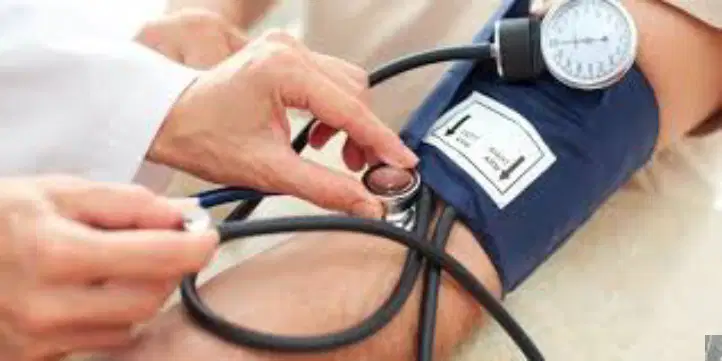
What device is being used in the image to measure blood pressure?
Thermometer
Manual sphygmomanometer and stethoscope
Glucometer
Digital blood pressure monitor
Blood Pressure is measured in ________ (millimeters of mercury).
mmHg
mmH2O
cmHg
Pa
What is the normal blood pressure reading for an adult?
120/80 mmHg
140/90 mmHg
100/60 mmHg
160/100 mmHg
What is the term for a blood pressure reading greater than 120/80 mmHg, also known as high blood pressure?
Hypertension
Hypotension
Bradycardia
Tachypnea
What is the term for a blood pressure reading less than 120/80 mmHg, also known as low blood pressure?
Hypotension
Hypertension
Normotension
Hyperglycemia
Why is it important to choose the right size cuff when taking blood pressure?
To ensure accurate readings
To make the patient comfortable
To save time during measurement
To use less equipment
It is recommended to take multiple readings if necessary when measuring blood pressure.
True
False
Which area should be initially considered for taking blood pressure?
Both arms
Right arm
Left arm
Right wrist
What is pain?
A pleasant sensation perceived by the nervous system
An unpleasant sensation that is perceived by the nervous system when illness or injury occurs
A type of disease
A type of exercise
Pain can be ______ or ______.
chronic; acute
mild; severe
short; long
sharp; dull
What is chronic pain?
Pain that lasts for a shorter time
Long term or ongoing pain (such as cancer pain, arthritis, etc.)
Pain from physical injury
Pain that is always mild
What is acute pain?
Pain that lasts for a shorter time (such as post-operative pain, pain from physical injury, sprain/strain, cut/scrape, etc.)
Long term or ongoing pain
Pain that never goes away
Pain that is not caused by injury
According to the information on Vital Signs, pain is what the person says it is and only they can describe what they are feeling. This means pain is:
Objective
Subjective
Imaginary
Measurable by others
According to the information on Vital Signs, pain can be measured/rated by the patient on a scale of 0-10. What does a rating of 0 mean?
No pain
Mild pain
Severe pain
Unbearable pain
According to the information on Vital Signs, pain can be measured/rated by the patient on a scale of 0-10. What does a rating of 10 mean?
Worst imaginable pain
No pain at all
Mild discomfort
Slight ache
According to the information on Vital Signs, a series of faces (very happy to very sad) can be used to rate pain if the patient is unable to use a numerical scale. This method is often used with which group of patients?
Elderly patients
Pediatric patients
Adult patients
All patients
It is acceptable to have a conversation with your patient while taking their blood pressure.
True
False

