
 Worksheets
Science 7 Reviewer (Term 1-3)
Total questions: 135
Worksheet time: 2hrs 58mins
A problem statement in a scientific research paper provides a concise and clear description of the issue or question the study aims to investigate.
TRUE
FALSE
The title of a scientific research paper is a concise and informative heading that captures the essence of the research project.
TRUE
FALSE
Data is the backbone of the scientific investigation, providing evidence to support or refute hypotheses and enabling researchers to draw meaningful conclusions.
TRUE
FALSE
Data graphs are pictures that represent data in an organized manner.
TRUE
FALSE
Matter are classified into pure substance and mixtures.
TRUE
FALSE
Pure substances are substances that are made up of one or more kinds of atoms and have a fixed structure.
TRUE
FALSE
Pure substances are classified into elements and compounds.
TRUE
FALSE
Compounds are pure substances composed of one kind of atom that cannot be broken down into another substance by chemical or physical means. Examples are oxygen and hydrogen.
TRUE
FALSE
Elements are pure substances composed of two or more kinds of atoms that are chemically combined. Examples are water and carbon dioxide.
TRUE
FALSE
A solution is made out of a solute and a solvent.
TRUE
FALSE
Among the choices are the important points to remember when formulating a problem statement EXCEPT:
It should be focused and well-defined.
It sholud be written in a declarative statement
It emphasize the research's significance and relevance.
It uses "how" and "why" when stating the independent variable.
What are the three (3) major types of hypothesis?
dependent, independent, formal
null, alternative, cause-and-effect
tentative, logical, untested
This type of hypothesis states that there is no (significant) effect between the results of the conditions being tested.
Null hypothesis
Alternative hypothesis
Cause-and-effect
This type of hypothesis states that there is an (significant) effect between the results of the conditions being tested.
Null hypothesis
Alternative hypothesis
Cause-and-effect
This type of hypothesis states that if a certain condition (cause) is true, then a supporting observation (effect) occurs.
Null hypothesis
Alternative hypothesis
Cause-and-effect
This type of hypothesis is also known as the IF-THEN HYPOTHESIS and is further categorized into formal and informal hypotheses.
Null hypothesis
Alternative hypothesis
Cause-and-effect
This type of data graph shows how a certain whole is divided into parts and how big each part is relative to each other.
circle graph
bar graph
line graph
pictograph
This type of data graph is suitable for displaying categorical data and is particularly useful when comparing different categories or showing the frequency or occurrences in each category.
circle graph
bar graph
line graph
pictograph
This type of data graph shows points connected by a line (straight or curved) and shows how one variable (IV) affects another variable (DV).
circle graph
bar graph
line graph
pictograph
It is a type of mixture that shows a composition that appears uniform all throughout the mixture which results to a solution.
homogenous
heterogenous
What do you call the horizontal axis containing numbers that represents the independent variable?
(a)
What do you call the vertical axis containing numbers that represents the dependent variable?
(a)
Identify the state of matter.
Its intermolecular force of attraction is the strongest. The molecules are held very closely to one another. Molecules are compact with very minimal spaces between them.
(a)
Identify the state of matter.
Its intermolecular force of attraction is strong. The molecules have small spaces between them, enabling the fluidity of liquid.
(a)
Identify the state of matter.
Its intermolecular force of attraction is weak. The molecules are with bigger spaces between them enabling spreading or more random movement of particles.
(a)
Identify the state of matter.
It has a definite shape and volume, a tight molecular arrangement, a very strong attraction between particles, and no compressibility.
(a)
Identify the state of matter.
It has an indefinite shape, definite volume, a loose molecular arrangement, a weak attraction between particles, and no compressibility.
(a)
Identify the state of matter.
It has an indefinite shape and volume, a spread out molecular arrangement, a very weak attraction between particles, and no compressibility.
(a)
What is the smallest unit of matter?
(a)
What is the smallest unit of matter?
(a)
What is being formed when atoms of the same or different kinds combine in a fixed ratio?
(a)
What do you call the group of atoms chemically combined, forming elements and compounds?
(a)
What do you call the different substances that are physically combined?
(a)
Which of the following can be separated by distillation?


Linda is cooking rice for dinner. Her mother asked her to washed the rice grain before she put it into fire. What separation of mixtures she should use?
Evaporation
Distillation
Chromatography
Decantation
Which of the following mixtures can be separated using Decantation?


Which technique use to separate substances that dissolved in water?
Decantation
Physical Manipulation
Evaporation
Chromatography
What is the difference between filtration and Sieving?
Filtration is separating liquid from solid components while sieving is separating solid mixtures with different particle size.
Filtration is separating solid mixtures with different sizes while sieving is separating liquid from solid components.
Filtration is separating magnetic from non-magnetic substances while sieving is separating immiscible from non-miscible mixtures.
Filtration is separating liquids with different boiling points while sieving is separating liquid from solid substances using filter.
Which Mixtures can be separated using Sieving?


This method is used to separate metals from non metals.
use of magnet
physical manipulation
sieving
chromatography
What is scientific notation?
A technique for measuring temperature.
A method for calculating averages.
A way to express numbers as fractions.
A method of writing numbers using powers of ten.
Why is scientific notation useful?
It is only used for whole numbers.
It makes numbers harder to read.
It is primarily for artistic purposes.
It simplifies the representation and calculation of very large or very small numbers.
Convert 4500 to scientific notation.
4.5 x 10^4
45 x 10^2
450 x 10^1
4.5 x 10^3
Convert 0.0045 to scientific notation.
4.5 x 10^3
4.5 x 10^-3
45 x 10^-5
0.45 x 10^-2
What is the scientific notation for 3.2 x 10^5?
3.2 x 10^5 = 320
3.2 x 10^5 = 3200000
3.2 x 10^5 = 3200
3.2 x 10^5 = 320000
Convert 7.89 x 10^3 to standard notation.
7900
7800
8000
7890
How do you round 0.000567 to two significant figures in scientific notation?
0.00057 x 10^-3
5.67 x 10^-4
5.6 x 10^-4
5.7 x 10^-4
What is the result of multiplying 2.5 x 10^4 by 3 x 10^2 in scientific notation?
5.0 x 10^6
7.5 x 10^6
7.5 x 10^4
1.5 x 10^5
Convert 1.2 x 10^-3 to standard notation.
1.2
0.0012
0.00012
0.012
What is the scientific notation for 0.00000089?
89 x 10^-9
0.89 x 10^-6
8.9 x 10^-7
8.9 x 10^7
How do you divide 6.4 x 10^6 by 8 x 10^2 in scientific notation?
5.0 x 10^5
7.2 x 10^4
6.0 x 10^2
8.0 x 10^3
What is the scientific notation for 100000000?
1.0 x 10^7
10 x 10^7
1.0 x 10^9
1.0 x 10^8
Convert 9.1 x 10^-5 to standard notation.
0.000001
0.000091
0.0000091
0.00091
How do you add 3.0 x 10^2 and 4.5 x 10^2 in scientific notation?
7.5 x 10^3
7.5 x 10^2
3.5 x 10^2
8.0 x 10^2
What is the scientific notation for the number 0.00012?
1.2 x 10^-4
1.2 x 10^-5
1.2 x 10^4
0.12 x 10^-3
The ____________________ is a number that should be greater than or equal to 1 but less than 10 (1≤ M ≤ 10) . The decimal point is moved to follow this condition.
EXPONENT
MANTISSA
LADDER METHOD
SCIENTIFIC NOTATION
METRIC SYSTEM
The ____________________ is an integer to which the base 10 is raised. It could be negative or positive and will determine the direction where the decimal point will be moved.
EXPONENT
MANTISSA
LADDER METHOD
SCIENTIFIC NOTATION
METRIC SYSTEM
The ____________________ is used to convert measurement using the SI units. Just move the decimal points according to which it will be converted.
EXPONENT
MANTISSA
LADDER METHOD
SCIENTIFIC NOTATION
METRIC SYSTEM

Scientific notation is used for....
shortening a very small or very large number
scientists only
scientific investigations
not sure

What is this number in scientific notation?
7,100, 000, 000
(hint: study the image above)
7.1 x 10⁹
7.1 x 10⁻¹⁰
7.1 x 10¹⁰
7.1 x 10⁻⁹
Which is true when converting from scientific to standard notation? (select all that apply)
move the decimal to the right if the exponent is negative
move the decimal to the left if the exponent is positive
move the decimal to the right if the exponent is positive
move the decimal to the left if the exponent is negative
How many spaces and which way would you move the decimal to convert this number to scientific notation?
0.000000034
7 to the right, because there are 7 zeroes
8 to the right, because there must be one number to the left of the decimal point that is more than 0 but less than 10
7 to the left, because you have to get rid of the zeroes
8 to the left, because there are 8 numbers to make it 3.4

The picture above is taken from a powerful microscope showing colonies of bacteria. The size of bacteria can be as small as 2.0 x 10 ^ -7 meters. What is this number in standard notation?
2,000,000
0.000002
20,000,000
0.0000002
UNDERSTANDING
If the exponent is a positive number...
you will get a large number
you will get a small number
UNDERSTANDING:
The first number in scientific notation must not be...
between and including 0 and 10
between and including 1 and 9.9999
between and including 0 and 9.999
between and including 1 and 10
Which of the following is correct scientific notation?
41.5 x 10⁻⁵
0.2035 x 10⁴
20.4 x 10⁸
4.5 x10⁹
How would you write 5.64 x 10⁸ in standard notation?
564,000,000
546, 000, 000
56, 400, 000
5,640, 000
Write 208,000 in scientific notation.
2.08 x 10⁵
0.0208 x 10⁻⁵
20.8 x 10⁵
0.208 x 10⁶
Write 7.8 x 10³ in standard form.
7,800
78,000
78
0.0078
Express the following in standard notation:
8.025 x 10⁻⁸
.00000008025
.000000008025
802,500,000,000
80,250,000,000
8.317 x 10⁶
in standard form?
What is the purpose of a beaker in a lab?
To filter liquids and solids.
To measure the weight of solids.
To mix, heat, and hold liquids.
To store chemicals for long-term use.
What is the function of a pipette?
To heat liquids for experiments.
To measure and transfer small volumes of liquid.
To mix solid and liquid substances.
To store large volumes of liquid.
Describe the use of a Bunsen burner.
A Bunsen burner is used for cooling substances in laboratory experiments.
A Bunsen burner is used for mixing chemicals in a beaker.
A Bunsen burner is used for heating substances in laboratory experiments.
A Bunsen burner is used for measuring liquid volumes.
What is a graduated cylinder used for?
To mix different chemicals together.
To store solid materials safely.
To measure the volume of liquids accurately.
To heat liquids for experiments.
What is the purpose of a petri dish?
To hold liquids for boiling experiments
To grow plants indoors
To culture microorganisms and conduct experiments.
To store food samples
Explain the use of a funnel in experiments.
A funnel is used to filter out solid particles from gases.
A funnel is primarily for mixing chemicals together.
A funnel is used to measure the temperature of liquids.
A funnel is used to transfer liquids or powders into containers safely and accurately.
What type of glassware is used for heating substances?
Beakers and flasks
Mortar and Pestle
Petri dishes
Test tubes
What is the role of a thermometer in a lab?
To measure the temperature of substances.
To cool down substances quickly.
To measure the pressure of gases.
To mix chemicals in a solution.

Identify the laboratory tool.
(a)
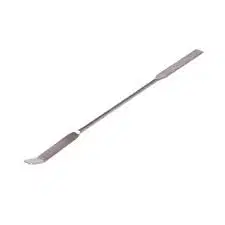
Identify the laboratory tool.
(a)
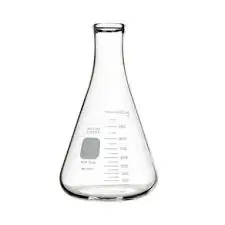
Identify the laboratory tool.
(a)

Identify the laboratory tool.
(a)
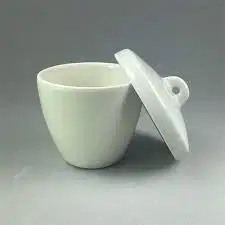
Identify the laboratory tool.
(a)

Identify the laboratory tool.
(a)
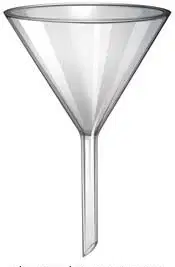
Identify the laboratory tool.
(a)

Why is a graduated cylinder more accurate than a beaker in measuring the volume of a liquid?
Graduated cylinder is longer than a beaker.
Graduated cylinder has more calibrations than a beaker.
Graduated cylinder has a better shape than a beaker.
Graduated cylinder has a colorful liquid than the liquid in the beaker.

Identify this laboratory tool. (Observe correct spelling)
(a)
Which statement describes weather?
.It is the amount of water vapor in the atmosphere.
It is the condition of the atmosphere at a given time.
It is the freezing of water in the atmosphere.
It is the blowing of cold air in land during the day.
What do you call seasonal changes in the Philippines brought about by the unequal heating of land and water?
ITCZ
monsoons
low pressure
high pressure
Which wind system is characterized by hot and humid weather, frequent heavy rainfall, and a prevailing wind?
trade winds
northeast monsoon (hanging amihan)
southwest monsoon (hanging habagat)
Intertropical Convergence Zone (ITCZ)
Which wind system carries cold and dry wind that affects the Philippines from November to March?
trade winds
northeast monsoon (hanging amihan)
southwest monsoon (hanging habagat)
Intertropical Convergence Zone (ITCZ)
It is a weather disturbance near the equator where the trade winds of the Northern and Southern Hemispheres come together.
trade winds
northeast monsoon (hanging amihan)
southwest monsoon (hanging habagat)
Intertropical Convergence Zone (ITCZ)
For a cyclone to develop it needs a large amount of water vapor. Where does the development of cyclones happen?
above clouds
above the ocean
near the mountain
above the continent
How are tropical cyclones classified?
According to its origin
According to its wind speed
According to the wind system
According to the amount of rainfall
Typhoon signal no. 5 has winds of more than 220 kph and may cause widespread damage to community. This weather disturbance is considered as ____.
tornado
storm surge
Intense rainfall
super typhoon
Which agency is responsible for giving weather reports, updates, and warning signals to the public?
Department of Health
GMA Weather News and Updates
Philippine Atmospheric Geophysical and Astronomical Services Administration
Philippine Atmospherical Geophysical and Astronomical Storm Administration
Strong wind can turn loose debris like roofs into flying projectiles making the outdoor environment even more dangerous. What should you do in order to keep yourself safe during a typhoon?
Store water.
Stay indoors.
Prepare first aid kit
Strengthen the house.

Which are the harmful effects of weather disturbances?
I, II, III
I, II, IV
I, III, IV
I, II, III, IV
What will be the effect of heavy rains on commuters if roads become flooded?
Transportation difficulties.
Transportation will be fast.
Transportation will be easy.
Transportation will be through boats.
Which of the following is the sudden rising of the sea level due to the low pressure, high winds, and high waves associated with a hurricane as it makes landfall?
tornado
strong wind
flash flood
storm surge
Your family lives near the sea, which of the following should you do in order to avoid storm surge?
Stay inside the house.
Keep yourself warm and dry.
Evacuate to a safe and elevated area.
Strengthen the roof and posts of house.
Which of the following should you do in order to prepare for the coming typhoon?
Don’t travel.
Stay indoors.
Prepare your emergency go-bag.
Keep yourself warm.
The weather layer of the atmosphere is ________.
mesosphere
stratosphere
thermosphere
troposphere
The most abundant gas in the atmosphere is ________.
carbon dioxide
argon
nitrogen
oxygen
In which layer of the atmosphere do cloud formation and precipitation occur?
mesosphere
stratosphere
thermosphere
troposphere
In which layer of the atmosphere do airplanes fly to avoid turbulence?
mesosphere
stratosphere
thermosphere
troposphere
________ is a region of highly ionized, or electrically charged, gases.
mesosphere
thermosphere
troposphere
stratosphere
It is the lowest layer of the atmosphere.
stratosphere
mesosphere
thermosphere
troposphere
In which atmospheric layer is the ozone formed?
mesosphere
stratosphere
thermosphere
troposphere
It is essential to maintain the ozone layer in the atmosphere because it ________.
prevent heat loss from the Earth
mixes the gases in the atmosphere
reflect sun's rays back to the atmosphere
absorb most of the ultraviolet radiation that enters the atmosphere
The layer of the atmosphere from top to down are ________.
stratosphere, mesosphere, thermosphere, ionosphere
thermosphere, mesosphere, stratosphere, troposphere
thermosphere, stratosphere, mesosphere, troposphere
troposphere, mesosphere, thermosphere, stratosphere,
Why is the troposhere called the weather sphere?
The troposhere has the densest air.
There is a high concentration of ozone in this layer.
Clouds, precipitation, and storms forms in the troposphere.
Temperature decreases as altitude increases in the troposhere.
The atmosphere is divided into layers based on ________.
density
weather
temperature
altitude
The atmosphere becomes less dense as altitude increases.
True
False
It is layer of the atmosphere where meteors burn up.
thermosphere
mesosphere
troposphere
stratosphere
It is layer of the atmosphere where aurora borealis is formed.
mesosphere
thermosphere
stratosphere
troposphere
It separates the stratosphere from the mesosphere.
mesopause
tropopause
stratopause
none of the above
It serves as a boundary between the troposphere and the stratosphere.
stratopause
tropopause
mesopause
none of the above
In the thermosphere, temperature increases as altitude increases.
True
False
The temperature in the troposphere increases as altitude increases.
True
False
In which layer do you live?
stratosphere
troposphere
mesosphere
thermosphere
What is the composition of the atmosphere?
70% nitrogen and 30% oxygen
78% oxygen, 21% nitrogen, and 1% other gases
78% nitrogen, 21% oxygen, 0.93% argon, 0.04% carbon dioxide, 0.03 other gases
none of the above
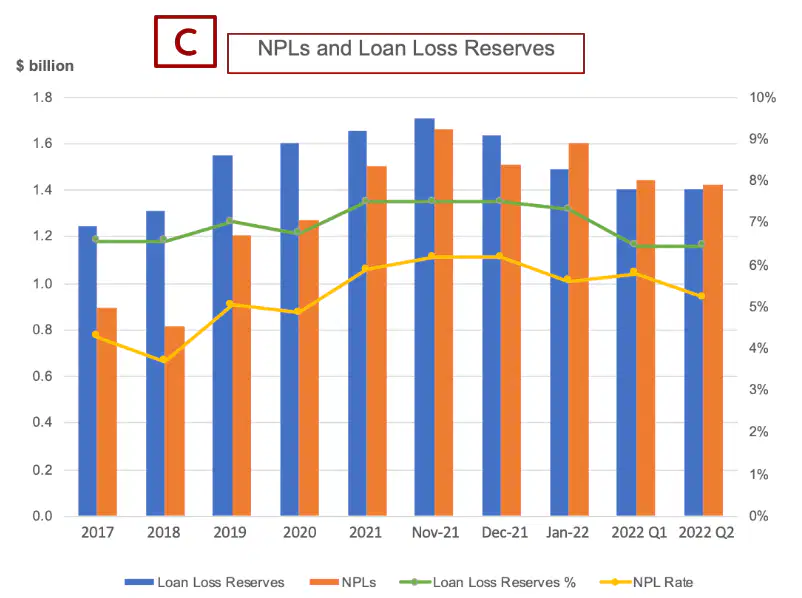
Identify the part of the the given data graph.
Figure Number & Title
Y-Axis
Data
Legend
X-Axis
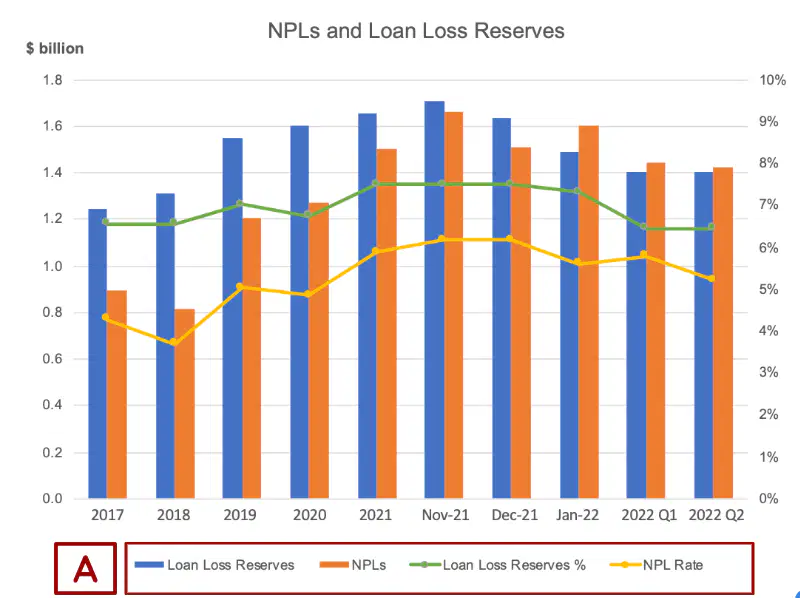
Identify the part of the the given data graph.
(a)
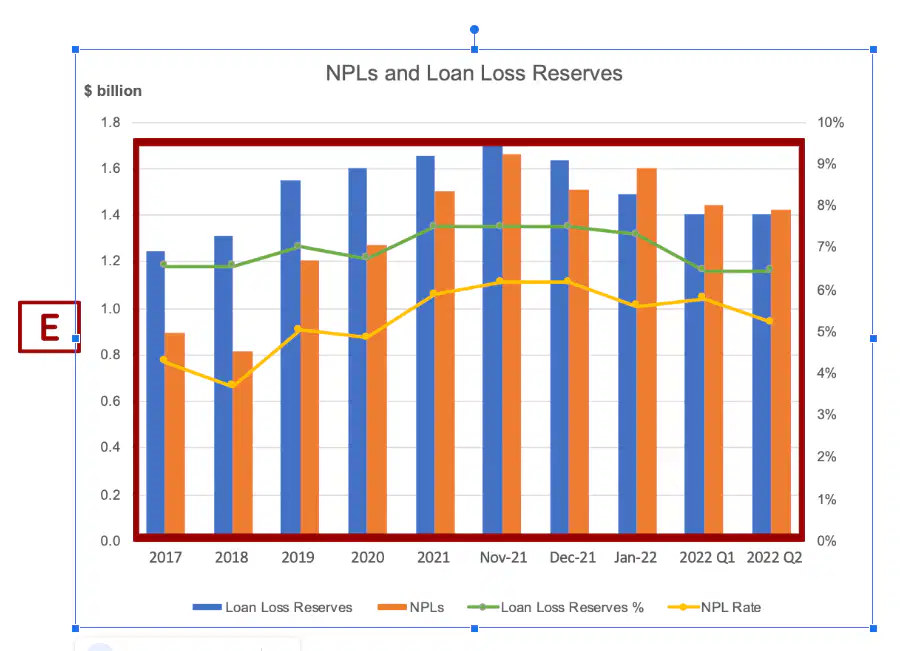
Identify the part of the the given data graph.
(a)
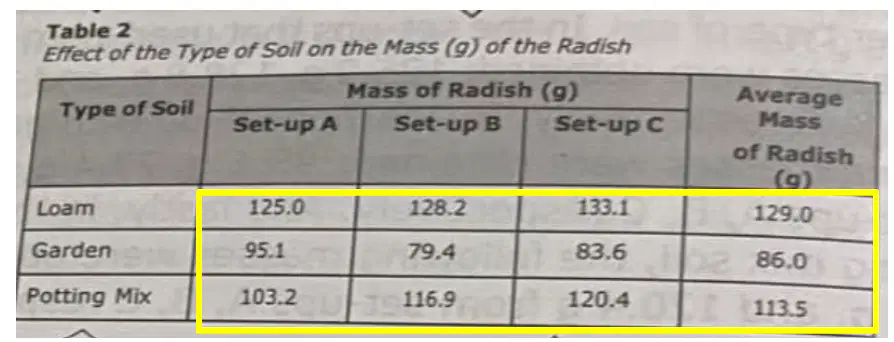
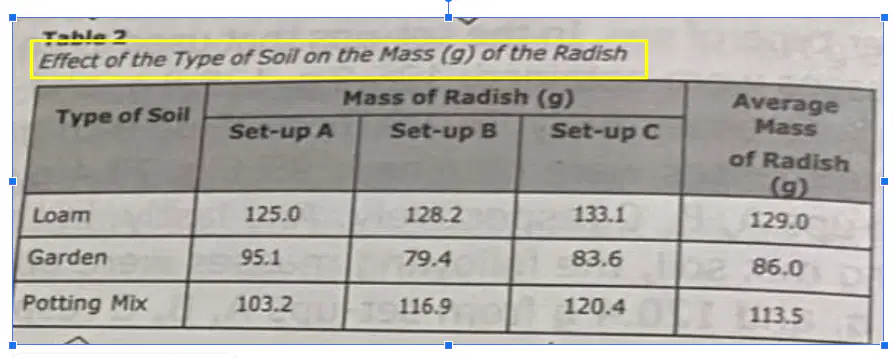
Identify the part of the the given data table.
dependent variable
independent variable
title
table number
header row
Identify the part of the the given data table.
(a)
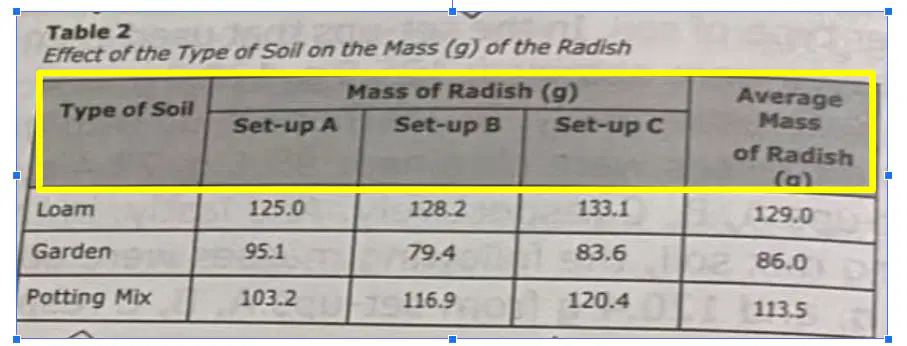
Identify the part of the the given data table.
dependent variable
independent variable
title
table number
header row
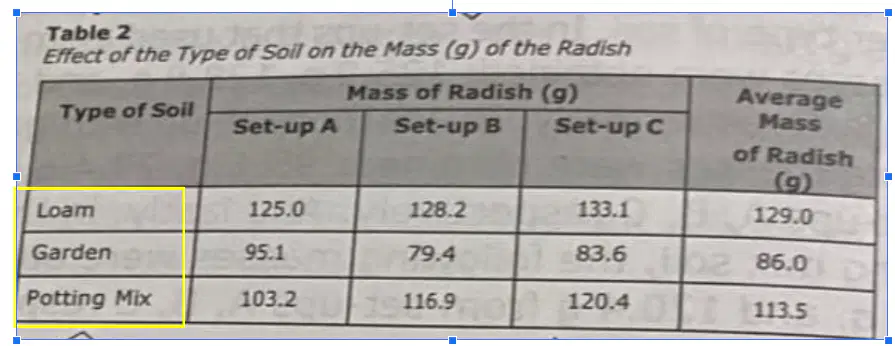
Identify the part of the the given data table.
(a)
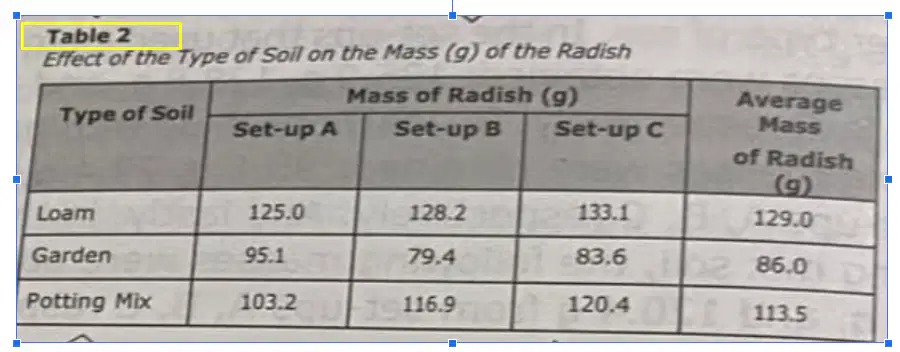
Identify the part of the the given data table.
(a)

What is the independent variable in the scenario?
mass (g) of fertilizer used in two weeks
height (cm) of the basil plant after two weeks
basil plant
water
What is the dependent variable in the scenario?
mass (g) of fertilizer used in two weeks
height (cm) of the basil plant after two weeks
basil plant
water

