
 Worksheets
Physical Science Study Game
Total questions: 80
Worksheet time: 40mins
Matter that has a definite volume and a definite shape is a __________.
solid
liquid
gas
plasma
The amount of energy needed to change a material from a liquid to a gas is the heat of __________.
evaporation
fusion
vaporization
condensation
The maximum amount of a solute that can be dissolved in a given amount of solvent is its __________.
dilution
solubility
concentration
density
When two or more substances are physically combined, the result is a(n) __________.
chemical change
element
compound
mixture
The air that you breathe is an example of a(n) __________ solution.
solid
liquid
gaseous
plasma
As a sample of matter is heated, its particles __________.
are unaffected
move more quickly
move more slowly
stop moving
The most common state of matter in the universe is __________.
solid
liquid
gas
plasma
The color of ink is a __________.
physical change
physical property
chemical change
chemical property
Three examples of physical changes are
sawing wood, crushing a can, and burning a marshmallow
burning of gasoline, rotting an egg, and exploding fireworks
freezing of water, evaporation of gasoline, and rusting of a nail
boiling water, blowing up a balloon, and melting a candle
In a solution, the substance that is being dissolved is the __________.
solute
solvent
liquid
gas
Atoms of elements in the same group of the periodic table share the same
number of energy levels
number of valence electrons
atomic numbers
atomic masses
The atomic number of magnesium is 12. Therefore its nucleus must contain
6 protons and 6 neutrons
6 protons and 6 electrons
12 neutrons and 6 electrons
12 protons and 12 neutrons
A neutral atom may contain 8 protons
9 neutrons and 10 electrons
8 neutrons and 10 electrons
9 neutrons and 8 electrons
10 neutrons and 9 electrons
An element with 5 protons, 6 neutrons, and 8 electrons has an atomic number of
5
6
8
11
An element with 5 protons, 6 neutrons, and 8 electrons has a mass number of
5
6
8
11
The farther an electron is from the nucleus, the more __________ it has.
charge
energy
mass
pull
The majority of the mass of the atom is located in the __________ and the majority of the volume of the atom is located in the __________.
nucleus, electron cloud
nucleus, nucleus
electron cloud, nucleus
electron cloud, electron cloud
Atoms of the same element that have different numbers of neutrons are called
molecules
ions
protons
isotopes
The total number of electrons in the outer shell of a sodium atom is
1
2
8
18
Which particles determine the atomic number of an element?
protons only
neutrons and protons
neutrons only
protons and electrons
The chemical bond formed when two atoms share electrons is called a(n)
covalent bond
ionic bond
metallic bond
electron bond
Which pair of atoms will combine with each other and form an ionic bond?
C and O
C and H
Ca and Mg
Ca and Br
Which element is most likely to gain electrons in a chemical reaction?
Kr
K
Br
Ca
Atoms become positive ions by
gaining electrons
losing electrons
gaining protons
sharing electrons
Which formula represents a substance that contains covalent bonds?
LiCl
CaCl2
K2O
CO2
Anions are formed by
gaining electrons
losing electrons
sharing electrons
none of these
How does an atom of aluminum become an ion?
It gains 3 electrons
It gains 3 protons
It loses 3 electrons
It loses 3 neutrons
Which element will most likely form an ionic bond with chlorine?
O
N
S
K
How many electrons are shared between the hydrogen atoms in a molecule of H2 gas?
0
1
2
4
Which atoms are most likely to form covalent bonds?
metal atoms that share electrons
metal atoms that share protons
nonmetal atoms that share electrons
nonmetal atoms that share protons
Each substance to the right of the arrow in a chemic equation is a(n) __________.
catalyst
product
reactant
inhibitor
The numbers that go before symbols and formulas in a chemical equation are __________.
superscripts
subscripts
catalysts
coefficients
Substances that speed up, chemical reactions are called __________.
catalysts
products
reactants
inhibitors
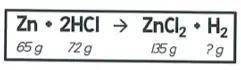
What mass of hydrogen (H2) was produced in the reaction in the image?
2 g
4 g
72g
144 g
When objects are burned a __________ reaction has occurred.
double displacement
single displacement
combustion
synthesis
The burning of wood in a campfire that produces heat and light would be both an __________ and an __________ reaction.
exergonic; exothermic
exergonic; endothermic
endergonic; endothermic
endergonic; exothermic
Brad and Julian conducted several tests to determine the properties of silver metal. They noted that it was white, and conducted both electricity and heat. They computed the density to be 10.49 g/cm3. Silver did not react with water but in nitric acid it released a gas. What evidence above supports a chemical change in silver?
Silver conducts electricity
Silver reacts with nitric acid to produce a gas.
The color of silver at room temperature is white.
Sliver conducted heat.
In a chemical equation, the symbol that means dissolved in water is __________.
(s)
(l)
(g)
(aq)
What type of reaction is the following chemical reaction? CH3CH2OH + 3O2 ---> 2CO2 + 3H2O
double-displacement
single-displacement
combustion
synthesis
Which chemical reaction represents a double displacement reaction?
2Na + Cl2 ---> 2NaCl
2KClO3 ---> 2KCl + 3O2
Zn + 2HCL ---> ZnCl2 + H2
NaOH + HCl ---> NaCl + H2O
The speed you read on a speedometer is __________.
instantaneous speed
constant speed
average speed
velocity
3 m/s north is an example of a(n) __________.
speed
velocity
direction
acceleration
A car moves around a wide turn going 45 mi/hr the whole time. The car has a constant ___________.
speed
velocity
direction
acceleration
If you ride your bicycle down a straight road for 500 m then turn around and ride back to your starting point, your distance is __________ your displacement.
greater than
equal to
less than
can't be determined
An object in motion must be undergoing a change of
velocity
position
acceleration
direction
A softball pitcher throws a ball at 42 meters per second. If the batter is 18 meters from the pitcher, approximately how much time does it take for the ball to reach the batter? (t= d / S)
1.9 s
2.3 s
0.86 s
0.43 s
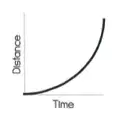
The graph in the image shows the relationship between distance and time for a moving object. According to the graph, the object is
speeding up
slowing down
motionless
moving at a constant speed
A high-speed train travels with an average of 227 km/hr. The train travels for 2 hrs. How far does the train travel? (d= S x t)
113.5 km
454 km
0.0088 km
225 km
A cross-country runner runs 10 km in 40 minutes. What is his average speed? (S= d / t)
30 km/min
4 km/min
400 km/min
0.25 km/min
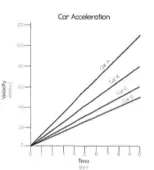
The graph in the image represents the change in velocity of four cars over a period of 10 hours. Which line represents the car with the greatest acceleration?
A
B
C
D
The __________ energy of an object increases with its height.
chemical potential
kinetic
thermal
gravitational potential
When water at 10oC is heated to 20oC its kinetic energy
decreases
increases
stays the same
is unaffected
The law of __________ states that energy in a system can change forms but can never be created or destroyed.
conservation of energy
consecration of energy
conversion of energy
construction of energy
The kinetic energy of an object increases as its __________ increases.
height
speed
volume
potential energy
How much force is required to lift a rock a vertical distance of 8 m if 80 J of work were done? (F= W / d)
80 J
80 N
10 J
10 N
As the time required to do a given amount of work decreases, the power developed __________.
decreases
increases
stays the same
is unaffected
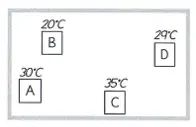
The diagram in the images shows four locations in a temperature field. The temperature of each location is given in degrees Celsius. Heat energy will normally flow from:
D to A
C to B
B to D
B to C
Energy stored in food would be considered
chemical potential
kinetic
thermal
gravitational potential
Conduction is the transfer of heat energy by __________.
direct particle contact
electromagnetic waves
density differences
movement through a vacuum
An example of an energy conversion from kinetic to thermal energy would be
friction
television
flower
gravity
The force or push that causes electric charges to move is called __________.
resistance
voltage difference
current
static electricity
Electric charges always flow from __________ areas to __________ areas.
positive, negative
negative, positive
positive, neutral
neutral, negative
A material through which electrons do NOT flow easily is a(n) __________.
insulator
fuse
conductor
circuit breaker
Which of the following statements about electric charge is true?
Objects must be touching on another to exert electrical force.
Electrical forces act at a distance.
Air cannot conduct electricity; it is conducted only be solid materials.
Opposite electric charges always repel one another.
Mr. Robinson and his class are conducting an experiment. The class needs to choose a good insulator. Which of the following could be used as an insulator?
plastic plate
silver spoon
copper wire
gold necklace
Which of the following will increase the resistance of a wire?
using a thicker/wider wire
using a shorter wire
increasing the temperature of the wire
using sliver instead of copper
What is the current produced by a 9-volt battery flowering through a resistance of 0.2 ohms? (I= V / R)
1.8 amps
45 amps
0.022 amps
8.8 amps
Which two areas of physical science are closely related to the development of electric motors and generators?
sound and light
electricity and sound
light and magnetism
electricity and magnetism
Which of the following will decrease the strength of the magnetic field around a wire?
increasing the current flowing through the wire
using less loops around the iron core
flipping the direction of the current flowing through the wire
using a larger iron core
Silver has a resistance of 0.0198 ohms. What voltage would produce a current of 100 amps? (V= I x R)
1.98 V
0.000198 V
5,050 V
100.0198 V
Refraction occurs when a wave changes its __________ as it passes through a different medium.
color
frequency
intensity
speed
Houses with carpet are much quieter than houses with tile or hardwood floors because of sound wave
absorption
diffraction
reflection
refraction
Which is an example of a compressional wave?
X-ray
gamma ray
sound wave
water wave
Increasing the amplitude of a sound wave will make it __________.
louder
have a higher pitch
travel faster
produce beats
Ocean waves crash on the beach at a velocity of 3.5 m/s. If the distance between the crests of each wave is 4 m, find the frequency of the waves. (f= λ / v)
0.88 Hz
1.14 Hz
0.0088 Hz
14.9 Hz
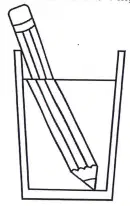
The picture shows which wave behavior?
absorption
reflection
diffraction
refraction
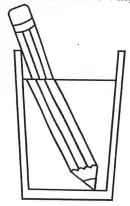
Look at the image, explain why it appears broken.
Electromagnetic waves cannot travel through solids.
Electromagnetic waves travel at different speeds through different mediums.
Electromagnetic waves compress more when they travel through denser mediums.
Electromagnetic waves get closer together when they go through dense mediums like glass.
An echo is an example of sound wave
absorption
reflection
diffraction
refraction
What is the velocity of a wave having a frequency of 25 Hz and a wavelength of 10 m? (v= λ x f)
250 m/s
2.5 m/s
35 m/s
0.4 m/s
A glass prism is able to bend light because
light is refracted as it enters a different medium
the prism creates destructive interference
energy is diffracted when it encounters an obstacle
the glass and the light's wavelength create resonance

