
 Worksheets
E.5.8 Review
Total questions: 140
Worksheet time: 2hrs 39mins
An explorer becomes lost on the ocean in a boat. The sky is covered in clouds. Which tool would help the explorer most, and why?
The telescope; the explorer can look for Polaris in the sky.
The astrolabe; the explorer can determine how fast the boat is moving.
The compass; the explorer can find the direction in which the boat is moving.
The sextant; the explorer can find the positions of different objects in the sky.
A telescope is used to view a faint, faraway object. How will it appear?
faint and closer
faint and farther
brighter and closer
brighter and farther
What is one purpose of a telescope?
to collect less light for the eye
to collect more light for the eye
to make small, close objects larger
to make large, faraway objects smaller
Which tool is most appropriate for studying objects in outer space?


Scientists at NASA have developed the James Webb Telescope. According to the scientists, it will bring a new perspective to viewing the universe. What is the importance of such telescopes?
They help aircraft navigate.
They help protect Earth from solar radiation.
They help predict upcoming climatic conditions.
They help study and explore new objects present in space.
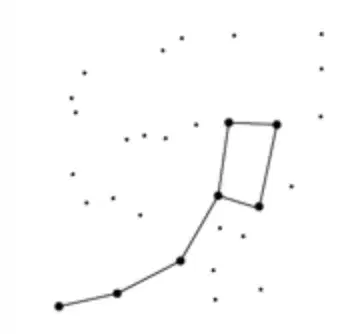
The image shows the constellation Ursa Minor, which never appears to set throughout the year. What can be inferred about this constellation?
It is a very large constellation.
It is located near one of the poles.
It is revolving continuously around the Sun.
It is very close to the solar system.
Why is the constellation Ursa Minor visible throughout the year in the Northern Hemisphere?
The constellation appears to circle the north star.
The constellation appears to revolve around Earth.
The constellation revolves around the Sun from west to east.
The constellation revolves around the Sun from east to west.
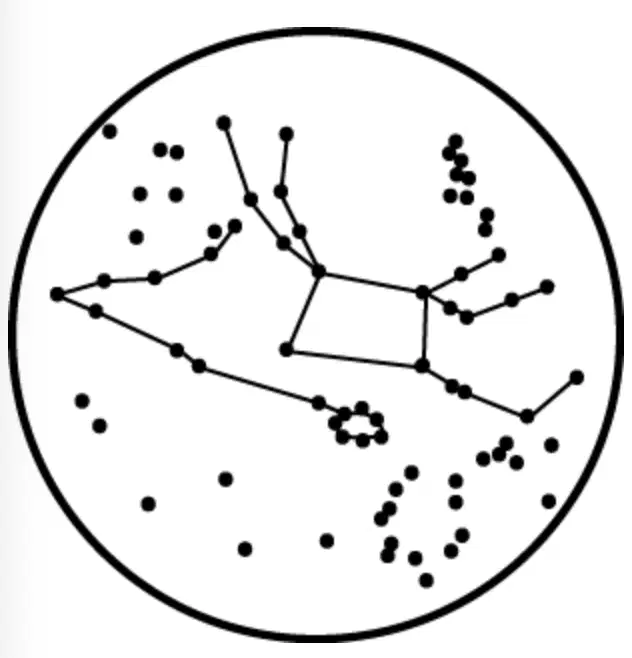
The image shows a star chart. Which information is best inferred from the star chart?
life cycles of the stars
patterns formed by the stars
distances of the stars from Earth
movements of the stars around the Sun
Orion appears in the eastern sky at sunset in December and disappears in the western sky in May in the Northern Hemisphere. What causes a change in the position of Orion in the sky across the seasons?
rotation of Earth on its axis
rotation of stars around Earth
revolution of stars around the pole star
revolution of Earth around the Sun
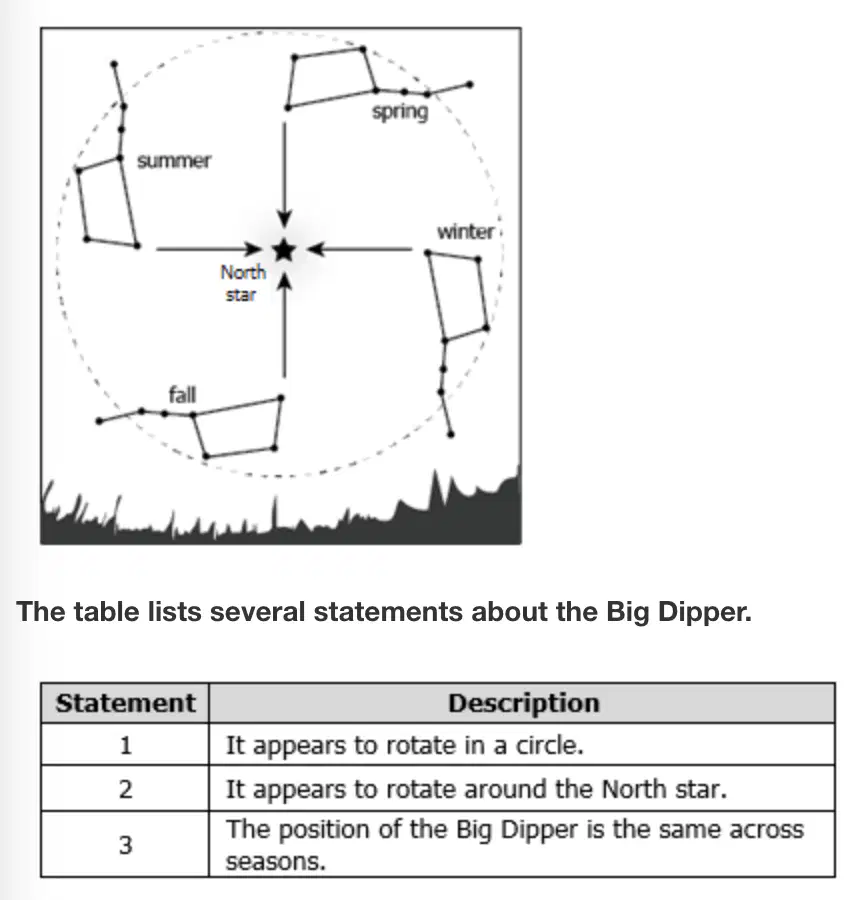
The diagram shows the positions of the Big Dipper in different seasons. Which statements correctly describe the characteristics of the Big Dipper?
Statements 1 and 2 only
Statements 2 and 3 only
Statements 1 and 3 only
Statements 1, 2, and 3
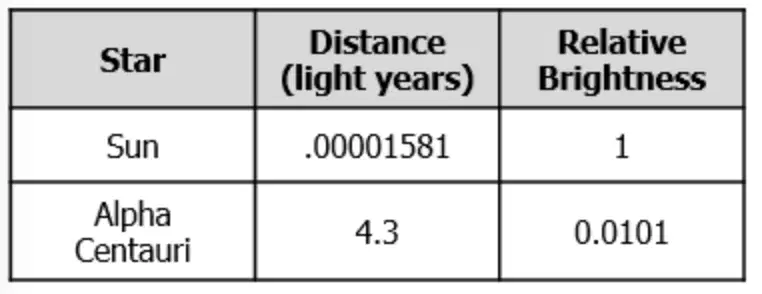
The table shows the distances of the Sun and Alpha Centauri from Earth and their relative brightness. A student claims that the Sun is brighter than Alpha Centauri when viewed from Earth. Is the claim correct, and why?
No. Alpha Centauri is closer to Earth than the Sun.
Yes. The Sun is closer to Earth than Alpha Centauri.
No. The Sun has a lower relative brightness than Alpha Centauri.
Yes. Alpha Centauri has a higher relative brightness than the Sun.
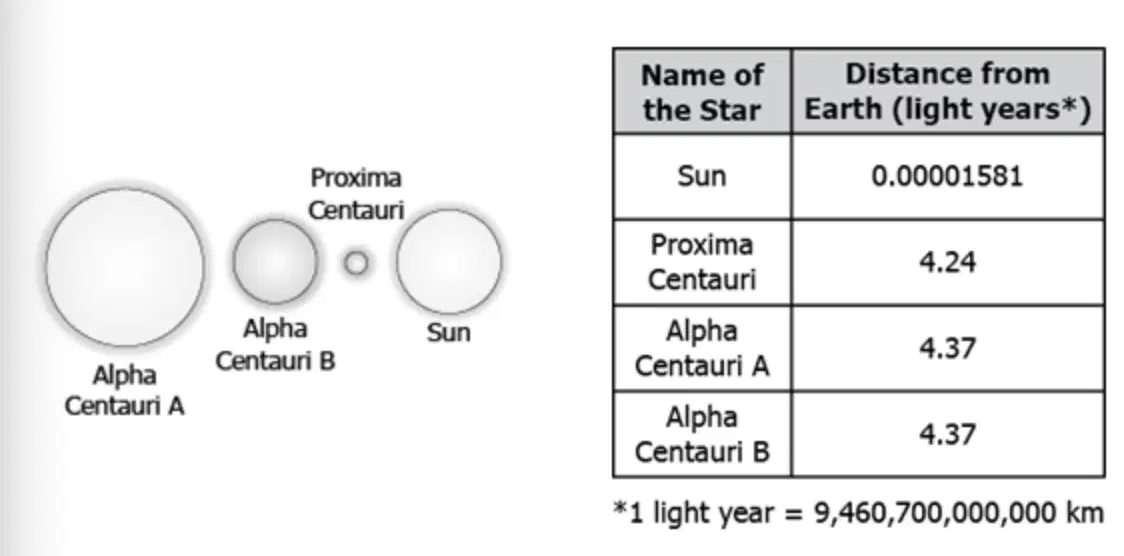
The image and table show the relative sizes and distances of different stars from Earth. A student argues that the Sun appears brightest among the other stars listed. Which statement supports the student’s argument?
The Sun is the biggest star.
The Sun is the closest star to Earth.
The Sun emits less light than other stars.
The Sun burns hot gases that make it brighter.
Which graph best represents the average surface temperatures of the planets in the solar system?


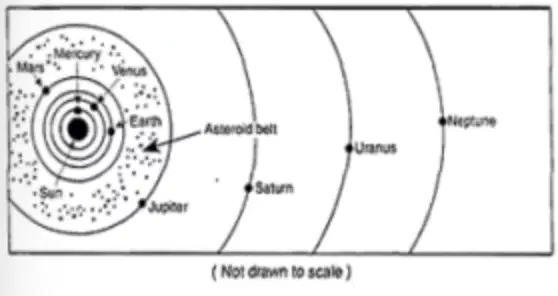
Look at the diagram of the solar system. Which planet has the longestyear based on its position in our solar system?
Jupiter
Mars
Uranus
Venus
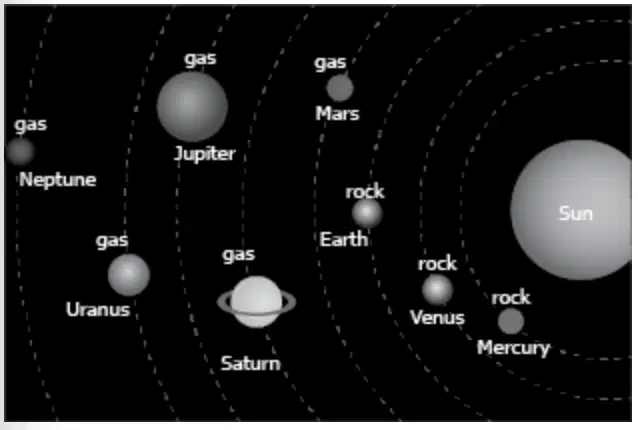
A student makes a model of the solar system, as shown. The student labels the surface compositions of the planets as rock or gas. A teacher observes the student’s model and finds errors. What changes should the student make?


The table shows the average distance of four planets from the Sun and the appropriate time it takes those planets to orbit the Sun. Which statement is best supported by the data in this table?
Earth takes less time to orbit the sun than Venus does.
Mars takes less time to orbit the sun than Earth does.
Mercury takes more time to orbit the sun than Venus does.
Mars takes more time to orbit the sun than Earth does.
Which is the best description of the Sun?
The Sun is a huge ball of hot gases.
The Sun is smaller than the Moon.
The Sun is a large planet.
The Sun has a rocky surface.

Ella draws the position of three objects in the solar system. She labels the three objects using letters X, Y, and Z. Which letters best represent Earth and its natural satellite?
X represents Earth, and Y is its natural satellite
Y represents Earth, and Z is its natural satellite.
X represents Earth, and Z is its natural satellite
Z represents Earth, and Y is its natural satellite.

The planets in the solar system have different orbits. Which planet has the hottest average surface temperature due to its closeness to the Sun and its heavy cloud cover?
Earth
Jupiter
Mars
Venus
A student makes a model of the planets in the solar system to show their compositions. The student uses wool to make the gas giants and modeling clay to make the rocky planets. Which table correctly matches the planets with the material the student uses to construct them?


The chart shows the eight planets in our solar system. Which planets make up the inner group of planets?
Earth, Jupiter, Mars, Mercury
Earth, Mars, Mercury, Venus
Neptune, Saturn, Uranus, Venus
Jupiter, Mercury, Saturn, Venus
Which planets have scientists found to be made mostly of gases?
Mercury, Venus, Earth, Mars
Venus, Mercury, Jupiter, Saturn
Mercury, Mars, Uranus, Neptune
Jupiter, Saturn, Uranus, Neptune

A student writes down three statements about an object in the solar system. What other statement could the student add to this list?
It is a natural satellite of Earth.
It does not have an atmosphere.
It has many craters and no water.
It is at the center of the solar system.

Zoe lists some facts in a chart about the Sun and its effect on Earth. Which facts are true?
1 and 2
3 and 4
1, 2 and 3
1, 2, 3, and 4
Which is not a characteristic of the inner planets?
The inner planets are much denser than the outer planets.
The inner planets have solid, rocky crusts.
The inner planets have many moons.
The inner planets are made of the same materials.

The table shows the sizes of different stars and their apparent magnitudes. Apparent magnitude shows the brightness of a star. A higher magnitude indicates that the star is less bright than a star with a lower magnitude. What evidence suggests that the Sun is the brightest when viewed from Earth?
The Sun is the biggest star.
The Sun is the smallest star.
The apparent magnitude of the Sun is the lowest.
The apparent magnitude of the Sun is the highest.

A student creates a model of four stars in the galaxy by placing basketballs in different locations on a playground. The student stands in one location and sketches how each basketball appears, as shown. If the student represents Earth, which basketball most likely represents the Sun?
basketball J
basketball K
basketball L
basketball M
Sam's class learned that there are differences among the stars in the universe. Which statement best describes the Sun?
It is the star that is orbiting Earth.
It is the star that is closest to Earth.
It is one of the oldest stars in the universe.
It is one of the largest stars in the universe.
The light from the Sun reaches Earth in approximately eight minutes. Which best explains why light from other stars takes years to reach Earth?
They are smaller than the Sun.
They give off less light than the Sun.
They produce more heat than the Sun.
They are much farther away than the Sun.
Which object in the solar system is a star?
Earth
Jupiter
the Sun
the Moon
1. Which planet orbits the Sun between Mars and Saturn?
a. Earth
b. Venus
c. Uranus
d. Jupiter
Mason is building a physical model of the Sun, Earth, and Moon. Which should he represent using the lamp?
a. Sun
b. Earth
c. Moon and Earth
d. Sun and Moon

About 2,300 years ago, this model of the solar system was presented. One major problem with the model is that...
a. Venus is in orbit beyond Mercury
b. The Moon is revolving around Earth
c. Saturn is in orbit beyond Jupiter
d. Earth is at the center of the model
Earth's solar system consists of how many known planets?
a. 3
b. 4
c. 8
d. 12

The picture shows an event that happens every day. Which number MOST likely shows the position of the Sun at noon?
a. 1
b. 2
c. 3
d. 4

Which labeled planet represents Earth in this solar system model?
a. W
b. X
c. Y
d. Z
Which planet is closest to the Sun?
a. Earth
b. Mars
c. Mercury
d. Venus
Which planet is the farthest from the Sun?
a. Jupiter
b. Mars
c. Neptune
d. Uranus

Planet Y is Earth. Which planet could be Planet X?
a. Jupiter
b. Saturn
c. Mars
d. Mercury

The diagram shows our solar system. Which planet is second from the Sun?
a. Earth
b. Venus
c. Mercury
d. Mars

A model of our solar system is shown below. Which planet is Mercury?
a. 1
b. 2
c. 3
d. 4
Which planet orbits the Sun between Mars and Saturn?
a. Venus
b. Jupiter
c. Earth
d. Neptune

Which drawing BEST represents the relative size and distances between the Sun, Earth, and Moon?
a
b
c
d
Which would be MOST similar about the parts of a model of the Sun, Earth, and Moon?
a. The size of the parts
b. The shape of the parts
c. The orbits of the parts
d. The color of the parts

A portion of the solar system is shown. If number 1 points to Earth, the 2 must point to...
a. Mercury
b. Jupiter
c. Venus
d. Mars
Brady is making a model showing the Sun, Earth, and Moon. Which will make the model accurate?
a. Making the Moon bigger than the Earth
b. Making the Moon bigger than the Sun
c. Making Earth bigger than the Sun
d. Making Earth bigger than the Moon

Which letters mark Earth and Neptune?
a. Z and Y
b. Y and X
c. Z and W
d. Y and W

Which four planets are numbered?
a. Mercury, Mars, Saturn, Neptune
b. Venus, Earth, Jupiter, Saturn
c. Mercury, Earth, Mars, Uranus
d. Venus, Mars, Saturn, Uranus
The figure shows the Sun and the four planets closest to it. Planet 1 is Mercury. Which is Planet 3?
a. Mars
b. Earth
c. Venus
d. Jupiter
Which of these planets is farthest from the Sun?
a. Earth
b. Saturn
c. Neptune
d. Jupiter
Which object in our solar system reflects light and is a satellite that orbits around one planet?
A. Earth
B. Mercury
C. the Sun
D. the Moon

The planets move around the center star in different orbits. Which planet has an orbit that is in the same relative position from its star as Earth's orbit from the Sun?
A. planet 1
B. planet 2
C. planet 3
D. planet 4
From Earth, the Sun appears brighter than any other star because the Sun is the...
A. newest star
B. largest star
C. hottest star
D. closest star

Based on the table, which star appears brightest to an observer on Earth?
A. star 1
B. star 2
C. star 3
D. star 4

From Earth, star Y appears to be the brightest, while star X and star Z appear to be similar in brightness. Which list orders the stars from closest to farthest from Earth?
A. star x, star Y, star Z
B. star X, star Z, star Y
C. star Y, star X, star Z
D. star Y, star Z, star X
Which statement correctly explains the movement of stars?
A. Stars move in a random motion across the sky
B. Stars are moving farther apart across the universe
C. Stars move in a circle around a central point in the universe
D. Stars are moving closer together toward the center of a large black hole.
The largest body in our solar system is
A. Earth
B. the Sun
C. Jupiter
D. the Moon
What is at the center of our solar system?
A. a medium planet with an atmosphere
B. a star composed of carbon and nitrogen
C. a black hole that was once a star
D. a star composed of hydrogen and helium
Gravity is responsible for the
A. orbits of the planets around the Sun
B. rotation of a planet on its axis
C. tilt of Earth's axis
D. phases of the Moon
Which planet orbits the Sun between Mars and Saturn?
A. Earth
B. Venus
C. Uranus
D. Jupiter
Which object in our solar system reflects light and is a satellite that orbits around one planet?
Earth
Mercury
the Sun
the Moon

There are four planets and a star in the solar system below. The planets move around the center star in different orbits. Which planet has an orbit that is in the same relative position from its star as Earth's orbit is from the Sun?
planet 1
planet 2
planet 3
planet 4
From Earth, the Sun appears brighter than any other star because the Sun is the ___________.
newest star.
largest star.
hottest star.
closest star.

The table shows the characteristics of four stars. Based on the table, which star appears brightest to an observer on Earth?
star 1
star 2
star 3
star 4

The three stars shown below are similar in type and temperature. From Earth, star Y appears to be the brightest, while star X and star Z appear to be similar in brightness. Which list orders the stars from closest to farthest from Earth?
star X, star Y, star Z
star X, star Z, star Y
star Y, star X, star Z
star Y, star Z, star X
Which statement correctly explains the movement of stars?
Stars move in a random motion across the sky.
Stars are moving farther apart across the universe.
Stars move in a circle around a central point in the universe.
Stars are moving closer together toward the center of a large blackhole.
The largest body in our solar system is _____________.
Earth
the Sun
Jupiter
the Moon
What is at the center of our solar system?
a medium planet with an atmosphere
a star composed of carbon and nitrogen
a black hole that was once a star
a star composed of hydrogen and helium
Gravity is responsible for the _________________.
orbits of the planets around the Sun.
rotation of a planet on its axis.
tilt of Earth's axis.
phases of the Moon.
Which planet orbits the Sun between Mars and Saturn?
Earth
Venus
Uranus
Jupiter
Mason is building a physical model of the Sun, Earth, and Moon. Which should he represent using a lamp?
Sun
Earth
Moon and Earth
Sun and Moon

About 2,300 years ago, this model of the solar system was presented. One major problem with this model is that _______________.
Venus is in orbit beyond Mercury.
The Moon is revolving around Earth.
Saturn is in orbit beyond Jupiter.
Earth is at the center of the model.
Earth's solar system consists of how many known planets?
3
4
8
12

The picture shows an event that happens every day. Which number MOST likely shows the position of the Sun at noon?
1
2
3
4

Which labeled planet represents Earth in this solar system model?
W
x
y
z
Which planet is closest to the Sun?
Earth
Mars
Mercury
Venus
Which planet is the farthest from the Sun?
Jupiter
Mars
Neptune
Uranus

Planet Y is Earth. Which planet could be Planet X?
Jupiter
Saturn
Mars
Mercury

The diagram shows our solar system. Which planet is second from the Sun?
Earth
Venus
Mercury
Mars

A model of our solar system is shown below. Which planet is Mercury?
1
2
3
4
Which planet orbits the Sun between Jupiter and Neptune?
Venus
Uranus
Mars
Earth
Which drawing BEST represents the relative sizes AND distances between the Sun, Earth, and Moon?


Which would be MOST similar about the parts of a model of the Sun, Earth, and Moon?
The size of the parts.
The shape of the parts.
The orbits of the parts.
The color of the parts.

A portion of the solar system is shown below. If number 1 points to Earth, then 2 must point to __________.
Mercury
Jupiter
Venus
Mars
Brady is making a model showing the Sun, Earth, and Moon. Which will make the model accurate?
Making the Moon bigger than Earth.
Making the Moon bigger than the Sun.
Making Earth bigger than the Sun.
Making Earth bigger than the Moon.

Which letters mark Earth and Neptune?
Z and Y
Y and X
Z and W
Y and W

Which four planets are numbered?
Mercury, Mars, Saturn, Neptune
Venus, Earth, Jupiter, Saturn
Mercury, Earth, Mars, Uranus
Venus, Mars, Saturn, Uranus

The figure below shows the Sun and four planets closest to it. Planet 1 is Mercury. Which is planet 3?
Mars
Earth
Venus
Jupiter
The asteroid belt is located between which two planets?
Earth and Mars
Uranus and Neptune
Mars and Jupiter
Mercury and Mars
The solar system is a system of eight planets, the Sun, moons, asteroids, and comets. (a) are identified as inner planets because they are closest to the sun.
Which statements describe the size of Earth as compared to the other planets in the solar system? (Choose 2)
smallest of the inner, rocky planets
largest of the inner, rocky planets
smaller than any of the gas giants
larger than any of the gas giants
smallest of the inner, rocky planets and gas giants
(a) , (b) , (c) , and (d) are identified as inner, rocky planets. (List the planets in order starting with the planet closest to the Sun.)
(a) , (b) , (c) , and (d) are identified as outer, gaseous planets. (List the planets in order starting with the planet closest to the Sun.)
Which of the following statements about the Sun are CORRECT? (Choose 2)
The Sun is a relatively large star.
The Sun is located 93 million miles away, making it the closest star to Earth.
The Earth orbits the Sun, which is in the center of our solar system, called the Milky Way.
The Sun is located in the center of our solar system.
The Sun is the brightest star in the Milky Way.
The image above shows a cluster of stars called Seven Sisters. These stars are located more than 400 light-years away from Earth. The stars in Seven Sisters appear significantly (a) than Earth's sun, because Earth's sun (b) than the stars of the Seven Sisters.
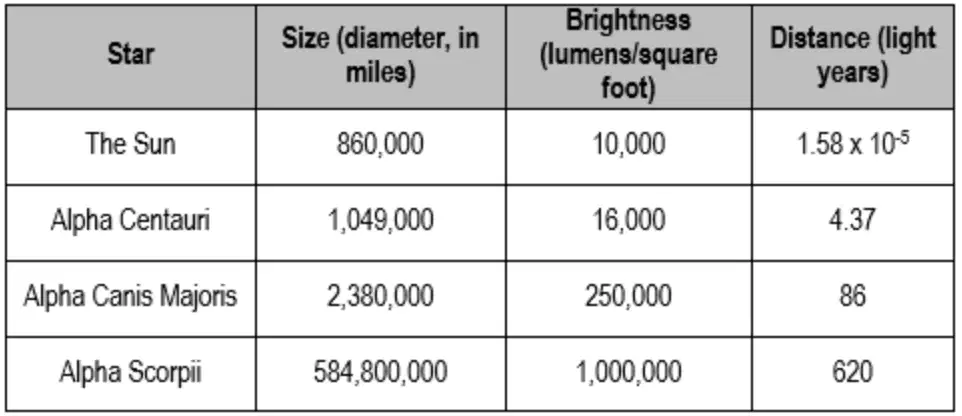
Based on the table coupled with observations, ___________ is the most important factor in determining relative brightness on Earth.
size
brightness
distance
Based on the table, there is a pattern of ________ in the stars.
increasing size and decreasing distance
decreasing distance and increasing brightness
increasing brightness and decreasing distance
increasing size and increasing brightness
During the summer months in Mississippi, the constellations Ursa Major and Lyra are visible in the night sky. During the winter months, Lyra is not visible and Ursa Major appears in a different area of the night sky. Which statements correctly explain the behavior of these constellations across the seasons?
The stars of both constellations move throughout the year.
The stars of Lyra move into view from Earth during the winter months.
The Earth's revolution around the Sun makes Ursa Major appear to move across the sky.
During the winter months, the stars of Lyra are positioned behind the Sun so they cannot be seen.
The Moon's orbit of Earth blocks Lyra's stars from view during the summer months.
Ursa Major is a constellation in the northern sky. Ursa Major also means “Great Bear”, and its brightest stars form the Big Dipper. As the Earth (a) on its axis, the pattern of this constellation (b) .
Long ago, sailors used different devices to guide their navigation while sailing at sea. Sailors often used a (a) to measure the angle between the horizon and the stars in the sky and calculate their latitude.
In centuries past, explorers used stars and constellations to navigate their direction. Polaris, also called the North Star, can be found in the constellation Ursa Minor. Ursa Minor is a constellation that can be viewed year-round in the Northern Hemisphere. Depending on their location, explorers were often able to use Polaris as a navigation tool to find geographic locations. Which statements support the idea of an explorer using the North Star to guide their navigation? CHOOSE 2!
If an explorer is in the Northern Hemisphere, they are facing North if they are looking at Polaris.
If an explorer is outside of the Northern Hemisphere, they are facing North if they are looking at Polaris.
If an explorer uses their position in the Southern Hemisphere, Ursa Minor in the sky will guide their journey.
If an explorer is in the Southern Hemisphere, the North Star will help them navigate.
If an explorer is in the Northern Hemisphere, they can use a sextant to determine their location.
The Moon completes one full (a) on its axis for each (b) around the Earth. As a result, only one half of the Moon is visible from Earth.
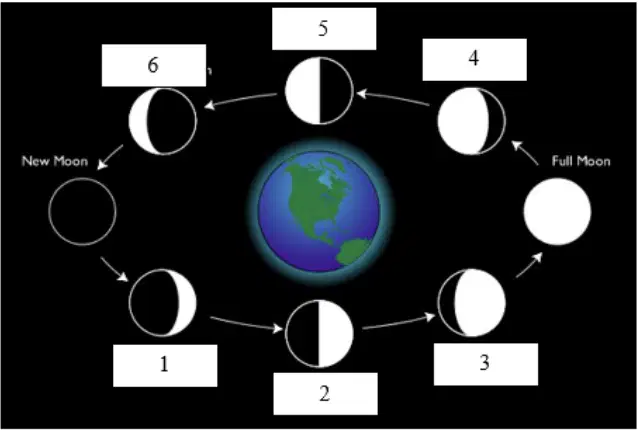
A group of students analyzed the Moon in its different phases while orbiting Earth. They created a model to illustrate a complete Moon phase cycle, but they left certain portions of their model incomplete. #1 is a (a)
A group of students analyzed the Moon in its different phases while orbiting Earth. They created a model to illustrate a complete Moon phase cycle, but they left certain portions of their model incomplete. #2 is a (a)
A group of students analyzed the Moon in its different phases while orbiting Earth. They created a model to illustrate a complete Moon phase cycle, but they left certain portions of their model incomplete. #3 is a (a)
A group of students analyzed the Moon in its different phases while orbiting Earth. They created a model to illustrate a complete Moon phase cycle, but they left certain portions of their model incomplete. #4 is a (a)
A group of students analyzed the Moon in its different phases while orbiting Earth. They created a model to illustrate a complete Moon phase cycle, but they left certain portions of their model incomplete. #5 is a (a)
A group of students analyzed the Moon in its different phases while orbiting Earth. They created a model to illustrate a complete Moon phase cycle, but they left certain portions of their model incomplete. #6 is a (a)
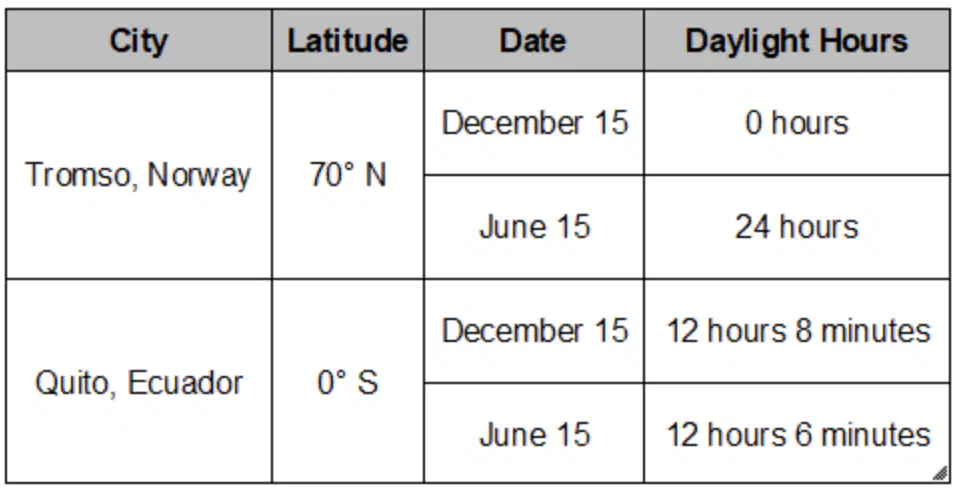
Based on the information in the table, which of the following factors BEST explains why these two cities have a significant difference in daylight hours?
the orbit of the Moon around Earth
the rotation of Earth on its axis
the tilt of the Earth's axis
the rotation of the Moon on its axis
Corinth, Mississippi has a latitude of 35° N. Based the table, how many hours of daylight did Corinth experience on June 15th of the same year?
less sunlight than Quito and more sunlight than Tromso
as much sunlight as Quito and more sunlight than Tromso
more sunlight than Quito and less sunlight than Tromso
as much sunlight as Quito and less sunlight than Tromso
In centuries past, scientists believed that the Earth was the center of the universe, which is now called the geocentric model. This model explains that the Sun, Moon, and stars all orbit Earth as it sits at the center of the universe. What instrument was responsible for building evidence against this model?
astrolabe
compass
optical telescope
star chart
Who said that the Earth was the center of the universe?
Ptolemy
Copernicus
Galileo
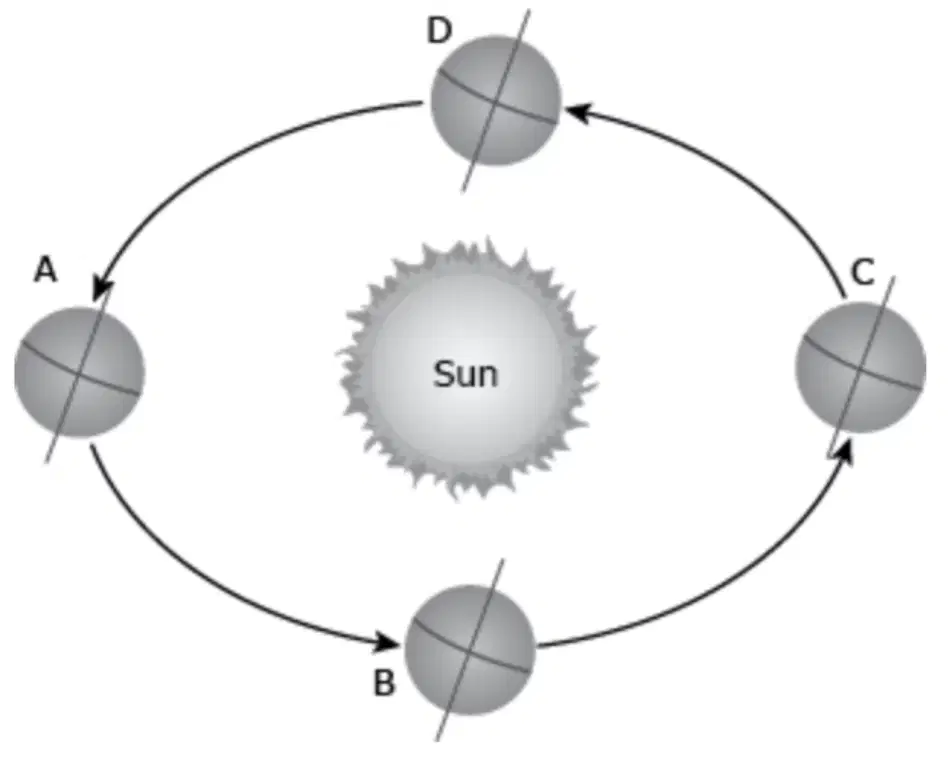
What season is the Northern Hemisphere having at spot B?
winter
spring
summer
fall
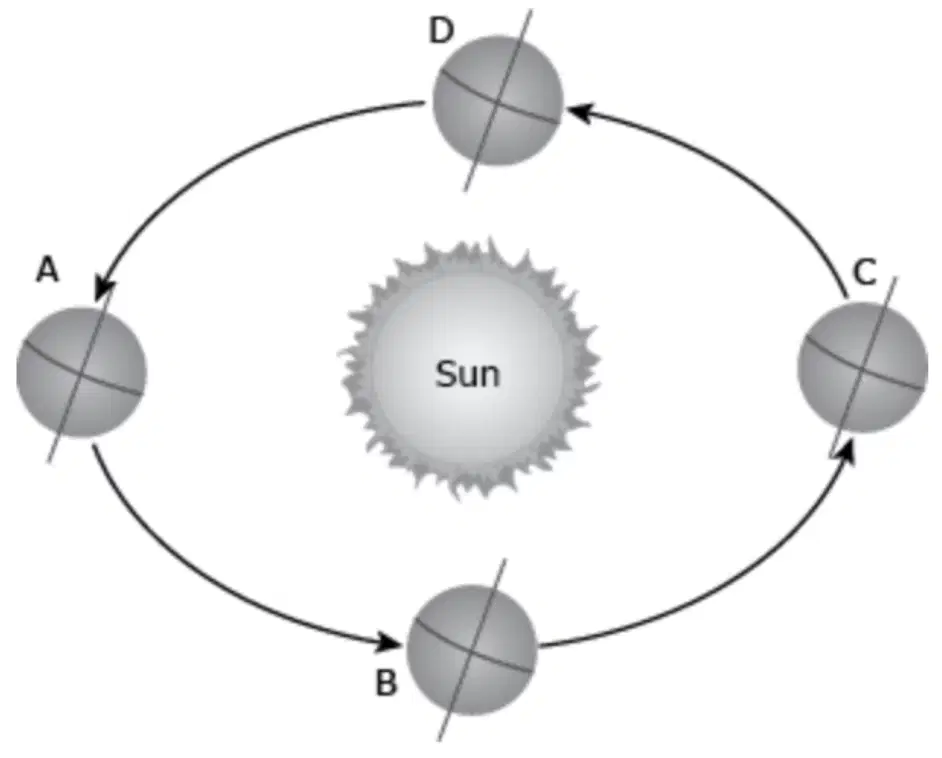
What season is the Southern Hemisphere having at spot A?
winter
spring
summer
fall
Who said that the Earth did not move and celestial objects orbited around it?
Galileo
Ptolemy
Copernicus
Who is credited with using the first telescope?
Aristotle
Ptolemy
Copernicus
Galileo
Who created the heliocentric model?
Aristotle
Ptolemy
Copernicus
Who's model was the geocentric model?
Aristotle
Copernicus
Who created the heliocentric model?
Aristotle
Copernicus
What does geo mean?
Earth
Sun
Moon
Stars
What does helios mean?
Ear th
Sun
Moon
Stars
What changed when we went from the geocentric model to the heliocentric model?
Where the planets were
Which object was in the center
Which scientist said that the Earth moves around the sun?
Copernicus
Aristotle
True or False: The planets orbit around the Earth.
True
False
If the Northern Hemisphere is facing towards the sun, it will be
Winter
Summer
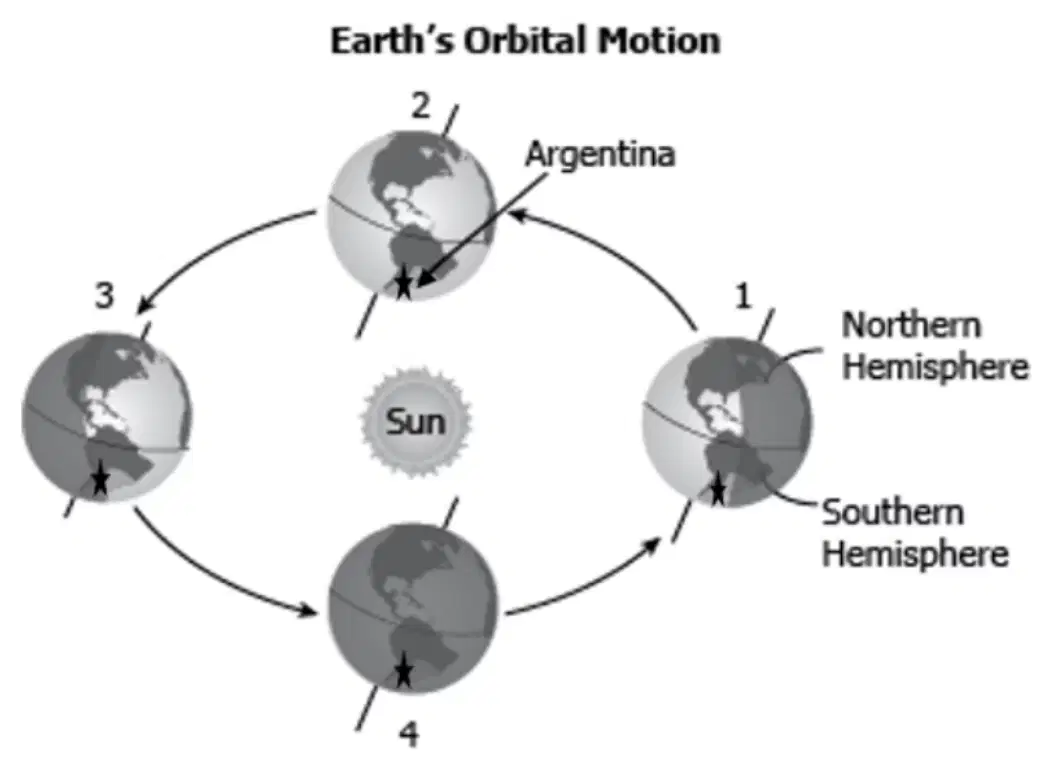
Argentina is located in the Southern Hemisphere. What season is it experiencing at location 1?
summer
winter
How long does Earth's revolution take?
24 hours
365 days
If the Earth was not tilted, what would happen?
Nothing
There would only be one season
the length of a day would change
all places on Earth would have equal temps.
What is the order during a solar eclipse?
Sun, Earth, moon
Moon, Earth, Sun
Sun, moon, earth
Moon, Sun, Earth
What is the order during a new moon?
moon, earth, sun
Earth, Moon, Sun
Sun, moon, earth
Moon, Sun, Earth
If four seasons have passed, what has also occurred?
Earth's rotation
A complete lunar cycle
Earth's revolution
A month
How long does it take to see two full moons?
About a year
About a month
If I see a full moon on June 02, when will I DEFINITELY see it again?
June 07
June 14
June 20
July 01
What moon phase comes after a first quarter moon?
third quarter
new moon
waxing gibbous
waning gibbous
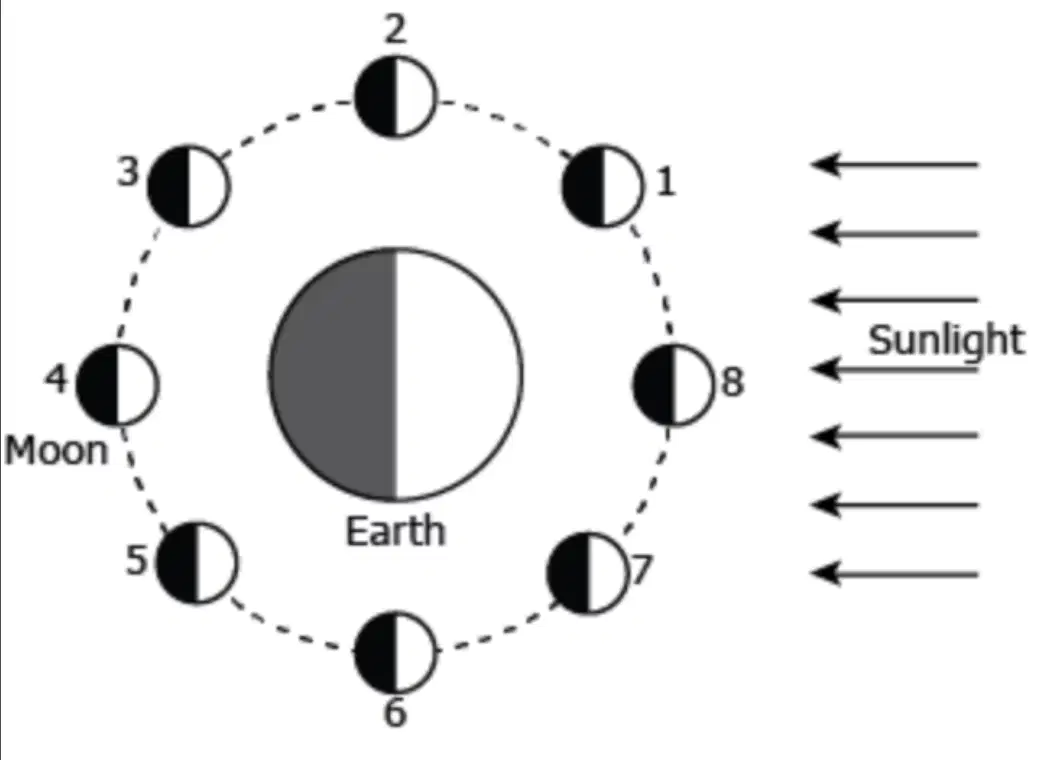
On which phase will I see a crescent moon?
1 and 5
1 and 7
2 and 6
4 and 8
Find the missing moon phase: new moon, waxing crescent, ________, waxing gibbous
last quarter
first quarter
full moon
waning gibbous
In order for a total solar eclipse to occur, the Sun, Moon, and Earth must be in a straight line
True
False
What moon phase will I see during a solar eclipse?
full moon
new moon
What moon phase will I see during a lunar eclipse?
full moon
new moon
Earth's rotation causes
seasons
day and night

