
 Worksheets
Psych 85 Cognitive Science
Total questions: 97
Worksheet time: 1hrs 4mins
What is the scientific study of the mind called?
Physics
Chemistry
Cognitive Science
Biology
The brain is the most complex entity in the universe.
True
False
Cognitive science conceptualizes the mind as a(n) ______-processing system.
information
energy
chemical
mechanical
Studying the complex mind requires expertise across diverse disciplines because:
it involves understanding biological, psychological, and social factors.
it is only related to biology.
it can be explained by a single field.
it does not require any expertise.
The benefit of combining linguistics and psychology according to the Interdisciplinary Perspective is:
Better understanding of language processing and mental functions
Improved mathematical modeling
Enhanced historical analysis
Greater focus on literature
Which of the following is NOT listed as an application of cognitive science?
Computer science
Sales
Cooking
Art
Fill in the blank: In mental health, cognitive science explores how thoughts can be reshaped to be more _______.
healthy
rigid
chaotic
negative
unrealistic
What is an example of a concept in mental representation, as described in the worksheet?
Dog
Running
Quickly
Yesterday
The mind can manipulate symbols, images, rules, and other ________.
representations
machines
colors
sounds
What does it mean to focus on computation in cognitive science?
It means studying how mental processes can be understood as information processing.
It means only studying the brain's physical structure.
It means ignoring mental processes.
It means focusing only on behavior.
List the three levels of analysis in cognitive science mentioned in the worksheet.
Computational, Algorithmic, Implementational
Behavioral, Emotional, Logical
Structural, Functional, Conceptual
Descriptive, Prescriptive, Predictive
What is the classical philosophical problem mentioned in the worksheet?
The mind-body problem
The problem of induction
The problem of evil
The problem of universals
1982 Frank Johnson proposed: Are seeing a color (red) and knowing about a color (wavelength ~600nm) different things? Which scientific approach would best show that Mary’s knowledge of red and experience of red are distinct?
Conducting a brain scan while Mary learns about color wavelengths and then experiences red for the first time
Asking Mary to describe the color red before and after seeing it
Measuring Mary’s reaction time to red objects before and after learning about wavelengths
Testing Mary’s ability to distinguish between different shades of red
The Mind-Body Problem asks: what is the relationship between your mind (experiences, thoughts, beliefs) and your brain (collection of connected neurons, and related activity)? Which of the following is true?
My internal experiences are observable, but physical body cannot be observed
My internal experiences are unobservable, but physical body can be observed
Both mind and body are observable
Neither mind nor body are observable
If the mind and body are different things, knowing information about one will not necessarily give information about the other.
True
False
Cartesian Dualism: The mind and the brain are completely separate substances. Brain is _______ matter, mind is _______ matter.
Brain is physical matter, mind is mental matter
Brain is mental matter, mind is physical matter
Brain is abstract matter, mind is concrete matter
Brain is chemical matter, mind is electrical matter
Which of the following is NOT a property of mental experiences according to Cartesian Dualism?
A) Mental experiences have intentionality
B) Mental experiences take up space and have mass
C) Mental experiences are not physical
D) Mental experiences are not popular
Property Dualism states that mental properties (consciousness) cannot be fully reduced to just the activation of neurons.
True
False
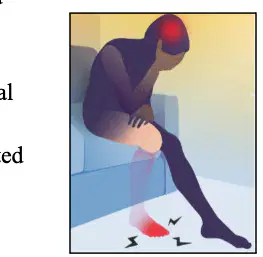
Interactionism: Neural events influence your mental states, and mental states influence neural events. The diagram shows a person with a red area on their arm. What phenomenon does this illustrate?
Pain perception
Memory formation
Visual processing
Motor coordination
Monism: The mind and body are made of the same things. Mind and brain are the same entity.
True
False
What is Idealism in philosophy?
The universe is entirely made of physical substances
The material that makes everything up is mental substance
The brain and mind are the same substance
The mind cannot be observed
Materialism is the belief that the universe is entirely made of _________.
physical substances
spiritual entities
mathematical concepts
mental ideas
Which of the following is NOT an issue with Reductive Materialism?
The brain is always changing
Activation differences, changes in neural connectivity
The mind and brain are the same substance
If we can't have the same brain state, how can we have the same experience
Eliminative Materialism argues that common-sense notions about mental states are fundamentally ________.
wrong
useful
accurate
necessary
Non-Reductive Materialism states that brain and mind are the same substance, but not all mental states can be reduced to ________ activity.
brain
chemical
emotional
spiritual
Phrenology is best described as:
The study of the mind through introspection
The belief that the brain had different regions that performed different tasks
Psychoanalysis
Operant conditioning
Structuralism is the study of the mind through ________.
introspection
observation
experimentation
conditioning
Who pioneered Behaviorism in animal research?
Sigmund Freud
B.F. Skinner
Wilhelm Wundt
John Watson
In operant conditioning, what is a reinforcer?
A cue from the environment
The result of an action
An outcome that will increase the performance of a behavior
An outcome that will decrease the performance of a behavior
According to Behaviorism, the mind can be objectively observed and studied.
True
False
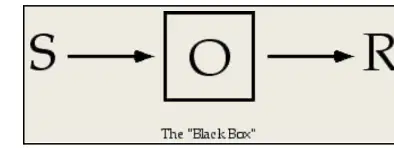
According to behaviorism, what should research focus on?
Mental states and processes
Responses (R) elicited by certain stimuli (S)
The structure of the mind
Theories of computation
Fill in the blank: In behaviorism, the mind of any organism is considered a '____ ____' that cannot be studied experimentally.
black box
open book
clear window
glass jar
Which of the following is NOT a criticism of behaviorism mentioned in the notes?
A) Behaviorism equates mental states with behavior
B) Behaviorism explains complex behaviors well
C) Behaviorism cannot eliminate mental entities
D) Behaviorism does not explain why stimulus does not always map onto response
According to the notes, what event in the 1950s-60s contributed to the cognitive revolution?
The development of the black box theory
The rise of neuroscience and computer theory
The elimination of mental entities
The end of behaviorism
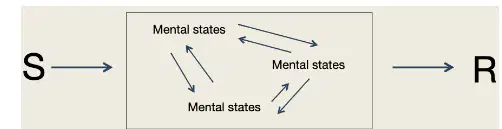
According to functionalism, anything that can perform the functions of the mind can have a mind. Which of the following could have a mind according to this view?
Only humans
Only animals
Humans, computers, and aliens
Only computers
Fill in the blank: According to functionalism, a computer that can do all of the functions of the mind (remember things, reason, perceive external stimuli) has a _____
mind
soul
body
consciousness
What does the concept of 'Multiple realizability' refer to in the philosophy of mind?
The belief that only the brain can produce mental states
The belief that the structure doesn't matter, just the function of the mind
The belief that consciousness is an illusion
The belief that machines cannot have mental states
Fill in the blank: The mind is to software as the brain is to ________.
hardware
memory
algorithm
network
What is the philosophical term for the introspective phenomenological aspects of our mental lives, such as the experience of the color red?
Qualia
NCC
Integration
Exclusion
What is the minimal set of neural events and structures that are sufficient to explain a conscious experience called?
Qualia
Neural correlates of consciousness (NCC)
Global Workspace
Intrinsic existence
According to the 1988 Global Workspace Theory by Baars and Franklin, what happens when you direct your attention towards certain processes?
You become unconscious of them
These processes enter a mental 'workspace' and can be acted upon
They are excluded from consciousness
They lose their structure
Which of the following is NOT one of the essential properties of experience according to Integrated Information Theory (IIT)?
A) Intrinsic existence
B) Composition
C) Exclusion
D) Simulation
Fill in the blank: According to IIT, ________ is the unification of many parts, such as a visual scene being integrated into a whole experience.
Integration
Segregation
Dissociation
Fragmentation
According to IIT, there are things that are not a part of your conscious experience.
True
False
What is the easy problem of consciousness?
Determining what brain activity underlies different forms of experience.
Explaining why consciousness exists at all.
Understanding the subjective quality of experiences.
Describing the fundamental nature of awareness.
What is the hard problem of consciousness?
What is the explanatory gap in consciousness studies?
Cognitive psychology studies knowledge representation in human beings. Which of the following is NOT included in cognitive psychology?
A) Representing information
B) Processing information
C) Storing information
D) Digesting food
Who described cognitive psychology as all processes wherein 'the sensory input is transformed, reduced, elaborated, stored, recovered'?
Ulric Neisser (1967)
B.F. Skinner (1957)
Jean Piaget (1952)
Noam Chomsky (1965)
What are the two main types of data in cognitive psychology?
Experiments performed on humans and computer simulation/modeling
Animal studies and plant studies
Surveys and interviews
Brain scans and blood tests
Process models emphasize the flow of information between discrete processes being performed.
True
False

According to the diagram, what is the correct order of information flow in visual memory processes?
Long Term Memory → Visual Working Memory → Internal Visual Representation
Internal Visual Representation → Visual Working Memory → Long Term Memory
Visual Working Memory → Internal Visual Representation → Long Term Memory
Internal Visual Representation → Long Term Memory → Visual Working Memory
According to Marr's 3 Levels of Analysis, what does the computational level describe?
At the algorithmic level in Marr's 3 Levels of Analysis, what is described?
What are the three levels of analysis described by Marr in cognitive science?
Computational, Algorithmic, Implementational
Visual, Auditory, Tactile
Fast, Innate, Fixed neural architecture
Domain specificity, Informational encapsulation, Mandatory application
According to the notes, what is the goal at the computational level when adding 30 and 40?
To determine the value of X in X=30+40
To memorize the numbers 30 and 40
To find the largest number less than 30
To subtract 40 from 30
Fill in the blank: At the algorithmic level, addition is represented through ______ numerals and processed through standard rules of addition.
Arabic
Roman
Binary
Greek
Which of the following is NOT a characteristic of Fodorian modules?
A) Domain specificity
B) Informational encapsulation
C) Mandatory application
D) Executive control
What does 'informational encapsulation' mean in the context of Fodorian modules?
According to Jerry Fodor, modular systems are the only aspects of mental function that cognitive science will be able to understand.
True
False
Which of the following is required for a specialized faculty of the mind to be considered a true module?
Fast
Innate
Fixed neural architecture
All of the above
What does modularity provide in the context of understanding the brain?
Domain specificity refers to:
The ability of the brain to process all information in the same area
Perceptions being handled by distinct areas of the brain
The brain's inability to process information
The brain's response to only visual stimuli
The Fusiform Face Area (FFA) is reliably activated when car experts view images of cars.
True
False
The FFA may not respond only to faces but may be responding to something else, as suggested by the ________ Effect.
McGurk
Stroop
Simon
Ponzo
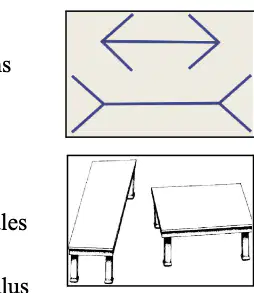
Informational encapsulation is illustrated by the mental persistence of optical illusions such as the Muller-Lyer illusion and Roger Shepard’s Turning the Tables illusion.
True
False
According to the worksheet, which of the following is NOT an issue with Modularity Theory?
Neural representations of specific types of information can be fairly distributed
Modules are fully specified innately
The neural wiring of domain-specific systems is malleable by experience
Domain-specific modules may be affected by information from other modalities
The perception of the Muller-Lyer illusion is explained by the ________ world hypothesis, which relates to our experience using corners and angles as distance cues.
Carpentered
Gestalt
Ecological
Constructivist
In the ventriloquist illusion, sound comes from a different place than visuals, but we perceive them as coming from the same place.
True
False
Parts of our brain seem specialized to process certain types of information, but there may be more flexibility and cross-communication than Fodor’s theory allows for.
True
False
What is the McGurk Effect?
A phenomenon where visual information influences what we hear
A type of neurotransmitter
A part of the brain
A type of neuron
Neuroscience is the study of different levels of the nervous system. Which of the following is NOT a level of neuroscience?
Cellular neuroscience/electrophysiology
Neuroanatomy
Systems neuroscience
Cardiac neuroscience
Fill in the blank: Neurons have dendrites (detect incoming signals), a cell body (contains nucleus and cellular machinery), and an ______ (transmits signals to other neurons).
axon
mitochondrion
ribosome
dendrite
What is the function of myelin on axons?
It slows down the speed of conduction
It insulates and increases the speed of conduction
It produces neurotransmitters
It stores genetic information
Which type of brain matter contains the cell bodies of the neurons?
White matter
Gray matter
Red matter
Blue matter
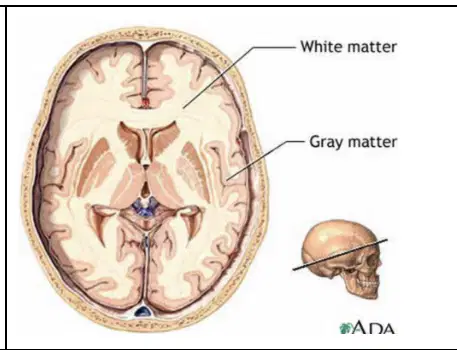
Which part of the brain is indicated as 'White matter' in the diagram?
The area labeled 'White matter' in the brain cross-section (as shown in the diagram).
The area labeled 'Cerebellum' in the brain cross-section (as shown in the diagram).
The area labeled 'Grey matter' in the brain cross-section (as shown in the diagram).
The area labeled 'Brainstem' in the brain cross-section (as shown in the diagram).
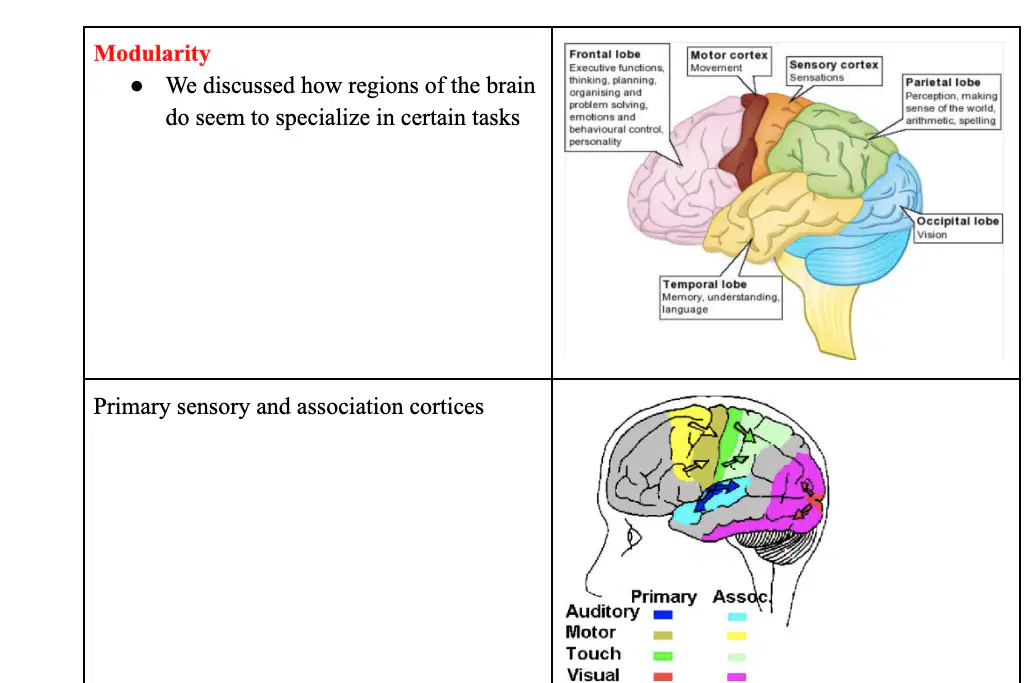
Which lobe of the brain is responsible for vision?
Frontal lobe
Parietal lobe
Occipital lobe
Temporal lobe

Which area of the brain is associated with memory and understanding language?
Frontal lobe
Parietal lobe
Occipital lobe
Temporal lobe
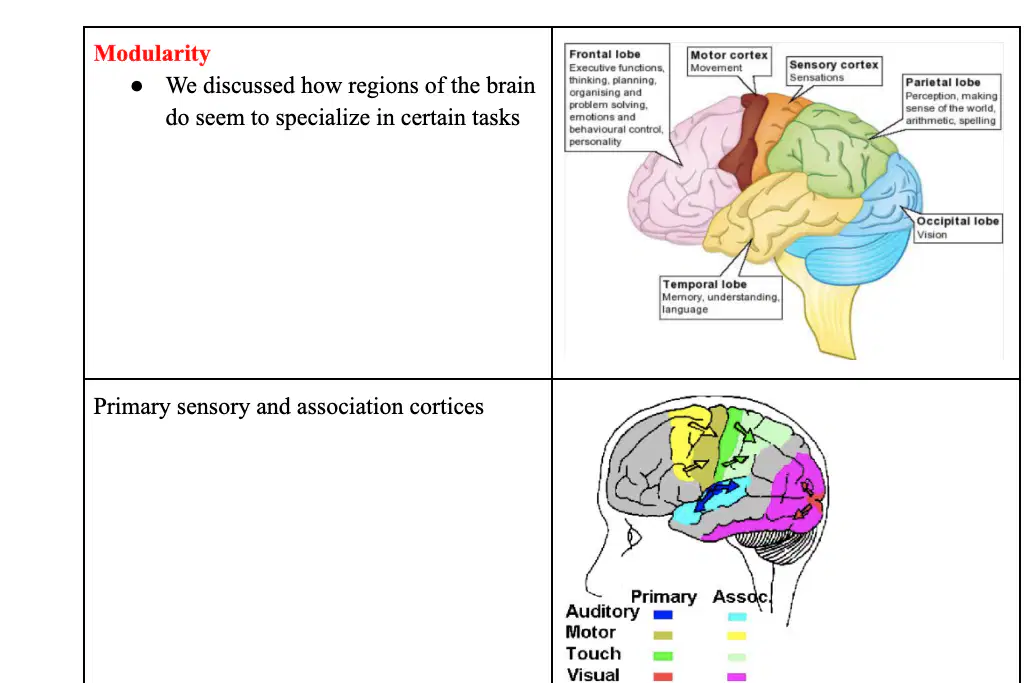
Fill in the blank: The ________ lobe is involved in executive functions, planning, and problem solving.
Frontal
Temporal
Occipital
Parietal
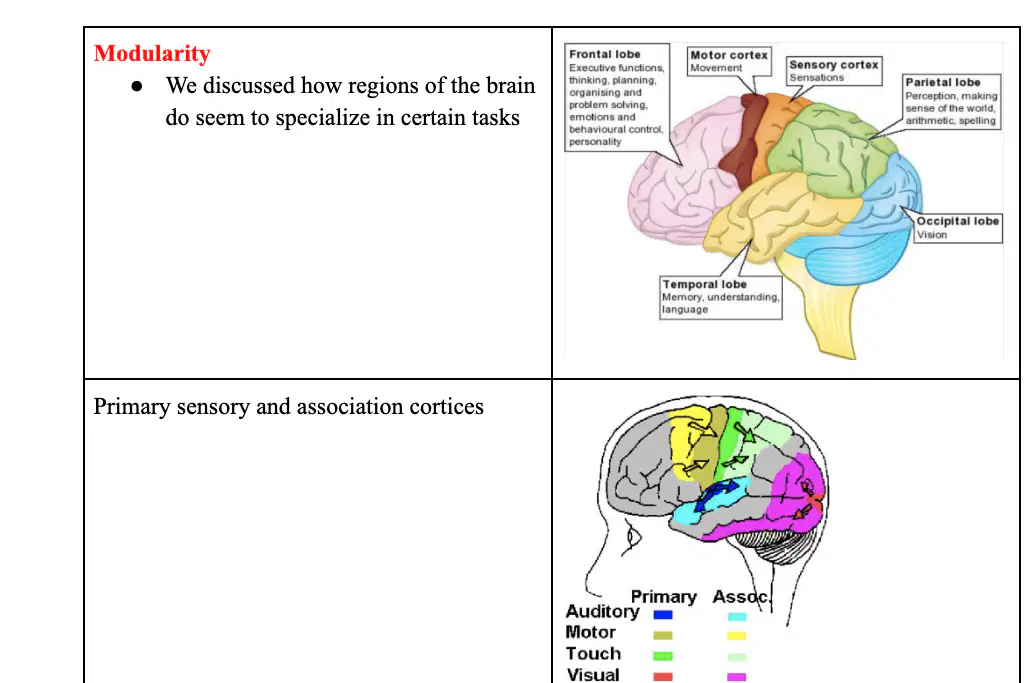
Which color in the diagram represents the primary auditory cortex?
Yellow
Green
Blue
Pink
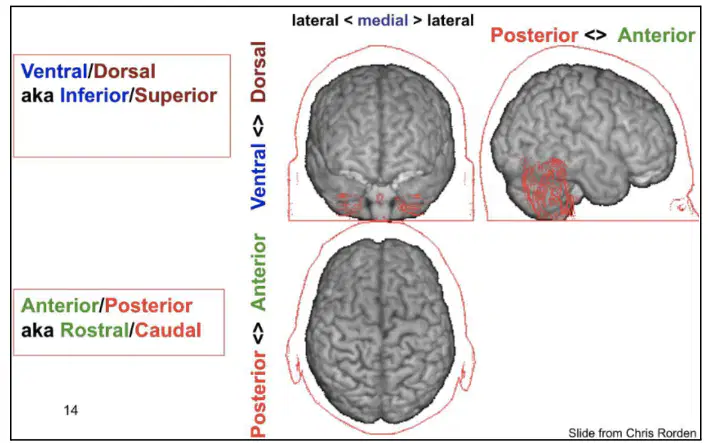
In brain anatomy, what does 'ventral' also refer to?
A) Anterior
B) Inferior
C) Posterior
D) Superior
Neuropsychological associations imply a link or connection between two cognitive deficits, suggesting a common representation or process is affected.
True
False
What is a single dissociation in neuropsychology?
Lesion to brain structure 1 disrupts function A but not function B
Lesion to brain structure 1 disrupts both function A and function B
Lesion to brain structure 2 disrupts function A but not function B
Lesion to brain structure 1 does not disrupt any function
What is a double dissociation in neuropsychology?
Lesion in brain structure 1 impairs function A but not function B, and a lesion in brain structure 2 impairs function B but spares function A
Lesion in brain structure 1 impairs both function A and function B
Lesion in brain structure 2 impairs function A but not function B
Lesion in brain structure 1 does not impair any function
Fill in the blank: In Broca's aphasia, a person can understand speech, but speech is (a) .
Fill in the blank: In Wernicke's aphasia, a person cannot understand speech, but speech is _______ and ongoing.
fluent
halting
silent
monotone
A double dissociation between two tasks does not imply a double dissociation between cognitive processes.
True
False
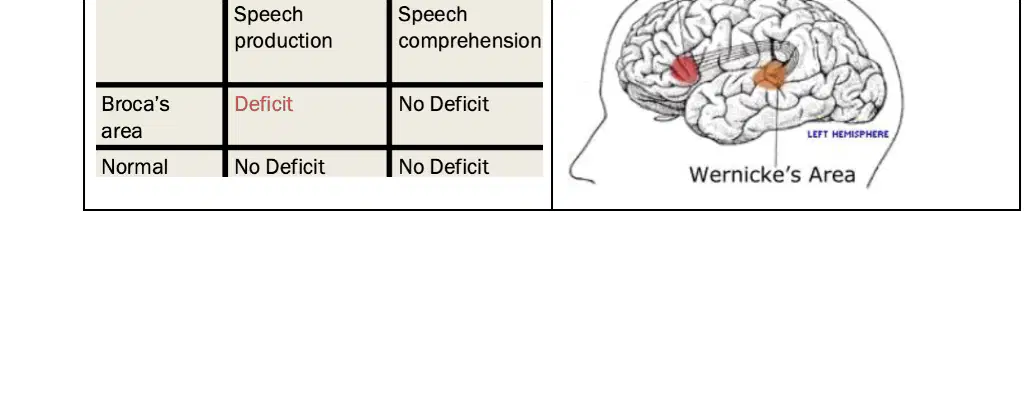
Which area of the brain is associated with speech production deficits in Broca's aphasia?
Wernicke's area
Broca's area
Occipital lobe
Parietal lobe
According to the Double dissociation table, damage to Broca's area results in which of the following?
Deficit in speech production
Deficit in speech comprehension
No deficit in either
Deficit in both
According to the Double dissociation table, damage to Wernicke's area results in which of the following?
Deficit in speech production
Deficit in speech comprehension
No deficit in either
Deficit in both
Angelo Mosso found that increased brain activity leads to increased _________
blood flow
body temperature
muscle strength
heart rate
Which of the following is NOT a step in Positron Emission Tomography (PET Scan)?
A. Subjects injected with radioactive isotope
B. Detectors register simultaneous photons
C. PET records energy from radioactive particles
D. MRI coil receives radio frequencies
Which of the following is a PRO of PET scans?
Invasive (radioactive injection)
Can measure neurotransmitter metabolism
Very expensive
Poor temporal resolution
Which of the following is a CON of PET scans?
Decent spatial resolution
Can aid in diagnosis of Alzheimer's disease
Invasive (radioactive injection)
Allows for localization
Magnetic Resonance Imaging (MRI) studies brain ________.
anatomy
temperature
electricity
behavior
Structural MRI is useful for clinical imaging (diagnosis).
True
False
MRI can complete images more slowly, and so can collect ________ resolution images.
higher
lower
blurred
distorted

