
 Worksheets
IPC Spring Final Review
Total questions: 125
Worksheet time: 3hrs 38mins
Which of these pH values represent an acid?
4
8
10
12
Which of the following are properties of acids?
They conduct electricity when dissolved in water
They taste sour
They react with metals to produce hydrogen gas
All of the answer choices are correct
Which of the following is a property of a base?
bitter taste
reacts with metals
salty
sour taste
Which of the following pH values represents a base?
2.1
4.6
6.8
8.1
The strongest bases have pH values close to
0
14
7
5
Stronger acids have a pH closer to...
7
14
0
9
Weaker bases have a pH closer to...
8
14
0
4
What is the correct formula for sodium oxide?
NaO(s)
NaN(s)
NO(g)
Na2O(s)
N2O2(g)
What is the formula for nitrogen dioxide
NO(g)
N2O2(g)
NO2(g)
Na3N(s)
Na2O(s)
What is the name for P2S5(s)?
phosphorus sulfide
diphosphorus pentasulfide
tristrontium diphosphide
potassium sulfide
dipotassium sulfide
What is the name for SO(g)?
sulfur oxide
monosulfur monoxide
sodium oxide
sulfur monoxide
sodium monoxide
In this type of compound, electrons are transferred
molecular
ionic
both ionic and molecular
Which of the following is the chemical formula for salt?
H2O
NaCl
HCl
SaLt
(hydrochloric acid) made up of?
Name the following compound: NaNO3
Sodium Nitrogen Oxide
Sodium nitrate
Sodium nitrite
Sodium nitride
How do covalent bonds form?
By donating and receiving valence electrons between atoms.
Scientists still aren't sure.
Opposite slight charges attract each atom in the compound.
Sharing valence electrons between atoms

What two types of atoms make a covalent bond?
2 Nonmetals
1 Metal and 1 Nonmetal
2 Metals
2 Noble Gases

Ionic Bonds
metal with nonmetal
nonmetal with nonmetal
Jasmine runs exactly 3 laps around a 400 meter track. What is the DISPLACEMENT?
800 m
400 m
0 m
1200 m
David walks 3 km north, and then turns east and walks 4 km. What is the DISTANCE?
7 km
3 km
4 km
1 km
Distance
Total length of the path travelled
How far an object is from its starting point
Location of an object relative to a defined zero point
Displacement
Total length of the path travelled
How far an object is from its starting point
Location of an object relative to a defined zero point
A car travels a distance of 200 km in 4 hours. What is its average speed?
60 km/h
50 km/h
40 km/h
100 km/h
A cyclist covers a distance of 30 km in 2 hours. What is the average speed of the cyclist?
15 km/h
25 km/h
20 km/h
10 km/h

A roller coasters accelerates from an initial speed of 6.0 m/s to a final speed of 70 m/s over 4 seconds. What's the acceleration?
24 m/s2
18 m/s2
16 m/s2
16 m/s

How do you find the net force of this image.
Add up all the arrows
Add a green arrow and the orange arrow.
Subtract all the arrows.
Add the green arrows and subtract the orange arrow.
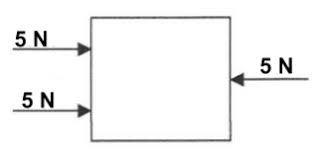
Is the Net Force balanced or Unbalanced?
Balanced
Unbalanced
What is Force?
A pull exerted on an object
A push exerted on an object
A push or pull exerted on an object
Nothing

what is the first law
F=M x A
an object in motion stays in motion, an object at rest stays at rest until acted on by an unbalanced force
an objects tendency to remain the same
for every action, there is an equal and opposite reaction
for every action there is a --- and opposite reaction
new
opposite
old
equal

Forces that do NOT cancel each other out are known as ______________ forces
balanced
unbalanced
pushed
pulled
How quickly an object accelerates would depend upon what two things
weight and mass
force and mass
motion and mass
none of these
Newton's 3rd Law deals with Action - _______________ forces
pulling
reaction
motion
inertia
When shopping, it is much easier to push the empty shopping cart than when it begins to fill up. Which law would this be an illustration of?
Newton's 1st Law
Newton's 2nd Law
Newton's 3rd Law
Magicians often use the trick of pulling a table cloth out from under a table full of dishes without moving the dishes. Which law would this be an illustration of?
Newton's 1st Law
Newton's 2nd Law
Newton's 3rd Law
We wear seat belts in cars because _________ will cause us to move forward in a crash.
mass
speed
inertia
An object in motion will stay in motion unless acted upon by ____________
a wall
friction
air resistance
all of the above

Whats Newtons First Law?
The more force applied to an object the faster it will accelerate.
An object in motion will stay in motion and an object at rest will stay at rest unless acted by an outside force.
for every ection there is an equal and oposite reaction
Newton's third law states that any action will have a(n) ___ and ___ reaction
Equal and similar
Equal and opposite
Equal and different
Greater and opposite
The amount of sliding friction depends on which things?
acceleration
type of surface
weight of the moving object
the rotundness of the man on the pogo stick


Which of these materials do you predict would have the MOST amount of friction
Metal
Tile
Sand Paper
Denim

Which type of friction is shown in the picture?
fluid
static
rolling
sliding

Which type of friction is shown in the picture?
rolling
static
fluid
sliding

Which type of friction is shown in the picture?
fluid
static
rolling
sliding
There are four types of friction. What are those four called?
sliding, rolling, static, and fluid
slipping, sliding, falling, and fluid
slipping, sliding, static, and flowing
What type of friction will you see when air or liquid slows an objects movement?
Rolling
Fluid
Static
Sliding

What type of friction will slow down the rolling soccer ball?
Fluid
Sliding
Rolling
Static

What kind of friction slows down the movement of the swimmer?
Fluid
Static
Sliding
Rolling
What is energy?
Something that takes up space.
The ability to make something move or change.
Anything that has mass.
What is potential energy?
The energy an object has due to its position or condition.
The energy an object has due to its chemical composition.
The energy an object has due to its atomic structure.
What is kinetic energy?
The energy an object has due to its motion.
The energy an object has due its chemical composition.
The energy an object has due to its atomic structure.
When does an object have NO kinetic energy?
When it's at rest.
When it's moving very slowly.
When it has no electrical charge.


Which element is this?
Nickel
Neon
Sodium
Nitrogen

Name this element.
Neon
Magnesium
Sodium
Manganese

How many valence electrons?
2
3
4
5
The equation for POWER is
power = mass x time
power = work / time
power = time / work
power = work x time
_______________ is done when a force acts on an object and the object moves in the direction of the force.
Work
Kinetic energy
Watt
Joule
________________ is the rate at which work is done.
Power
Work
Time
Energy
What is work defined as in physics?
The force that opposes motion between two touching surfaces.
The distance an object travels.
The force applied on a machine.
When a force causes an object to move in the same direction that the force is applied.
What is the mechanical advantage of a machine?
The ratio of the input work to the output work.
The ratio of the output force to the input force.
The ratio of the input force to the output work.
The ratio of the output work to the input work.
What is a simple machine?
A machine that is easy to use.
A machine that does work with only one movement.
A machine made up of several parts.
A machine that requires electricity to operate.
Which of the following is an example of an inclined plane?
Lever
Wedge
Screw
Compound machine
What is the function of a lever?
To oppose motion between surfaces.
To move objects in the same direction as the applied force.
To pivot or rotate about a point.
To wrap around a cylinder or post.
What does a wheel and axle consist of?
Two circular objects of the same size that rotate independently.
Two circular objects of different sizes that are attached and rotate together.
A grooved wheel with a rope wrapped around it.
A circular object with spokes that connect to a central point.
What is a pulley?
A circular object that rotates on a central axle.
A wheel with teeth that meshes with a chain or belt.
A grooved wheel with a rope or cable wrapped over it.
Two circular objects of different sizes that rotate independently.

When force is used to move an object across a distance, this is called...
effort
power
energy
work
If the object does not move then what is happening
nothing
work
power
no work is being done on the object
Which of the following examples has NO work being done? (Choose all that apply)
An archer stretches her bowstring.
An ant carries a leaf cutting from a tree to his colony
An athlete does push-ups on the ground
A book sits on the shelf
Which of the following shows work being done:
pushing a wall
holding a box
picking up a pencil
sitting in a chair
Which of the following would be an example of a wedge:
a knife
stairs
a skateboard
a broom
Which is not considered a simple machine?
The pump
The wheel & axle
The wedge
The screw
The pulley

An axe is an example of which simple machine?
Pulley
Inclined Plane
Wedge
Wheel and Axle
Screw

Which of these household items is an example of a screw?
Can Opener
Refrigerator
Hammer
Peanut Butter Jar

Stairs
wedge
pulley
inclined plane
wheel and axle



