Font size
 Worksheets
Physics Paper 1 Multiple Choice
Total questions: 100
Worksheet time: 2hrs 17mins
A hot drink has what type of energy store?
Kinetic Energy
Heat Energy
Thermal Energy
Nuclear Energy
A cyclist at the top of a hill has what type of energy store?
Kinetic Energy
Chemical Potential Energy
Elastic Potential Energy
Gravitational Potential Energy
Humans get their energy from has what type of energy store?
Chemical Potential Energy
Thermal Energy
Kinetic Energy
Nuclear Energy
Energy stored in an atom's nucleus is what type of energy store?
Atomic Energy
Electrostatic Energy
Nuclear Energy
Elemental Energy
Energy stored in objects being stretched or squashed...
Elastic Potential Energy
Kinetic Energy
Chemical Energy
Thermal Energy
Batteries are an example of which type of energy store?
Thermal
Magnetic
Chemical
Gravitational potential
Energy transferred by a force is a (a) transfer.
Energy transferred through wires is an example of:
Mechanical transfer
Electrical transfer
Heating
Radiation
Conduction, convection and radiation are examples of which energy transfer?
Mechanical transfer
Electrical transfer
Heating
Radiation
A ball drops to the floor and makes a sound. Which form of energy transfer is this?
Mechanical transfer
Electrical transfer
Heating
Radiation
Friction is which form of energy transfer?
Mechanical transfer
Electrical transfer
Heating
Radiation
A cyclist starts at the top of the top of a hill and rolls to the bottom of the hill. His (a) energy store decreases. His (b) energy store increases. Energy is transferred (c) .
A battery is used to power a light bulb using wires.
The (a) store of the battery decreases. The (b) store of the light bulb increases. The energy is transferred (c) .

A car engine burns petrol and turns the wheels of a car.
The (a) store of the petrol decreases when burned in an engine. The (b) store of the wheels increases. The energy is transferred (c) .
The energy in which store decreases as a candle burns?
Chemical energy store
Kinetic energy store
Nuclear energy store
The energy in which store increases as an elastic band is stretched?
Gravitational Potential
Chemical
Elastic
Kinetic
_________________ is when energy is transferred because a force moves an object through a distance.
Elastic
Mechanically
By radiation
By heating
_______________ is when energy is transferred due to charge flowing around a circuit.
Electrically
Kinetic
Mechanically
By radiation
________ is when energy is transferred between areas that have different temperatures.
By radiation
By heating
Mechanically
Nuclear
When you eat fruits and vegetables, the energy is stored as ...
a. thermal energy
b. food energy
c. electrical energy
d. chemical energy


Food, fuels and batteries have energy in this energy store
Chemical
Thermal
Gravitational Potential
Elastic

A stretched rubber band has energy in this energy store
Magnetic
Electrostatic
Elastic
Nuclear

Two negatively charged particles which are close together have energy in this energy store
Electrostatic
Magnetic
Nuclear
Elastic

Energy which is transferred by a force moving an object through a distance
Mechanically
Electrically
By Radiation
By Heating

Energy which is transferred by charges moving due to a potential difference (voltage)
Mechanically
Electrically
By Radiation
By Heating

Shooting an arrow from a bow converts ____ into kinetic energy.
Elastic potential energy
Chemical energy
Gravitational potential energy
Thermal energy
A ____ converts chemical energy into kinetic energy?


What is the Kinetic Energy of a 150 kg object that is moving with a speed of 15 m/s?
(a)
An object has a kinetic energy of 25 J and a mass of 34 kg , how fast is the object moving?
(a)
An object moving with a speed of 35 m/s and has a kinetic energy of 1500 J, what is the mass of the object.
(a)
What is the Kinetic Energy of a 1200 kg object that is moving with a speed of 24 m/s?
(a)
An object has a kinetic energy of 14 J and a mass of 17 kg , how fast is the object moving?
(a)

You serve a volleyball with a mass of 2.1 kg. The ball leaves your hand with a speed of 30 m/s. The ball has (a) energy. Calculate it.

A cinder block is sitting on a platform 20 m high. It weighs 7.9 kg.
If the block fell of the platform, calculate its velocity just before it hit the ground.
(a)
A baby carriage is sitting at the top of a hill that is 21 m high. The carriage with the baby has a mass of 1.5 kg. The carriage has (a) energy. Calculate it.
A cart is loaded with a brick and pulled at constant speed along an inclined plane to the height of a seat-top. If the mass of the loaded cart is 3.0 kg and the height of the seat top is 0.45 meters, then what is the potential energy of the loaded cart at the height of the seat-top?
(a)
The potential energy of a 40 kg cannon ball is 14000 J. How high was the cannon ball to have this much potential energy?
(a)
What is the unit of measurement for resistance?
Voltage
Ampere
Watts
Ohms
What happens to resistance when the length of the wire increases?
Stays the same
Increases
Decreases
How do you calculate resistance?
Current x Voltage
Voltage x Power
Voltage ÷ Current
Current ÷ Voltage

What effect does a hotter temperature have on resistance?
No effect
Increases resistance
Decreases resistance
Stays the same
What other factor of a wire could affect its resistance?
Material its made of
How shiny it is
Colour
How do you calculate current from voltage and resistance?
Current = voltage x resistance
Current = resistance x power
Current = voltage ÷ resistance
Current = resistance ÷ voltage
How much charge flows through a wire in 80s if the current is a constant 5.4A?
432C
360C
524C
344C
Calculate the power rating of an electric toaster that uses 210 000 J while toasting bread for 140 s
1500 J
1200 W
1500 W
1300 J
A heater uses 10J of electric energy in one second. How many watts of power does this heater consume in 5 seconds?
What is the energy transferred when a 2000 C of charge pass through a 230 V kettle?
460 000 J
8.7 J
2 230 J
2000 J
A kettle uses 100J of electrical energy to produce 7J of sound energy and 93J of thermal energy. How efficient is the kettle?
100%
7%
93%
95%
A hairdryer uses 300J of energy to produce 60J of sound energy and 240J of thermal energy. Calculate it's efficiency.
80%
90%
20%
100%

How much energy is wasted as sound?
350J
450J
250J
550J

How much energy is wasted as thermal energy
24
16
14
12

What is the efficiency?
2%
20%
5%
15%
Which of the following shows current travelling in only one direction?


Where should an ammeter be located to correctly measure the TOTAL current?
Position 1
Position 2
Position 3
Position 4
Where should an voltmeter be positioned to correctly measure the TOTAL voltage?
Position 1
Position 2
Position 3
Position 4
Where should an voltmeter be positioned to correctly measure the voltage across a wire? (the wire is shown as a zigzag line)
Position 1
Position 2
Position 3
Position 4
As the length of a wire increases, the resistance of the wire will
increase
decrease
stay the same
As the diameter of a wire increases, the resistance of the wire will
increase
decrease
stay the same
Match the following wires to the correct color and potential
0 V - Blue wire
Neutral
0 V - Green wire
Earth
230 V - Brown wire
Live
Label the wires
Which of the three wires is safe and appropriate to touch?
Live
Neutral
Earth
None. you should never poke at electrical sockets.
What is the independent variable
Anything that can change
The thing you change
The thing you measure at the end
The thing you keep the same
What is the dependent variable
Anything that can change
The thing you change
The thing you measure at the end
The thing you keep the same
What is a control variable
Anything that can change
The thing you change
The thing you measure at the end
The thing you keep the same
How can we reduce the problem of thermal energy passing on to the beaker and into the air?
By using an insulator with a higher thermal conductivity
By using an insulator with a lower thermal conductivity
By using a larger beaker
By using a smaller beaker
If you don't have a joulemeter, how do you find the energy in the circuit?
E = power/time
E = current x voltage
E = power x time
E = current x time
The specific heat of platinum is 0.133 J/g°C. How much heat(Q) is released when a 10 g piece of platinum cools from 100°C to 50°C?
66.5 J
665 J
0.0266 J
0.665 J

What would heat up the fastest if left out in the sunlight on a clear, summer day?
Liquid Water
Dry Air
Lead
Granite

Object A, it has a lower specific heat
Object B, it has a lower specific heat
Object A, it has a higher specific heat
Object B, it has a higher specific heat

2 kg of glass at a temperature of 20°C is given 84 000 J. What is the final temperature?
+50°C
-50°C
-30°C
70°C
20°C

What state is the matter between C and D
Solid
Liquid
Gas
Plasma
Not enough information to say

What state is the matter in at E?
Solid
Liquid
Gas
Plasma
Not enough information to say

What does section C show?
Melting
Boiling
Condensing
Freezing
None of these options
How much energy is needed to raise the temperature of 5.0 grams of lead from 25°C to 35°C? [specific heat (c) = 0.129 J/(g•°C)]
6.45 J/(g•°C)
6.45 J
16.1 J/(g•°C)
d.16.1 J
How much energy is needed to raise the temperature of 5.0 grams of lead from 25°C to 35°C? [specific heat (c) = 0.129 J/(g•°C)]
6.45 J/(g•°C)
6.45 J
16.1 J/(g•°C)
d.16.1 J
The heat absorbed by melting a solid is known as
latent heat of fusion
latent heat of solid
latent heat of liquid
latent heat of vaporisation
How much energy is required to change 5 kg of ice at 0 ° C into water at the same temperature? (latent heat of fusion is 3.36 X 10⁶ J/kg )
16.1 XundefinedJ
16.8 XundefinedJ
15.1 Xundefinedcal
16.8 Xundefinedcal
How much energy is required to melt down a 2000 g of mercury?(latent heat of fusion is 1.14 x 10⁴ J/kg)
2.55 x undefinedJ
2.28 x undefinedJ
2,280 x undefinedJ
3.28 x undefinedJ
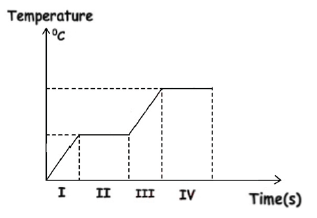
Consider the following temperature-time graph when a solid is heated. which part of the graph involves latent heat of vaporization?
Part I
Part II
Part III
Part IV
Who said: Atomic model was solid, and stated all atoms differ in size, shape, mass, position and arrangement, with a void exists between them.
Democritus
Thompson
Bohr
Rutherford
Who said: Atoms are small and indivisible.
Democritus
Dalton
Thompson
Rutherford
What is golden foil experiment about?
Electrons are bombarding a golden foil and some of them go through, but others are scattered.
Protons are bombarding a golden foil and some of them go through, but others are scattered.
Alpha particles are bombarding a golden foil and some of them go through, but others are scattered.
Beta particles are bombarding a golden foil and some of them go through, but others are scattered.
What was discovered by golden foil experiment?
Atom is like a plum pudding where pudding is the positive particle and plums are the electrons
Electron are orbiting around the nucleus
Electrons are on different energy levels
Atom is empty, and it has a positive nucleus
What is wrong in planetary model?
If electrons loose energy, they would fall on the nucleus but they don's
We can't say where electrons will be in different time like we can predict the position of the planets
Electrons are orbiting around the nucleus.
Identify each model by the scientist who theorized it

Thomson

Rutherford

Bohr
Whose model of an atom would be described as a solid sphere?
Thomson
Rutherford
Dalton
Bohr
Which scientist was the first to provide evidence that atoms contained subatomic particles?
Schrodinger
Dalton
Thomson
Rutherford
Which of the following statements about Bohr's model of the atom is NOT true?
The exact orbital path of an electron is not known.
Electrons are found in fixed circular orbits.
The model can be compared to planets revolving around the sun.
Electrons orbit the nucleus.