
 Worksheets
Key Stage 3 PE year 8 Summer Assessment
Total questions: 68
Worksheet time: 39mins
What are the 5 key components of a warm up? 1. Pulse raiser 2. Mobility 3. Stretching 4. Dynamic movements 5. Skill rehearsal. The component of a warm up that involves practicing common skills used in the activity is called:
Skill rehearsal
Pulse raiser
Mobility
Stretching
Which of the following is an example of a pulse raiser?
Arm swings
Jogging
Dribbling drills
Shuttle runs
Exercises that take the joints through their full movement, such as arm swings and hip circles, are called ________.
Mobility
Strength
Endurance
Flexibility
Dynamic movements in a warm up show a change of speed and direction, such as shuttle runs.
True
False
The benefit of a warm up that involves raising your body temperature by heating up your muscles is:
Increased risk of injury
Improved muscle flexibility and performance
Decreased blood flow to muscles
Slower reaction time
Which of the following is NOT a benefit of a warm up?
Enhances muscle performance
Boosts heart function
Increases risk of injury
Improves load distribution in joints
What are the two key components of a cool down? The aim of low intensity exercises in a cool down is to gradually lower the ________ and reduce body temperature.
heart rate
blood pressure
muscle mass
oxygen level
A cool down is important because:
It helps the body recover after exercise.
It increases the risk of injury.
It makes you tired.
It decreases flexibility.
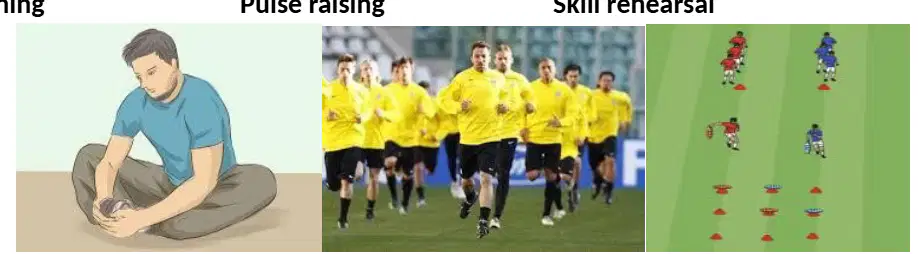
Match the following warm up components to their examples:
Pulse raiser
Jogging
Mobility
Arm swings
Stretching
Touching your toes
Dynamic movements
Shuttle runs
Skill rehearsal
Dribbling drills
What is the definition of Aerobic Endurance?
The ability to work the whole body for a long period of time without tiring.
The ability to repeat muscle contractions over a long time without tiring.
The amount of force a muscle can exert against a resistance.
The time taken to perform a particular action or cover a particular distance.
What is the definition of Muscular Endurance?
The ability to work the whole body for a long period of time without tiring.
The ability to repeat muscle contractions over a long time without tiring.
The amount of force a muscle can exert against a resistance.
The time taken to perform a particular action or cover a particular distance.
What is the definition of Strength?
The ability to work the whole body for a long period of time without tiring.
The ability to repeat muscle contractions over a long time without tiring.
The amount of force a muscle can exert against a resistance.
The time taken to perform a particular action or cover a particular distance.
What is the definition of Speed?
The ability to work the whole body for a long period of time without tiring.
The ability to repeat muscle contractions over a long time without tiring.
The amount of force a muscle can exert against a resistance.
The time taken to perform a particular action or cover a particular distance.
What is the definition of Flexibility?
The range of movement possible at a joint.
The percentages of fat, bone, water and muscle in human bodies.
The ability to use two or more body parts together.
The ability to change direction quickly.
What is the definition of Body Composition?
The range of movement possible at a joint.
The percentages of fat, bone, water and muscle in human bodies.
The ability to use two or more body parts together.
The ability to change direction quickly.
What is the definition of Balance?
The ability to maintain a position or posture without falling over.
The ability to use two or more body parts together.
The time taken to respond to a stimulus.
The ability to change direction quickly.
What is the definition of Co-ordination?
The ability to maintain a position or posture without falling over.
The ability to use two or more body parts together.
The time taken to respond to a stimulus.
The ability to change direction quickly.
What is the definition of Reaction time?
The ability to maintain a position or posture without falling over.
The ability to use two or more body parts together.
The time taken to respond to a stimulus.
The ability to change direction quickly.
What is the definition of Agility?
The ability to maintain a position or posture without falling over.
The ability to use two or more body parts together.
The time taken to respond to a stimulus.
The ability to change direction quickly.
What is the definition of Power?
The ability to maintain a position or posture without falling over.
The ability to use two or more body parts together.
The time taken to respond to a stimulus.
The ability to perform strength actions quickly.
Match the Component of Fitness with its Example in Sport:
Aerobic Endurance
Having good aerobic endurance fitness is important for a rugby player to play the full rugby match
Muscular endurance
Muscular endurance is important for a marathon runner so that his muscles don’t tire quickly when running
Strength
A shot putter will need to have good strength to throw the shotput
Speed
A sprinter will need good speed within a 100 m race
Flexibility
A gymnast would need good flexibility in order to perform the splits
What is a balanced diet?
A diet that excludes all carbohydrates
A diet that provides the body with all the essential nutrients in the correct proportions to maintain health and support physical activity
A diet that only includes proteins and fats
A diet that avoids all vitamins
A balanced diet includes appropriate amounts of carbohydrates, proteins, fats, vitamins, minerals, fibre, and _____
water
sugar
caffeine
salt
Name one of the 7 essential nutrients mentioned in the worksheet.
Carbohydrates
Plastic
Sand
Glass
What is the primary energy source for the body?
Carbohydrates
Proteins
Fats
Vitamins
Which of the following is a source of protein?
Bread
Eggs
Potatoes
Butter
Fats (Lipids) provide energy, insulation, and protection of organs.
True
False
Which nutrient supports various bodily functions, including immune response and bone health?
Vitamins
Carbohydrates
Fats
Sugars
Name one source of minerals mentioned in the worksheet.
Meat, dairy, leafy greens, or nuts
Sugar, salt, and oil
Soft drinks and candy
Processed white bread
Fibre aids digestion and prevents ________.
constipation
headache
fever
cough
Water helps maintain hydration, regulate body temperature, and facilitate bodily functions.
True
False
A deficiency in Vitamin C can cause which disease?
Scurvy
Rickets
Beriberi
Pellagra
What can a deficiency in Vitamin D lead to?
Rickets
Scurvy
Night blindness
Goitre
Malnutrition includes both undernutrition and overnutrition.
True
False
What can overnutrition result in?
Obesity and associated health problems
Malnutrition and stunted growth
Increased immunity to diseases
Improved athletic performance
What does the Eatwell Guide emphasize?
The importance of consuming a variety of foods in the right proportions for a balanced diet.
The elimination of all carbohydrates from the diet.
Eating only one type of food group for optimal health.
Focusing solely on high-protein foods for every meal.
How many players can be on the field at once in a rounders team?
Up to 9 players
Up to 7 players
Up to 11 players
Up to 5 players
In rounders, each batter gets one good ball to hit. Must they run if they hit the ball?
True
False
In rounders, what does a 'full rounder' mean?
Reaching the 4th post without being out.
Catching the ball before it hits the ground.
Hitting the ball out of the playing field.
Running to the 2nd post and back.
What does a 'half rounder' mean in rounders?
Reach 2nd post on a good hit, or 4th post on no-ball.
Score a full rounder by reaching 4th post on a good hit.
Catch the ball before it touches the ground.
Miss the ball three times in a row.
Name one way a player can be out in rounders.
Caught out, stumped at a post, miss three good balls, run outside posts, overtaking another batter.
Score a home run, miss all the balls, stand still at the post, hit the ball out of the field
Which of the following is NOT a skill in batting?
Grip the bat correctly
Stand sideways
Throwing (accurate and fast)
Swing with control
Select the correct technique for fielding in rounders.
Standing still and waiting for the ball
Using two hands to catch the ball and throwing quickly to the base
Kicking the ball to a teammate
Ignoring the ball if it is rolling
Bowling in rounders should be underarm, with a smooth action, and the ball should reach the batter between which two body parts?
Between head and knees.
Between feet and waist.
Between shoulders and ankles.
Between elbows and hips.
Which of the following is a tactic in rounders?
Swing with control
Quick fielding and teamwork to stump batters
Underarm bowling
Stand sideways
What is the distance for a middle distance running event in athletics?
800m, 1500m
100m, 200m
5000m, 10000m
42.195km
Which event requires baton passing and teamwork?
Relays – 4x100m, 4x400m
Long Jump
Shot Put
High Jump
In high jump, which of the following techniques are mentioned?
Fosbury Flop and Scissors
Straddle and Backstroke
Butterfly and Crawl
Layup and Dunk
Which throwing event requires the athlete to rotate their body and release at shoulder height?
Discus
Javelin
Shot Put
Hammer Throw
Shot put requires which of the following?
Over-the-shoulder technique
Power, push not throw
Baton passing
Explosive start
What is the primary function of carbohydrates in the body?
To provide energy
To build and repair tissues
To regulate body temperature
To insulate and protect organs
Which of the following is a key component of a balanced diet?
High sugar intake
Variety of nutrients
Excessive protein consumption
Elimination of fats
What is the definition of Flexibility?
The time taken to respond to a stimulus.
The ability to move joints through their full range of motion.
The ability to change direction quickly.
The ability to maintain a position or posture without falling over.
Which of the following is a benefit of regular physical activity?
Increased risk of chronic diseases
Improved cardiovascular health
Decreased muscle strength
Reduced flexibility
Which nutrient is essential for muscle repair and growth?
Proteins
Vitamins
Carbohydrates
Fats
What is the primary function of proteins in the body?
To regulate body temperature
To insulate and protect organs
To provide energy
To build and repair tissues
Which of the following is a key component of flexibility training?
Long-distance running
Weight lifting
Static stretching
High-intensity interval training
What is the definition of Coordination?
The time taken to respond to a stimulus.
The ability to use two or more body parts together.
The ability to maintain a position or posture without falling over.
The ability to change direction quickly.
What is the primary function of carbohydrates in the body?
To regulate body temperature
To insulate and protect organs
To provide energy
To build and repair tissues
Which of the following is a benefit of regular physical activity?
Improved cardiovascular health
Increased risk of chronic diseases
Reduced bone density
Decreased muscle mass
What is the definition of Muscular Strength?
The time taken to respond to a stimulus.
The ability to change direction quickly.
The amount of force a muscle can exert against a resistance.
The ability to work the whole body for a long period of time without tiring.
Which of the following is a benefit of regular physical activity?
Increased risk of chronic diseases
Reduced energy levels
Improved cardiovascular health
Decreased muscle strength
What is the primary function of carbohydrates in the diet?
To build muscle mass
To store vitamins
To provide energy
To regulate body temperature
Which nutrient is essential for the repair and growth of body tissues?
Vitamins
Proteins
Carbohydrates
Fats
What is the primary function of carbohydrates in the body?
To provide energy
To improve flexibility
To build muscle mass
To insulate the body
Which vitamin is essential for calcium absorption in the body?
Vitamin A
Vitamin C
Vitamin B
Vitamin D
In rounders, what is the role of the backstop?
To bowl the ball
To catch the ball behind the batter
To run between posts
To hit the ball
Which of the following is an example of a flexibility exercise?
Weightlifting
Running
Swimming
Yoga

