
 Worksheets
Massive 6th Grade Science Review
Total questions: 106
Worksheet time: 2hrs 20mins
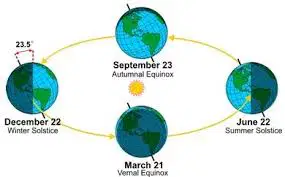
According to the Image, What season starts in the Northern Hemisphere on June 22nd
Summer
Winter
Autumn
Spring
Why do we experience different seasons on Earth?
Because of the Earth's rotation on its axis
Due to the Earth's revolution around the Sun
Because of the tilt of the Earth's axis as it revolves around the Sun
The distance between the Earth and the Sun changes
What type of reaction occurs at the core of the Sun?
Thermo Nuclear fusion
Electrolysis
Acid Base Reaction
Combustion
What is the main source of energy for Earth?
Sun
Moon
Water
Wind
What is solar radiation?
The process of storing sunlight in batteries
The process of converting electricity into sunlight
Energy emitted by the sun in the form of electromagnetic waves.
The process of converting sunlight into electricity
How does solar radiation contribute to the Earth's climate?
Solar radiation warms the Earth's surface and influences its climate.
Solar radiation only affects the climate of other planets.
Solar radiation cools the Earth's surface and influences its climate.
Solar radiation has no impact on the Earth's climate.
The heat Energy Stored in the earth's interior is called
Hydrothermal Energy
Geochemical Energy
Geothermal Energy
Kinetic energy
What is the order of the planets in our solar system?
Earth, Venus, Uranus, Mercury, Saturn, Mars, Neptune, Jupiter
Mercury, Venus, Earth, Mars, Jupiter, Saturn, Uranus, Neptune
Earth's moon, the Sun, Mars, Neptune, Venus
None of the above

At what angle is Earth tilted on the axis?
23 degrees
40 degrees
80 degrees
92 degrees

What is the name of the moon phase that occurs when we do not see a moon at all?
Crescent moon
full moon
Gibbous
New Moon
What causes the moon to light up?
The moon is always lit
The sun
It lights up at night
none of the above
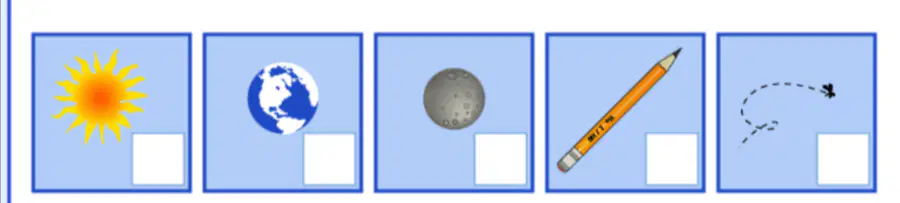
Which of these objects exerts a gravitational pull? (Click all that apply.)
The Sun
The Earth
The Moon
Your pencil
A fly
How does increasing mass and distance affect the gravity between two objects?

Jupiter has more mass
Jupiter has less mass
Every planet has its own gravity number
Jupiter is more dense

If Object #2 is the Sun, then Object #1 is a (a) . Arrow #3 represents (b) and Arrow #4 represents (c) .

What two things are wrong about this model of the solar system?
The planets are too big
The planets are too close together
The planets are out of order
The Sun is too big

Milo and Rue were discussing how scientists have changed their model of our solar system over time. It has transitioned from
a Sun-centered to a Moon-centered model
a Sun-centered to an Earth-centered model
an Earth-centered to a Sun-centered model
a Moon-centered to an Earth-centered model
During a classroom discussion, Oakland asked why people historically believed in the geocentric theory. What is the most important reason that people thought that the geocentric theory was correct?
They saw the sun rising and setting each day.
They saw lunar eclipses.
They saw the moon rotating around Earth.
They saw solar eclipses.

What are the unique properties that make Earth one of a kind in our solar system?
Presence of water and life
Rings like Saturn
Closest to the Sun
Largest planet
Why is Earth's location in the solar system ideal for supporting life?
It is very close to the Sun, making it extremely hot.
It is located at a moderate distance from the Sun, allowing water to exist in all three states.
It is farthest from the Sun, making it very cold.
It is the smallest planet in the solar system.
Why is Earth's size important for sustaining life?
It allows Earth to have a suitable atmosphere and gravitational pull.
It makes Earth visible from space.
It allows Earth to support only aquatic life.
It makes Earth the largest planet in the solar system.
What does Earth provide to help protect us from skin cancer?
The moon
Ozone layer
Trees
Rivers
What is the primary gas in Earth's atmosphere?
Oxygen
Carbon dioxide
Nitrogen
Argon
What percentage of Earth's atmosphere is oxygen?
78%
21%
Less than 1%
50%
What is the function of Earth's magnetosphere?
It generates the Earth's gravity.
It protects the atmosphere from solar winds.
It controls the Earth's rotation.
It produces light for the Earth.
Why is water essential for life on Earth?
It helps in transportation.
Life could not exist without it.
It is used for cooking.
It is a fuel source.
What percentage of Earth's water is available to drink as fresh water?
A) 71%
B) 1%
C) 10%
D) 50%
What is the process called that continuously recycles water through the Earth System?
A) The Water Cycle
B) The Carbon Cycle
C) The Nitrogen Cycle
D) The Oxygen Cycle
What does Earth use to protect us from harmful UV rays?
The moon
The ozone layer
Clouds
Trees
Surface tension is the property of water in which...
water molecules at the surface tend to stick together.
water spills easily.
water tends to be see-through.
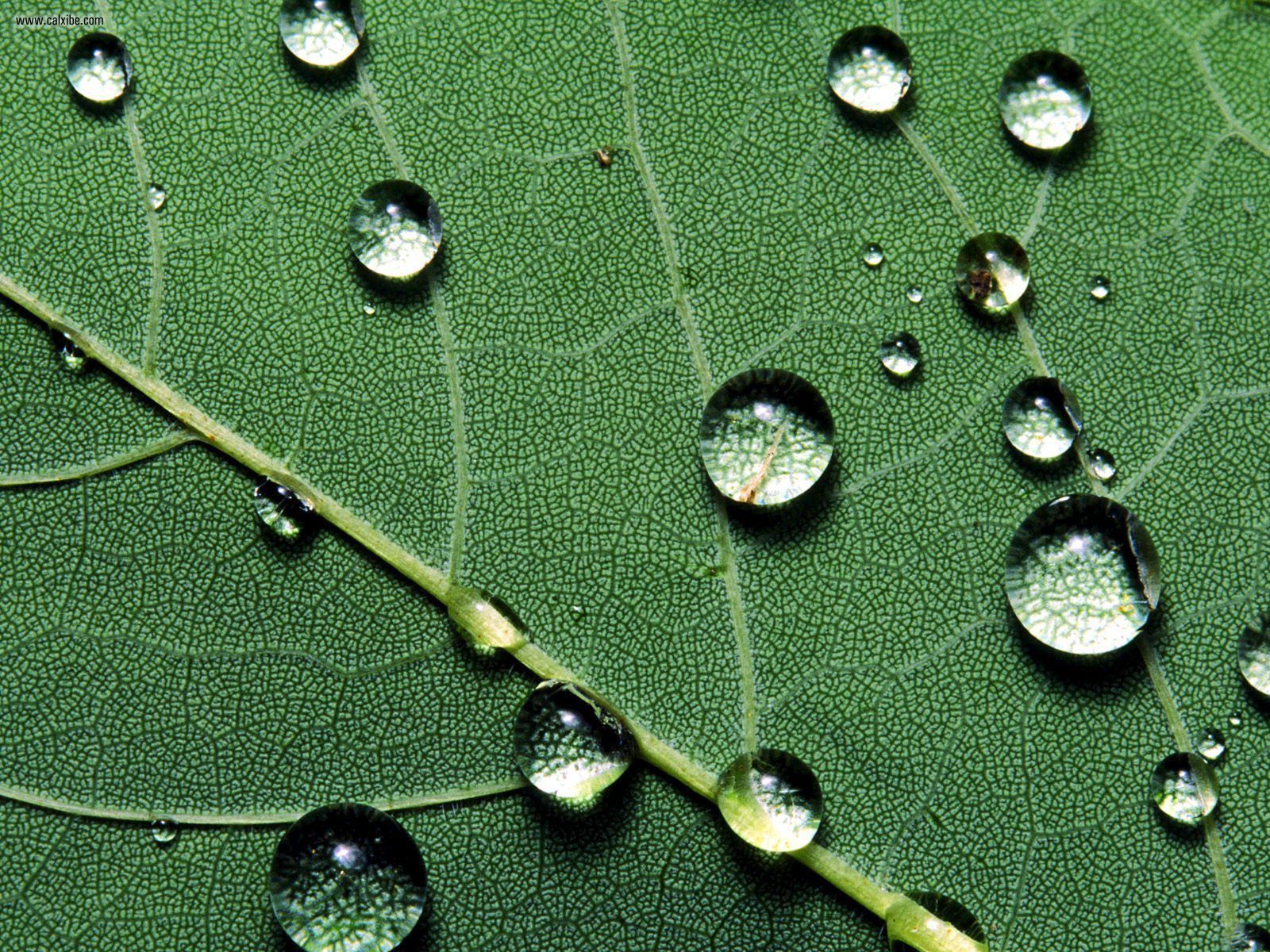
Refer to the picture of water sticking to a leaf; this is occurring because of:
Adhesion
Cohesion
Describe COHESION.
Water molecules attracted to other substances.
Water molecules climbing upwards against the force of gravity.
Water molecules dissolving many substances because of its polarity.
Water molecules attracted to other water molecules.

Earth’s atmosphere is composed of different gases in different amounts. The table shows the relative amounts of gases present in Earth’s atmosphere. Which graph most accurately represents the data given in the table?


In which atmospheric layer does all weather occur?
exosphere
stratosphere
thermosphere
troposphere

A student uses pieces of cardboard and rods to make a model of the layers of Earth’s atmosphere and labels the layers W, X, Y, and Z. In which layer of the model would most of the weather on Earth likely occur?
Layer W
Layer X
Layer Y
Layer Z
How does the ozone layer help life on Earth?
It produces oxygen for the atmosphere.
It protects Earth from meteors.
It absorbs damaging ultraviolet radiation from the Sun.
It reflects most of the Sun's radiation to keep the planet cool.
When a person climbs a mountain, what happens to the air pressure around him?
It decreases.
It increases.
It remains constant.
It decreases, then increases.

A student collects information about the order of different layers of the atmosphere and makes a model, as shown. The student wants to add a weather system to the model. To which layer should the student add the weather system?
mesosphere
stratosphere
thermosphere
troposphere
What is the hottest layer of the atmosphere due to the absorption of the sun's rays?
Mesosphere
exosphere
thermosphere
stratosphere
Which of the following can be found in the exosphere?
meteoroids
treetops
weather
satellites
Put the layers of the atmosphere in order. (1 being closest to the earth)
troposphere
stratosphere
mesosphere
thermosphere
exosphere
The process by which molecules of liquid water escape into the air after becoming water vapor is called
evaporation
condensation
humidity
How is weather different than climate?
weather is long term patterns
weather is short terms patterns
weather tells you the clothes you should buy for different seasons
What fuels a hurricane's strength?
Wind
Warm Water
Sunlight
Cold Water


What causes the moon's phases to change as we view them from Earth?
As the moon revolves around the Earth, we see different amounts of reflected sunlight.
As Earth revolves around the moon, we see different amounts of reflected sunlight.
As the moon's orbit speed increases and decreases, we see different amounts of reflected sunlight.
True or False: In space, half of the moon is always lit and the other half is dark.
True
False
When the moon is completely illuminated (filled with light)
When light on the moon is increasing
The side of the moon that is facing the Earth
When light on the moon is decreasing


Use the calendar to predict the moon phase on March 9th.
New Moon
Full Moon
Third Quarter
First Quarter

Which major watershed is the northern part of Virginia a part of?
Mississippi River Watershed
Chesapeake Bay Watershed
North Carolina Sound Watershed
The process where water or irrigation runs over land and seeps into the ground, or flows into streams or oceans.
water cycle
runoff
precipitation
evaporation
All water below the surface of land is called__________.
water table
watershed
groundwater
runoff


Which watershed is Prince William County located in?
Mississippi River Watershed
Potomac River Watershed
Shenandoah River Watershed
James River Watershed
Which statement is true regarding the Chesapeake Bay Watershed?
Pollution from New Jersey contaminates the Atlantic Ocean
Citizens from other states send trash to Virginia
Pollution from 6 states can end up in the Chesapeake Bay watershed
Steams start in Pennsylvania and end up in Virginia
Oxygen, Sunlight, Temperature and Soil are all considered _________
Abiotic Factors
Biotic Factors
organisms in comparison to the open ocean?
There are more nutrients and food available in estuaries.
There are two main causes for the ecological problems in the bay. (check only two)
People are not using the Bay enough.
People are putting too many pollutants into the Bay.
People are “overharvesting” or taking too much seafood out of the Bay.
People are not eating enough seafood from the Bay.

What is wrong with too much algae in the Bay?
Many boaters complain they can't see the fish for food.
It is making the Bay unpleasant to look at.
It clouds the water and keeps light from reaching the grass. Causing the grass to die

What amount of incoming solar energy is absorbed by Earth's surface?
23%
51%
49%
15%

How much solar energy is radiated directly to space from Earth? (Hint! look at RED arrows)
64%
6%
4%
What is the greenhouse effect?
The process by which the sun affects houses and they turn green
the process by which gases in the atmosphere absorb and give off infrared radiation. Essentially, it's how the Earth stays warm

Look at the data table. Which graph below best represents the most abundant elements in the Earth's crust?


The Earth's crust is made up of mainly what two elements?
Oxygen and Nitrogen
Oxygen and Silicon
Oxygen and Carbon
Oxygen and Hydrogen
Which four elements make up most living things?
oxygen, carbon, hydrogen, nitrogen
silicon, calcium, oxygen, aluminum
chlorine, sodium, hydrogen, oxygen
sulfur, phosphorous, calcium, nitrogen

Which pie chart MOST accurately reflects the information in the table?


Which of the following is a renewable energy source?
Coal energy
Solar energy
Wind energy
Gasoline
Why is it important to try to use as many renewable resources as possible?
To save money
To reduce pollution
To support the fossil fuel industry
To increase energy consumption
Which energy source is not renewable?
Wind energy
Coal energy
Solar energy
Renewable Energy Resources: (a) (b) (c) (d) (e)
Coal is an example of a nonrenewable energy source because
it is easily replenished in a short period of time.
it can be replaced naturally and can be used again and again.
it take millions of years to form and once they used, we can not replace them.
Identify each example of a nonrenewable energy source.
Petroleum
Biomass
Natural Gas
Geothermal
Coal

