wayground logo

Free Printable Worksheets

Font size

S
M
L
XL
Worksheets

Funk Bio Review Spring 2025

Total questions: 86

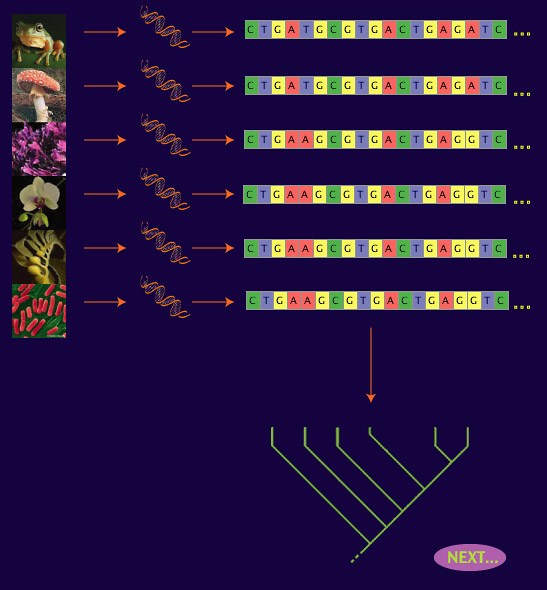
Worksheet time: 1hrs 22mins

Name
Class
Date
1.
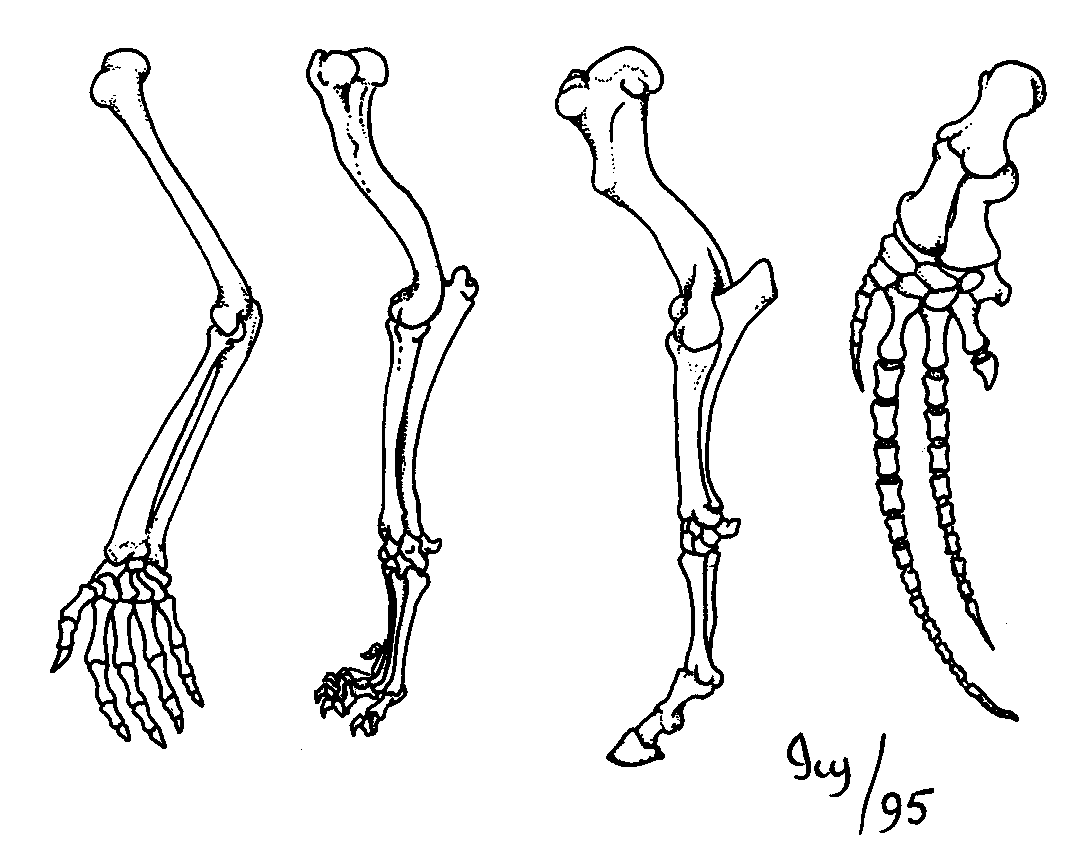
What type of structures are these?
a)
homologous
b)
vestigial 
c)
analogous
d)
fossil
2.
Which layer is oldest?
a)
A
b)
W
c)
G
d)
Z
3.

Many different groups of organisms have wings, even though they do not share a recent common ancestor. This is because they evolved in environments with similar selective pressures. Wings are an example of a(n) ______________ structure.

a)

vestigial

b)

analogous

c)

homologous

4.
The diagram shows fossils in different rock layers. Which of these statements about the age of these fossils is most likely correct?
a)
Fossil A and C are the same age
b)
Fossil B is older than fossil C
c)
Fossils A is older than fossil B
d)
Fossil D is older than fossil C
5.
Survival of the Fittest and Evolution were proposed by what scientist?
a)
Charles Darwin
b)
Albert Einstein
c)
Steven Hawking
d)
Isaac Newton
6.

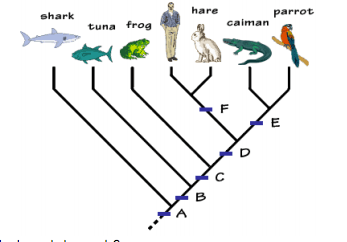
According to the diagram, crocodiles evolved from dinosaurs and birds.

a)

True

b)

False

7.
Comparing human hemoglobin of chimpanzees, horses, kangaroos, and chickens, reveal that humans have the fewest amino acid differences with 
a)
Kangaroos
b)
Horses
c)
chickens
d)
chimpanzees
8.
On the cladogram, which organism is the closest relative of the human?
a)
Frog
b)
Hare
c)
Caiman
d)
Parrot
9.
Which rock layer in the diagram seems to be the oldest?
a)
F
b)
E
c)
B
d)
A
10.
Two organisms that are closely related would have
a)
very similar DNA sequence
b)
exactly the same DNA sequences
c)
no proteins in common
d)
completely different DNA sequence
11.
What are the monomers (building blocks) of CARBOHYDRATES?
a)

Monosaccharides/Glucose (simple sugars)

b)
Amino Acids
c)
Nucleotides
d)
Triglycerides/No true monomer
12.
What are the monomers (building blocks) of PROTEINS?
a)
Monosaccharides (simple sugars)
b)
Amino Acids
c)
Nucleotides
d)
Triglycerides/No true monomer
13.
What are the monomers (building blocks) of NUCLEIC ACIDS?
a)
Monosaccharides (simple sugars)
b)
Amino Acids
c)
Nucleotides
d)
Triglycerides/No true monomer
14.
What are the monomers (building blocks) of LIPIDS?
a)
Monosaccharides (simple sugars)
b)
Amino Acids
c)
Nucleotides
d)

Triglycerides(made of 3 fatty acids)/No true monomer

15.
What is the primary function of CARBOHYDRATES?
a)
Source of energy
b)
Long term storage of energy
c)
Transmitting genetic information
d)
Cell processes and cell signaling
16.
What is the primary function of PROTEINS?
a)
Source of energy
b)
Long term storage of energy
c)
Transmitting genetic information
d)
Cell processes and cell signaling
17.
What is the primary function of LIPIDS?
a)
Source of energy
b)
Long term storage of energy
c)
Transmitting genetic information
d)
Cell processes and cell signaling
18.
What is the primary function of NUCLEIC ACIDS?
a)
Source of energy
b)
Long term storage of energy
c)
Transmitting genetic information
d)
Cell processes and cell signaling
19.
Examples of which biological macromolecule include glucose, fructose, starch, and glycogen?
a)
Lipids
b)
Carbohydrates
c)
Nucleic Acids
d)
Proteins
20.
The brain or "control center" of the cell. 
a)
Mitochondria
b)
Cell Membrane
c)
Cytoplasm
d)
Nucleus
21.

What is the function of a chloroplast?

a)

makes proteins for animal cells

b)

allows materials in and out of the cell

c)

provides structure and support

d)

absorbs sunlight for photosynthesis

22.

If many of the ribosomes of a cell were destroyed, what effect would this most likely have on the cell?

a)

The cell would not be able to create energy.

b)

The cell would not be able to make proteins.

c)

The cell would not e able to photosynthesize.

d)

The cell would not be able to break down waste in the cell.

23.

True or False. Plant cells have Chloroplasts AND Mitochondria.

a)

True.

b)

False

24.

Mitochondria

a)

creates energy (ATP) from food; site of cellular respiration

b)

stores food, water, or wastes with the cell; plant cells have a special vacuole

c)

uses enzymes to digest bacteria, viruses, and old organelles (old cell parts are recycled)

d)

create special structures called spindle fibers that are used in cell division

25.
Robert Hooke, Anton van Leeuwenhoek, Theodor Schwann, Rudolf Virchow, and Matthias Schliden were all responsible for what theory?
a)
The Theory of Gravity
b)
The Theory of Relativity
c)
The Cell Theory
d)
The Theory of Continental Drift
26.

What is the function of the cell membrane?

a)

To control what comes in and out of the cell

b)

To break down food inside the cell

c)

to serve as a barrier

d)

to eat the cells food

27.
Passive transport is called "passive" because it occurs WITHOUT
a)
cause.
b)
energy.
c)
a concentration gradient.
d)
a cell wall.
28.
Osmosis is the diffusion of _____ across a membrane
a)
glucose
b)
NaCl
c)
proteins
d)
water
29.

When the concentration of solutes on both sides of a membrane is the SAME, the solution is

a)
isotonic
b)
hypertonic
c)
hypotonic
30.
What will happen to this cell?
a)
It will shrink and shrivel up
b)
It will swell and get bigger
c)
Nothing will happen
31.
Water will move?
a)
Into the cell
b)
Out of the cell
c)
Neither into or out of the cell
32.

Which of the following is produced by the process of photosynthesis?

a)

Water

b)

Oxygen

c)

Starch

d)

Carbon dioxide

33.
What is the purpose of cell respiration?
a)
produce glucose
b)
make oxygen
c)
remove carbon dioxide 
d)
produce usable energy - ATP
34.
What are the products of cellular respiration?
a)
Energy (ATP), Water, and Carbon DIoxide.
b)
Water and Oxygen
c)
Oxygen and Carbon Dioxide
d)
Water and Energy (ATP)
35.

Which of the following chemical equations properly demonstrates Cellular Respiration? Choose the BEST answer.

a)

C6H12O6 + O2 --> H2O + CO2

b)

H2O + CO2 -> C6H12O6 + O2

c)

C6H12O6 + 6 O2 -> 6 H2O + 6 CO2

d)

6 H2O + 6 CO2 -> C6H12O6 + 6 O2

36.

What are reactants of cell respiration?

a)

Glucose and Oxygen

b)

Glucose and Carbon Dioxide

c)

Carbon Dioxide and water

d)

ATP and Water

37.
The longest phase of the cell cycle 
a)
prophase
b)
interphase
c)
metaphase
d)
mitosis
38.
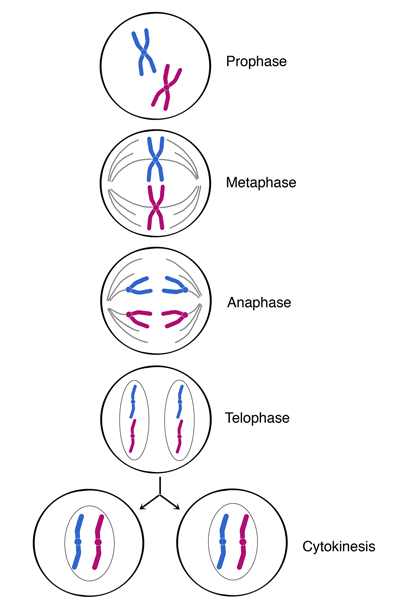
Identify the phase of mitosis
a)
prophase
b)
metaphase
c)
anaphase
d)
telophase
39.
Which phase comes NEXT?
a)
prophase
b)
metaphase
c)
anaphase
d)
telophase
40.
Which is the correct order?
a)
C,D, B, A, F, E
b)
D,A,F,C,E,B
c)
B,E,C,F,A,D
d)
C,B,D,A E,F
41.
This picture shows which process? 
a)
mitosis
b)
meiosis
c)
the cell cycle
42.

During what phase of the cell cycle is DNA replicated?

a)

S-Phase

b)

G1

c)

Mitosis

d)

Cytokinesis

43.

What does Cytokinesis mean?

a)

spindle fibers form

b)

chromosomes line up in the cell

c)

division of cytoplasm

d)

falling in lava in Minecraft

44.

What are the four stages of mitosis?

a)

Anapest, protophase, multiphase, and telephase

b)

Prophase, metaphase, anaphase, and telophase

c)

Adenine, guanine, thymine, and cytosine

d)

Phase 1, Phase 2, Phase 3, and Phase 4

45.
Which process and type of resulting cells are represented?
a)
mitosis, gametes
b)
mitosis, body cells
c)
meiosis, gametes
d)
meiosis, body cells
46.
Which letter(s) in the diagram correspond to cells that are haploid? 
a)
A
b)
B
c)
C
d)
A and B
47.

In humans, the haploid number of chromosomes is ____.

a)

23

b)

46

c)

69

d)

92

48.

What phase is being shown?

a)

Metaphase or mitosis

b)

Metaphase of meiosis I

c)

Metaphase II of meiosis

d)

Crossing over

49.
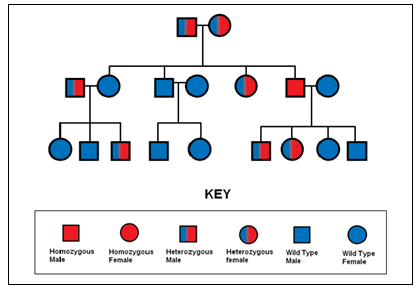
Which describes the type of cross shown in the picture?
a)
co dominance: both homozygous alleles make up the phenotype for the heterozygous
b)
incomplete dominance: both homozygous alleles become a mixture for the heterozygous
c)
Mutation: change in the DNA
d)
Nondisjunction: chromosomes separate incorrectly
50.
In a heterozygous genotype, the ___________ allele takes over in the phenotype.
a)
recessive
b)
dominant
c)
lower case letter
d)
both 
51.
Two brown eyed parents (Bb) have a baby. What is the chance the baby is blue eyed?
a)
0 %
b)
25%
c)
50%
d)
75%
52.
In a pedigree, what shape represents a male?
a)
circle
b)
square
c)
triangle
d)
diamond
53.
G = green, g = yellow
The genotype for a yellow plant is...
a)
GG
b)
Gg
c)
gg
d)
all of the choices result in yellow
54.

Hybrid (Bb); having 2 different alleles for a trait

a)

Heterozygous

b)

Homozygous

c)

Pure bred

55.
Which of the following is homozygous dominant?
a)
Yy
b)
Y
c)
yy
d)
YY
56.
Genotype refers to the ...
a)
physical expression of the genes
b)
the possible combination of alleles in a gene
c)
whether an allele is dominant or recessive
d)
how an organism will appear
57.
T - tall and t = short
In the punnett square below, what belongs in the missing square
a)
tt
b)
Tt
c)
Bb
d)
TT
58.

What is the probability that the offspring will express the dominant trait?

a)

25%

b)

50%

c)

75%

d)

100%

59.
What you see, or the physical appearance.
a)
Genotype
b)
Phenotype
c)
Homozygous
d)
Heterozygous
60.
The different forms of a gene are called 
a)
traits
b)
chromosomes
c)
alleles
d)
peas
61.
A homozygous dominant dog with brown fur is crossed with a heterozygous dog with brown fur. What are the percentages of the possible genotypes?
a)
100% BB
b)
75% BB and 25%Bb
c)
50 % BB and 50% Bb
d)
50% Bb and 50% bb
62.

What is DNA replication?

a)

the process of creating proteins

b)

the process of creating RNA molecules

c)

the process of copying a DNA molecule to produce two identical DNA molecules

d)

is the process of creating new cells

63.

What is the role of helicase in DNA replication?

a)
The role of helicase in DNA replication is to unwind the double-stranded DNA helix.
b)
The role of helicase in DNA replication is to stabilize the DNA strands.
c)
The role of helicase in DNA replication is to repair damaged DNA.
d)
The role of helicase in DNA replication is to synthesize new DNA strands.
64.

What enzyme is responsible for building the new DNA strands?

a)
RNA polymerase
b)
Protease
c)
DNA polymerase
d)
Lipase
65.

What type of bonds are formed by ligase between sugars and phosphates in the backbone of the new DNA strands?

a)

hydrogen

b)

ionic

c)

covalent

66.

What is a picture of all of the chromosomes in a cell called?
a)
Genotype
b)
Phenotype
c)
Chromotype
d)
Karyotype
67.
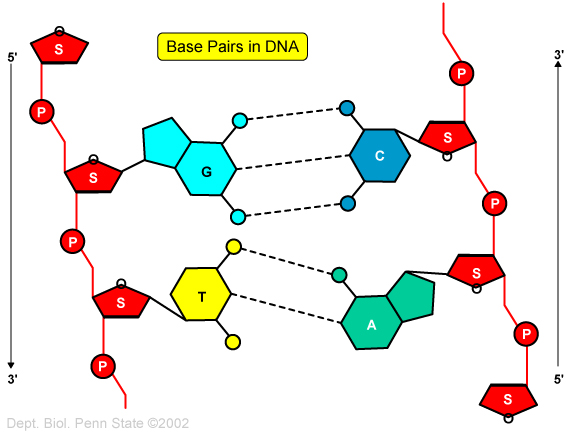
Nitrogenous bases are joined by which type of bond?
a)
polar bonds
b)
ionic bonds
c)
covalent bonds
d)
hydrogen bonds
68.

Choose the correct complementary nucleotide sequence for the following:

CTACGAGGATAT

a)

GATGCTCCTATA

b)

GTTGCTCCTATA

c)

TATGCTCCTATA

d)

GATGCTCCTATT

69.

Which letter in the picture below depicts the leading strand in DNA replication?

a)

A

b)

C

c)

B

d)

None of the above

70.

DNA is an acronym for _____

a)

Diphosphorus Nucleic Acid

b)

Ribose Nucleic Acid

c)

Deoxyribonucleic Acid

d)

Deoxyribonucleic Acetate

71.

A nucleotide is composed of

a)

A phosphate, sugar and nitrogenous base

b)

A protein, protein and Guanine

c)

A phosphate, Adenine, and nitrogenous base

d)

A protein, Adenine and nitrogenous base

72.

Which organelle is the location where protein is made?

a)

Ribosome

b)

Nucleus

c)

Cytoplasm

d)

Nucleotide

73.

mRNA occurs during this process

a)

Translation

b)

Transcription

c)

Replication

d)

Delivery

74.

Which of the following is the complementary mRNA sequence to this DNA strand: AACTGAA

a)

UUGACUU

b)

TTGACTT

c)

AACTGAA

d)

AACUGAA

75.

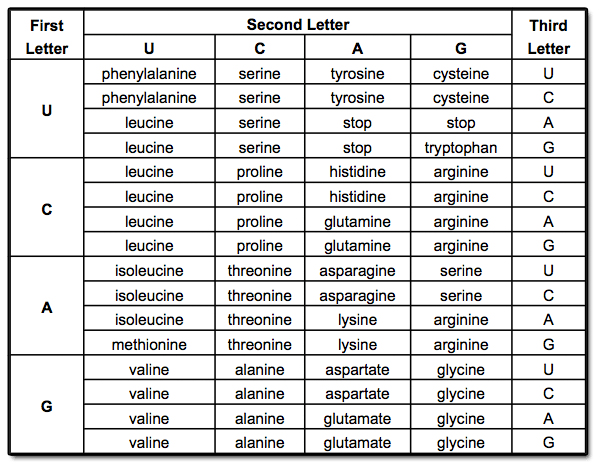
What is the amino acid sequence for the following mRNA strand:

AUG-GAC-UAG

a)
Met-Asp-Stop
b)

Met-Gln-Stop

c)

Met-Glu-Stop

d)

Met-Met-Stop

76.

What is the amino acid sequence for the following mRNA strand:

AGG-UUC-CUG

Write your answer like this: ___-___-___

a)
Arg-Phe-Leu
b)

Arg-Met-Leu

c)

Arg-Phe-Stop

d)

Met-Phe-Stop

77.
What amino acid is represented by the codon UUA?
a)
Phenylalanine
b)
Tyrosine
c)
Leucine
d)
Stop codon
78.

The following codon is translated into which amino acid?


AUU

a)

Methionine

b)

Isoleucine

c)

Histidine

d)

Arginine

79.

The following codon is translated into which amino acid?


AGG

a)

Methionine

b)

Isoleucine

c)

Histidine

d)

Arginine

80.
What is formed during primary succession that doesn't need to be formed during secondary succession?
a)
pioneer species
b)
soil
c)
climax community
d)
lichens
81.
What type of succession is shown going from figure A to figure B?
a)
primary succession
b)
eutrophication
c)
secondary succession
d)
intermediate
82.
Structures with the same parts have different functions; suggests that organisms share a common ancestry
a)
vestigial structures
b)
homologous structures
c)
adaptive radiation
d)
fossil
83.
The white feathers of a snowy owl allow it to blend in with its environment during the winter months (snow). This is an example of ________________
a)
Species
b)
Environmental Change
c)
Adaptation
d)
Variation
84.
A species lives in a particular environment.  What is TRUE about the environment that the species lives in and about how the species will look over thousands of years?
a)
The environment will stay the same, and the traits of the species will stay the same.
b)
There will be changes to the environment, but the traits of the species will stay the same.
c)
There will be changes to the environment that could lead to changes in the traits of the species.
d)
There will be changes to the environment, and the traits of the species will change, but the changes in the environment could never lead to changes in the traits of species.
85.
type of growth shown here:
a)
exponential growth
b)
logistical growth
86.
What type of graph is this?
a)
exponential growth
b)
logistical growth