
Font size
 Worksheets
Anne Year 10 Chemistry exam quiz
Total questions: 148
Worksheet time: 2hrs 40mins
How would you describe the movement of particles in a solid?
Stationary
Vibrate around a fixed position
Move quickly in random directions
Able to flow
How would you describe the movement of particles in a gas?
Move randomly in all directions
Stationary
Vibrate around a fixed position
Can flow
How would you describe the motion of particles in a liquid?
Stationary
Vibrate around a fixed postion
Able to flow and move over one another
Moves quickly in random directions
Which of these particle diagrams represents a solid?


Which of these particle diagrams represents a liquid?


Which of these particle diagrams represents a gas?


Definite shape and definite volume
Solid
Liquid
Gas

Has a definite volume but not a definite shape
Solid
Liquid
Gas

The state of matter that has no definite size or shape is
Solid
Liquid
Gas
In which state of matter are the particles farthest away from each other
solid
liquid
gas
Can't tell
The temperature at which a solid becomes a liquid is called it's ______?
boiling point
melting point
condensation
sublimation
Which is NOT a part of the kinetic theory?
everything is made of tiny particles
when particles collide with something, they exert a force
the particles in a substance are always moving
a substances melting point is the same as it's freezing point
mixture

Element
Compound
Mixture

Element
Compound
Mixture

Element
Compound
Mixture

Element
Compound
Mixture

Element
Compound
Mixture

Element
Compound
Mixture

Element
Compound
Mixture

Element
Compound
Mixture

Element
Compound
Mixture
The nucleus of an atom
is positively charged
is negatively charged
has no charged particles
has both positively and negatively charged particles
Electrons are particles which
have a positive charge
have a negative charge
have no charge
can have either a positive or a negative charge
An atom is neutral because
the positive charge of the nucleus is equal to the sum of the negative charges of the electrons
the negative charge of the nucleus is equal to the sum of the positive charges of the electrons
it does not contain any charged particles
What two particles are found in the nucleus?
proton and neutron
neutron and electron
proton and electron
Which particle is neutral?
neutron
proton
electron
if carbon has 12 protons, how many electrons does it have?
6
12
11
none

Which particle has a relative mass of 1 but no charge?
Proton
Neutron
Electron
Megatron

What is the charge on an electron?
+1
0
-1
-2

What is the atomic number?
Number of protons
Number of electrons
Number of neutrons

What is the relative mass of an electron?
1
-1
1/2000

If the atomic number is 7 and the mass number 17 how many protons does the atom have?
17
7
10
0

The mass number is the number of what?
Atoms
Protons
Protons + Neutrons
Neutrons + Electrons

How do find the number of neutrons?
Atomic number
Mass number
Mass number - Atomic number
Atomic number - Mass number

What sub-atomic particle is labelled A?
Neutron
Electron
Ion
Atom
What sub-atomic particle is labelled B?
Neutron
Electron
Ion
Atom

How many neutrons does a lithium atom have?
7
3
4
10
What is the relative atomic mass of lithium?
7
3
4
10
What is the atomic number of lithium?
7
3
4
10

How many neutrons are in magnesium?
12
24
25
36

The mass number is always larger than the atomic number (exept for Hydrogen).
TRUE
FALSE
The Periodic Table is organized by increasing
charges
atomic number
mass number
electronegativity
The horizontal rows of the Periodic Table are called ______________.
Periods
Groups
Families
Halogens
Metals are found on the ______________ side of the periodic table.
nonmetals
left
right
metals
There are two primary isotopes found in any sample of copper: copper-63 and copper-65. The isotope 65Cu composes 69.2% of the sample and 63Cu comprises the other 30.8%. Based on this data, what is the atomic mass of copper?
29 amu
63.546 amu
64.4 amu
63.6 amu

Which diagram represents the electronic structure for Sodium?
A
B
C
D
What will be the electronic configuration of boron.
Hint: it is in period 2 and group 3.
2, 8
2, 3
3, 2
3, 3
An atom that gains or loses an electron becomes
an isotope
a new element
an ion
a molecule
An atom that gains or loses an electron becomes
an isotope
a new element
an ion
a molecule
Ionic bonds happen when valence electrons are
shared
too heavy
transferred
Valence electrons are
neutral (no charge)
found in the outer most energy level of the atom
equal to the number of protons
Which type of bond occurs between non metals?
covalent bonds
ionic bonds
metallic bonds
all types of bonds
How many valence electrons does Oxygen have?
0
16
6
8
How many different elements are in the C6H12O6
3
6
12
24
How many total atoms are in C6H1206
3
6
12
24
What type of bond forms CaF2
covalent bond
ionic bond
metallic bond
all answers are correct
What is the charge of an aluminum ion that has 13 protons and 10 electrons?
3+
3 -
no charge
Is this equation balanced? C3H8 + 5O2 = 4H2O + 3CO2
yes
no
How many oxygen atoms on each side of C3H8 + 5O2 = 4H2O + 3CO2
2
3
5
10
After a chemical reaction occurs, atoms are not created nor destroyed,
just rearranged into a new substance
just changed into different elements
just turned into unstable elements
Most elements bond to create compounds because
their outer electron level is full
they are unstable
they are positively charged
Compounds that share specific valence electrons are formed by
covalent bonds
ionic bonds
metallic bonds
all types of bonds
Which of the following is an alloy?
stainless steel
chromium
nickel
lead
Which statement best described the structure of a metal?
A lattice of positive metal atoms surrounded by delocalised electrons.
A lattice of positive metal ions surrounded by delocalised electrons.
A lattice of metal atoms in neat rows.
A lattice of metal ions.
What are delocalised electrons?
Electrons that are transferred from one atom to another
Electrons that are fixed in place
Electrons that are free to move throughout the metal lattice
Electrons that are shared between two atoms
What is an alloy?
A type of ionic compound
A pure metal
A mixture of metals
A non-metallic compound
Steel generally speaking is made of
iron and carbon
copper and iron
tin and carbon
aluminum and nickel
Why are alloyed metals usually stronger?
They have atoms of different metals in them, which makes it easier for the layer to move past each other...less likely to break
They have atoms of different metals in them, which makes it harder for the layer to move past each other...less likely to break
When a metal salt reacts with a more reactive metal, what sort of reaction occurs?
Displacement
Neutralisation
Combustion
No Reaction
Which metal is more reactive than calcium?
magnesium
potassium
silver
aluminum
What will be the result of the following:
Li + NaF ->
Li will replace F
Na will replace Li
Li will replace Na
no reaction will occur
Choose the least reactive metal
calcium
magnesium
iron
copper
Choose the most reactive metal
calcium
magnesium
iron
copper
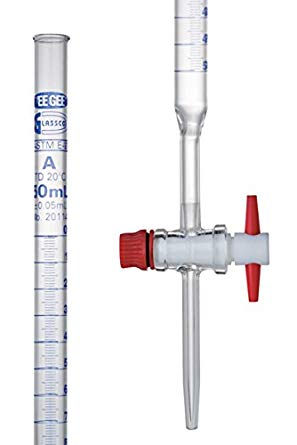
What is this piece of apparatus called
Pipette
Burette
Janette
Cuvette

What is the reading on this burette?
24.0cm3
25.8cm3
24.2cm3
23.9cm3
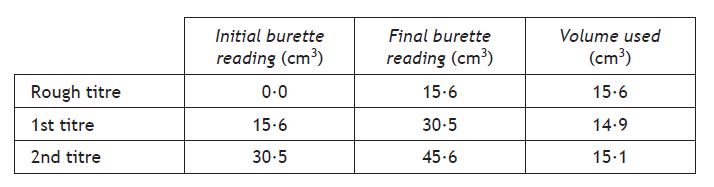
Calculate the average volume of acid needed for this neutralisation
15.2cm3
15.0cm3
35.5cm3
30.1cm3
Identify the correct formulae for the three common lab acids
H2SO4, HNO2, HCl
HCl, HNO3, H2SO3
H2SO4, HCl, HNO3
HNO3, HCl2, H2SO4
An acid is a...
proton donor
electron donor
electron acceptor
proton acceptor
Nitric acid produces .................... salts
Chloride
Nitrate
Sulphate
Carbonate
Which statement is incorrect?
An alkali releases H+ ions in aqueous solution
An alkali is a water soluble base
acid + alkali -> salt + water
neutralisation is the reaction of H+ and OH- ions to form water
A solution with more hydrogen ions than hydroxide ions will be more ......
alkaline
neutral
acidic
A solution turns blue litmus paper red, what is the chemical?
An acid
An alkali
Neutral
Cannot tell
What salt is made in the reaction between sodium and sulfuric acid?
silver sulfate
sodium nitrate
sodium sulfate
sodium chloride
How can we test a gas to see if it is hydrogen?
A lit splint will make a squeaky pop sound
Limewater will turn cloudy
Damp blue litmus paper will be bleached
A glowing splint will relight
Which of the following elements will form an anion?
Tin
Lead
Chlorine
Zinc
To test for oxygen gas we use...
a lit splint
a glowing splint
limewater
red litmus paper
Ammonia gas.......
is acidic
will turn damp blue litmus red then bleach it white
is alkaline
will turn damp red litmus blue
Chlorine is a halogen. What group number is that?
1
2
7
0
Limewater tests for carbon dioxide. What happens?
goes blue
explodes
goes cloudy/milky
turns red
Describe the accurate result for a flame test on Lithium ion.
Flame colour: Red
Flame colour: Yellow
Flame colour: Lilac
Flame colour: Blue green
Describe the accurate result for a flame test on sodium ion.
Flame colour: Red
Flame colour: Yellow
Flame colour: Lilac
Flame colour: Blue green
Which result best describes flame test result on copper (II) ion?
Flame colour: Yellow
Flame colour: Red
Flame colour: Lilac
Flame colour: Blue green
Test for sulphate ions is...
Add acid or barium chloride
Add barium chloride or barium nitrate
Add silver nitrate or barium nitrate
Add barium chloride or silver nitrate
Dilute hydrochloric acid is added to a colourless solution. Bubbles appear immediately and this gas turns limewater cloudy. What ion was present in the solution?
Carbonate
Sulfate
Nitrate
Chloride
Products will form faster if____________
the particle size of the reactants are larger
the temperature decreased
concentration of the reactants are increased
the reaction is not stirred
What does the collision of reactant particles provide in a chemical reaction?
The energy to cool the reactant molecules.
The energy to dissolve the reactant molecules.
The energy to break the bonds in the reactant molecules.
The energy to freeze the reactant molecules.
What does the collision of reactant particles provide in a chemical reaction?
The energy to cool the reactant molecules.
The energy to dissolve the reactant molecules.
The energy to break the bonds in the reactant molecules.
The energy to freeze the reactant molecules.

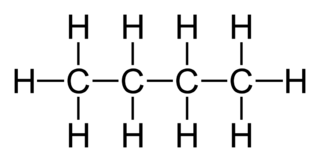

Fractional distillation separates crude oil based on the different __________ of the molecules in the mixture
melting point
boiling point
freezing point
chemical reactivity
A fraction of crude oil is made up of:
Hydrocarbons of similar chain lengths
Numbers
Large hydrocarbons
Alkenes only
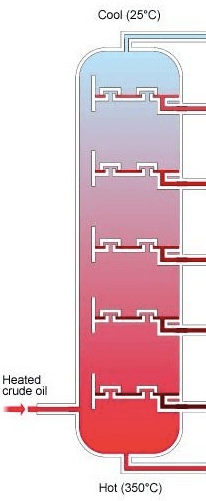
What process happens at each level in the fractionating column?
Evaporation
Condensation
Combustion
What process happens as the crude oil enters the fractionating column?
Evaporation
Condensation
Combustion

Where do short chain hydrocarbons collect?
At the top
In the middle
At the bottom

Where do long chain hydrocarbons collect?
At the top
In the middle
At the bottom
Used in gas cooker
kerosene
fuel oil
bitumen
refinery gas
The most viscous fraction in the fractional distillation of crude oil
kerosene
fuel oil
bitumen
refinery gas
The most flammable fraction
kerosene
fuel oil
bitumen
refinery gas
Fuel for ships
fuel oil
petroleum
diesel
bitumen
Fuel for lorries
fuel oil
petroleum
diesel
bitumen
For surfacing roads
bitumen
refinery gas
petroleum
diesel

