
 Worksheets
S2 Anatomy Exam
Total questions: 80
Worksheet time: 11hrs 33mins

These muscles that make up someone's "six pack" are really called what?
extermal obliques
gluteus maximus
rectus abdominus
gastrocnemius

Name this muscle.
triceps
trapezius
hamstrings
latissimus dorsi


What muscle is this?
Gluteus Maximus
Biceps femoris
Gastrocnemius
Pectoralis major

Name this muscle.
deltoids
latissimus dorsi
gluteus maximus
gastrocnemius


Tricep brachii
Bicep brachii

Biceps brachii
Tricep brachii
brachialis

Soleus

name the muscle
sartorius
Vastus Intermedius
Rectus Femoris
Vastus Lateralis

name the muscle
Vastus Medialis
Vastus Intermedius
Rectus Femoris
Vastus Lateralis

name the muscle
Vastus Medialis
Vastus Intermedius
Rectus Femoris
Vastus Lateralis
Fight or flight
adrenaline
noradrenaline
dopamine
serotonin
gaba
concentration
adrenaline
noradrenaline
dopamine
serotonin
gaba
associated with addiction
adrenaline
noradrenaline
dopamine
serotonin
gaba
mood
adrenaline
noradrenaline
dopamine
serotonin
gaba
calming
adrenaline
noradrenaline
dopamine
serotonin
gaba
Decision making
Frontal Lobe
Temporal Lobe
Brain Stem
Parietal lobe
Occipital Lobe
emotions
Frontal Lobe
Temporal Lobe
Brain Stem
Parietal lobe
Occipital Lobe
behavior
Frontal Lobe
Temporal Lobe
Brain Stem
Parietal lobe
Occipital Lobe
hearing
Frontal Lobe
Temporal Lobe
Brain Stem
Parietal lobe
Occipital Lobe
facial recognition
Brain Stem
Temporal Lobe
Cerebellum
Parietal lobe
Occipital Lobe
heart rate
Brain Stem
Temporal Lobe
Cerebellum
Parietal lobe
Frontal Lobe
breathing
Brain Stem
Temporal Lobe
Cerebellum
Parietal lobe
Frontal Lobe
sight
Brain Stem
Temporal Lobe
Cerebellum
Parietal lobe
Occipital lobe
color perception
Brain Stem
Temporal Lobe
Cerebellum
Parietal lobe
Occipital lobe

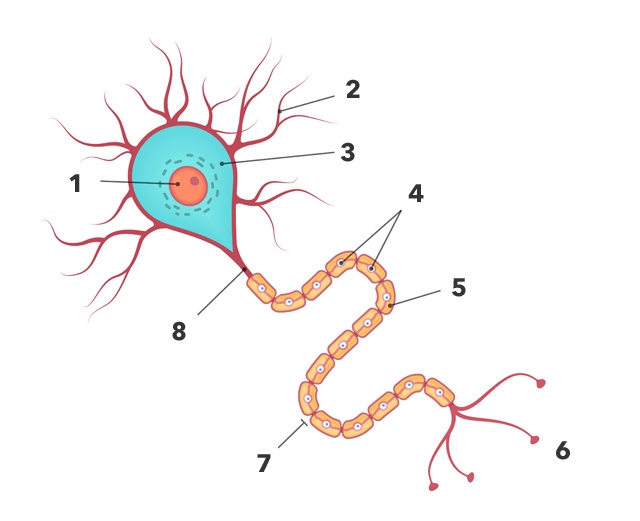
Identify #2
axon
cell body
dendrite
myelin sheath
This is where neurotransmitters get release from to go to the next neuron.
Match the cranial nerves with their function
Olfactory
smell
Optic
vision
Oculomotor, Trochlear, Abducens
pupil, eye, eyelid movement
Trigeminal
facial sensation and chewing
Facial
facial expressions
How do hair cells relate to the frequencies we hear?
more hair cells= hear higher frequencies
more hair cells= hear less frequencies
less hair cells= hear higher frequencies
Stimulates growth in bones and muscles
Thyroid-stimulating hormone (TSH)
Adrenocorticotropic Hormone (ACTH)
Growth Hormone
Melanocyte Stimulating Hormone
Prolactin
Stimulates melanocytes to produce melanin (pigment)
Thyroid-stimulating hormone (TSH)
Adrenocorticotropic Hormone (ACTH)
Growth Hormone
Melanocyte Stimulating Hormone
Prolactin
Which is NOT released by the anterior pituitary gland?
Thyroid-stimulating hormone (TSH)
Adrenocorticotropic Hormone (ACTH)
Growth Hormone
Melanocyte Stimulating Hormone
Melatonin
Stimulates release of sex hormones and gamete production
Luteinizing and Follicle Stimulating Hormones
Antidiuretic hormone (vasopressin)
Oxytocin
Pituitary Stimulating hormones
Melatonin
Causes sleep and wake cycles
Luteinizing and Follicle Stimulating Hormones
Antidiuretic hormone (vasopressin)
Oxytocin
Pituitary Stimulating hormones
Melatonin
Reduces calcium levels in blood
Calcitonin
Thyroxine and Triiodothyronine (T3 and T4)
Parathyroid hormone (PTH)
Epinephrine and Norepinephrine
Glucocorticoids
Regulate the "Fight or Flight" response to emergency situations. Increases heart rate, blood pressure, blood flow, intake of oxygen for immediate energy.
Calcitonin
Thyroxine and Triiodothyronine (T3 and T4)
Parathyroid hormone (PTH)
Epinephrine and Norepinephrine
Glucocorticoids
Lower blood glucose levels
Insulin
Glucagon
Thymopoietin, Thymic Factor, Thymosin
Estrogen
raise blood glucose levels
Insulin
Glucagon
Thymopoietin, Thymic Factor, Thymosin
Estrogen
maturation of reproductive organs and secondary sex characteristics, production of sperm.
Insulin
Glucagon
Estrogen
Progesterone
Testosterone
Has an Anterior and Posterior section that secretes different hormones
Hypothalamus
Pineal
Pituitary
Thymus
Adrenal
Located in the brain
Hypothalamus
Pineal
Pituitary
Thymus
Adrenal
Excessive hair growth EVERYWHERE caused by increased testosterone.
Hirsutism
Acromegaly
Generalized Hypertrichosis
Hyperthyroidism
Hypothyroidism
Caused by problems with the anterior pituitary and growth hormone.
Dwarfism
Acromegaly
Generalized Hypertrichosis
Hyperthyroidism
Hypothyroidism

Letter D is pointing to
Aorta
Right Pulmonary Artery
Superior Vena Cava
Pulmonary Trunk

Letter G is pointing to
Right atrium
Left Atrium
Right ventricle
Left ventricle

What letter is pointing to the aorta?
D
K
C
B

Which letter is pointing to the tricuspid valve?
M
N
L
O


Irregularly shaped cell fragments that help clot blood
Platelets
Lymph
Plasma
White Blood Cells
Contains hemoglobin, supplies body with oxygen
Plasma
Platelet
White Blood Cell
Red Blood Cell
The liquid part of blood made of mostly water; nutrients, minerals and oxygen are dissolved
Marrow
Plasma
Proteins
Urea
What are the cells that are granulocytes?
erythrocytes
lymphocytes and monocytes
eosinophils and monocytes
neutrophils, basophils, and eosinophils
How are arteries and veins different?
One is bigger than the other.
The arteries carry more blood than the veins.
The arteries carry blood away from the heart while veins carry blood to the heart.
The veins carry blood away from the heart while arteries carry blood to the heart.

Blood in the left ventricle:
Oxygenated
Deoxygenated
heart
pumps blood
arteries
Vessels going away from the heart and lungs - full of oxygen
veins
vessels going back to the heart and lungs - full of carbondioxide
capillaries
mini blood vessels, where oxygen and carbondioxide are exchanged
Match part of the blood with its job
red blood cells
carry oxygen and nutrients to the body
white blood cells
fight pathogens
plasma
water, nutrients, minerals
platelets
clot the blood so you stop bleeding
O-
AB-
A+
B-
O+
Match the following
Ingestion
Taking in food
Propulsion
Peristalsis
Digestion
Breaking down and absorbing food
Egestion
Storage and elimination of waste
What type of digestion do teeth do?
Mechanical
Chemical
What is the job of the epiglottis?
Prevents food from entering the nasal cavity
Pushes food toward the esophagus
Provides seal around teeth
Produces Amylase to break down starch
Flap of skin that prevents food from entering the trachea (Windpipe)
Food moves down the esophagus using peristalsis. What type of digestion is this?
Chemical
Mechanical
Select all that apply:
What are the functions of the small intestine?
nutrient absorption and digestion
absorption of water
removal of waste
churn gastric juices
Select all that apply:
What are the functions of the large intestine?
nutrient absorption and digestion
absorption of water
removal of waste
churn gastric juices
What increases the surface area within the small intestine?
villi
sphincter
rugae
epiglottis
Why do we call them "accessory" organs?
Food doesn't travel through them and they aren't that important
They are not in the direct path of digestion, but are needed for the release of different chemicals
They are in the direct path of digestion but don't release any chemicals to break down food
They are in the direct path and release many different chemicals

stomach

esophagus

liver
Reorder the following. Put these in order that food follows as it passes through the digestive system.
mouth
esophagus
stomach
small intestine
large intestine

