
 Worksheets
Core Bio Unit 4 Practice
Total questions: 85
Worksheet time: 48mins
What is the term for each level in the transfer of energy and matter within a biological community?
energy path
food web
trophic level
food pyramid
Autotrophs make up the _______ trophic level in all ecosystems.

Which type of symbiosis is represented by a tick that feeds on the blood of a mammal and potentially transmits pathogens to the host?
parasitism
mutualism
commensalism
nonalism

What type of symbiotic relationship exists in which both organisms benefit?
competition
mutualism
commensalism
parasitism
A long-term relationship between two species in which one organism is harmed is called...
mutualism.
commensalism.
parasitism.
niche.


The image provided is an example of a(n)...
carnivore.
herbivore.
producer
autotroph.
Which of the following would be the definition of a detritivore?
Animals that eat insects.
Organisms that feed on rocks, recycling the nutrients back into the ground.
Organisms that eat only pants.
Things that feed on waste products of other organisms or dead organisms.
What are the nonliving parts of an ecosystem?
abiotic factors
biotic factors
What are the living parts of the ecosystem?
biotic factors
abiotic factors
Water temperature would be an example of a(n) ...
biotic factor.
abiotic factor.
What is a collection of organisms that belong to different populations but all live in the same area and interact with one another?
Population
Ecosystem
Community
Ecosphere
What is a collection of organisms that make up a community as well as all of the nonliving aspects of the environment?
Population
Community
Habitat
Ecosystem
What organisms eat both living producers and other consumers?
Carnivores
Omnivores
Herbivores
Detritivores
Which of the following types of organisms occupy the second trophic level?
Apex predators
Producers
Herbivores
Carnivores

What is any relationship in which two species live closely together for an extended period of time?
resource
mutualism
succession
symbiosis

What is the study of how living things interact with one another and with their environment?
Biology
Lithology
Ecology
Farmacology
Two or more members of the same species living and interacting in the same area is an example of what level of ecology?
Community
Population
Organisms
Biosphere
Which of the following is not an important biogeochemical cycle in the environment?
helium cycle
water cycle
carbon cycle
nitrogen cycle
Much of Canada is covered in coniferous evergreen trees and the soil is nutrient-poor. The winter is cold and long. What is this biome?
tundra
taiga or boreal forest
deciduous forest
grassland
An organism's specific role in its habitat is called its...
consumer.
niche.
birth right.
habitat.

How would the removal of the earth worms affect the other organisms?
The number of bass (fish) will increase.
The number of crayfish (crustacean) will decrease.
The crayfish will get their energy directly from the sun .
The number of bass and ospreys (bird) will increase.


An animal that is hunted and eaten for food is a...
predator.
prey.
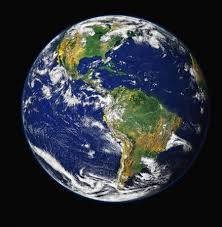
Everywhere living things are found in the hydrosphere, lithosphere, and atmosphere combined.
Population
Ecosystem
Biome
Biosphere

What is the maximum number of organisms that can survive in a particular ecosystem called?
carrying capacity
birth rate
limiting factor
death rate

If the temperature and amount of rainfall changes in an area from what is normal, this can also change the populations living there.
True
False


Which curve best describes an organism that invests a lot of energy in parenting?


What does the graph represent?
Emigration
Exponential growth
Immigration
Logistic Growth
When a population has reached carrying capacity...
growth and immigration are equal to death and emigration.
growth and immigration are less than death and emigration.
growth and immigration are greater than death and emigration
growth is exponential.
What is an environmental factor such as predation, disease, and competition that depends on the number of members in a population per unit.
dispersion
density- independent factor
density- dependent factor
population growth rate
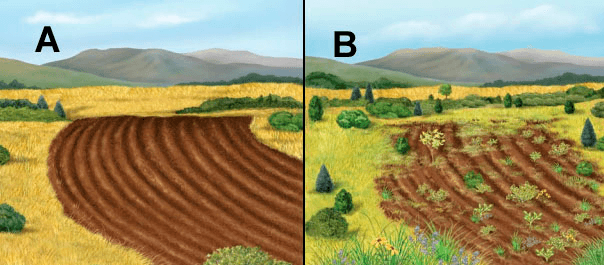
What type of succession occurs when soil is no longer present after an ecological disturbance?
Primary Succession
Secondary Succession
Tertiary Succession
Quaternary Succession
Which type of succession occurs when soil is still present after an ecological disturbance?
Primary Succession
Secondary Succession
Tertiary Succession
Quaternary Succession
The first species to inhabit an area after a disturbance is called a(n)...
pioneer species.
invasive species.
initial species.
limiting species.
Resource partitioning is best described by which of the following statements?
Competitive exclusion results in the success of the superior species.
Slight variation in niche allows closely related species to coexist without direct competition.
Two species can coevolve and share the same niche.
Species diversity is maintained by switching between prey species.
Character displacement has occurred if:
Two species in the same habitat evolve to be more different than if they are in different habitats due to competition.
One species chases the other out of the habitat they previously shared.
A characteristic is lost when an organism migrates into a new area.
A characteristic lost by one species is adopted by another.

Which biome holds the greatest biodiversity?
grassland
tundra
tropical forest
desert
Kangaroo rats don't drink water, so they are adapted to live in a ____________.
deciduous forest
savanna
desert
tropical forest
Which biome is covered with ice most of the year?
tundra
grassland
taiga
tropical forest
Which biome is covered in grasses?
Desert
Savanna
Tropical Rainforest
Temperate Forest
Which biome has a dry season and a wet season?
Desert
Savanna
Temperate Forest
Taiga
An impermeable, permanently frozen layer of soil is called...
frozen ground.
permafrost.
ice.
glacier.
Which is of the following is not a type of aquatic ecosystem?
ocean
estuary
monastery
wetland
What special adaptations do intertidal species have?
to resist UV rays
only to survive exposure to air
only to survive heavy waves
survive daily exposure to air and strong waves
The aphotic zone is...
the ocean's dark lower layer where photosynthesis cannot occur.
the sunlit upper layer of the ocean where photosynthesis occurs.
on the bottom of lakes, streams, and oceans.
where benthos are found.
This area starts several kilometers from the coast.
intertidal zone
coral reef
continental shelf
oceanic zone
The part of the ocean that extends from the end of the low-tide zone to the edge of the continental shelf is the...
neritic zone.
pelagic zone.
intertidal zone.
abyssal zone.
What ocean zone extends beyond the continental shelf (distance from shore)?
intertidal
neritic
oceanic
photic
Any ocean water that receives sunlight
aphotic zone
euphotic zone
photic zone
oceanic zone
What is a behavior or trait that allows an organism to survive in its environment?
trait
adaptation
characteristic
species

