
 Worksheets
M&WH EOC Review
Total questions: 152
Worksheet time: 1hrs 18mins
Which of these was a key idea of the Renaissance?
Responses
an interest in classical civilizations of Greece and Rome
emphasis on the next world rather than man's place in this one
the equality of all mankind
the suppression (keep down) of artistic innovation
The Silk Roads connected East and West Asia beginning as early as 114 B.C., but its use declined in the late 1400s and came to a definite halt in the early 1500s. The use of the Silk Roads decreased when
a series of wars erupted.
railway trade increased.
sea trade increased.
the rivers changed course.
Which statement BEST explains why the Renaissance began in Italy?
Northern Europe artists arrived bringing their artistic style that the artists copied.
The successful creation of a unified Italian monarchy meant resources were available for art
Italy was the victor in the Hundred Years War.
Italian cities were trade centers in the late fourteenth century.
The spread of religions during this time period would have been made easier by which of these?
the Silk Roads
the Mongols
Islamic Caliphates
trans-Saharan trade
What was the motivation for the exchange of commerce along the Silk Roads, Sea Roads, and Sand Roads?
Imposing cultural traditions on new people motived the exchange of commerce along these three networks.
The exchange of commerce along these three networks was motivated by an opportunity to expand empires and take over new land.
The acquisition of hard-to-find luxury items sustained trade along these three exchange networks.
Exchange of commerce was influenced by similar climates along the three networks. This allowed for easier exchange of goods and ideas
What geographic challenge was shared by both the Trans-Saharan trade route and parts of the Silk Road?
unpredictable oceans
deserts
narrow waterways
mountains
Judaism is an example of a monotheistic religion. What does monotheism mean?
Belief in many gods
Belief in one god
Belief in the worship of animals
Belief in no god
What religion did Siddhartha Gautama found?
Buddhism
Hinduism
Christianity
Islam
What religion originated in India and remains the most practiced religion in India today?
Hinduism
Islam
Judaism
Buddhism
This series of conflicts between Christians and Muslims for control of the Holy Land between 1095 and 1291 is one of the causes of tension between these two religious groups today.
Warring states period
The Spanish Inquisition
The Crusades
The Hundred Years War
The Ming Emperor wanted more tributaries so he gave his trusted adviser, ___________ the title "Admiral of the Western Seas" and told him to sail to "the countries beyond the horizon"
Ibn Battuta
Zheng He
Jamal al-Din
Marco Polo
Which of the following is a negative impact that the Columbian Exchange had on the native peoples of the Americas?
Europeans established global trade networks that brought maize to Europe, chili peppers to India, and wheat to the Americas.
The use of the horse caused native peoples to leave.
Agriculture spread to more regions.
The spread of disease killed millions of people
What's the BEST definition of the Columbian Exchange?
The spread of religions from Europe to Africa in exchange for slaves.
The exchange of Renaissance ideas from Italy to China through the Silk Road
The introduction of gunpowder weapons to the Ottoman, Safavid, and Mughal Empires
The exchange of plants, animals, people, and resources between the New World and the Old World.
What resource made the Mali and Songhai Empires of West Africa wealthy and powerful?
Gold
Silver
Diamond
Salt
In the 13th and 14th centuries, the Mongol Empire- shown here- controlled nearly the entire path of the ancient trade route called
Salt Route
Trans-Saharan trade
Old Roman Road
Silk Road
This religion originated on the Arabian peninsula and spread quickly throughout the Middle East, North Africa and Central Asia mostly through merchants and traders.
Islam
Buddhism
Christianity
Judaism
This religious organization provided structure and order to feudal Europe and would be influential in the political and cultural lives of people during the Medieval period. This organization was seen as the highest power on Earth, responsible for crowning Kings and Queens.
Roman Catholic Church
Delhi Sultanate
Abbasid Caliphate
Eastern Orthodox Church
This religion began in Roman Judaea in the 1st century C.E. and spread throughout the Roman Empire and Europe.
Judaism
Christianity
Buddhism
Islam
How did humanism during the Renaissance differ from earlier traditional medieval ideas?
They emphasized the importance of individual potential and growth.
They had an interest in the spiritual life of the people.
They were disinterested in the ideas of ancient Greece and Rome
They rejected traditional Christian teachings.
What helped increase the production of vernacular literature during the Renaissance?
Realism
printing press
Plays and sonnets
Humanism
Trade routes and sea routes were important for the transferring all EXCEPT
disease
dietary laws
religion, beliefs, and traditions
spices, fabrics, and goods
Many achievements of Islamic civilization reached European society by way of the
Middle Passage and the Columbian Exchange
Crusades and eastern Mediterranean trading networks
merchant guilds and the Industrial Revolution
conquests of the Germanic tribes and trade along the Silk Road
conquests of the Germanic tribes and trade along the Silk Road
Revival of trade in western Europe, decline of feudalism, revival of interest in learning, and cultural interaction with the Middle East are associated with the
Impact of the Crusades
growth of the Maya Empire
effects of the barter system
rise of Charlemagne
Which of the following beliefs is shared by Hindus and Buddhists?
The soul can be reincarnated.
Everyone should have the same social status.
Material wealth is a sign of the blessing of the gods.
People should pray five times a day.
Image B is known as the last supper and represents geometric painting
hi
hi
hi
hi
Image A depicted famous paintings by Leonardo da Vinci
. These paintings represent new art techniques that became popular during the Renaissance. Image A is named The Mona Lisa. It represents an art technique known as
sfumato that created a very lifelike skin tone on the subject, giving the painting a photographic quality.
hi
hi
hi
hi
Monotheistic- The belief in only one God or deity
Polytheistic- The belief in multiple Gods or deities
Universalizing religion- religions meant to appeal as many people as possible
Ethnic religions- religions one must be born into
Buddhism- religion founded by Siddhartha Gautama
hi
hi
hi
hi
In order for the United States to protected and broadened U.S. trade with China, the US implemented which policy?
Open Door Policy
Japan Policy
Closed Door Policy
Chinese Policy
Social Darwinists believed that
powerful nations were meant to dominate weaker societies.
human beings had reached the point where competition among nations was no longer necessary.
the teaching of evolution theories in American public schools was unconstitutional.
religious and scientific worlds should be kept separate.
During the Meiji period, this country rose to prominence and became a world power.
Japan
India
China
Turkey
A major obstacle to German unification in the mid 1800s was
the lack of a national language among the Germans.
the lack of modern transportation in Germany.
the division of the German people into many states.
the German defeat in the Franco-Prussian War.
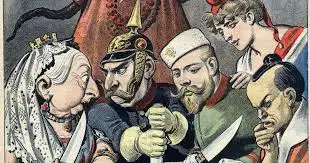
What is being demonstrated in this cartoon, published in the late 1890s?
China should be administered by different leaders from around the world to better trade.
The Chinese viewed European leaders as benevolent leaders who had the best interest of China.
India was not welcome in determining the carving up of China.
The Qing Dynasty was powerless to stop European and Japanese imperialism.
The Berlin Conference of 1884 is an example of the following:
Banana Republics in Latin America.
Scramble for Africa.
Spheres of Influence in China.
Philippine-American War.
The political cartoon of King Leopold's colony in the Congo can best be used to describe which of the following:
The Belgian Congo was especially brutal and King Leopold was notorious for his treatment of the indigenous population.
The political structure of the Belgian Congo was democratic and free.
Indigenous Australians were treated very poorly by King Edward VII and they were unable to resist British rule.
The Belgian Congo was a difficult place for European settlers to survive.
The Belgian Congo was a difficult place for European settlers to survive.
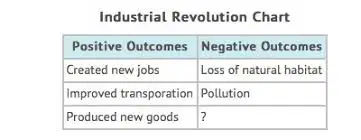
Which BEST completes the chart?
creation of highways
increased education
women in the workforce
poor working conditions
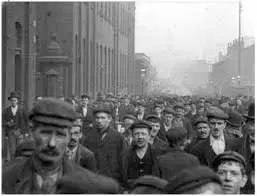
What challenges of urbanization and industrialization does the photo illustrate?
Suffrage protests
Overcrowding and pollution.
Unfair labor practices
Child labor exploitation
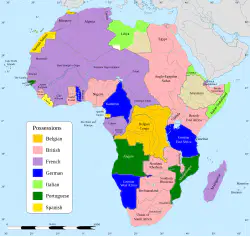
Which European nations had the greatest influence in Africa in the early 1900s?
Great Britain and France
Belgium and Italy
Spain and Portugal
Great Britain and Spain
In the late 1800s, feudalism was abolished in this East Asian nation.
Mongolian Khanate
Mughal India
Qing China
Meiji Japan
What was the outcome of the Opium Wars?
British opium addicts had to find new drug sources.
British gunboats forced China to make major concessions.
British missionaries were thrown out of China.
British merchants was forbidden to trade in China.
Expansionists in the U.S. believed that taking over foreign territories was an economically imperative for
prevention of foreign expansion.
raw materials and new markets.
to spread Christianity and civilization to "inferior peoples" of the world.
a stronger military.
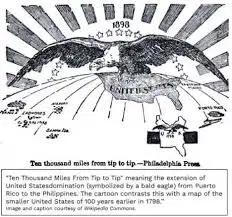
Which best explains the historical context behind this political cartoon?
The competition between capitalist and communist ideologies led to the United States expanding into new markets.
The American Revolution led to the spread of Enlightened ideas and independence movements in new regions of the world.
The need for more markets and raw materials led the United States to become more imperialistic.
New innovations and technology led to the spread of industrialization to Latin America and Southeast Asia.
The desire for self-rule leading to revolutions in Europe is an example of which ideology?
imperialism
nationalism
militarism
communism
How did Otto Von Bismarck unite Germany under Prussian leadership?
Through a series of 3 wars against Austria, France, and Denmark.
By ending the Seven Years War.
By defeating his other German states.
He established international trade with America, Asia, and Africa.
The opening of Japan in 1854 was a result of
revolutions incited by the merchant class.
the arrival of U.S. Commodore Matthew Perry.
the death of the Tokugawa shogun.
overseas diplomats from Qing China.
What was one impact of industrialization on Japan during the Meiji Restoration?
Demand for natural resources increased, leading to the need for overseas territories.
Traditional practices of Bushido were reintroduced.
Japan became more isolated from world affairs.
Japan became a colonial possession of China.
This conflict was a result of the increasing foreign occupation of China. Foreign multinational forces put down the
Taiping Rebellion
Panthay Rebellion
Opium War
Boxer Rebellion
What term is used for the various regions in which foreigners controlled their own affairs in China in the 19th and 20th centuries?
Extraterritorial regions
Special economic zones
Foreign administered regions
Spheres of influence
One of the most important motives for the European imperialism in Africa in the late 1800s was that Africa provided a source of
slaves for the American colonies.
new technology to gain from Africans.
raw materials used in industry.
religious conversion of Africans.
One of the major impacts of urbanization in the 1800s and early 1900s was
the increase in the spread of infectious diseases such as tuberculosis.
transportation improvements decreased because travel became too expensive.
a dwindling of the middle class as wealth grew among city dwellers.
the decrease in agricultural production as more people moved to the cities.
Name given to the sensational writing style and headlines used by journalists and depicted in the photo above.
Isolationalism
Expansionism
Imperialism
Yellow journalism
Before the United States annexed Hawaii, the island was
in the middle of a civil war
ruled by a sovereign ruler, Queen Liliuokalani
asked to join the United States
in need of governance and law
How did the Industrial Revolution change the structure of society?
Society reverted to noblemen, knights, and ladies as classifications for members.
Women gained importance as the new decision makers for industry.
Society began to see a class structure evolve between the working middle class and the industrial middle class.
Everyone move to the cities where all classes were equal.
Which of the following are the 4 Factors of Production
Land, Labor, Courage, Entrepreneurship
Land, Labor, Ideas, Courage
Land, Labor, Capital, Entrepreneurship
Land, Labor, Capital, Ingenuity
In a
Captalism
economic system the factors of production are privately owned, but in
Socialism
the factors are owned by the state, while in a
Communism
economic system the factors are owned equally by the people.
hi
hi
hi
hi
As a result of the Spanish American war, the United States gained possession of all of the following territories EXCEPT
Hawaii
Cuba
Puerto Rico
Phillipines
The outbreak known as the Sepoy Mutiny started ......
over who should rule India
over rifle cartridges greased with beef and pork fat
over disagreements between Muslims and Hindus
over the loss of local textile production
News stories like the one above helped gain support for which war?
Spanish American War
Opium War
War of 1812
Boxer Rebellion
The Industrial Revolution was the change from an economy based in
agriculture
to an economy based on
manufacturing
hi
hi
hi
hi
The League of Nations
was established prior to World War I but proved incapable of preventing the war.
had widespread popular support in the US but was rejected by President Wilson.
was supported by President Wilson, but rejected by the Senate.
was created to stop the spread of communism following World War II.
Which country withdrew from World War I in 1917 due to a revolution?
Russia
Germany
France
China
Which of these was NOT one of the major negotiators at the Versailles Conference following World War I?
the Premier of France
the Tsar of Russia
the Prime Minister of England
The United States President
Which of these is considered to be the "spark" which ignited World War I?
the assassination of Franz-Ferdinand
the sinking of a British passenger ship
the invasion of Belgium
the invasion of Poland
During World War I, the western front in Europe was characterized by
trench warfare.
unrestricted submarine warfare.
constant movement of troops.
the breakdown of the Russian defense.
· Nationalism
· Imperialism
· Militarism
· Secret Alliances
These terms represent the causes of what conflict?
Civil War
World War I
World War II
Spanish American War
According to Woodrow Wilson, the purpose of the League of Nations was
to help promote prohibition in other countries.
to help the US gain more territories.
to prevent nuclear proliferation.
to remove the threat of future wars.
Absolute freedom of navigation upon the seas, outside territorial waters, alike in peace and in war, except as the seas may be closed in whole or in part by international action for the enforcement of international covenants.
---Woodrow Wilson, Fourteen Points Speech, 1918
President Wilson is referring specifically to
the attack on Pearl Harbor
Sinking of the titanic
unrestricted submarine warfare
Italian dominance in the Mediterranean.
Which Soviet leader was responsible for 5-Year Programs, collectivization, and mass purges that resulted in the deaths of thousands?
Trotsky
Brezhnev
Stalin
Lenin
Which eastern European empire's collapse after its defeat in World War I resulted in the creation of several autonomous territories?
Austro-Hungarian Empire
Byzantine Empire
Roman Empire
Russian Empire
Woodrow Wilson's political agenda following World War I was based on
his attempt to be re-elected after World War I.
the desire for a global and lasting peace.
the fear of communism and its spread to democratic countries.
American economic investments in western Europe.
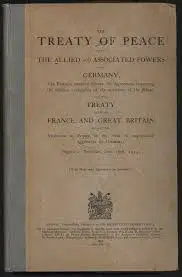
What is the name of the document shown, which ended the war between the Allied Powers and the Central Powers?
the Molotov-Ribbentrop Pact
the Hague Convention
the Fourteen Points
the Treaty of Versailles
The Bolshevik Party in 1917 gained the support of the peasant class because they promised them
"Liberty, Equality, Fraternity"
democratic reforms in all levels of government.
"Peace, Land, Bread"
abolition of the secret police.
What was the primary motivation for the assassination of Archduke Franz Ferdinand and his wife Sophia?
Austrian Nationalism
Ottoman Nationalism
Serbian Nationalism
German Nationalism
Why did Russia come to the aid of Serbia at the start of World War 1?
Militarism
Alliances
Imperialism
Nationalism
World War I saw large numbers of casualties because of new technology such as
Machine gun, bayonet, rifle, saber, sword
Poison gas, rifle, tomahawk, bayonet, knife
Machine gun, tank, airplane, poison gas, submarine
Cannon, pistol, mortar, airplane, ax
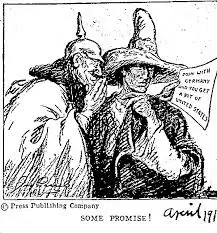
What event is depicted in the cartoon?
The assassination of the Archduke Ferdinand
The Zimmerman Telegram
The sinking of the Lusitania
The alliance between Serbia and Russia
What was responsible for the sinking of the Lusitania?
a fire aboard the weapons cargo bay
mines in the English channel
friendly fire
unrestricted submarine warfare
What's the BEST definition of "Total War"?
Being a man means that you need to totally support war.
All part of the government must totally support war.
The total resources of a nation, human and material, are used in war
Military troops need to totally commit themselves to war.
Which of the defeated empires of World War I was known as "the sick man of Europe"?
Ottoman Empire
Austria-Hungary
Former Russian Empire
Germany
Nationalism at the end of World War I led to.......
a lack of international trade.
the breakdown of the League of Nations.
the creation of new migration laws in Europe.
the creation of many new countries.
A war where each side tries to out produce and outlast the enemy is called?
War of attrition
Total war
Complete war
Production reduction
This group of people lived half in Russia and the other half under Ottoman Rule and were forced out of Ottoman lands or killed during World War I.
the Orthodox Greek
the Dardanelles
the Byzantines
the Armenians
Using all of a nation's resources against the enemy is known as
collectivization
total war
propaganda
conscription
During World War I the Ottomans used cultural and religious differences to commit __________________ .
genocide
nationalistic threats to Russia
revolution
mass migrations
Thru much of the war, Germany engaged in
unrestricted biological warfare
unrestricted sabotage of vehicles
unrestricted submarine warfare
unrestricted age limits for soldiers
Belt fed machine guns, chlorine and mustard gas, zeppelins and tanks were all
new weapons for World War I
outdate weapons for the new war
designed and created by the Allies to fight militarism
grow out of Germany's "Blood and Iron" period
During total war it is necessary for a nation to keep moral high in order to improve
productivity
the odds of returning soldiers
the nations' ability to negotiate a peace
the number of military recruits
It is most likely that the Mandate Powers felt the need to rule over the Mandates because......
the Europeans were strategically planning for the next World War.
it helped Britain and France claim more land.
it limited who could join the League of Nations.
the people of the Middle East were ethnically different from the Western Europeans.
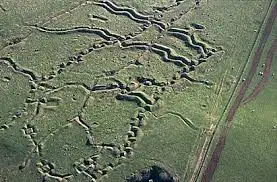
The above image depicts the scars from this type of warfare
Aerial surveillance warfare
Trench warfare
Land carving warfare
Tunnel warfare
The Battle of Midway was significant in World War II because it marked the end of
the German advance into France.
the Japanese eastward advance in the Pacific.
the German bombing of British population centers.
the Japanese assault on China.
World War II in Europe began with
Germany's attack on Russia.
the assassination of Franz Ferdinand.
Germany's invasion of Poland.
the invasion of Belgium.
During World War II, security concerns in the United States prompted
the internment of the Japanese.
the Lend-Lease Act.
the repeal of the Eighteenth Amendment.
the integration of the armed forces.
What is the significance of Pearl Harbor to the ending of World War II?
The United States immediately bombed Japan, ending World War II.
In retaliation for the bombing at Pearl Harbor, the Soviet Union declared war on Japan, effectively ending World War II.
The bombing at Pearl Harbor brought the US into the war, which signified a turning point toward an eventual Allied victory.
The Japanese surprise victory at Pearl Harbor marked the end of World War II.
These two Japanese cities were destroyed by the first nuclear weapons in August of 1945
Nagasaki & Hiroshima
Kyoto & Tokyo
Osaka & Nagoya
Yokohama & Sapporo
How did the Battle of Stalingrad act as a turning point to help the Allied Powers?
This battle got the people of Turkey to join the war against Germany
The Allied Powers pushed the Germans back West of the Soviet Union
The Axis powers benefited more from this battle than the Allied Powers
Stalingrad made the Soviets rulers of Germany
What was the agreement between Hitler and Stalin in 1939 stating that they would not attack each other and divide the countries that lay between them?
Non-Aggression Pact
Appeasement
The Munich Agreement
Treaty of Versailles
Which of the following enabled the British to win the Battle of Britain in 1940-41?
radar
tanks
blitzkrieg
poison gas
The Trinity test was conducted by _______________________________.
the League of Nations
the Manhattan Project
the Geneva Convention
the Holocaust survivors
The military formation above that is used to puncture an enemies lines of defense is known as____________________________
Shock and Awe
Panzer Point
Battle of the Blitz
Blitzkrieg
The Battle of el Alamein was victorious for the Allies in large part because
the Allies had already figured out how to overcome Blitzkrieg battles
the mass production and delivery of M4 Sherman tanks by the Americans
Rommel was no strategic match for the British commanders
the Germans were not use to fighting in desert terrain
What was the name of the strategy employed by the Allies in the Pacific theatre in which commanders picked which islands to leapfrog over?
Island Jumping
Island Hopping
Waterkrieg
Pacific Po Go Stick
What was the result of the atomic bombs dropped on two Japanese cities?
Soviet Union invades Japan
WWII ended with Japan surrendering to the Allies
Germany surrenders to the Allies
The US initiates the Marshall Plan to rebuild Japan
Native Americans were a valuable resource in World War II. A select group from the Navajo tribe were used as
fisherman for military stranded on islands
decoys for the Japanese
guards for the interment camps for the Japanese
code talkers or wind talkers
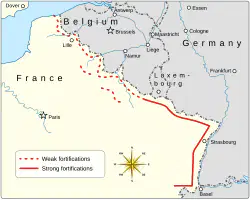
This area in France had been reinforced during the interwar years with bunkers, underground services and armed turrets as a result of past invasions by the Germans. It is known as
----------------------------
the maginot line
operation no invasion
the French finale
the last defense
Leaders of France, Great Britain, and Germany meant at the Munich conference to decide what?
if Hitler could take control of the Sudetenland ( a part of Czechoslovakia)
to establish the European order of command
to prevent the invasion of Austria
to protest Italy's invasion of Ethiopia
Read the list.
Poland
Soviet Union
France
Which title best describes this list?
Countries That Were Conquered During World War II
Countries Invaded by Germany During World War II
Countries Allied with Germany During World War II
Countries That Were Neutral During World War II
Why did the United States seize Pacific islands during World War II?
to protect shipping routes for neutral countries in Asia and the Pacific
to fulfill commitments to military alliances like the Australians
to establish military bases (particularly air strips) for use in further attacks
to gain access to vital natural resources
What term best represents the message portrayed in this political cartoon by Dr. Seuss?
interference
imperialism
appeasement
isolationism
Which event of World War II marked the beginning of the liberation of Western Europe?
D-Day Invasion
Battle of Stalingrad
Battle of Britain
Bombing of Pearl Harbor
Identify the leaders associated with the Allied forces during World War II.
Adolf Hitler
Franklin D. Roosevelt
Winston Churchill
Emperor Tojo
Joseph Stalin
The Yalta Conference was a meeting between which three World War II allies?
United States
France
Germany
Great Britain
Soviet Union
One major purpose of the Yalta Conference in 1945 was to decide
where to launch the final invasion of Japan.
how to restructure Europe after the war.
which countries to include in the United Nations.
when to open the second front against Germany.
Which statement about the Nuremberg Trials is true?
The purpose of the Nuremberg Trials was to bring Italian war criminals to justice.
The purpose of the Nuremberg Trials was to bring Nazi war criminals to justice.
The purpose of the Nuremberg Trials was to bring Austrian war criminals to justice.
The purpose of the Nuremberg Trials was to bring Soviet war criminals to justice.
The main objective of Operation Overlord (D-Day) was to liberate which of the following countries?
Germany
Belgium
France
Poland
To fight effectively in the Pacific during World War II, the US forces employed a triphibious type of warfare which meant.....
fighting with American, Australian, and British troops
fighting in the air, the land, and the sea
fighting with weapons, soldiers, and government policies
fighting in Europe first, then the ocean and then Japan
Which of the following were NOT a tactic Hitler used to increase the population to prepare for war? (select all that apply)
loyal Nazi followers could take inexpensive ski vacations or cruises
women were rewarded with medals for having children
men were given jobs building roads and bridges
parents got reduced rent and utilities to have more children
youth were required to go to afterschool programs
How did the German people see Hitler?
He was a evil and ruthless dictator
He was quiet and shy and not much of a threat.
He was a passionate speaker that had answers to fix many of Germany's problems.
He was simply just the politician that was in office. He wasn't well known.
Kristallnacht, or night of the broken glass, is significant because.....
it is seen as the beginning of the Holocaust
it justified physical aggression against the Jews by the Germans
it was not controlled by the government
it was started by the Jews
Hitler took over the Sudetenland of Czechoslovakia because he had promised the German people
volkswagens
Gemeinschaft Kraft durch Freude
blitzkrieg
lebensraum
Why did Great Britain and France try to appease Hitler when he first began to become aggressive in Europe?
Both thought it would be an easy way of dealing with Hitler
Great Britain and France were not prepared or excited to go to war with Germany after WWI.
Great Britain and France did not think that Hitler or Germany were real threats.
It had been suggested as a tactic by the United States
Once the USA gets involved in World War II, the Allies decided to take a Europe first approach by attacking
the soft underbelly of Europe- Italy
attaching Europe through the beaches of France
providing re-enforcements to the Russian army
invading through the neutral countries of Sweden and Finland
This man is known as El Libertador for gaining independence from Spain for the modern nations of Peru, Colombia, Venezuela, Ecuador, Panama and Bolivia.
Jose de San Martin
Francisco de Miranda
Father Miguel Hidalgo
Simon Bolivar
How did Napoleon end the chaos of the French Revolution?
He decreased the size of the military.
He continued to use the guillotine against his enemies.
He stabilized the country with his new policies.
He worked with the Directory to bring peace.
What two documents from English history, both reinforced the concept of limited monarchy?
Magna Carta and English Bill of Rights
Magna Carta and Declaration of Independence
Magna Carta and Mayflower Compact
English Bill of Rights and Declaration of Rights of Man
_______________________________ first suggested that the universe was heliocentric not geocentric
Nicolaus Copernicus
Tycho Brahe
Johannes Kepler
Galileo
Which of the leaders below were all influences on the ideals that shaped American government?
Andrew Carnegie, JP Morgan, and Francis Lowell
Nelson Mandela, Desmond Tutu, and Samuel Slater
John Locke, Baron de Montesquieu, and Jean Jacques Rousseau
Louis the XIV, Peter the Great, and Catherine the Great
The most successful slave revolt in history led to this revolution.
American Revolution
French Revolution
Revolutions led by Simon Bolivar
Haitian Revolution
Why did the Monarchs of Europe attack France during the French Revolution
many thought the revolution made France weak and thus an easy target
the German monarchs want to rid France of Catholics and set up Protestant Churches
many were scared that if the ideals of freedom and liberty spread, their thrones would be threatened.
many wanted France's great wealth
What is one role colonies play in a mercantilist system?
Colonies purchase raw materials from other countries.
Colonies sell raw materials to other countries.
Colonies manufacture finished products for the mother country.
Colonies purchase finished products from the mother country.
Why was the guillotine considered the Humane death?
It could kill thousands in a day.
It killed the same no matter if you were rich or poor.
It created very little "mess" to be cleaned up.
It was used as a public display of governmental power.
Prior to the French Revolution, which class had the most people but the least political power?
Estate Assembly
Estates General
Third Estate
Second Estate
Which ruler made England Protestant again by restoring the Anglican Church in 1558?
Victoria
Edward V
Charles III
Elizabeth I
A similarity between the American and French Revolutions was that both revolutions
were successful in large part because of help from abroad.
were led primarily by the middle class or bourgeoisie.
led to the crowning of a new monarch.
led to the establishment of stable democratic governments.
The Haitian Revolution is unique in that it.....
influenced Simon Bolivar to liberate South America from the Spanish.
was the first and only successful slave revolt.
convinced the slaves of North America to fight in the Civil War.
it was a continuation of the French Revolution.
Why did the findings of Galileo frighten Catholic and Protestant leaders?
His findings supported the theories of Aristotle.
His findings went against Church teaching and authority.
His findings led him to rebel against the Cardinals.
His findings did not support the Copernican theory.
John Locke claimed there were three natural rights. Which one of the following is NOT a natural right.
Life
Liberty
Happiness
Property
Which of the following DID NOT contribute to the French Revolution
the French wanted a better republic than the Americans
poor harvest in previous years in France
the lavish lifestyle of the King and Queen
the large amounts of money spent on the 7 year war and helping in the Revolutionary war
What is mercantilism?
Wars that start over money.
Where colonies trade gold and silver with each other.
Plantation colonies trading slaves for money.
A system where a mother country gains money and power from natural resources that come from its colonies.
How was Toussaint L 'Ouverture different than most slaves on the island of Saint Dominque?
Toussaint was invited to join the white Church as an attendant.
Toussaint was allowed to travel to the New World with his masters.
Toussaint was taught to read and write
Toussaint's masters allowed him to work with plantation owners
Which of these BEST describes the initial reaction of the Catholic Church to the knowledge developed during the Scientific Revolution?
Faith no longer has a place in scientific study.
Scientists should not question the word of God.
Evolution should not be taught.
The theories back up the teachings of the Bible.
Enlightenment thinkers contributed to changes in relationships between citizens and governments through their belief that
most changes in government are dangerous.
governments are instituted to protect citizens’ rights.
popular liberties should be limited by the need for social order.
absolute monarchy is the most effective form of government.
During the Age of Absolutism, European monarchs looked to
encourage the growth of political farms.
develop better relations with Muslim rulers.
increase human rights for citizens.
centralize political power in their nations.
Montesquieu is credited with devising the basic Constitutional principle of
separation and balance of governmental power
popular sovereignty
natural rights
the government was created by man for his own purposes
According to John Locke, if the government didn't protect the people's natural rights, what could the people do?
Overthrow the government
Refuse to perform work tasks until their rights were given
Nothing, the people don't have rights
Petition the government for their rights
Napoleon's new system of law, the Napoleonic Code emphasized
equality and religious tolerance
religious tolerance but difference in law for different genders
laws for the military only
laws that only protected families
What is a direct effect of the decline of the Indigenous populations in the New World?
The isolation of China and Japan from the rest of the world
Mass migration of Indigenous peoples to the Old World
The Human Rights movement in the New World
The movement of enslaved Africans to the New World
Luther's criticism of the Catholic Church was called what?
95 Theses
Chicken Soup for the Catholic Soul
101 Problems with Catholics
Criticism of the Catholic Church
A voyage that brought enslaved Africans across the Atlantic Ocean to North America and the West Indies
Declaration of Sentiments
Declaration of the Rights of Man and Citizen
Glorious Revolution
Middle Passage
This man was the main leader of the revolution in Haiti in its attempt to gain independence from France.
Toussaint Louverture
Simon Bolivar
George Washington
Maximilien Robespierre
Social Contract Theory holds that governments get their power from the people, and that if the government no longer serves the people it can be overthrown. Which of these offers the BEST example of Social Contract Theory in practice in America?
Albany Plan
Articles of Confederation
Mayflower Compact
Declaration of Independence
Natural Rights are rights .........
allotted only to men who own property.
granted to everyone upon birth.
that protect the environment
that must be earned from the government.
Why did Henry VIII break away from the Catholic Church?
Henry VIII started a war with the king of Spain, the Pope's distant cousin.
He wanted to annul his marriage to marry his girlfriend to get an heir to the throne.
Henry VIII had deep theological disagreements with the Church.
The Pope Excommunicated Henry VIII.
What was the significance of Charles I being executed?
It allowed the French to attack and gain control of England.
It started the English Civil War which was responsible for many deaths.
It marked the beginning of disputes between the Catholic Kings and the Protestant subjects.
It marked the first time in history a King was executed by his subjects.

