
 Worksheets
Mock Test_5-11_Plane and Solid Geometry
Total questions: 140
Worksheet time: 7hrs 0mins
What condition exists if an axiomatic system is independent?
It can be proven from the other axioms.
It cannot be proven from the other axioms.
It is true based on the other axioms.
It is false based on the other axioms.
What is the illustration to define the undefined terms so that the axioms are true?
Model
Replica
Isometry
Diagram
What is any statement that can be proven using logical deduction from the axioms?
Undefined Terms
Definition
Theorem
Axiom
What is a list of undefined terms together with a list of axioms (presupposed to be “true”), a definition in proving theorems and other components of mathematical system?
Mathematical Structure
Mathematical Set
Axiomatic Structure
Axiomatic Set
What condition exists if an axiomatic system is complete?
If every true statement can be proven from the axioms.
If every true statement exists.
If every true statement can stand on its own.
If every true statement is independent and consistent.
What condition exists if an axiomatic system is consistent?
It can be proven from the other axioms.
It cannot be proven from the other axioms.
There is a model for an axiomatic system where the axioms are all true .
There is a model for an axiomatic system where one axiom is independent.
How many models can be used to illustrate axiomatic systems?
Only one
Two models
Three models
Cannot be determined
What is an axiom?
presupposed to be “true”
always true
presupposed to be “false”
always false
Which of the following axioms cannot be proven from other presupposed axioms?
Consistent
Redundant
Independent
Inconsistent

Which axiom satisfies the model below?
Each pot is a set of two flowers.
Each flower is on exactly one pot.
Two flowers may be together on more than one pot.
There is at least one flower.
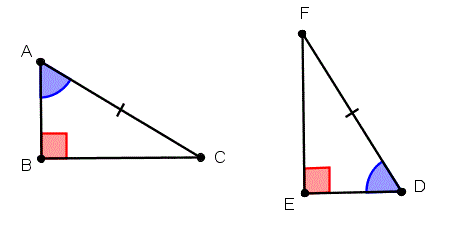
which is true?
Which is a true statement?
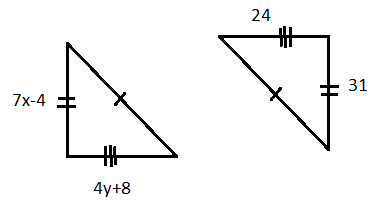
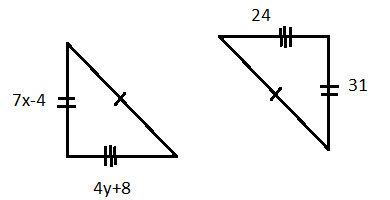
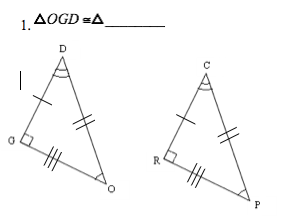
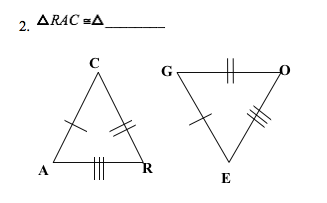
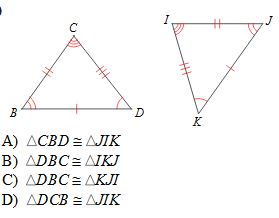
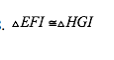
∠F = ___

Which theorem can be used to prove the quadrilateral is a parallelogram?
Parallelogram Opposite Sides Converse Theorem
Parallelogram Opposite Angles Converse Theorem
Opposite Sides Parallel and Congruent Theorem
Parallelogram Diagonals Converse Theorem

Which theorem can be used to prove the quadrilateral is a parallelogram?
Parallelogram Opposite Sides Converse Theorem
Parallelogram Opposite Angles Converse Theorem
Opposite Sides Parallel and Congruent Theorem
Parallelogram Diagonals Converse Theorem

Which theorem can be used to prove the quadrilateral is a parallelogram?
Parallelogram Opposite Sides Converse Theorem
Parallelogram Opposite Angles Converse Theorem
Opposite Sides Parallel and Congruent Theorem
Parallelogram Diagonals Converse Theorem

Which theorem can be used to prove the quadrilateral is a parallelogram?
Parallelogram Opposite Sides Converse Theorem
Parallelogram Opposite Angles Converse Theorem
Opposite Sides Parallel and Congruent Theorem
Parallelogram Diagonals Converse Theorem

Find the value of x that makes the quadrilateral a parallelogram.
41
12
14
This quadrilateral cannot be a parallelogram.

Find the value of x that makes the quadrilateral a parallelogram.
4
6
8
10

Find the value of x that makes the quadrilateral a parallelogram.
29
42
78
11

Find the value of x that makes the quadrilateral a parallelogram.
5
35
75
55

Which method will NOT prove the quadrilateral is a parallelogram.
Show that a pair of sides are congruent and parallel.
Show that both pairs of opposite sides are congruent
Show that both pairs of opposite sides are parallel
Show that a pair of sides are parallel

Is this enough information to prove this quadrilateral is a parallelogram?
Yes, if two pairs of consecutive sides are congruent, then it is a parallelogram.
No, there is not enough information.
The formula
P = 2L + 2W
Is the formula for what type of polygon?
Quadrilateral
Square
Rectangle
Tetragon
The formula for the area
Ellipse
Circle
Hemisphere
Sphere
What is the formula for the perimeter of any triangle, given their side measurements as Latin alphabet letters?
P = a + b
P = a + b + c
P = a + b + c + d
P = a + b + c + d + e
The formula for the area
Rectangle
Rectangle and parallelogram
Rectangle and rhombus
Rectangle and kite
The sum of the area of two isosceles triangles will give you the area of a ______________?
Rhombus
Square
Rectangle
Circle
Given that you want to find the surface area of a frustum of a regular pyramid. How do you solve for its lateral surface area?
Four times the area of the regular isosceles trapezoids
Four times the area of the regular trapezoids
Four times the area of the regular rhombuses
Four times the area of the regular parallelograms
Given that you do not know the exact formula for finding the area of a regular hexagon, how will you solve for the area?
Get the area of the 6 equilateral triangles inside of the figure
Get the area of the 6 isosceles triangles inside of the figure
Get the area of the 6 scalene triangles inside of the figure
Get the area of the 6 acute triangles inside of the figure
What is the best strategy to solve for the area of an irregular polygon?
Deconstruction of the polygon
Reconstruction of the polygon
Re-assembly of the polygon
Creating a new polygon
The formula
πab ,where a is the major axis and b is the minor axis, is the formula for the area of what figure?Circle
Ellipse
Ellipsoid
Sphere
The surface area of a cylinder is equal to?
Two times the circular base plus the circumference of the base multiplied by the height of cylinder
Two times the elliptical base plus the circumference of the base ellipse by the height of cylinder
Two times the rectangular base plus the perimeter of the base multiplied by the height of cylinder
Two times the apeirogon-base plus the perimeter of the apeirogon-base multiplied by the height of cylinder
The word "frustum" is a Latin word meaning:
Piece cut off
Piece add
Piece divided
Piece un-removed
How do you solve for the surface area of a hemisphere?
Divide the surface area of a sphere by 2
Divide the surface area of a sphere by 2 then add the area of the circular base
Divide the surface area of a sphere by 2 then add half the area of the circular base
Divide the surface area of a sphere by 2 then add half the volume of the sphere
A cone is ______ of a cylinder
1/2
1/3
1/4
1/5
All the Platonic solids have _________ polygonal faces.
Regular
Irregular
Incongruent
Congruent
An icosahedron has 20
Equilateral-triangle-shaped faces
Acute-triangle-shaped faces
Obtuse-triangle-shaped faces
Isosceles-triangle-shaped faces
The formula
V=31πh(R2+Rr+r2) is the formula for the volume of a _________.Cylinder
Frustum of a cylinder
Cone
Frustum of a cone
The formula
Surface area of the frustum of a cone
Volume of the frustum of a cone
Surface area of a hollow cylinder
Volume of a hollow cylinder
What is the main difference of a tetrahedron from a pyramid?
Number of vertices
Number of sides
Number of angles
Number of faces
The volume of a pyramid is ___________?
1/3 the volume of a rectangular prism
1/3 the volume of a cube
1/3 the volume of a parallelepiped
1/3 the volume of a tetrahedron
The general formula for solving the surface area of any solid figure is:
SA = LSA + BA
SA = LSA + 2(BA)
SA = 2(LSA) + BA
SA = (LSA + BA)/2

Which statement BEST describes why the shape below is a rhombus?
It is a square with no right angles.
It is a parallelogram with equal sides.
It is a polygon with equal sides and equal angles.
It is a quadrilateral with one pair of acute angles and one pair of obtuse angles.
A rectangle must be a __________ and a __________.
parallelogram, rhombus
square, quadrilateral
trapezoid, square
quadrilateral, parallelogram
Select ALL the properties that both rectangles and parallelograms share.
4 sides
4 right angles
2 pairs of parallel sides
2 pairs of sides with equal length
2 acute angles and 2 obtuse angles
The definition of a trapezoid is a quadrilateral with __________.
all four sides the same length and opposite sides parallel
at least one pair of parallel sides
both pairs of opposite sides parallel
four right angles and opposite sides parallel
Which statement is true?
A quadrilateral is always a parallelogram.
A square is always a parallelogram
A parallelogram is never a rhombus.
A trapezoid never has two congruent sides.
Select ALL the properties that all trapezoids and squares share.
4 sides
4 sides of equal length
at least 1 pair of parallel sides
2 pairs of sides of equal length
2 pairs of angles of equal measure

Which statement correctly compares these two isosceles triangles?
Both figures are polygons whose interior angles total 360 degrees.
Both figures are polygons with one right interior angle.
Both figures are polygons with one pair of sides of equal length.
Both figures are polygons with 3 acute interior angles.
Which of the following statements supports the fact that an equilateral triangle is also an isosceles triangle?
They both have at least two congruent sides.
They are both triangles.
The sum of all the measures of the angles is 180 degrees.
All the angles are congruent.

Using this hierarchy of two dimensional figures, determine which of the following labels can be given to the shape below. Select three that apply.
paralellogram
polygon
quadrilateral
rectangle
Which of these correctly arranges the figures in a hierarchy based on their classification?
polygon→isosceles→triangle→equilateral
polygon→triangle→equilateral→isosceles
polygon→triangle→isosceles→equilateral
polygon→isosceles→equilateral→triangle

Look at the hierarchy. Which figure can be placed below the rectangle in this hierarchy?
rhombus
trapezoid
square
triangle
Which of the following characteristics of rectangles help to distinguish them from parallelograms?
Rectangles have opposite angles that are congruent.
Rectangles have opposite sides that are congruent.
Rectangles have four right angles.
Rectangles have at least two parallel sides.
Which of the following characteristics of rhombi help to distinguish them from parallelograms?
Rhombi have four congruent sides.
Rhombi have opposite angles that are congruent.
Rhombi have opposite sides that are parallel.
Rhombi have four right angles.
How would you differentiate between a line segment and a ray?
A. By their angles
B. By their lengths
C. By their endpoints
D. By their positions in space
Discuss the importance of angles in real-life application, providing examples of situations where understanding angles is crucial.
A. Angles have no practical significance in real life.
B. Angles are used solely for artistic purposes and have no practical value.
C. Understanding angles is essential in architecture for designing buildings.
D. Angles are only relevant in academic settings and have no real-life applications.
In a city map, which geometric concept is most relevant for representing a one-way street?
A. Angle
B. Line
C. Line Segment
D. Ray
Compare and contrast the concepts of a point and a line segment in terms of their geometric properties and applications.
A. Point and line segment are identical geometrically.
B. A line segment has length and two endpoints, while a point has no size.
C. A point has length but no width, while a line segment has both length and width.
D. A point has no size, while a line segment extends infinitely in both directions.
If you were given three points, how would you determine if they lie on the same line?
A. By arranging them in a triangular shape.
B. By calculating the angles between each point.
C. By measuring the distance between each point.
D. By connecting them and checking if it forms a straight path.
How does the concept of a point contribute to the definition of other geometric figures?
A. It determines the orientation of circles.
B. It defines the size and shape of polygons.
C. It serves as the basis for defining lines and angles.
D. It is not relevant to the definition of other geometric figures.
Solene was tasked to create a model to represent a 90° angle, which of the following would be most appropriate?
A. Drawing a curved line.
B. Drawing two intersecting lines.
C. Drawing a line with a single arrowhead.
D. Drawing a straight line with two arrowheads.
Why is it important to understand the concept of a plane geometry, particularly in three-dimensional space?
A. It defines the shape of two-dimensional figures.
B. It helps in calculating the perimeter of polygons.
C. It determines the intersection of lines and points.
D. It provides a framework for understanding the spatial relationship between shapes.
How does the concept of an angle relate to the concept of a line?
A. An angle is a subset of a line.
B. An angle is always perpendicular to a line.
B. An angle is formed by the intersection of two lines.
D. An angle extends infinitely in both directions, similar to a line.
In a construction project, which geometric concept would be most useful for ensuring that two walls meet at a precise angle?
A. Angle
B. Line
C. Ray
D. Plane


Find the surface area
60.4 m2
188.4 m2
94.2 m2
881.9 m2


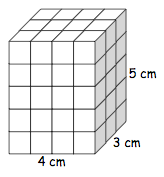

length = 9 m
height = 10 m
width = 12 m

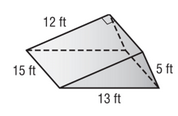
Find the Surface Area
500 ft2
515 ft2
525 ft2
510 ft2

Find the surface area of the figure.
Round your answer to the nearest hundredth.
576.40 in2
1,031.8 in2
2,504.70 in2
517.3 in2

Find the surface area of the figure.
Round your answer to the nearest hundredth.
89.4 yd2
163.20 yd2
44.7 yd2
64.8 yd2

Find the surface area of the figure.
Round your answer to the nearest hundredth.
542.87 mm2
271. 44 mm2
221.06 mm2
442.12 mm2

Find the surface area of the figure.
Round your answer to the nearest hundredth.
73.6 m2
362.2 m2
36.8 m2
181.1 m2

Find the surface area of the figure.
Round your answer to the nearest hundredth.
311.4 ft2
155.7 ft2
196.2 ft2
248.4 ft2

Find the surface area of the figure.
Round your answer to the nearest hundredth.
857.18 km2
428.59 km2
1,537.34 km2
771.64 km2

Find the surface area of the figure.
Round your answer to the nearest hundredth. (Hint: you'll have to use Pythagorean Theorem to find the slant height)
2,400 ft2
1,200 ft2
1,560 ft2
18,000 ft2

Find the surface area of the figure.
Round your answer to the nearest hundredth.
353.43 mm2
833.67 mm2
176.7 mm2
566.76 mm2

Find the surface area of the figure.
Round your answer to the nearest hundredth.(Hint: use the Pythagorean theorem to find half of the side length of the square)
696.96 cm2
541.44 cm2
348.48 cm2
329.76 cm2

13.5 m
29.06 m
10 m
14.46 m

11.4 cm
8.5 cm
10 cm
21.45 cm

Find the surface area of the figure.
Round your answer to the nearest hundredth.
696.80 mm2
348.40 mm2
436.80 mm2
1,034.80 mm2
Determine the area of a regular 6-star polygon if the inner regular hexagon has 10 cm sides.
441.66 cm2
467.64 cm2
519.60 cm2
493.62 cm2
A regular pentagon has sides of 20 cm. An inner pentagon with sides of 10 cm is inside and concentric to the large pentagon. Determine the area inside and concentric to the larger pentagon but outside of the smaller pentagon.
430.70 cm3
573.26 cm3
473.77 cm3
516.14 cm3
The area of a circle is 89.42 sq. inches. What is the length of the side of a regular hexagon inscribed in a circle?
5.533 in.
5.335 in.
6.335 in.
7.335 in.
A regular hexagon is inscribed in a circle whose diameter is 20 m. Find the area of the 6 segments of the circle formed by the sides of the hexagon.
36. 45 sq. m
63. 54 sq. m
45. 63 sq. m
54. 36 sq. m
In triangle ABC, angle C = 70o, A= 45o, AB = 40 m. What is the length of the median drawn from vertex A to side BC?
36.3 m
36.6 m
36.9 m
37.2 m
The angle of a sector is 30 degrees and the radius is 15 cm. What is the area of the sector?
89.5 cm2
58.9 cm2
59.8 cm2
85.9 cm2
What is the radius of the circle circumscribing an isosceles right triangle having an area of 162 sq. cm?
13.52
14.18
12.73
1564
Two complementary angles are in the ratio 2:1. Find the larger angle.
30°
60°
75°
15°
One side of a parallelogram is 10 m and its diagonals are 16 m and 24 m, respectively. Its area is:
156.8 sq. m.
185.6 sq. m.
158.7 sq. m.
142.3 sq. m.
The area of a rhombus is 132 square cm. if its shorter diagonal is 12 cm, the length of the longer diagonal is:
20 centimeter
21 centimeter
22 centimeter
23 centimeter
A regular octahedron has an edge 2m. Find its volume (in m3).
3.77
1.88
3.22
2.44
The central angle of a spherical wedge is 1 radian. Find its volume if its radius is 1 unit.
2/3
1/2
3/4
2/5
The bases of a right prism is a hexagon with one of each side equal to 6 cm. The bases are 12 cm apart. What is the volume of the right prism?
1211.6 cm3
2211.7 cm3
1212.5 cm3
1122.4 cm3
A circular cylinder with a volume of 6.54 cu. m is circumscribed about a right prism whose base is an equilateral triangle of side 1.25 m. What is the altitude of the cylinder in meters?
3.50
3.75
4.00
4.25
The height of a right circular base down is h. If it contains water to depth of 2h/3 the ratio of the volume of water to that of the cone is:
1:27
2:3
8:27
26:27
A conical vessel has a height of 24 cm. and a base diameter of 12 cm. It holds water to a depth of 18 cm. above its vertex. Find the volume of its content in cc.
387.4
381.7
383.5
385.2
The slant height of a right circular cone is 5m long. The base diameter is 6m. What is the lateral area in sq. m?
37.7
47
44
40.8
The base areas of a frustum of a cone are 25 sq. cm. and 16 sq. cm, respectively. If its altitude is 6 cm, find its volume.
120 cm3
122 cm3
129 cm3
133 cm3
The surface area of the sphere is 4πr2. Find the percentage increase in its diameter when the surface area increases by 21%.
5%
10%
15%
20%
If a solid steel ball is immersed in an eight cm. diameter cylinder, it displaces water to a depth of 2.25 cm. the radius of the ball is:
3 cm
6 cm
9 cm
12 cm
A ___________is any closed, two-dimensional shape.
quadrilateral
figure
plane figure
solid figure
A ______________ is three-dimensional, having length, width and height.
plane figure
solid figure
triangle
quadrilateral
Any flat surface of a solid figure is called a ____.
edge
face
vertice
shape
The line segment where two faces of a solid figure intersect is called ______.
face
vertex
edge
The point at which two or more lines, line segments, or rays meet to form an angle. In solid figures, a _______ is the point at which three or more faces meet.
face
edge
vertex
What shape am I?
I have one circle and one curved side. My curved side surface meets at a sharp point. I have no edges.
cube
sphere
cone
triangular prism
What shape am I?
I have two congruent circles that are joined by a curved surface. I have no edges or vertices, but I can roll.
Cylinder
Sphere
Cone
Cube
What shape am I?
I am round with no edges, vertices, or edges.
Cyclinder
Sphere
Cone
Circle
What shape am I?
I have 6 faces , 12 edges, and 8 vertices. I have all the same shaped faces. All my edges are the same length.
Square Pyramid
Rectangular Prism
Cube
Cone
What shape am I?
I have 12 edges, 8 vertices, and 6 faces. I have both square and rectangular faces.
Rectangle
Cube
Square Pyramid
Rectangular Prism
What shape am I?
I have 5 faces, 8 edges, and 5 vertices. I have two different shaped faces.
Square Pyramid
Rectangular Prism
Cube
Cyclinder

What geometric figure will be created?
Cube
Rectangular Prism
Square Pyramid
Cone

What geometric shape will be created?
Cube
Rectangular Prism
Squares
Cyclinder
What combinations of shapes would you need to create a cube?
6 square faces
6 rectangle faces
4 squares and 2 rectangles faces
4 rectangles and 2 square faces
What combinations of shapes would you need to create a rectangular prism?
6 square faces
6 rectangle faces
4 squares and 2 rectangles faces
4 rectangles and 2 square faces
It is a segment drawn from a vertex that bisects that vertex angle.
Median
Angle Bisector
Altitude
hypotenuse

Find x.
72
67
65
54


Find the area of this triangle.
25
15.59
13.5

It is the longest side of a right triangle
Hypotenuse
Median
Base
Altitude
The sum of the lengths of any two sides of a triangle is _____ than the third side
less
greater
equal

