
 Worksheets
A & P chapter 1 part 3 Anatomical Terms/Planes/Cavities
Total questions: 70
Worksheet time: 37mins
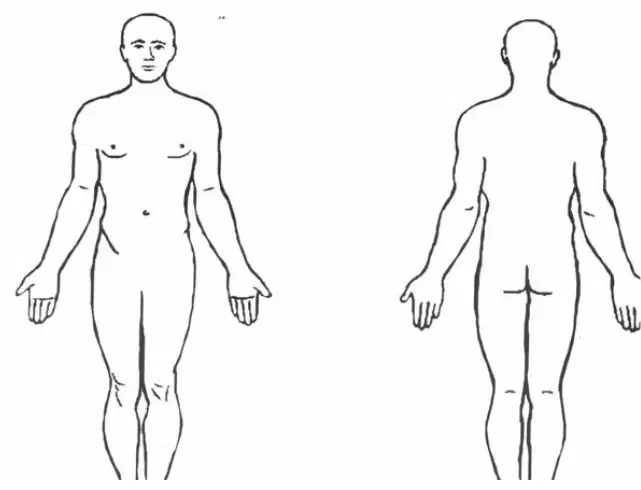
What is the standard anatomical position?
Body erect, feet slightly apart, palms facing forward with thumbs pointing away from body
Body sitting, feet together, palms facing backward
Body erect, feet slightly apart, palms facing backward with thumbs pointing toward body
Body standing, arms crossed
Fill in the blank: In the standard anatomical position, the palms are facing ______ with thumbs pointing away from the body.
forward
backward
downward
inward
Directional terms describe one body structure in relation to ________.
another body structure
a chemical reaction
an external environment
a body function
Direction is always based on the standard anatomical position.
True
False
Right and left refer to the observer, not the body being viewed.
True
False
What does the term 'Superior (cranial)' mean?
Toward the head end or upper part of a structure or the body; above
Toward the feet or lower part of a structure; below
Away from the midline of the body; on the outer side
Toward or at the front of the body; in front of
Which term describes 'Away from the head end or toward the lower part of a structure or the body; below'?
Inferior (caudal)
Superior (cranial)
Anterior (ventral)
Posterior (dorsal)
What does 'posterior (dorsal)' mean?
Toward or at the back of the body; behind
Toward or at the front of the body; in front of
Away from the midline of the body; on the outer side
Closer to the origin of the body part or the point of attachment
What is the definition of 'Medial'?
Toward or at the midline of the body; on the inner side of.
Away from the midline of the body; on the outer side of.
Above or higher than another part of the body.
Toward the back of the body.
What is the definition of 'Lateral'?
Away from the midline of the body; on the outer side of.
Toward the midline of the body; on the inner side of.
Closer to the origin of the body part or the point of attachment.
Farther from the origin of a body part or the point of attachment.
What is the definition of 'Intermediate'?
Between a more medial and a more lateral structure.
Closer to the surface of the body.
Farther from the origin of a body part.
On the opposite side of the body.
Fill in the blank: ________ means closer to the origin of the body part or the point of attachment of a limb to the body trunk. Example: The elbow is ______ to the wrist.
Proximal
Distal
Inferior
Lateral
Fill in the blank: ________ means farther from the origin of a body part or the point of attachment of a limb to the body trunk. Example: The knee is ______ to the thigh.
Distal
Proximal
Medial
Superior
Fill in the blank: ________ means toward or at the body surface. Example: The skin is ________ to the skeletal muscles.
Superficial
Deep
Medial
Lateral
Fill in the blank: ________ (internal) means away from the body surface; more internal. Example: The lungs are ______ to the skin.
Deep
Superficial
Lateral
Anterior
Which anatomical term refers to 'toward the head'?
Inferior
Superior
Distal
Lateral
Which anatomical term refers to 'away from the midline of the body'?
Medial
Lateral
Proximal
Dorsal
Which anatomical term refers to 'closer to the point of attachment or origin'?
Distal
Proximal
Inferior
Ventral
Which anatomical term refers to 'farther from the point of attachment or origin'?
Proximal
Distal
Superior
Cephalic
Which anatomical term refers to 'toward the midline of the body'?
Lateral
Medial
Dorsal
Caudal
Which anatomical term refers to 'toward the feet or lower part of the body'?
Superior
Inferior
Cephalic
Ventral
Which anatomical term refers to 'toward the front of the body'?
Posterior
Dorsal
Anterior
Caudal
Which anatomical term refers to 'toward the back of the body'?
Ventral
Dorsal
Medial
Proximal
Which anatomical term refers to 'toward the head (specifically the head end)'?
Caudal
Cephalic
Inferior
Distal
Which anatomical term refers to 'toward the tail or lower part of the body'?
Cephalic
Caudal
Superior
Proximal
Which anatomical term refers to 'toward the back or rear side'?
Anterior
Dorsal
Medial
Lateral
What does the term 'Superior' refer to in the context of brain anatomy?
In front of
Above
Behind
Below
What does the term 'Inferior' refer to in the context of brain anatomy?
In front of
Above
Behind
Below
What does the term 'Anterior' refer to in the context of brain anatomy?
A) In front of
B) Above
C) Behind
D) Below
BONUS QUESTION:
The longitudinal axis of the forebrain runs from _______ to _______.
Rostral to Caudal
Dorsal to Ventral
Medial to Lateral
Inferior to Superior
BONUS QUESTION:
The longitudinal axis of the brainstem and spinal cord runs from _______ to _______.
Dorsal to Ventral
Anterior to Posterior
Medial to Lateral
Superior to Inferior
What does the term 'Ipsilateral' mean?
On the same side of the body
On the opposite side of the body
In the middle of the body
Away from the body
What does the term 'Contralateral' mean?
On the same side of the body
On the opposite side of the body
In the middle of the body
Away from the body
The right arm and right leg are _________. (Fill in the blank with the correct directional term.)
ipsilateral
contralateral
proximal
distal
The right arm and left leg are _________. (Fill in the blank with the correct directional term.)
contralateral
ipsilateral
proximal
distal
Fill in the blank: The anatomical term for the cheek region is _______.
Buccal
Femoral
Cervical
Orbital
Fill in the blank: The anatomical term for the wrist is _______.
Carpal
Tarsal
Femoral
Patellar
Fill in the blank: The anatomical term for the thigh is _______.
Femoral
Brachial
Cervical
Carpal
Fill in the blank: The anatomical term for the forehead is _______.
Frontal
Temporal
Occipital
Mandibular
Which of the following is the anatomical term for the calf?
Crural
Sural
Femoral
Patellar
Which of the following is the anatomical term for the arm?
Brachial
Antebrachial
Carpal
Acromial
Which of the following is the anatomical term for the sole of the foot?
Plantar
Tarsal
Calcaneal
Hallux
Which regional term refers to the back of the head?
Otic
Occipital
Cervical
Scapular
The term 'Gluteal' refers to which area of the body?
Hip
Buttock
Thigh
Calf
Fill in the blank: The anatomical term for the region between the anus and external genitalia is ________.
Perineal
Femoral
Axillary
Popliteal
What are the three most common body planes used for anatomical study?
Sagittal plane, Frontal (coronal) plane, Transverse (horizontal) plane
Dorsal plane, Ventral plane, Oblique plane
Median plane, Lateral plane, Inferior plane
Superior plane, Inferior plane, Oblique plane
Fill in the blank: A cut made that divides the human body into left and right results in a ______ section.
sagittal
transverse
coronal
oblique
Fill in the blank: Surfaces along which body or structures may be cut for anatomical study are called ______.
body planes
body cavities
body tissues
body systems
What is the name of the plane that divides the body vertically into right and left parts if cut along this plane?
Sagittal plane
Coronal plane
Transverse plane
Oblique plane

Which plane is described as a cut made perfectly on the midline? (divides into equal right and left parts)
Midsagittal (median) plane
Frontal (coronal) plane
Transverse (horizontal) plane
Oblique plane
Which plane is described as a cut that was off-centered, not on the midline?
Parasagittal plane
Midsagittal plane
Transverse plane
Coronal plane
What does the frontal (coronal) plane do?
Divides the body horizontally into upper and lower parts
Divides the body vertically into anterior and posterior parts (front and back)
Divides the body diagonally
Produces a transverse section
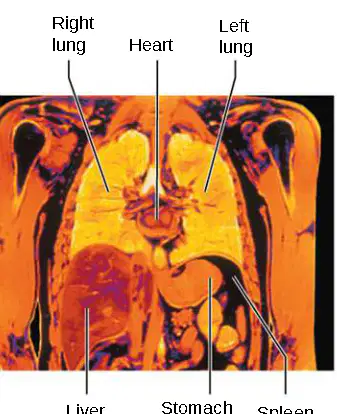
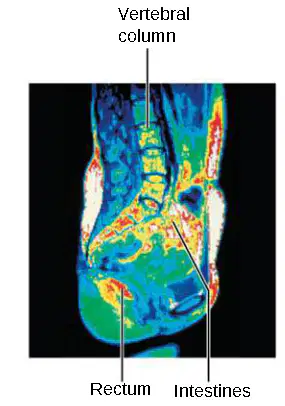
In the MRI scan shown, which plane would this be considered?
Transverse Plane
Frontal(coronal) Plane
Midsagittal Plane
Sagittal Plane
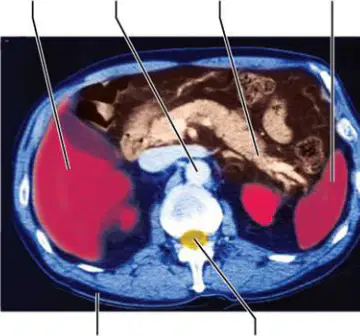
In the scan shown, which plane would this be considered?
Frontal(Coronal) Plane
Midsagittal Plane
Transverse Plane
Plain Jane Plane
Cavities provide different degrees of ______ to organs within them.
protection
exposure
movement
pressure
Which of the following is NOT one of the two sets of body cavities?
Dorsal body cavity
Ventral body cavity
Lateral body cavity
Name the two sets of body cavities mentioned in the passage.
Dorsal body cavity and Ventral body cavity
Cranial cavity and Thoracic cavity
Abdominal cavity and Pelvic cavity
Pleural cavity and Pericardial cavity
Which body cavity contains the brain?
Thoracic cavity
Cranial cavity
Abdominal cavity
Pelvic cavity
The vertebral cavity contains the ________.
spinal cord
heart
lungs
stomach
Which of the following is NOT a subdivision of the ventral body cavity?
Thoracic cavity
Abdominopelvic cavity
Cranial cavity
Pelvic cavity
The ________ cavity contains the heart and lungs.
thoracic
abdominal
pelvic
cranial
Which cavity is separated from the abdominal cavity by the diaphragm?
Cranial cavity
Thoracic cavity
Pelvic cavity
Vertebral cavity
The ventral body cavity is subdivided into which two main cavities?
Cranial and spinal cavities
Thoracic and abdominopelvic cavities
Dorsal and ventral cavities
Abdominal and pelvic cavities
True/False: Synovial(joint) cavities are exposed to the environment.
True
False
True/False: The pericardial cavity is located within the mediastinum.
True
False
The majority of the digestive organs are located in this body cavity:
Abdominal
Pelvic
Thoracic
Dorsal
Which organ separates the thoracic cavity from the abdominopelvic?
Liver
Lungs
Diaphragm
Stomach
The pelvic cavity contains which organs?
Reproductive
Lungs
Heart
Bladder

