
 Worksheets
Food Science Review
Total questions: 64
Worksheet time: 51mins
Which elements are the basic components of a sugar?
Carbon and Nitrogen
Carbon and Oxygen
Carbon, Hydrogen, Oxygen
Hydrogen, Oxygen, Nitrogen
All dietary carbohydrates are converted to which simple sugar before being used for energy?
Fructose
Sucrose
Glucose
Galactose
Which statement best defines a disaccharide?
Two monosaccharides joined together
A single sugar ring molecule
A long chain of sugar units
A lipid made from fatty acids
In fudge, why is controlled crystallization important for texture?
It forms larger crystals for firmness
It prevents any crystals from forming
It ensures small crystals for smoothness
It replaces sugar with natural acids
Higher sugar concentration in lollipop mixtures most directly leads to which outcome?
Smaller crystals and softer candy
Larger crystals and harder candy
No crystals and chewy candy
Irregular crystals and sticky candy
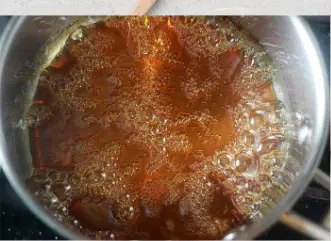
During caramelization, what fundamental change happens to sugar molecules?
They absorb water without reacting
They break down and form new compounds
They freeze and become inert solids
They dissolve protein to reduce browning
A chef wants soft, smooth fudge. Describe one specific adjustment to achieve this outcome and explain the reasoning.
Increase sugar concentration to grow large crystals
Cool the syrup rapidly to prevent any crystals
Control crystallization to form small crystals
Heat until deep amber to enhance hardness
Which statement best defines the Maillard reaction in cooking?
A browning process when sugars and amino acids heat
A caramelization of sucrose without any proteins
A fermentation of sugars by yeasts at low temperatures
A oxidation of fats causing rancidity in stored foods
Name one everyday food change caused by the Maillard reaction.
Crust on bread becoming brown and flavorful
Sugar dissolving faster in cold water
Butter melting at room temperature
Salt drawing water out of cucumbers
Why does sugar act as a preservative in jams and candies?
It inhibits the growth of microorganisms
It neutralizes all acids in fruit
It increases protein content in foods
It blocks oxygen from touching the surface
Which statement best defines a polysaccharide in the context of starches?
A chain of many glucose units
A pair of linked glucose units
A single unlinked glucose unit
A fat composed of glycerol units
Which list correctly identifies other common starch sources?
Rice, corn, potatoes, oats, soy
Rice, beef, potatoes, oats, soy
Rice, corn, apples, oats, soy
Rice, corn, potatoes, milk, soy
Which statement best describes starch absorption during cooking?
Granules take up liquid and swell
Granules release liquid and shrink
Granules evaporate liquid as steam
Granules dissolve into fats quickly
When heated, starch granules swell and burst, releasing molecules into the liquid. What is this process called?
Gelatinization
Caramelization
Fermentation
Emulsification
Starch helps gluten-free baking by primarily doing what?
Binding ingredients together
Creating gluten networks
Reducing oven temperatures
Increasing sugar caramelization
Fill in the blank: Starch thickens when heated and (a) when cooled, helping foods keep shape.
A sauce fails to thicken because cornstarch was mixed into cold liquid after cooking. What adjustment would best fix this?
Heat starch in liquid before adding
Add more salt to the mixture
Cool the sauce rapidly with ice
Whisk in oil to emulsify
A cook wants thicker gravy with smooth texture. Which step demonstrates understanding of gelatinization?
Simmer with starch until granules swell
Freeze gravy then add raw starch
Add starch to oil without liquid
Avoid heating to keep molecules intact
A sol is primarily characterized by which condition?
Unheated starch dispersed in cold liquid
Heated starch with partial gelatinization
Complete gelatinization forming a rigid gel
Highly viscous paste almost gelatinized
Which term refers to a heavily thickened starch liquid mixture that is almost gelatinized?
Slurry
Sol
Paste
Gel
Fill in the blank: A rigid starch mixture that has fully set is called a (a) .
During cooling, starch granules try to return to their prior structure, causing what process?
Gelatinization progresses further
Retrogradation increases firmness
Syneresis decreases water expulsion
Liquefaction reduces viscosity
A sauce set overnight shows a watery layer around a firm center. What is the most likely explanation?
Incomplete gelatinization during heating
Retrogradation leading to cracking
Syneresis expelling water from the gel
Incorrect starch type causing separation
Which method mixes equal parts starch and fat to disperse starch evenly?
Cold water paste technique
Roux
Gelatinization through simmering
Sugar syrup incorporation
Which item is a category of lipids commonly used in cooking?
Fats used for frying and baking
Glucose for quick energy bursts
Cellulose providing plant structure
Starch stored in plant seeds
Which statement best distinguishes fat and oil products at room temperature?
Fat is solid, oil is liquid,
Fat is liquid, oil is solid,
Fat and oil are both semi solid
Fat is semi-solid, oil is liquid
What is the most accurate definition of smoke point in cooking oils?
Temperature when oil begins to visibly smoke
Temperature when oil fully evaporates
Temperature when oil freezes from cooling
Temperature when oil changes color permanently
Fill in the blank: The flash point is the temperature at which a cooking lipid will catch (a) .
You are comparing two oils for deep frying: Oil A has a higher smoke point than Oil B. Which consequence is most likely when using Oil A?
Less smoke production when cooking at higher temps
Greater risk of immediate flaming in the fryer
More water absorption into fried foods
Instant solidification at room conditions
Which statement best describes how fats act as aerators in batters during mixing?
They trap tiny bubbles to create lift
They dissolve starch to form gels
They denature proteins for structure
They absorb water to prevent gluten
In baked goods, what is a primary outcome of incorporating fat that has aerated the batter?
Increased lift in the final product
Stronger gluten network formation
Lower moisture loss during baking
Higher sugar caramelization rate
What is marbling in meat?
Specks or streaks of fat in muscle
Crystals of salt in connective tissue
Air pockets formed during cooking
Bundles of protein aligned in fibers
A chef wants a more tender steak. Which choice aligns with the role of fat described?
Select cuts with more marbling
Trim all visible fat before cooking
Use lean meat with minimal fat
Soak in water and seasonings
Which statement best defines an emulsion in food science?
Mixture of lipid and water fully combined
Solution of dissolved sugar in hot water
Suspension of solid particles in salty water
Blend of gases evenly distributed in air
In an emulsion, which type of substance is the lipid component typically considered?
Nonpolar molecule with neutral charge
Polar molecule with partial charges
Ionic compound with full charges
Amphoteric base reacting with acids
A student tries to mix oil and water and observes separation. Which evidence-based change should they make to achieve a stable emulsion?
Introduce an emulsifier like egg yolk
Increase stirring speed only
Chill the mixture to near freezing
Add table salt for ionic strength
Which statement best describes auto-oxidation in food lipids?
Slow water loss that dries fatty tissues
A reaction to oxygen exposure causing lipid deterioration
Heat-induced melting that softens fatty structures
Enzymatic browning that darkens carbohydrate surfaces
Rancidity is best characterized as which of the following?
Always a severe health hazard in all cases
A form of food spoilage that may become harmful
A cooking technique to tenderize aged fats
A preservative process preventing oxidation
Complete proteins are those that...
Contain amino acids
Contain all necessary amino acids
Contain 9 Amino acids
Come from plants
Incomplete proteins typically come from
Meat
Milk
Eggs
Plants
Denaturation occurs when...
Proteins are frozen
Proteins are incomplete
Proteins are mixed with lipids
Proteins are heated or agitated
Which is not a demonstration of denaturation of proteins
Scrambled eggs solidifying when cooked
Water steaming from heat
Chicken going from white to pink
Coagulation is the...
Break down of proteins
Changing of texture
Forming of clots
Creation of layers
Which of the following is a characteristic of unsaturated fats?
Found mostly in dairy products
Increases risk of heart disease
Solid at room temperature
Liquid at room temperature
Saturated fats come from which sources?
Soil
Animal
Plant
Alien
Boiling water is an example of ______________, because the warm water rises and the cool water sinks as heat energy is transferred from the bottom of the pan to the top.
Radiation
Conduction
Convection
Condensation
_____________, travels through waves, does not touch
Radiation
Transpiration
Conduction
Convection
The type of heat transfer that occurs when heat is transferred from one item to another through direct contact is called
A. conduction.
B. convection.
C. microwave.
D. radiation.
Heat transfer by conduction happens when:
there is a circulation of hot air/water rising and cold air/water sinking
there is space that heat travels through in waves outwardly
two objects are touching and heat moves from one object into the next object
Without temperature control Raw food can stay out for ______ hours
2
4
6
1
To brown or cook in a small amount of fat.
Sauté
Boil
Whip
Knead
To cook in a liquid just under the boiling point in which bubbles break below the surface.
Simmer
Boil
Fry
Bake
To cut or chop into very small pieces.
Mince
Knead
Dice
Peel
To work or press dough with the palms of your hands.
Fold
Knead
Blend
Mix
The two "T"'s in FAT TOM stand for?
Time and Temperature
Testability and Tolerance
Time and Tom
Terminal and Toast
The "F" in FAT TOM stands for?
Friend
Fat
Food
Foreign
The "A" in FAT TOM stands for?
Aerobic
Anaerobic
Acidity
Activity
The "O" in FAT TOM stands for?
Optimize
Over
Oatmeal
Oxygen
The 4 easy steps to food safety IN ORDER are....
Cook, Clean, Separate, Chill
Chill, Cook, Clean, Separate
Clean, Separate, Cook, Chill
Separate, Clean, Cook, Chill
The "danger zone" of temperature is...
32-100 degrees F
0-100 degrees C
40-140 degrees F
Anything not boiling

How many teaspoons are in a Tablespoon?
2
3
4
6

How many Tablespoons are in a cup?
8
12
16
14

How many ounces are in a pound
12
16
18
14

