wayground logo

Free Printable Worksheets

NEW

Font size

S
M
L
XL
Worksheets

Biology Semester 1

Total questions: 60

Worksheet time: 1hrs 4mins

Name
Class
Date
1.
The maintenance of an organism’s internal environment is called:
a)
compensating
b)
homeostasis
c)
balancing
d)
routine
2.
An experiment is performed on plants to see how different liquids affect plant growth. Each plant in the experiment is given a different liquid; water, apple juice, or milk. Each plant has the same amount of soil, sunlight, and listens to the same music. In this investigation, what are the controlled variables?
a)
Type of plant, amount of music, and sunlight
b)
Water, apple juice, milk
c)
Plant growth
3.
What are the products of photosynthesis?
a)
water and carbon dioxide
b)
oxygen and glucose
c)
oxygen and carbon dioxide
d)
oxygen and water
4.
Which gas is removed from the atmosphere during photosynthesis?
a)
hydrogen
b)
oxygen
c)
nitrogen
d)
carbon dioxide
5.
Which sentence correctly describes photosynthesis. (assume there is enough sunlight)
a)
CO2 and water combine and make O2 and glucose
b)
O2 and water combine to make glucose and CO2
c)
O2 and CO2 combine to make water and glucose
d)
CO2 and glucose combine to make O2 and water
6.
What is the organelle that contains the chlorophyll used in photosynthesis ?
a)
mitochondria
b)
ribosome
c)
chloroplast
d)
nucleus
7.
What is the end product of photosynthesis ?
a)
carbon dioxide
b)
water
c)
glucose
d)
methane
8.
Which of the following is the correct equation for PHOTOSYNTHESIS?
a)
CO+ light + H2O --> O+ glucose
b)
CO+ glucose + H2O --> O+ light
c)
O2 + light + H2O --> CO+ glucose
d)
CO+ O2 + H2O --> Light+ glucose
9.

In which way are photosynthesis and cellular respiration similar?

a)

Both processes destroy energy.

b)

Both create energy.

c)

Photosynthesis breaks down sugar while cellular respiration produces sugar.

d)

Both processes transfer energy from one form to another.

10.

What is the correct equation for cellular respiration?

a)

oxygen + sugar -> carbon dioxide + water + Energy

b)

carbon dioxide + sugar + Energy -> carbon dioxide + water

c)

carbon dioxide + water -> oxygen + sugar + Energy

d)

carbon dioxide + water + Energy -> oxygen + sugar

11.

What is important about cellular respiration?

a)

It produces energy from the sun.

b)

It forms sugar.

c)

It transforms sugar into a usable form of energy (ATP)

d)

Only plants perform this process.

12.

One molecule needed for cellular respiration is

a)

carbon dioxide

b)

glucose

c)

water

d)

chlorophyll

13.

What are the 3 reactants of photosynthesis? The reactants are the things needed for photosynthesis to occur.

a)

oxygen, glucose, sunlight

b)

sunlight, oxygen, water

c)

water, oxygen, carbon dioxide

d)

carbon dioxide, sunlight, water

14.

What are the 2 products of photosynthesis? The products are the things made in the process of photosynthesis.

a)

water, sunlight

b)

glucose, carbon dioxide

c)

oxygen, glucose

d)

sunlight, oxygen

15.
How are plant cells different from animal cells?
a)
Only plant cells can grow
b)
Only animal cells can reproduce
c)
Only animal cells can store energy
d)
Only plant cells can perform photosynthesis
16.
What is diffusion?
a)
when molecules move 
b)
when molecules move from a high concentration to a low.
c)
no movement 
d)
molecules move everywhere
17.
Osmosis is the movement of _____ across a membrane.
a)
food
b)
energy
c)
oxygen
d)
water
18.
When both inside and outside of a cell have the same amount of water it is said that the cell has reached a state of
a)
Osmosis
b)
Diffusion
c)
Equilibrium
19.
What are the nucleotides made of?
a)
Sugar, Phosphate, nitrogen base
b)
Phosphate, Adenine, nitrogen base
c)
Thymine, Adenine, Cytomine
d)
Phosphate, Nitrogen, Adenine
20.
Adenine bonds with ______________.
a)
Guanine
b)
Thymine
c)
Cytosine
d)
Adenine
21.
Guanine bonds with ______________.
a)
Adenine
b)
Guanine
c)
Cytosine
d)
Thymine
22.
Which sequence of DNA bases would pair with this partial strand
ATG TGA CAG
a)
ATG TGA CAG
b)
TAC ACT GTC
c)
GTA AGT GAC
d)
CAT TCA CTG
23.
What determines the code, or information, of a DNA molecule?
a)
the shape (structure) of the nitrogen bases
b)
the order (sequence) of the nitrogen bases
c)
the color of the nitrogen bases
d)
the frequency (number) of nitrogen bases
24.
How does RNA differ from DNA?
a)
RNA contains uracil and deoxyribose
b)
RNA contains ribose and thymine
c)
RNA contains uracil and ribose
d)
RNA contains adenine and ribose
25.
How would the DNA sequence GCTATA be transcribed to mRNA?
a)
GCUAUA
b)
CGATAT
c)
CGAUAU
d)
GCUTUT
26.
The process by which the genetic code of DNA is copied into a strand of RNA is called
a)
translation
b)
transcription
c)
transformation
d)
replication
27.
Which of the following describes RNA?
a)
RNA is usually double-stranded and contains the base thymine
b)
RNA is usually single-stranded and contains the base uracil
c)
RNA is longer than DNA and uses five bases to encode information
d)
RNA is made in the nucleus of eukaryotic cells and stays there to carry out its functions
28.
The process of making proteins on the ribosome based on instructions from messenger RNA is called
a)
transcription
b)
transformation
c)
translation
d)
molecular biology
29.

What base does RNA have that DNA does not?

a)

uracil

b)

thymine

c)

cytosine

d)

guanine

30.
Transfer RNA or tRNA reads the mRNA in groups of three bases called...
a)
codons
b)
codes
c)
anticodons
d)
bases
31.
If a DNA strand reads ATT CGT CTA, what would the tRNA strand read?
a)
  UAA GCA GAT
b)
UAU CGA GAU
c)
AUU CGU CUA
d)
ATT CGT CTA
32.

Which of these is in the proper order for the hierarchy of life?

a)

Molecules, Organelles, Cells, Tissue, Organs, Organ Systems, Organism

b)

Molecules, Cells, Organelles, Tissue, Organs, Organ Systems, Organism

c)

Organelles, Molecules, Tissue, Organs, Organ Systems, Organism

d)

Molecules, Cells, Tissue, Organelles, Organs, Organ Systems, Organism

33.

All living organisms are made up of ________.

a)

cells

b)

theory

c)

particles

d)

chloroplasts

34.

A(n) ___________ is a planned procedure to test a hypothesis.

a)

plan

b)

experiment

c)

theory

d)

cell

35.

What is homeostasis?

a)

changing temperatures

b)

being the same

c)

maintaining a constant internal environment

36.

Amount of sunlight and climate are examples of ________ factors.

a)

biotic

b)

abiotic

37.

The process of turning light energy into chemical energy is _____________.

a)

carbon dioxide

b)

photosynthesis

c)

cellular respiration

d)

decomposition

38.

Enzymes are made of.....

a)

lipids

b)

carbs

c)

protein

d)

glucose

39.

Which is a monomer of proteins?

a)

lipids

b)

amino acids

c)

enzymes

d)

water

40.

What is the source of energy for all cells?

a)

oxygen

b)

cells

c)

glucose

d)

enzymes

41.

Movement across the cell membrane that does NOT require energy from the cell

a)

passive transport

b)

active transport

c)

concentration gradient

d)

osmosis

42.

The diffusion of water through a selectively permeable membrane.

a)

passive transport

b)

osmosis

c)

carrier proteins

d)

diffusion

43.

What is the function of ribosomes?

a)

to transport material

b)

to digest material

c)

to make endoplasmic reticulum

d)

to make proteins

44.

What is true about eukaryotes?

a)

All have chloroplasts

b)

All have a nucleus

c)

All have a cell wall

d)

They have no nucleus

45.

What happens when a cell is put in a solution with a concentration of solutes that is higher than in the cell?

a)

The cell swells and bursts

b)

The cell shrivels and becomes dehydrated

c)

The cell can no longer use its carrier proteins

d)

Active transport can happen quicker

46.

What is the chemical formula for glucose?

a)

H2O

b)

CHO

c)

C6HO9

d)

C6H12O6

47.

water is ________

a)

non-polar

b)

a carb

c)

polar

48.

Which of the following is NOT an example of a carbohydrate?

a)

glucose

b)

meat

c)

lactose

d)

starch

49.

The monomer of a carbohydrate is a(n) _______________.

a)

fatty acid

b)

monosaccharide

c)

amino acid

d)

nucleotide

50.
Which type of cell?
a)
Prokaryote
b)
Eukaryote
51.
The mitochondria
a)
Controls what enters and leaves the cell
b)
Performs photosynthesis to make food for the cell.
c)
Contains the chromosomes and is known as the "brain" of the cell.
d)
Breaks down food to produce energy for the cell.
52.
The jelly-like fluid that supports the organelles in place. 
a)
nucleus
b)
cell membrane
c)
chloroplast
d)
cytoplasm
53.
Which rigid organelle provides strength and support to plant cells.
a)
Chloroplast
b)
Cell Wall
c)
Cell Membrane
d)
Vacuole
54.
What is photosynthesis?
a)
The process in which humans eat their food
b)
When a photographer takes a photo.
c)
To get your pictures from the photo lab.
d)
The process in which plants make their food.
55.
The basic unit of life is
a)
photon
b)
nutron
c)
organism
d)
cell
56.
Dominant alleles are represented by a:
a)
Male gene
b)
lowercase letter
c)
recessive trait
d)
capital letter
57.
In a heterozygous genotype, the ___________ allele takes over in the phenotype.
a)
recessive
b)
dominant
c)
lower case letter
d)
both 
58.
What you see, or the physical appearance.
a)
Genotype
b)
Phenotype
c)
Homozygous
d)
Heterozygous
59.
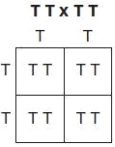
What ratio of the offspring from the cross shown will be homozygous recessive for the  trait of tallness? 
a)
0 in 4
b)
1 in 4
c)
2 in 4
d)
4 in 4
60.
W=white hair
w= non-white hair
If you cross a horse with WW and a horse with ww what fraction of the offspring would be expected to have white hair?

a)
none
b)
3/4
c)
1/2
d)
all