
NEW
Font size
 Worksheets
Anatomy and Physiology Final Exam Review
Total questions: 66
Worksheet time: 33mins
ANATOMY is the study of:
the position of body parts
the function of body parts
the structure of body parts
the creation of body parts
PHYSIOLOGY is the study of:
the function of body parts
the structure of body
the position of body parts
the creation of body parts
Cells that perform similar functions form:
cavities
tissues
appendices
membranes
Which body system is responsible for maintaining water balance and excretion of wastes?
digestive
nervous
endocrine
urinary
Which body system is responsible for gas exchange?
respiratory
excretory
endocrine
lymphatic
The pericardial cavity is the area that surrounds the:
lungs
heart
muscles
brain
The body cavity that houses your lungs, esophagus, and heart is the:
abdominal cavity
pleural cavity
diaphragm cavity
thoracic cavity
The body's tendency to maintain a balanced, stable environment is called:
homeostasis
static constancy
biofeedback
hormonal balance
The thoracic cavity is separated from the abdominopelvic cavity by the:
heart
mesentery
pleural membrane
diaphragm
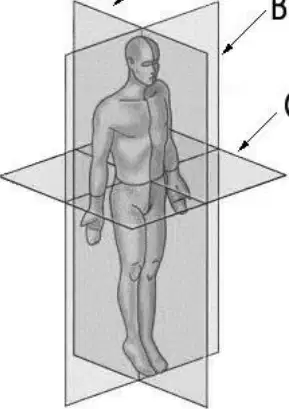
Which letter on the drawing represents a CORONAL SLICE? Choose A, B, or C
A
B
C
The appendicular portion of the body refers to the:
head and spine
arms and legs
gut region
lobes of the brain
A cut that only goes through the layer of skin, would be called:
lateral
deep
superficial
superior
If an organ is said to be “superior” to another organ, that generally means that it is:
parallel to it
below it
above it
more complex
The word "lateral" means:
to the side
down the midline
thinner
Which cell organelle is responsible for transporting substances?
ribosomes
endoplasmic reticulum
nucleolus
golgi apparatus
Which cell organelle is often found attached to the ER and makes proteins?
lysosomes
golgi apparatus
ribosomes
nucleolus
This organelle secretes enzymes that can help break down food substances or foreign particles:
endoplasmic reticulum
ribosomes
nucleus
lysosomes
The movement of WATER molecules across a membrane is called:
mitosis
endocytosis
osmosis
active transport
This term refers to the “taking in” of solid particles by a cell and involves the surrounding of the particle by the cell membrane:
diffusion
endocytosis
exocytosis
neurotransmission
The purpose of the spindle fibers during mitosis is:
to copy the DNA
to dissolve the cell membrane
to make protein
to move the chromosomes
If a blood cell is placed into a salt solution, the cell will:
swell
shrink
When a cell divides uncontrollably, what condition develops?
AIDS
osteoporosis
cancer
arthritis
Small molecules such as oxygen enter the cell through what process?
excitation
phagocytosis
permeation
diffusion

The image shows a cell in:
metaphase
interphase
telophase
anaphase
prophase
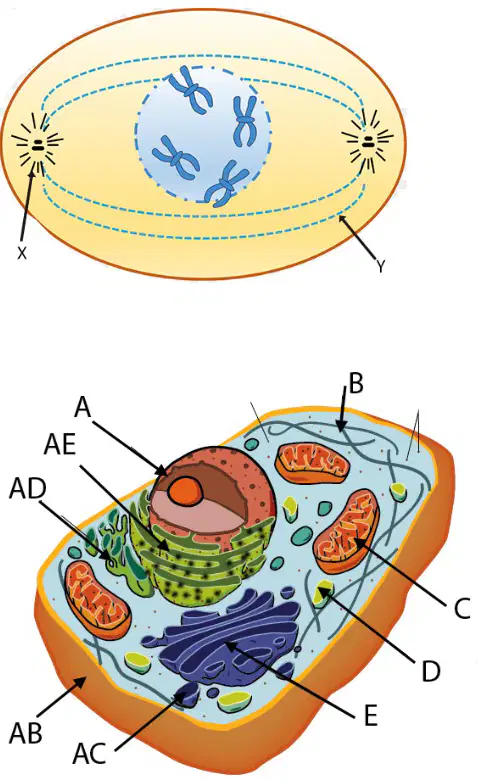
The arrow (X) is pointing to a:
centriole
centromere
nuclear membrane
flagella
spindle
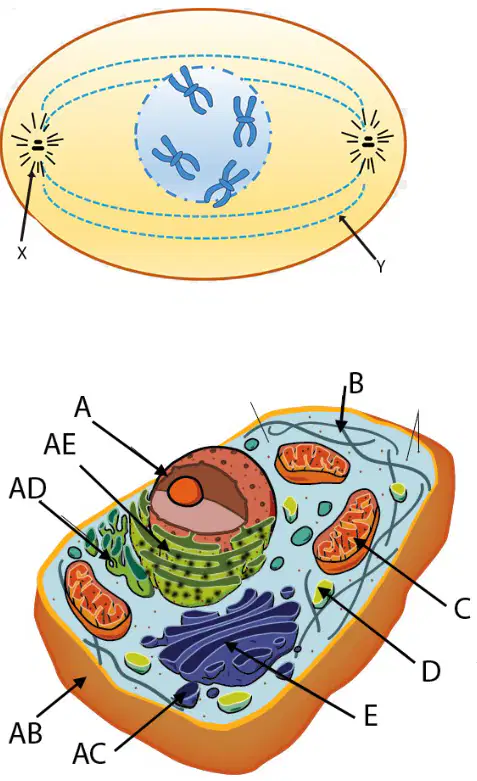
This arrow (Y) is pointing to a:
centriole
centromere
nuclear membrane
flagella
spindle
43. Proteins are “refined and packaged for delivery” to other areas of the cell by the:
golgi apparatus
mitochondria
nucleus
lysosomes
These “packages” are exported out of the cell as:
ventricles
vesicles
tubules
ribosomes
The matrix of this type of tissue contains collagen and elastic fibers:
epithelial
nervous
connective
muscle
Epidermolysis bullosa (EB) is a condition caused by a defect in which type of tissue?
connective
cardiac
liver
cuboidal
ATP is obtained from chemical energy released by processes occurring in the:
golgi apparatus
lysosomes
nucleolus
mitochondria
Simple squamous, cuboidal, and transitional all refer to different types of this type of tissue:
epithelial
nervous
connective
muscle
Tendons and ligaments are composed primarily of:
connective tissue
muscle tissue
adipose tissue
nervous tissue
Simple squamous cells are found in the lungs. These cells are specialized for what function?
secretion
absorption
protection
diffusion
The end of a long bone in your skeleton is called the:
diaphysis
epiphysis
endosteum
medullary condyle
The large hole in the bottom of the skull is called the:
mandibular foramen
orbital foramen
foramen magnum
vertebral foramen
The clavicles and the scapulas make up the:
pectoral girdle
thoracic cage
pelvic girdle
cranium
Red bone marrow is found within the:
spongy bone
endosteum
medulla
canaliculi
The wrist bones are collectively called:
tarsals
metatarsals
carpals
phalanges
Which cartilage covers and cushions the end of bones?
articular
axial
lumbar
medullary
The shaft of a long bone is called the:
epiphysis
endosteum
diaphysis
periosteum
What type of joint is found in your shoulder (where the humerus connects to the scapula)?
saddle
hinge
pivot
ball and socket
What type of joint is found at your knee?
hinge
ball and socket
pivot
saddle
Bone cells are called:
canaliculi
osteocytes
chondrocytes
phalanges
Coxal bones make up the:
rib cage
ankle
skull
pelvis
Fingers and toes are collectively called:
coxal bones
carpals
phalanges
fontanels
In addition to support and movement, the skeletal system also:
helps to digest food
functions in blood cell formation
secretes hormones
protects the body against cancer
The bones of the neck are called:
cervical vertebrae
lumbar vertebrae
thoracic vertebrae
What bone is found at the lower end of the vertebral column?
scapula
hyoid bone
coxal bone
sacrum
These skull bones are located at the top of the skull and is separated by the sagittal suture:
temporal
occipital
parietal
frontal
The sliding filament theory explains how:
muscles obtain energy
muscles grow
muscles contract
Myofibrils are composed primarily of:
ATP & ADP
troponin
actin & myosin
calcium
Which of the following is a symptom of muscular dystrophy?
muscle weakness
muscle twitching
pain in joints
tendon detachment
Smooth muscle is found in the:
hands and feet
surrounding the heart and lungs
wall of the stomach and intestine
attached to most bones
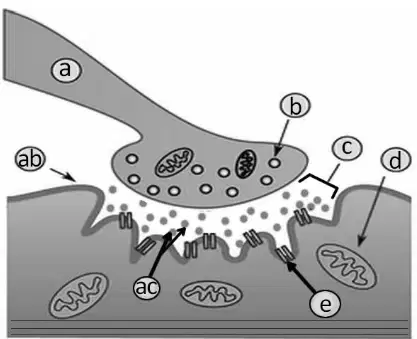
In myasthenia gravis, the area labeled “e” is damaged. This causes what problem?
muscle does not receive signal to contract
muscle is overstimulated, causing muscle cramps
muscle does not have enough energy to contract
What is the function of myelin?
removes debris
supplies blood
insulates the axon
sends impulses
The part of the brain that connects to the spinal cord is the:
medulla oblongata
cerebellum
thalamus
cerebrum
What connects the two hemispheres of the brain?
arachnoid mater
brain stem
corpus callosum
The largest portion of the human brain which functions in reasoning and learning is the:
cerebellum
cerebrum
brain stem
meninges
Support cells of the neurons are collectively called:
meninges
neuroglia
synapses
collagen
This area of the brain is responsible for balance and coordination:
hypothalamus
hippocampus
cerebellum
frontal lobe
This lobe of the brain (as well as this bone of the skull) lies at the area just above your ear:
occipital
frontal
parietal
temporal
A nerve impulse travels down the axon of one neuron and then jumps across to the ___ of another.
axon
dendrite
chromatophilic substance
astrocyte
These cells within the nervous system produce myelin sheaths:
oligodendrocytes
microglial cells
astrocytes
dendrites
This division of the nervous system controls the “fight or flight” response:
parasympathetic
sympathetic
limbic
hippocampus

