
Font size
 Worksheets
Year 9 Physics CTA 2
Total questions: 87
Worksheet time: 2hrs 31mins
The units of force are:
Joules
Newtons
Newtonmeters
Newtons per meter squared
Scalar means
It has mass and direction
It only has direction
It only has direction
It only has magnitude
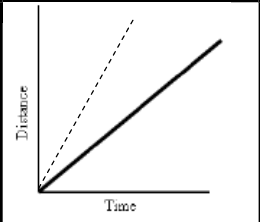
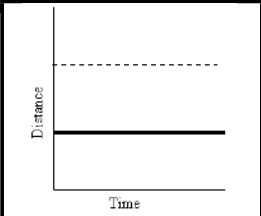
Match the description to the graph:
"The car is stopped."


Match the description to the graph:
"The car is traveling at a constant speed."

Match the description to the graph:
"The car is coming back."
Which of the graphs shows that both runners started in the same place?


In which of the following graphs below did one runner overtake (run past) the other?


Match the description to the graph:
"The car is slowing down."

Describe the motion in the graph:
Constant Speed (positive slope)
Stopped (at rest)
Acceleration (increasing speed)
Return Home (negative slope)
A measurement of how fast an object is moving with direction
Velocity
Speed
Vector
Acceleration

Which is faster?
walking
skating
biking
Which of these is not a scalar quantity?
Weight
Mass
Temperature
Time
Which of these is not a vector quantity
Weight
Acceleration
Distance
Velocity
What is the definition of a vector?
It has both mass and direction
It has both mass and displacement
It has both magnitude and displacement
It has both magnitude and direction
What do we use to show vectors?
Arrows
Dotted lines
Tangents
The gradient
Which of these is NOT a contact force
Normal reaction forces
Air resistance
Tension
Weight
To calculate the weight of an object?
Mass x gravitational field strength
Mass / gravitational field strength
Gravitational field strength / mass
On a different planet you would(pick 2):
have the same mass
have the same weight
have a different mass
have a different weight

weight and mass are the same thing
No - mass is a function of gravity and weight is the atoms and molecules that make up the object
No - weight is a function of gravity and mass is the atoms and molecules that make up the object
Yes - they are both the same
Maybe - it depends on the flux capacitor

When the air resistance or drag is equal and opposite to the weight of the object you would call this
terminal velocity
gravitational weight
flux capacitor
rotational inertia

In which state of matter do particles have the most energy?
solid
liquid
gas
all of them
Which is the change of state from liquid to solid
melting
freezing
evaporation
condensation
In which process do particles escape from the liquid surface?
evaporation
condensation
melting
freezing
What exerts a force for gas pressure?
Collar
Colour
Collisions
Conduction
If a container can not expand what happens to the gas pressure when more particles are added into it?
Increase
Decrease
Stays the same
Nothing

Here are the results from cooling a substance over a period of time. What is the melting point of this substance?
89 oC
80 oC
67 oC
0 oC

The steam coming off the pot of boiling water is an example of....
Melting
Freezing
Evaporating
Condensing

What does this picture represent?
solid
liquid
gas

What does this picture represent?
solid
liquid
gas

Which of the following statements describes a gas?
It has a fixed volume
It can be compressed
Which of the following statements describes a liquid?
It has a fixed volume
It can be compressed

What is the graph called?
Melting and Boiling graph
Temperature Graph
Heating Curve of a substance
Graph of Temperature and heating up

At which point does the substance finish boiling
B
C
E
F
D

Increasing the temperature of a gas increases the store of which energy type of the particles?
Potential Energy
Chemical Energy
Kinetic Energy
Pressure
In gases, pressure is
directly proportional to volume
inversely proportional to volume
directly proportional to friction
inversely proportional to heat
Gas pressure is caused by
Gas molecules heating up
Gas molecules reacting with other gas molecules
Gas molecules hitting the walls of a container
Gas molecules hitting other gas molecules
The temperature of gas is held constant, while its volume is decreased. The pressure exerted by the gas on the wall of the container increases, because its molecules
Strike the walls with higher velocities
Strike the walls with large farce
Strike the walls more frequently
Are in contact with the walls for a shorter time

The pressure of the gas in the balloon in the ice water will be:
Greater than that of the balloon in the boiling water.
Less than that of the balloon in the boiling water.
The same as that of the balloon in the boiling water.
Not enough information to answer the statement.

The reason gases can be compressed is because:
The particles are very close together.
The particles are merely vibrating.
The particles are unable to move.
The particles are very far apart.
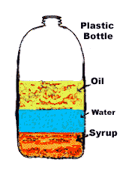


Why does the liquid inside a thermometer rise?
When the thermometer heats up, the liquid inside ...... because the particles move about ........
expands, less quickly
expands, more quickly
contracts, less quickly
contracts, more quickly

For what reason do liquids flow so easily?
Because the particles.....
are so tightly compacted to one another.
can slide past one another.
vibrate with one another.
are so far apart from one another.
Chemical Energy is
Energy stored due to the vibrations of the molecules of a substance. The hotter the substance, the greater the energy stored.
Energy stored because of the chemical makeup of a substance e.g. foods, fuels, batteries
Energy stored when a charged object is in an electric field (e.g. a charged balloon)
Energy stored by objects due to their position above Earth's surface
Elastic Potential Energy is
Potential energy that is stored when an object is stretched or compressed (squashed)
Energy stored by objects due to their position above Earth's surface
Energy stored due to the vibrations of the molecules of a substance. The hotter the substance, the greater the energy stored.
Energy stored when a charged object is in an electric field (e.g. a charged balloon)
What is the Equation for Work Done?
Work Done = Force x Distance
Work Done = Force / Distance
Work Done = Distance / Force
What is the Equation for Kinetic Energy?
Kinetic Energy = 0.5 x Mass x Speed²
Kinetic Energy = 0.5 x Mass² x Speed
Kinetic Energy = 0.5 x Mass² / Speed
What are Equations for Gravitational Potential Energy?
Gravitational Potential Energy = Mass x Gravitational Field Strength x Height
Gravitational Potential Energy = Weight x Height
Gravitational Potential Energy = Mass x Gravitational Field Strength / Height
Gravitational Potential Energy = Weight / Height
An object's gravitational potential energy store can be increased by...
by lifting the object higher
increasing the velocity (speed) of the object
decreasing the size of the object
decreasing the mass of the object
What is the efficiency of a light that produces 90J thermal energy, and 10J Light energy, for every 100J of electrical input?
90%
10%
9%
100%

What is the extension of the spring?
12cm
10cm
12mm
10mm
To convert grams to kilograms
multiply the grams by 100
divide the grams by 100
multiply the grams by 1000
divide the grams by 1000
To convert cm/s to m/s
multiply the cm/s by 100
divide the cm/s by 1000
divide the cm/s by 100
multiply the cm/s by 1000
Why do we insulate buildings?
To slow down the rate of heat loss to surroundings
Because it looks nice
Because it's what all the cool kids do
Is Nuclear energy, as a source of electricity, renewable or non-renewable?
Non-renewable
Renewable
What is a disadvantage of using geothermal energy?
Only available in select places
Doesn't produce very much energy
Extremely complex to set up
Will one day run out

