
 Worksheets
Genetics and Evolution Vocabulary
Total questions: 91
Worksheet time: 1hrs 2mins
Define Fitness.
The range of genetic material present within a population or species.
Fitness is the process of photosynthesis in plants.
Fitness is the measure of an organism's intelligence.
Fitness is the ability to fly in any environment.
Define Genetic Diversity.
The relative ability of an organism to survive and reproduce in a given environment.
The number of different species in an ecosystem.
Genetic diversity is the process of genetic modification in organisms.
Genetic diversity is the study of how traits are inherited from one generation to another.
Define Heritable.
Heritable refers to a trait or characteristic that increases an organism's fitness in a specific environment due to natural selection.
Heritable refers to traits that are only acquired during an individual's lifetime and cannot be passed on.
Heritable means traits that are influenced solely by environmental factors and not by genes.
Heritable describes characteristics that are unique to each generation and never repeated.
Define Adaptation.
Adaptation is the process of photosynthesis in plants.
Traits or characteristics that can be passed from parents to offspring through genetic information.
Adaptation is the movement of animals from one place to another.
Adaptation is the breaking down of food in the stomach.
Define Selective pressure.
Selective pressure is the tendency of organisms to migrate to new environments for better resources.
Selective pressure is the process by which organisms choose their mates based on physical appearance.
The gradual change in the genetic makeup of a population over generations, often driven by natural selection.
Selective pressure is the random occurrence of genetic mutations in a population.
What is the term for the following definition? The process by which certain traits become more or less common in a population based on their impact on survival and reproduction.
Natural selection
Genetic drift
Mutation
Speciation
What is the term for the following definition? Factors in the environment that favor the survival and reproduction of certain individuals over others.
Selective pressures
Genetic drift
Mutation rate
Gene flow
Fill in the blank: Define the term 'Probability'.
Probability is the measure of the likelihood that an event will occur.
Probability is the process of collecting and analyzing data.
Probability is the study of shapes and their properties.
Probability is the calculation of speed and distance.
Fill in the blank: Define the term 'Advantageous trait'.
An advantageous trait is a characteristic that improves an organism's ability to survive or reproduce in its environment.
An advantageous trait is a feature that always makes an organism larger than others.
An advantageous trait is a trait that decreases an organism's chance of survival.
An advantageous trait is a characteristic that only affects an organism's color.
Fill in the blank: Define the term 'Environmental factors'.
Environmental factors are external elements like climate, food, and predators that can affect an organism's survival.
Environmental factors are the internal genetic codes that determine an organism's eye color.
Environmental factors are the chemical reactions that occur inside an organism's cells.
Environmental factors are the specific organs that help an organism to breathe underwater.
What is the term for the collection, analysis, interpretation, and presentation of data?
Statistics
Geography
Philosophy
Linguistics
What is the term for the relationship between a part and the whole, often expressed as a fraction or percentage?
Proportion
Equation
Variable
Sum
What is the term for living entities that carry out life processes, including plants, animals, and microorganisms?
Organisms
Minerals
Elements
Compounds
Natural selection is:
the process by which organisms better adapted to their environment tend to survive and produce more offspring.
the random change in the frequency of alleles in a population.
the inheritance of acquired characteristics during an organism's lifetime.
the process of humans choosing specific traits in organisms for breeding.
Mutations are:
changes in the DNA sequence
a type of cell division
the process of protein synthesis
the movement of genes between species
Inherited traits are:
characteristics passed from parents to offspring
behaviors learned from the environment
skills acquired through practice
habits developed over time
Genetic information is:
the set of instructions encoded in DNA that determines the traits of an organism
the amount of protein in a cell
the number of chromosomes in a cell
the process of cell division
Genetic variation is:
the differences in DNA sequences among individuals within a population.
the process by which organisms produce energy from sunlight.
the similarity in physical traits among all members of a species.
the inheritance of acquired characteristics from parents to offspring.
What is the term for the process by which certain traits become more or less common in a population based on their impact on survival and reproduction?
Natural selection
Genetic drift
Mutation
Gene flow
What is the term for the order of nucleotide bases (adenine, thymine, cytosine, and guanine) in a DNA molecule?
DNA sequence
Genetic drift
Chromosomal crossover
Protein synthesis
What is the term for changes in the DNA sequence that can lead to genetic variation within a population?
Mutation
Translation
Replication
Transcription
What is the term for differences in the genetic makeup of individuals within a population?
Genetic variation
Natural selection
Mutation
Speciation
Define the term 'Genotype'.
Genotype refers to the genetic makeup of an organism; the combination of alleles located on homologous chromosomes that determines a specific trait.
Genotype refers to the physical appearance of an organism resulting from its genetic makeup.
Genotype is the process by which organisms adapt to their environment over time.
Genotype is the study of how traits are passed from parents to offspring.
Define the term 'Phenotype'.
Phenotype is the set of observable characteristics or traits of an organism resulting from the interaction of its genotype with the environment.
Phenotype is the genetic makeup of an organism.
Phenotype refers to the process of cell division in living organisms.
Phenotype is the study of heredity and variation in organisms.
Define the term 'Antibiotic Resistant'.
Antibiotic resistant refers to bacteria that have developed the ability to survive or grow despite the presence of antibiotics that would normally kill them or limit their growth.
Antibiotic resistant refers to antibiotics that are stronger than normal and can kill all types of bacteria.
Antibiotic resistant refers to the process of making antibiotics from natural sources only.
Antibiotic resistant refers to the use of antibiotics to prevent any kind of infection in humans.
Define the term 'Alleles'.
Alleles are different forms of a gene that are found at the same place on a chromosome.
Alleles are the physical appearance of an organism.
Alleles are the process by which cells divide.
Alleles are the building blocks of proteins.
Define the term 'Inheritance patterns'.
Inheritance patterns are the ways in which genes and traits are passed from parents to offspring.
Inheritance patterns are the process of cell division in plants.
Inheritance patterns refer to the environmental factors affecting an organism.
Inheritance patterns are the methods used to classify living organisms.

What is the term for different versions or variants of a gene that can lead to variations in traits?
Alleles
Chromosomes
Enzymes
Nucleotides
Agar is used for which purpose in a laboratory?
To culture microorganisms
To measure temperature
To filter liquids
To weigh chemicals
A Petri dish is a shallow, flat, cylindrical container made of glass or plastic. It's commonly used in laboratories to culture (grow) ________, such as bacteria or fungi, for various purposes.
microorganisms
plants
minerals
insects
What is the main difference between genotype and phenotype?
Genotype refers to learned behaviors, phenotype to inherited traits
Genotype is influenced by the environment, phenotype is not
Genotype is the genetic makeup, while phenotype is the observable traits
Phenotype is inherited, genotype is acquired during life
Which term refers to the random changes in allele frequencies in a population, especially in small populations?
Genetic drift
Natural selection
Mutation
Gene flow

The range of different inherited traits in a species.
Evolution
Genetic diversity
Common ancestor
Fitness
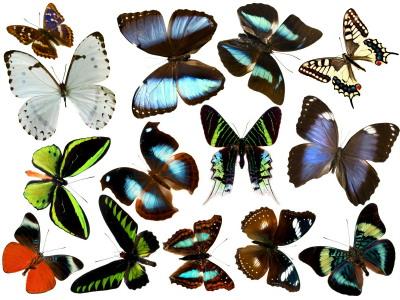
Mutations can be beneficial because they increase genetic _____________________ and can make the individual and species more likely to survive.
diseases
complications
disorders
diversity

How do traits like eye color and hair type get passed down from parents to their children? Scientists call this process heredity (passing genetic features from one generation to the next).
genotype
parent
heredity
offspring

What is another name for natural selection?
survival of the smartest
survival of the fastest
survival of the biggest
survival of the fittest
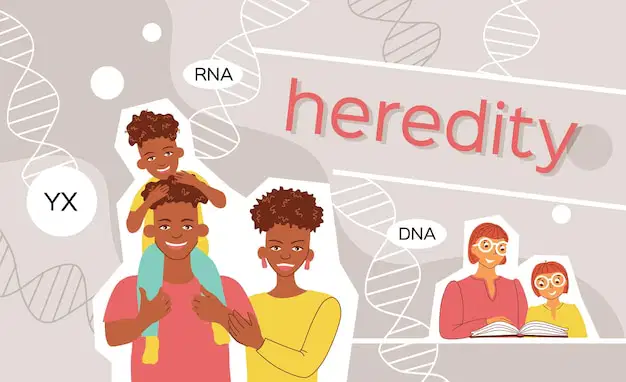
Having two of the same genes for the trait
homozygous
hetrozygous
protein
chromosome

the passing of traits from parents to offspring
asexual reproduction
sexual reproduction
unicellular
multicellular
heredity
Define Gene
A section of RNA that determines a specific trait.
A section of DNA that determines a no trait.
A section o protien that determines a specific trait.
A section of DNA that determines a specific trait.
Define Allele
Different forms of the same gene (e.g., dominant "A" or recessive "a").
Define Dominant Allele
The trait that is expressed when at least one copy is present (represented by a capital letter).
Define Recessive Allele
The trait that is only expressed when two copies are present (represented by a lowercase letter).
Define Genotype
The genetic makeup of an organism (e.g., AA, Aa, aa).
Define Phenotype
The physical appearance or trait that is expressed (e.g., brown eyes, blue eyes).
Define Homozygous
Having two identical alleles for a trait (AA or aa).
define Heterozygous
Having two different alleles for a trait (Aa).
Define Punnett Square
A chart used to predict the possible genotypes and phenotypes of offspring based on the genetic makeup of the parents.
Define Probability
The likelihood that a particular outcome will occur, often expressed as a fraction, percentage, or ratio.
Define Monohybrid Cross
A genetic cross that examines the inheritance of only one trait.
Define Dihybrid Cross
A genetic cross that examines the inheritance of two traits at the same time.
Define Trait
A specific characteristic of an organism (e.g., hair color, height).
Define Carrier
An individual who has one recessive allele for a trait but does not show the trait.
Define Inheritance
The process by which genetic traits are passed from parents to offspring.
Define Ratio
A comparison of outcomes (e.g., 3:1 ratio of dominant to recessive).
Define Percentage
How often a trait is expected to occur out of 100 possibilities (e.g., 75% chance).
Define Hybrid
An organism that is heterozygous for a trait (e.g., Aa).
Define F1 Generation
The first generation of offspring from a genetic cross.
Define F2 Generation
The second generation of offspring, typically from crossing F1 individuals.

Why does the ability to lay 1,000 to 5,000 eggs increase the fitness of the species L. clamitans clamitans?
Mutations can be beneficial because they increase genetic _____________________ and can make the individual and species more likely to survive.
diseases
complications
disorders
diversity
The range of different inherited traits in a species.
Evolution
Genetic diversity
Common ancestor
Fitness


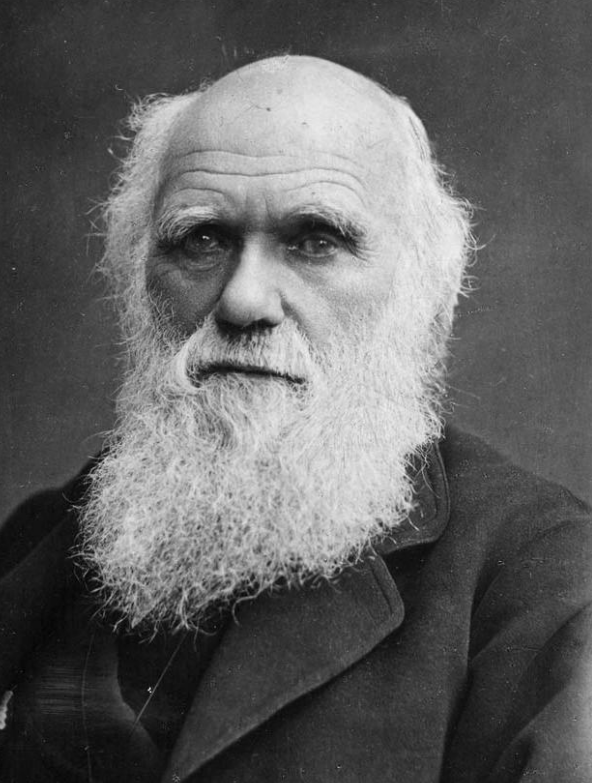
Who was the Scientist most famous for his study of natural selection and evolution?
Theodor Schwann
Robert Hooke
Charles Darwin
Rudolf Virchow
What is another name for natural selection?
survival of the smartest
survival of the fastest
survival of the biggest
survival of the fittest


Having two of the same genes for the trait
homozygous
hetrozygous
protein
chromosome
the passage of genetic instructions from one generation to the next
genotype
parent
heredity
offspring

Which of the following describes heredity?
A tiger teaching its young how to hunt
A tree making food by photosynthesis
Bacteria dividing into to make a new bacteria
An animal eating a plant
the passing of traits from parents to offspring
asexual reproduction
sexual reproduction
unicellular
multicellular
heredity

Passage of genetic instructions from one generation to the next?
chromosomes
traits
homeostasis
heredity
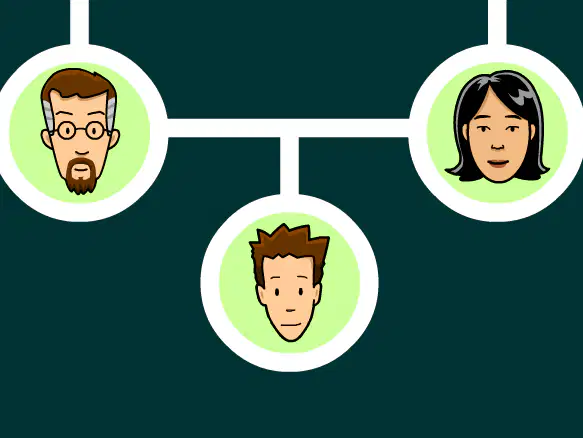
The passing of traits from parent to offspring.
Heredity
Allele
Trait
Phenotype

__________ is the passing of traits from parents to a child.
Phenotype
Genotype
Gene
Heredity
What is selective pressure?
The pressure an organism feels to physically change its body shape to fit into its environment.
A consistent, directional force of natural selection that leads to a change in allele frequency within a population.
The social pressure within a population to select the best mates.
A measure of the amount of rainfall an area receives, influencing vegetation and, consequently, herbivore populations.
Evaluate the impact of environmental factors on allele frequencies in a population.
Environmental factors can lead to changes in allele frequencies by favoring certain traits that are better adapted to the environment.
Environmental factors have no impact on allele frequencies in a population.
Environmental factors decrease genetic variation by eliminating alleles.
Environmental factors only affect allele frequencies in small populations.
Analyze the role of selective pressures in natural selection.
Selective pressures are environmental factors that favor certain traits over others, leading to changes in allele frequencies in a population.
Selective pressures are random events that change allele frequencies in a population.
Selective pressures decrease genetic variation by eliminating alleles.
Selective pressures have no effect on natural selection.
Analyze how selective pressures can lead to adaptation in a population.
Selective pressures favor certain traits that are better adapted to the environment, leading to an increase in the frequency of those traits in the population.
Selective pressures randomly change allele frequencies in a population.
Selective pressures decrease genetic variation by eliminating alleles.
Selective pressures have no effect on adaptation.
What are the four key components of natural selection?
What does a bell-shaped curve represent in trait distribution?
What is directional selection?
What is stabilizing selection?
Stabilizing selection favors the average trait and selects against extremes, narrowing the bell curve.
How can a change in predator behavior affect a population graph?
If predators begin to target individuals with a certain trait, that trait will decrease in frequency, and the population graph will shift accordingly.
Why is variation important in a population?
Variation allows some individuals to have advantages in survival and reproduction, which is essential for natural selection to occur.
What is a Punnett square used for?
To determine the probability of offspring inheriting traits

