
 Worksheets
Organic Evolution Test #1 B
Total questions: 99
Worksheet time: 50mins
Fill in the blank: According to the principles of evolution by natural selection, there is ______ among individuals ("virtually universal" within populations).
variation
uniformity
stability
identity
Fill in the blank: The variation among individuals is ______.
inherited
temporary
artificial
irrelevant
Fill in the blank: Some variants ______ and reproduce at higher rates than others.
survive
sleep
shrink
hesitate
Fill in the blank: The consequence of natural selection is ______ (change in frequency of an inherited trait within a population).
evolution
mutation
photosynthesis
respiration
According to the slide 'The Nature of Natural Selection', what is the ultimate source of variation on which natural selection (NS) acts?
Migration
Mutation
Adaptation
Selection
According to the slide 'The Nature of Natural Selection', NS and Mutation are (generally) ________ processes.
separate
identical
continuous
dependent
According to the slide 'The Nature of Natural Selection', mutations are random with respect to the needs of the organism.
True
False

Based on the diagram in the slide 'The Nature of Natural Selection', what happens after constant random mutations in a population of bacteria?
All bacteria die
Selection for a trait and reproduction
No change occurs
The population decreases

According to the diagram and text, what does natural selection (NS) act on?
Populations
Individuals
Species
Ecosystems
Fill in the blank: NS acts on individuals, but the consequences (evolution) occur in _________.
populations
cells
organs
ecosystems

Based on the diagram, what is the role of constant random mutations in a population of bacteria?
They ensure all bacteria are identical
They introduce variation in traits
They prevent reproduction
They eliminate all bacteria

According to the diagram, selection for a trait (& reproduction) leads to:
A) A decrease in population size
B) Evolution in populations
C) No change in the population
D) Random elimination of traits
Fill in the blank: 'Darwinian' fitness is based on an individual's ability to _______ and _______ relative to other individuals in the same population.
survive; reproduce
eat; sleep
grow; migrate
hunt; gather
Fill in the blank: Fitness is 'a measure of _______ success relative to the average reproductive success of a population.'
reproductive
physical
economic
social
Which of the following statements is true about the phrase 'survival of the fittest'?
It is an accurate and complete description of natural selection.
It is an oversimplification and can be misleading.
It only refers to physical strength.
It means the same as Darwinian fitness.

Based on the diagram, which muscle condition in gulls is most likely to be targeted by trained raptors?
Low
Normal
High
What does natural selection act at the level of?
Genotype only
Phenotype (genotype x phenotype interaction)
Environment only
Population only
Fill in the blank: The norm of reaction is a curve that represents the ______ expressed by a given genotype as a function of environmental conditions.
phenotype
genotype
allele
mutation
According to the definition provided, what does the norm of reaction curve represent?
The number of species in an environment
The phenotype expressed by a given genotype as a function of environmental conditions
The genetic variation in a population
The average temperature of an environment

What environmental factor is being varied to observe changes in the number of leaves and mean leaf area?
Temperature
Water availability
Light intensity
Soil type

Which of the following statements is true?
Genotypes do not code for a fixed number of leaves
Genotypes do not code for fixed leaf area
Genotypes code for a number and area of leaves that depends on the intensity of light to which the plant is exposed
All of the above

Based on the images and map provided, is there variation among individuals in the coat color of Oldfield Mice?
True
False
All almost all traits in natural populations vary (at least in part) due to what?
genotype
climate
diet
behavior
Which of the following genes influences coat color in many mammals and has a specific mutation in beach populations of light oldfield mice?
Agouti
Mc1R
SRY
Pax6
Specific mutations in which gene contribute to light coat color in beach populations and are also found in deer mice in Nebraska sandhills?
Mc1R
Agouti
Pax6
SRY

Based on the diagram, which group of mice had the highest percentage captured?
Group A (53.7%)
Group B (55.1%)
Group C (23%)
According to the example, some variants survive and reproduce at higher rates than others.
True
False
What is a confounding factor mentioned in the example that may affect the survival of mice?
Mice may have different behaviors that reflect survival.
The color of the cage the mice are kept in.
The type of bedding used in the experiment.
The time of day the experiment is conducted.
Based on the graphs and images, which type of mouse is attacked more frequently in the light background beach environment?
Light mice
Dark mice
Both are attacked equally
In the dark background inland environment, which type of mouse has a lower proportion of attacks according to the graph?
Light mice
Dark mice
Both have the same proportion
Fill in the blank: In the experiment shown, some variants of Oldfield Mouse survive and reproduce at higher rates than others because their ______ matches the environment, making them less likely to be attacked.
coat color
tail length
ear shape
body size
What is the definition of adaptation according to the passage?
A) A trait that currently serves one function today, but evolved from a trait that served a different function in the past.
B) An inherited trait that makes an organism more fit in its abiotic (nonliving) and biotic (living) environment and has arisen as a result of the direct action of natural selection for its contemporary function.
C) A random change in an organism's DNA.
D) A behavior learned during an organism's lifetime.
What is exaptation?
A trait that currently serves one function today, but that evolved from a trait that served a different function in the past.
An inherited trait that makes an organism more fit in its environment.
A random mutation.
A learned behavior.

Fill in the blank: The sharp spines of a cactus help to _________
deter herbivores.
absorb sunlight.
store water.
attract pollinators.

Fill in the blank: The waxy cuticle of a cactus helps to _________
prevent water loss.
absorb more sunlight.
attract pollinators.
increase water uptake.

Fill in the blank: The accordion-like structure of a cactus allows the plant to _________
expand and contract with water availability.
grow taller rapidly during the night.
produce flowers year-round.
move towards sunlight like a sunflower.

Fill in the blank: The low surface area to volume ratio of a cactus minimizes _________
evaporative water loss.
photosynthesis efficiency.
nutrient absorption.
seed dispersal.

Fill in the blank: The shallow root system of a cactus collects water after _________.
infrequent rains.
strong winds.
sunny days.
cold nights.

Fill in the blank: The flowers of a cactus entice _________
pollinators.
predators.
herbivores.
decomposers.
Which experiment is associated with predation and natural selection in guppies?
E. coli: Long-Term Evolution Experiment (LTEE)
Predation and Natural Selection in Guppies
Natural Selection on Lizards in Urban Heat Islands
Which topic involves natural selection on lizards in urban heat islands?
Predation and Natural Selection in Guppies
Natural Selection on Lizards in Urban Heat Islands
E. coli: Long-Term Evolution Experiment (LTEE)
The Long-Term Evolution Experiment (LTEE) is conducted with which organism?
Guppies
Lizards
E. coli
When did the ongoing study of experimental evolution by Lenski start?
Feb. 24, 1988
Jan. 1, 1990
Mar. 15, 1985
Dec. 31, 1992
The Lenski experiment started with a genetically homogenous line of _________
E. coli
Staphylococcus aureus
Bacillus subtilis
Saccharomyces cerevisiae
How many generations has the Lenski experiment recently passed?
8,000
80,000
800,000
8,000,000

According to the diagram, what is the first step in Lenski's experimental evolution system?
Carry out daily protocol for 15,500+ days
Take a single bacterial clone and create 12 genetically identical lines
Store samples in a freezer
Dilute 100-fold

The Lenski experiment periodically stores samples in a -80°C freezer.
True
False

Refer to Figure 3.16. What does the graph in panel A show about the average cell volume in one E. coli line over 10,000 generations?
It decreases steadily
It remains constant
It increases and then levels off
It fluctuates randomly

What does a relative fitness value greater than one indicate in panel B?
A relative fitness value greater than one indicates higher fitness than the ancestor.
A relative fitness value greater than one indicates lower fitness than the ancestor.
A relative fitness value greater than one indicates no change in fitness compared to the ancestor.
A relative fitness value greater than one indicates the same fitness as the ancestor.

What does the graph in panel A show about cell volume in 12 E. coli lines over 10,000 generations?
All lines show a decrease in cell volume
All lines show an increase in cell volume
Cell volume remains constant in all lines
Cell volume fluctuates randomly in all lines

What does the graph in panel B show about relative fitness in 12 E. coli lines over 10,000 generations?
Relative fitness increases in all 12 E. coli lines over 10,000 generations.
Relative fitness decreases in all 12 E. coli lines over 10,000 generations.
Relative fitness remains constant in all 12 E. coli lines over 10,000 generations.
Relative fitness fluctuates randomly in all 12 E. coli lines over 10,000 generations.
Based on the figures and captions, evolution can be repeated in E. coli lines. Which of the following best explains this observation?
Yes, because similar evolutionary changes can occur in separate E. coli lines under the same conditions.
No, because evolution is always random and cannot be repeated.
Yes, but only if the E. coli lines are genetically identical at the start.
No, because E. coli cannot evolve under laboratory conditions.
Natural selection is limited in what it can achieve, and organisms are not perfectly adapted to all environmental conditions because:
There are genetic, historical, and environmental constraints.
Natural selection always produces perfect organisms.
All mutations are beneficial and lead to perfect adaptation.
Organisms can adapt instantly to any change in the environment.
Fitness increased in lines grown at 37°C – even though they had been grown at similar temp (35-40°C) for billions of generations. Why might this occur?
New beneficial mutations can still arise, leading to further adaptation.
The environment became less stressful over time.
Genetic drift eliminated all harmful mutations.
The population size decreased drastically.
Evolutionary changes that increase growth rate at one specific temperature will be associated with a reduction in growth rates at other temperatures.
Yes, there is often a trade-off in growth rates at other temperatures.
No, growth rates at all temperatures will increase.
No, evolutionary changes only affect the targeted temperature.
Yes, but only if the temperature change is extreme.

According to Figure 3.18, what is the optimal temperature for growth in the E. coli population after 20,000 generations?
20°C
37°C
40°C
42°C

Fill in the blank: The maximal rate of division for the E. coli population after 20,000 generations at 37°C is highest at _________.
37°C
25°C
42°C
15°C
Why did optimal performance at 37°C lead to suboptimal results at other temperatures (20°C & 42°C)?
Accumulation of random mutations decreased fitness at other temperatures
E. coli cannot survive at other temperatures
The experiment was only conducted at 37°C
There was no change in fitness at other temperatures
True or False: Mutator strains of E. coli had a greater decline in fitness at suboptimal temperatures compared to non-mutator strains.
True
False
What is antagonistic pleiotropy?
A gene that only has positive effects
A gene that has both beneficial and deleterious effects depending on the conditions
A gene that is only active at high temperatures
A gene that does not affect fitness

Fill in the blank: Antagonistic pleiotropy results in a trade-off between fitness under one set of conditions and ______ under another set of conditions.
fitness
temperature
mutation
reproduction

The same gene(s) that code for increased growth at 37°C can also code for deleterious effects at other temperatures.
True
False
According to the concept of antagonistic pleiotrophy, what is predicted to happen to fitness in a population at the start when the population is most variable and positive selection is most powerful?
Fitness should increase slowly
Fitness should remain the same
Reduced fitness should happen quickly
No change in fitness is expected
Most of the time, reduced fitness due to antagonistic pleiotrophy was observed within ______ generations.
5,000
500
50,000
50
Began with a single population, grew for ______ generations at 37°C.
2,000
200
20,000
500
How many populations were created, made up of 6 replicate populations grown at 5 different temperatures?
10
20
30
50
The populations evolved for an additional ______ generations.
2,000
200
20,000
500
Genome sequencing was performed for one representative of each replicate population and compared to each other and the ______ population.
original
mutant
control
experimental
The experiment focused on new mutations that affected a single ______.
gene
cell
organism
chromosome

Refer to the diagram and text on Convergent Evolution. What does each vertex of the diagram represent?
A specific gene
A specific temperature regime
A population size
A mutation type

According to the diagram, what is the mean percentage of mutated genes in common among replicates of the 32°C temperature treatment?
23.0%
15.5%
30.2%
10.8%
Populations evolved at the same temperature share more mutations than those evolved at different temperatures.
True
False
What does the difference between S_b and S_w indicate in the context of the temperature regimes?
The difference between S_b and S_w was used as a measure of temperature-specific pattern of genomic evolution.
It indicates the average temperature difference between two regions.
It measures the rate of heat transfer in the system.
It represents the difference in humidity levels between two samples.
Based on the information provided, convergent evolution in the context of this experiment refers to:
The process where unrelated organisms independently evolve similar traits due to similar environmental pressures.
The process where related organisms develop different traits due to different environments.
The process where organisms lose traits over time due to lack of use.
The process where organisms evolve in isolation without any influence from their environment.
According to the slide titled 'Origin of Complex Traits', what is one way complex structures could have evolved? Fill in the blank: Intermediate Stages with Function ______ to Modern Function.
Similar
Unrelated
Opposite
Random
According to the slide titled 'Origin of Complex Traits', what is another way complex structures could have evolved? Fill in the blank: Novel Structures and ______.
Exaptations
Mutations
Duplications
Adaptations
According to the slide, what did Darwin say about the formation of the eye by natural selection?
He thought it was easily explained
He thought it was absurd in the highest possible degree
He thought it was a simple process
He thought it was not possible
What is hypothesized about the evolution of the eye according to the slide?
The eye evolved suddenly
The eye evolved through a series of small changes, each more beneficial than the last
The eye did not evolve
The eye evolved only in mammals
Possible intermediates in the evolution of the eye can be seen among extant organisms.
True
False

Based on the diagram, which organism has an eye structure most similar to a pinhole camera, casting a sharp image on the retina at the expense of a loss in brightness?
Octopus
Nautilus
Patella
Murex

Fill in the blank: The ________ uses a lens to focus light on the retina, much like a vertebrate eye.
Octopus
Earthworm
Jellyfish
Starfish

Match the following mollusks to their eye structure as shown in the diagram:
Eye with lens and retina
Octopus
Pinhole camera-like eye
Nautilus
Simple eye that can distinguish between light and dark
Patella
Indented eye cup that can detect the direction of a light source
Murex
What is an exaptation in evolutionary biology?
A trait that is lost over time
A trait originally selected for one function, but later co-opted for a different function
A trait that never changes its function
A trait that is only found in modern species
Feathers currently play a prominent role in flight but pre-date it, and likely evolved only once.
True
False

According to the diagram, which group is most closely related to modern birds?
Allosaurus
Sinosauropteryx
Archaeopteryx
Tyrannosaurus
Fill in the blank: Some traits were originally selected for one function, but later ______ for a different (selectively advantageous) function.
co-opted
eliminated
ignored
mutated
Feathers are an example of an exaptation because:
they originally evolved for insulation and were later adapted for flight.
they were always used for flight in birds.
they are only found in modern birds.
they evolved solely for display purposes.
What is gene sharing?
A protein that serves one function in one part of the body is recruited to perform a new and different function
A gene that is shared between two individuals
A protein that only serves one function in the body
A gene that is not expressed in the body

Fill in the blank: The crystallin δ is found in _______ and its enzyme function is argininosuccinate lyase.
Birds and reptiles
Mammals
Amphibians
Fish

Fill in the blank: The crystallin ε is found in _______ and its enzyme function is lactate dehydrogenase D4.
Birds and crocodiles
Mammals
Amphibians
Fish

Fill in the blank: The crystallin τ is found in _______ and its enzyme function is α-Enolase.
Lamprey, fish, reptiles, and birds
Mammals only
Insects and amphibians
Plants and fungi

Fill in the blank: The crystallin λ is found in _______ and its enzyme function is hydroxyacyl-CoA dehydrogenase.
Rabbit
Human
Dog
Cat
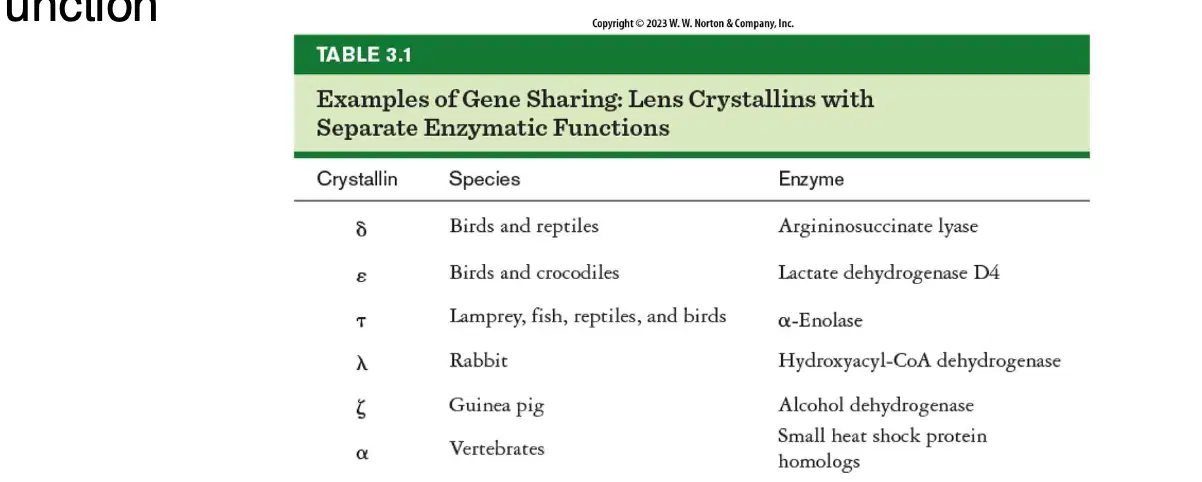
Fill in the blank: The crystallin ζ is found in _______ and its enzyme function is alcohol dehydrogenase.
Guinea pig
Rabbit
Dog
Cat

Fill in the blank: The crystallin α is found in _______ and its enzyme function is small heat shock protein homologs.
Vertebrates
Insects
Fungi
Plants

Fill in the blank: The crystallin Ω is found in _______ and its enzyme function is aldehyde dehydrogenase homolog.
Cephalopods
Mammals
Reptiles
Birds
Fill in the blank: Gene duplication is the formation of an extra ______ of a gene.
copy
mutation
chromosome
protein

According to the classical model shown in the diagram, what are the possible outcomes for gene A' after gene duplication?
Maintains function
Accumulates mutations
Becomes non-functional or gains a new function
All of the above

A signaling protein could evolve to match a receptor that has not yet risen (or vice versa) through which evolutionary process?
By random mutations and natural selection leading to co-evolution
By direct communication between unrelated species
By intentional genetic engineering in nature
By immediate adaptation without genetic changes

According to the diagram, what hormone binds to the M receptor?
Cortisol
Aldosterone
Insulin
Glucagon

