
Font size
 Worksheets
Perioperative Care Quiz
Total questions: 98
Worksheet time: 49mins
Which of the following is a key objective in perioperative care?
Recognize patients at risk for complications of surgical procedures
Prescribe medications for post-operative pain
Perform surgical procedures independently
Diagnose chronic illnesses
What is the purpose of identifying teaching needs of the perioperative client and family?
To implement effective teaching strategies
To schedule surgery dates
To assign hospital rooms
To order laboratory tests
Which communication method should be applied in the preoperative phase to ensure clear information exchange?
SBAR communication
SOAP notes
PIE charting
PQRST assessment
What is the nurse’s role in the process of informed consent?
Discuss elements of informed consent and identify their responsibilities
Perform the surgical procedure
Prescribe anesthesia
Discharge the patient
Which of the following best demonstrates critical judgement in perioperative care?
Making decisions based on patient assessment and evidence
Following a routine without considering patient needs
Ignoring patient concerns
Delegating all tasks to unlicensed personnel
Why is it important to discuss safety considerations when providing care for the perioperative patient?
To prevent complications and ensure patient well-being
To reduce paperwork
To shorten hospital stays
To increase medication dosages
Which of the following is a component of assessment in the perioperative patient?
Identifying risk factors for complications
Scheduling follow-up appointments
Ordering dietary supplements
Assigning hospital beds
What is the correct procedure for preparing clients for the intraoperative phase?
Ensure all preoperative preparations are completed and documented
Discharge the patient before surgery
Skip the consent process
Ignore patient allergies
Which of the following best describes perioperative nursing?
Care of the patient only before surgery
Care of the patient only during surgery
Care of the patient in all three phases of a patient's surgery experience
Care of the patient only after surgery
Which of the following is NOT one of the three phases of surgery?
Preoperative
Intraoperative
Postoperative
Preventative
What are the two main OR (Operating Room) settings mentioned in the introduction?
Emergency and Routine
Inpatient and Outpatient/Ambulatory
Intensive and General
Pediatric and Adult
A patient is being cared for before, during, and after surgery. Which type of nursing is this an example of?
Pediatric Nursing
Perioperative Nursing
Geriatric Nursing
Psychiatric Nursing
Explain why it is important for perioperative nursing to cover all three phases of surgery rather than just one phase.
It ensures comprehensive patient care and safety throughout the entire surgical experience.
It reduces the workload for nurses.
It shortens the duration of surgery.
It eliminates the need for postoperative care.
Which of the following is a goal of the National Patient Safety Goals set by the Joint Commission?
Ensuring correct procedure, correct patient, and correct body location
Increasing hospital profits
Reducing patient wait times
Improving hospital food quality
What is the purpose of marking the surgery site on a patient’s body?
To ensure the correct site is operated on
To identify the patient’s allergies
To record the patient’s medical history
To indicate the patient’s insurance provider
What does the term "Time Out" refer to in the context of surgical safety?
A planned pause to confirm correct patient, procedure, and site before surgery
A break for the surgical team to rest
A delay in surgery due to equipment failure
A period for patient recovery after surgery
Which of the following is a communication tool mentioned in the safety guidelines?
SBAR
MRI
CPR
ECG
What is the main focus of the Surgical Care Improvement Project (SCIP)?
Reducing surgical complications through core compliance measures
Increasing the number of surgeries performed
Training new surgeons
Improving hospital architecture
How might a surgical checklist contribute to patient safety during surgery?
By ensuring all necessary steps are followed to prevent errors and complications
By reducing the cost of surgery
By shortening the duration of surgery
By increasing the number of staff in the operating room
According to SCIP recommendations, when should prophylactic antibiotics be administered in relation to surgical incision?
Within 1 hour of incision
2 hours after incision
12 hours before incision
Only after surgery is completed
Which of the following is a SCIP recommendation for surgery patients who are already on beta blockers?
Discontinue beta blockers preoperatively
Switch to calcium channel blockers preoperatively
Receive beta blocker preoperatively
Avoid all medications preoperatively
What is the recommended duration for administering prophylactic antibiotics after surgery according to SCIP?
12 hours
24 hours
48 hours
72 hours
Why is it important for cardiac surgery patients to have controlled 0600 postoperative blood sugar, according to SCIP recommendations?
To reduce the risk of infection and improve recovery outcomes
To prevent dehydration
To increase heart rate
To promote hair growth
Which of the following is NOT listed as a SCIP recommendation?
Appropriate hair removal
Venous thromboembolism prophylaxis
Routine use of steroids
Prophylactic antibiotics within 1 hour of incision
A patient is scheduled for surgery and is in the pre-op holding area. Who is usually responsible for administering the prophylactic antibiotic?
The patient’s family
The OR team or pre-op holding area staff
The hospital administrator
The insurance provider
A surgical team is reviewing SCIP recommendations. Which step should they take to prevent venous thromboembolism in their patients?
Provide venous thromboembolism prophylaxis
Delay surgery by 24 hours
Increase the patient’s fluid intake
Avoid all medications

Which type of surgery is performed to reshape normal body structures to improve the patient’s appearance or self-image?
Cosmetic
Curative
Diagnostic
Palliative
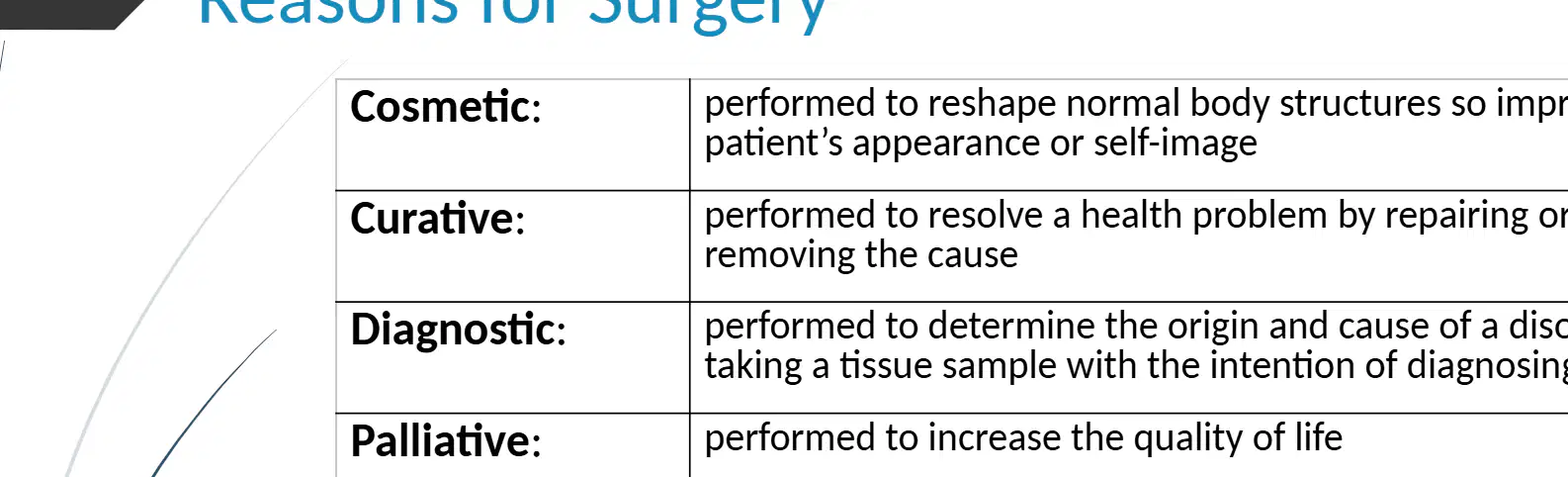
What is the main goal of curative surgery?
To increase the quality of life
To resolve a health problem by repairing or removing the cause
To improve self-image
To replace a malfunctioning structure
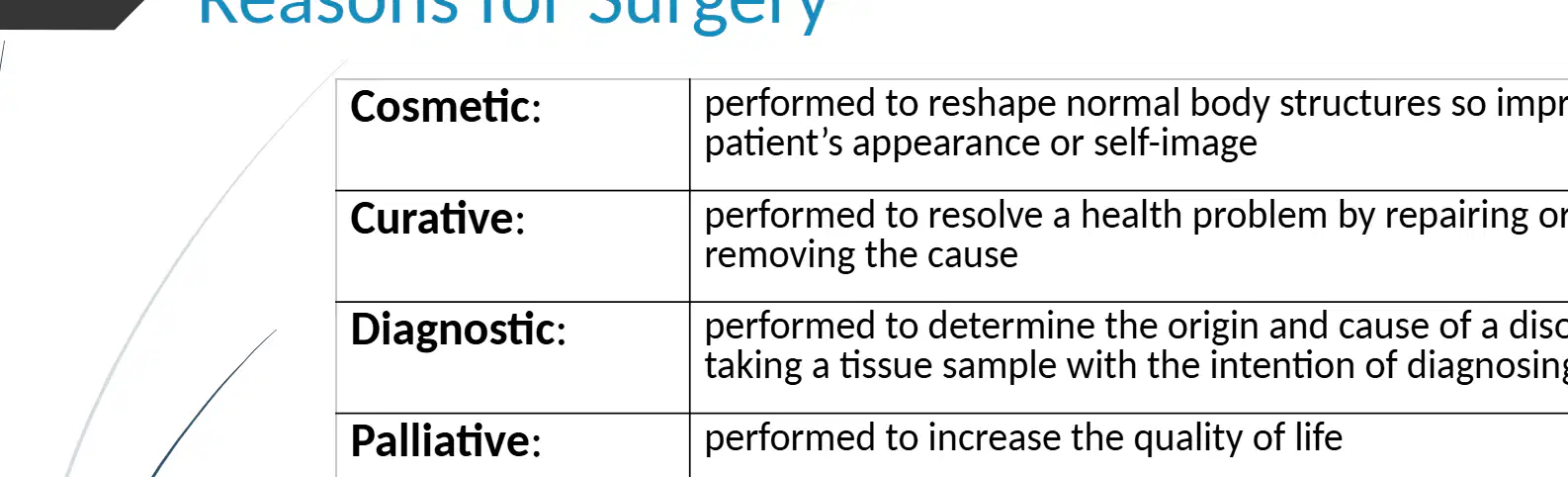
Which type of surgery is performed to determine the origin and cause of a disorder by taking a tissue sample?
Preventative
Diagnostic
Reconstructive
Transplantation

A patient undergoes surgery to increase their quality of life, even though the underlying disease cannot be cured. What type of surgery is this?
Palliative
Cosmetic
Curative
Reconstructive
Which surgery is performed with the intention that a condition will not develop?
Diagnostic
Preventative
Reconstructive
Curative
If a surgery is performed on abnormal or damaged body structures to improve function, what is it called?
Cosmetic
Reconstructive
Transplantation
Palliative
Transplantation surgery is best described as:
Performed to increase the quality of life
Performed to replace a malfunctioning structure
Performed to improve self-image
Performed to determine the cause of a disorder

A patient is scheduled for surgery to remove a tissue sample for diagnosis. What type of surgery is this, and why is it important in the medical field? (DoK Level 3)
Diagnostic; it helps identify the origin and cause of a disorder, guiding further treatment.
Curative; it resolves the health problem by removing the cause.
Preventative; it stops a condition from developing.
Reconstructive; it improves function of damaged structures.
Which of the following is a characteristic of a minor surgical procedure?
Extensive reconstruction or alteration in body parts
Designed to correct deformities
Poses great threat to well-being
Involves removal of the larynx
Which of the following is an example of a major surgical procedure?
Cataract removal
Facial plastic surgery
Open heart surgery
Tooth extraction
What is a key difference between minor and major surgical procedures?
Minor procedures pose a great threat to well-being, while major procedures do not.
Major procedures involve minimal alteration in body parts, while minor procedures involve extensive reconstruction.
Minor procedures are designed to correct deformities with minimal risks, while major procedures involve extensive reconstruction and pose a great threat to well-being.
Both minor and major procedures involve the same level of risk.
A patient is scheduled for a tooth extraction. Based on the seriousness of the surgical procedure, how would you classify this surgery?
Major
Minor
Emergency
Elective
If a surgery involves resection of the lung, what level of seriousness does it represent and why?
Minor, because it involves minimal alteration in body parts
Major, because it poses a great threat to well-being and involves extensive reconstruction
Minor, because it is designed to correct deformities
Major, because it is a cosmetic procedure
Which type of surgery is planned for the correction of a nonacute problem?
Elective
Urgent
Emergent
Preventive
What is the main characteristic of an urgent surgery?
It is planned for a nonacute problem
It requires prompt intervention and may be life threatening if delayed more than 24-48 hours
It is only performed for cosmetic reasons
It requires no intervention
Which type of surgery requires immediate intervention because of life-threatening consequences?
Elective
Urgent
Emergent
Optional
A patient arrives at the hospital with a condition that could become life threatening if not treated within 36 hours. According to the urgency of surgery, what type of surgery does this patient most likely need?
Elective
Urgent
Emergent
Delayed
Compare and contrast urgent and emergent surgeries in terms of timing and consequences. Which one allows for a short delay, and which one does not?
Urgent allows for a short delay; emergent does not allow for any delay
Emergent allows for a short delay; urgent does not allow for any delay
Both allow for a short delay
Neither allows for a short delay
When does the preoperative phase start?
When the patient enters the surgical suite
When the patient is scheduled for surgery
After the surgery is completed
When the patient is discharged from the hospital
Which of the following marks the end of the preoperative phase?
When the patient is scheduled for surgery
When the patient leaves the hospital
The moment the patient enters the surgical suite
After preop testing is completed
What is the main difference between inpatient and outpatient/ambulatory admission to a surgical setting?
Inpatients go home the same day, outpatients stay overnight
Inpatients are admitted to the hospital, outpatients go home the same day
Outpatients require more preop testing than inpatients
Inpatients do not require preop assessment
Why is preop testing and assessment important in the preoperative phase?
It helps determine if the patient can be discharged early
It ensures the patient is prepared and safe for surgery
It reduces the need for anesthesia
It eliminates the need for postoperative care
A patient is scheduled for surgery and will arrive at the hospital in the morning and return home the same day. What type of admission is this?
Inpatient
Emergency
Outpatient/ambulatory
Long-term care
A hospital administrator wants to improve the efficiency of the preoperative phase. What is one strategic step they could take to ensure patients are ready for surgery upon arrival?
Schedule surgeries without preop assessment
Implement a standardized preop testing and assessment protocol
Allow patients to skip the preoperative phase
Only admit patients as inpatients

Which of the following is an expected outcome of the preoperative phase?
Increased anxiety
Relieve Anxiety
Lack of understanding of the procedure
Evidence of preoperative complications
What is one goal related to patient knowledge during the preoperative phase?
Understanding of the surgical intervention
Forgetting the surgical procedure
Ignoring medical advice
Avoiding questions about surgery
Which of the following best describes a successful preoperative phase regarding patient emotions?
Increased fear
Decreased Fear
Indifference to surgery
Overconfidence
A patient is being evaluated before surgery. Which outcome would indicate a complication-free preoperative phase?
No evidence of preoperative complications
High levels of anxiety
Lack of understanding about the surgery
Persistent fear about the procedure
A nurse is planning care for a patient in the preoperative phase. Which combination of outcomes should the nurse prioritize to ensure patient readiness for surgery? (Select the best answer.)
Relieve anxiety, decreased fear, understanding of the surgical intervention, no evidence of preoperative complications
Increase anxiety, increase fear, confusion about the procedure, evidence of complications
Ignore patient concerns, provide minimal information, allow for complications
Focus only on physical preparation, ignore emotional needs

Which of the following is NOT typically included when taking a preoperative history?
Age
Favorite food
Medical history
Family history
Why is it important to assess a patient's psychosocial status during preoperative history taking?
It helps determine the patient's favorite hobbies
It provides insight into the patient's emotional and mental well-being, which can affect surgical outcomes
It is required for insurance purposes only
It is not relevant to the surgical process
A patient is scheduled for surgery. Which aspect of their background would be most relevant to understanding potential hereditary risks?
Social history
Family history
Cultural or spiritual needs
General health status
If a patient expresses specific religious beliefs that may affect their care, which component of the preoperative history does this information belong to?
Medical history
Surgical history
Cultural or spiritual needs
General health status
Which of the following is considered a risk factor for increased surgical complications according to the chart?
Age: >65
Blood type
Eye color
Height
Which of the following is NOT listed as a factor that increases the risk for surgical complications?
Family History
Type of surgical procedure planned
Favorite food
Medications
A patient is 70 years old, takes multiple medications, and has a history of previous surgeries. Based on the chart, what can be inferred about their risk for surgical complications?
Their risk is increased due to multiple factors.
Their risk is decreased because of their age.
Their risk is unaffected by their medical history.
Their risk is only related to the type of surgery planned.
Why might a patient's prior surgical experience be important when assessing their risk for surgical complications?
It can indicate how they may respond to anesthesia and surgery.
It determines their blood pressure.
It predicts their recovery time exactly.
It is unrelated to surgical risk.
Which ASA PS Classification describes a normal healthy patient?
ASA I
ASA II
ASA III
ASA IV
A patient with mild systemic disease but without substantive functional limitations falls under which ASA PS Classification?
ASA II
ASA I
ASA IV
ASA V
Which of the following best describes a patient classified as ASA III?
Patient with severe systemic disease (e.g., DM, COPD)
Normal healthy patient
Patient with mild systemic disease
Declared brain-dead patient
A patient with a severe systemic disease that is a constant threat to life, such as recent MI, CVA, or TIA, is classified as:
ASA IV
ASA II
ASA V
ASA VI
Which ASA PS Classification is assigned to a patient who is not expected to survive without the operation, such as in cases of massive trauma or massive intracranial bleed?
ASA V
ASA III
ASA I
ASA VI
A declared brain-dead patient whose organs are being removed for donor purposes is classified as:
ASA VI
ASA IV
ASA II
ASA III
Given a patient with diabetes mellitus (DM) and chronic obstructive pulmonary disease (COPD), which ASA PS Classification would they most likely fall under?
ASA III
ASA I
ASA V
ASA VI
If a patient has recently suffered a myocardial infarction (MI) and is scheduled for surgery, which ASA PS Classification should be assigned?
ASA IV
ASA II
ASA VI
ASA I
Which of the following is commonly included in preoperative testing?
Urinalysis
Vision test
Hearing test
Skin allergy test
What is the purpose of performing a blood type and screen before surgery?
To determine the patient's risk of infection
To identify the patient's blood group for potential transfusion needs
To check for electrolyte imbalances
To assess lung function
Which test is used to evaluate a patient's ability to form blood clots before surgery?
Chest x-ray
Clotting studies (PT, INR, PTT)
Pregnancy test
Electrolyte panel
A patient is scheduled for surgery and has abnormal kidney function. Which preoperative test would be most relevant to assess this condition?
BUN & creatinine
CBC / hemoglobin & hematocrit
12 lead EKG (ECG)
Chest x-ray
Why might additional testing and consults be needed during preoperative evaluation?
To ensure all possible health risks are identified and managed
To reduce the cost of surgery
To shorten the hospital stay
To avoid using anesthesia
Which of the following is NOT typically part of standard preoperative testing?
Pregnancy test
Chest x-ray
Vision screening
12 lead EKG (ECG)
A 35-year-old woman is scheduled for elective surgery. Which preoperative test would be specifically indicated for her if there is a possibility of pregnancy?
Electrolytes
Pregnancy test
Chest x-ray
Clotting studies

What does the blue arrow in the diagram emphasize about preoperative testing?
Only the listed tests are ever needed
Additional testing and consults may be required based on individual patient needs
Testing is optional before surgery
Only blood tests are important

Which of the following is a reason for assessing dentition during preoperative assessment?
To check for allergies
To prevent dislodgement during intubation and airway occlusion
To assess for infection
To determine nutritional needs
What is the recommended NPO (nothing by mouth) time before surgery to decrease the risk for aspiration?
2-3 hours
4-5 hours
6-8 hours
10-12 hours
Which of the following should be assessed to help prevent postoperative nausea and vomiting (PONV)?
Blood pressure
Fluid and electrolyte imbalances
Heart rate
Oxygen saturation
Why are dietary restrictions, such as NPO status, important before surgery?
To increase energy levels
To decrease the risk for aspiration
To improve wound healing
To reduce anxiety
A patient is scheduled for surgery. Which factor should be identified during the preoperative assessment to ensure optimal surgical recovery?
Family history of cancer
Factors affecting nutritional and fluid status
Previous travel history
Sleep patterns

Which of the following is a reason surgery is usually postponed according to preoperative respiratory assessment?
High blood pressure
Respiratory infection
Low blood sugar
Dehydration

How long before surgery is smoking cessation recommended in the preoperative assessment?
1-2 weeks
2-4 weeks
4-8 weeks
8-12 weeks
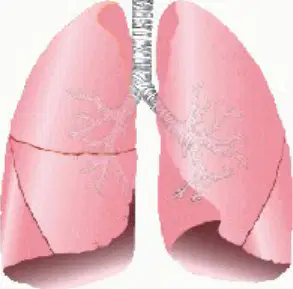
Which of the following is NOT listed as a co-morbid condition that may affect respiratory function in preoperative assessment?
Obstructive sleep apnea (OSA)
Asthma
Chronic obstructive pulmonary disease (COPD)
Diabetes mellitus
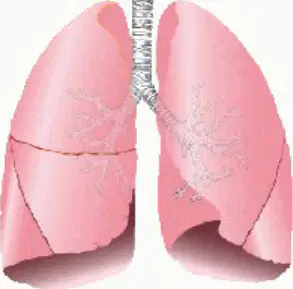
A patient with chronic obstructive pulmonary disease (COPD) is scheduled for surgery. Based on the preoperative assessment guidelines, what should the healthcare team consider?
The patient should be given extra fluids before surgery.
The surgery may need to be postponed or special precautions taken due to the risk to respiratory function.
The patient should start a new exercise regimen immediately.
The patient should avoid all medications before surgery.
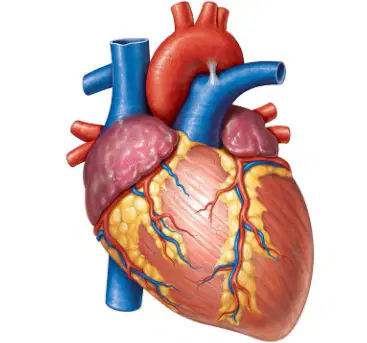
Which of the following is a risk factor for myocardial infarction (MI) during surgery?
History of MI, heart failure, or CAD
History of asthma
History of diabetes only
History of bone fractures

What is the primary function of the liver in relation to anesthetic medications?
Metabolizes anesthetic medications
Stores anesthetic medications
Excretes anesthetic medications
Absorbs anesthetic medications
Why are patients with existing heart problems at greater risk during surgery?
They are more likely to experience an MI during surgery
They are more likely to develop infections
They are more likely to have allergic reactions
They are more likely to bleed excessively
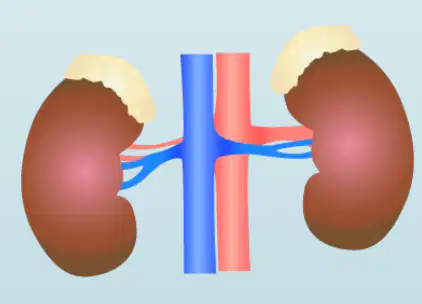
Which organ is responsible for excreting anesthetic medications from the body?
Kidneys
Heart
Lungs
Stomach
A patient with a history of VTE/DVT should be carefully assessed before surgery because:
They have an increased risk of cardiovascular complications
They may have difficulty metabolizing medications
They are more likely to develop infections
They may have allergic reactions to anesthesia
What is the effect of strict blood sugar control in diabetic patients undergoing surgery?
Increases the risk of wound infection
Decreases the surgical risk
Causes adrenal insufficiency
Leads to respiratory failure
Which endocrine disorder increases the risk for adrenal insufficiency during the preoperative assessment?
Diabetes
Corticosteroid use
Hyperthyroidism
Hypothyroidism
A patient with hyperthyroidism is at risk for which of the following complications during surgery?
Adrenal insufficiency
Thyrotoxicosis
Hypoglycemia
Respiratory failure
Why does hyperglycemia increase the risk of wound infection in surgical patients?
It results from excessive insulin administration
It may result from the stress of surgery
It is caused by corticosteroid use
It is due to respiratory failure
Which thyroid disorder puts a patient at risk for respiratory failure during surgery?
Hyperthyroidism
Hypothyroidism
Diabetes
Adrenal insufficiency

