Worksheets
Lower Limb Anatomy - Comprehensive Multiple Choice Questions
Total questions: 51
Worksheet time: 26mins
How many bones are found in the foot?
24
26
27
28
Which surface of the foot refers to the top/anterior surface?
Plantar
Dorsal
Medial
Lateral
The bottom/posterior surface of the foot is called the:
Dorsal surface
Plantar surface
Medial surface
Lateral surface
The base of which metatarsal has a lateral tuberosity and is a common site for trauma?
1st metatarsal
3rd metatarsal
4th metatarsal
5th metatarsal
Which of the following bones of the foot is fractured most often?
Base of the fifth metatarsal
Navicular
Distal fifth phalanx
Third cuneiform
How many interphalangeal (IP) joints does the 1st toe have?
0
1
2
3
The 2nd through 5th toes each have:
One IP joint
DIP and PIP joints
Only a DIP joint
Only a PIP joint
The interphalangeal joints are classified as what type of movement?
Modified ellipsoidal
Plane
Ginglymus
Saddle
The metatarsophalangeal (MTP) joints are classified as what movement type?
Ginglymus
Modified ellipsoidal
Plane
Saddle
Sesamoid bones are:
Embedded in ligaments
Embedded in tendons
Found only in the hand
Located on the dorsal surface of the foot
Sesamoid bones are present:
Near joints
In the middle of long bones
Only in the skull
At muscle origins
In the foot, sesamoid bones are located on the:
Dorsal surface
Plantar surface
Medial surface
Lateral surface
How many tarsal bones are there?
5
6
7
8
Using the mnemonic "Come to Colorado the Next 3 Christmases," which bone does "Come" represent?
Cuboid
Calcaneus
Cuneiform
Calcaneocuboid
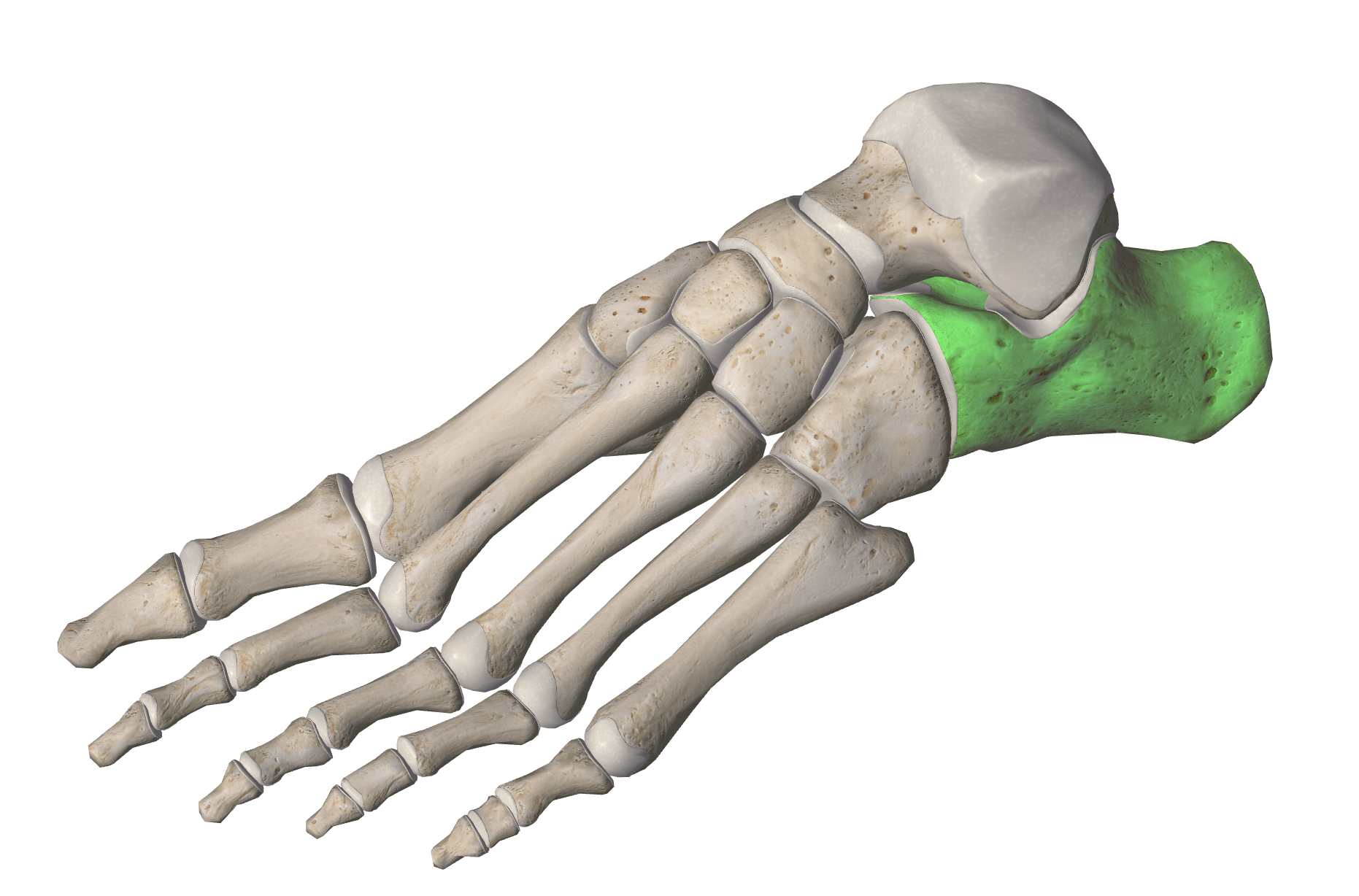
Which tarsal bone is the largest and strongest?
Navicular
Cuboid
Calcaneus
Talus
The calcaneus articulates with which bones?
Talus and navicular
Talus and cuboid
Cuboid and navicular
Only the talus
Which tarsal bone is the second largest bone in the foot?
Calcaneus
Cuboid
Navicular
Talus
The sustentaculum tali is found on the:
A. Calcaneus
B. Talus
C. Base of the fifth metatarsal
D. Cuboid
How many cuneiform bones are there?
1
2
3
4
The foot has how many main arches?
1
2
3
4
The two main arches of the foot are:
Medial and lateral
Anterior and posterior
Longitudinal and transverse
Superior and inferior
The medial malleolus is part of which bone?
Fibula
Tibia
Talus
Calcaneus
The lateral malleolus is part of which bone?
Fibula
Tibia
Talus
Calcaneus
In the lateral ankle position, the distal fibula should be positioned over:
The anterior half of the tibia
The posterior half of the tibia
The entire tibia
Completely separate from the tibia
The ankle joint is classified as what movement type?
Ginglymus
Saddle
Plane
Modified ellipsoidal
The articular facets making up the tibial plateau slope posteriorly at:
5° to 8°
10° to 20°
25° to 30°
35° to 45°
The intercondylar eminence consists of:
One tubercle
Medial and lateral intercondylar tubercles
Three tubercles
No tubercles
The tibial tuberosity is located on the:
Posterior tibia
Anterior tibia
Medical tibia
Lateral tibia
The fibular notch is a feature of the:
Fibula
Tibia
Femur
Patella
The femur is:
The second longest bone in the body
The longest and strongest bone in the body
The strongest but not longest bone
Equal in length to the tibia
The patella is located approximately how far above the knee joint?
¼ inch (0.6 cm)
½ inch (1.25 cm)
¾ inch (1.9 cm)
1 inch (2.5 cm)
The distal medial and lateral condyles of the femur have an angle of:
5° to 7°
10° to 15°
15° to 20°
20° to 25°
Another term for the patellar surface of the distal femur is:
Capitellum
Intercondylar fossa
Meniscus
Intercondylar sulcus
The knee joint consists of which articulations?
Femorotibial only
Patellofemoral only
Femorotibial and patellofemoral
Tibiofibular and patellofemoral
How many major ligaments are in the knee joint?
2
3
4
5
The four major ligaments of the knee joint are:
A. Anterior cruciate, posterior cruciate, medial collateral, lateral collateral
B. Anterior cruciate, posterior cruciate, fibular collateral, tibial collateral
C. Medial meniscus, lateral meniscus, anterior cruciate, posterior cruciate
D. Patellar, quadriceps, fibular collateral, tibial collateral
The femorotibial joint is classified as what movement type?
Ginglymus
Bicondylar
Saddle
Plane
The patellofemoral joint is classified as what movement type?
Ginglymus
Bicondylar
Saddle
Plane
All joints of the lower limb except the distal tibiofibular joint are classified as:
Fibrous
Cartilaginous
Synovial
Immovable
The distal tibiofibular joint is classified as:
Synovial
Fibrous
Cartilaginous
Ball and socket
Most joints of the lower limb have what type of mobility?
Synarthrodial (immovable)
Amphiarthrodial (slightly movable)
Diarthrodial (freely movable)
None of the above
The distal tibiofibular joint has what type of mobility?
Synarthrodial
Amphiarthrodial
Diarthrodial
Completely immovable
The intertarsal joints are classified as what movement type?
Ginglymus
Saddle
Plane
Modified ellipsoidal
The proximal tibiofibular joint is classified as what movement type?
Ginglymus
Saddle
Plane
Bicondylar
Dorsiflexion refers to:
Pointing the foot downward
Lifting the foot upward
Turning the foot inward
Turning the foot outward
Plantar flexion refers to:
Pointing the foot downward
Lifting the foot upward
Turning the foot inward
Turning the foot outward
Inversion is also called:
Valgus
Varus
Dorsiflexion
Plantar flexion
Eversion is also called:
Valgus
Varus
Dorsiflexion
Plantar flexion
Turning the foot inward is called:
Eversion
Inversion
Dorsiflexion
Plantar flexion