
 Worksheets
1700 final review
Total questions: 90
Worksheet time: 1hrs 7mins
On assessment of a patient in the ICU, the respiratory therapist notes a heart rate of 130 beats per minute. What might explain this finding? Mark all that apply
anxiety
hypoxia
blood loss
hypovolemia
Which laboratory study is used to assess the quantity and quality of erythrocytes, leukocytes, and thrombocytes?
clinical chemistry
serum creatinine
cardiac markers
complete blood count
A successful patient and/or family interview includes: establishing rapport with the patient and family, identifying the chief complaint and chronology of events, and demonstrating compassion and professionalism.
true
false
The two waveforms that are common for pressure scalars are which of the following?
Exponential decay and descending ramp
Rectangular and exponential rise
Sinusoidal and ascending ramp
Descending ramp and ascending ramp
The volume curve on a volume-time scalar is consistently dropping below the baseline during exhalation. The first action to take is which of the following?
Measure the plateau pressure.
Check the ventilator circuit for a leak.
Measure the endotracheal (ET) tube cuff pressure.
Assess the patient for active exhalation.
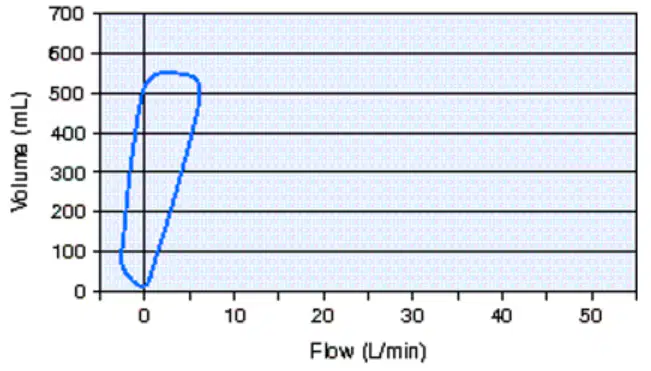
The type of breath shown in the flow-volume loop below is which of the following?
Pressure-controlled continuous mandatory ventilation (PC-CMV)
Continuous positive airway pressure (CPAP)
Spontaneous without support
Pressure support ventilation (PSV)
Bronchospasm, mucosal edema, secretions, endotracheal tubes, tracheostomy tubes, ventilator demand flow systems, ventilator circuits, and increased ventilator inspiratory flow rates may all be causes of:
increased airway resistance
decreased airway resistance
increased airway compliance
decreased airway compliance
atelectasis, pneumonia, ARDS, pulmonary edema, and pulmonary fibrosis have what effect on lung cL?
increase
decrease
Measurement of exhaled nitric oxide provides a test of:
airway inflammation
gas exchange
effect of bronchodilators
ventilation adequacy
There is strong literature support for the use of ________ in acute exacerbations of COPD and acute cardiogenic pulmonary edema (CPE).
tracheostomy placement
bronchoscopy
noninvasive ventilation
endotracheal intubation
Critical care ventilators may sometimes be used to deliver NIV in a hospital setting. Which of the following are considered advantages to using a critical care ventilator versus a noninvasive ventilator to provide NIV? select all that apply
increased availability in the ICU
leak compensation software
fewer co2 rebreathing issues
lower cost associated with use
NIV pressure settings generally should be set:
relatively high and subsequently increased to meet therapeutic objectives
relatively low and subsequently increased to meet therapeutic objectives
relatively high and subsequently decreased to meet therapeutic objectives
relatively low and subsequently decreased to meet therapeutic objectives
Which type of interface is generally recommended for NIV in the setting of acute respiratory failure?
interface to cover the nose only
interface to cover both the mouth and nose
endotracheal tube
tracheostomy tube
True or False. CPAP may be beneficial for the management of OSA and hypoxemic respiratory failure
true
false
At a minimum, the following should be regularly monitored during the use of NIV:
VS and oxygenation
neurologic status and level of dyspnea
level of WOB
all the above
What should the RT recommend to improve oxygenation?
Increase the respiratory rate setting
Increase the tidal volume setting
Increase the IPAP
Increase the EPAP
There are various types of ventilators used to deliver NIV. It is imperative that clinicians:
select the cheapest option to reduce medical bills
understand the equipment they have in their facility
practice using only the newest type of ventilators
run daily equipment checks to ensure proper functioning
Which section of the medical record allows for assessment of trends and patterns in vital signs?
patient data/demographics
flowsheets
physicians' orders
admitting diagnosis/problem list
Findings consistent with severe hypoxia include which of the following?
loss of conscience and somnolence
convulsions
coma
all the above
Which of the following represent life threatening complications during mechanical ventilation requiring an immediate response?
airway obstruction and tension pneumothorax
ventilator malfunction
patient disconnect
all the above
Which of the following may be useful in optimizing PEEP and in performing and assessing the results of recruitment maneuvers?
flow-volume loops
pressure-volume curves
volume-time loops
pressure-time curves
Which of the following are commonly used to assess for proper endotracheal tube placement?
colorimetric CO₂ detection devices
exhaled nitric oxide measurement
chest CT scan
amplified auscultation
Which of the following techniques provides a noninvasive method for assessment of heart rate and rhythm, and recognition of major arrhythmias?
cardiac ultrasound
cardiac CT imaging
ECG
nuclear imaging
The Glasgow scale is commonly used to assess patient's:
mental status
level of consciousness
neurologic function
cognitive function
Grimacing, writhing, tachycardia, hypertension, tachypnea, or sweating are associated with which of the following?
anxiety
pain
discomfort
hypercapnia
When reviewing sensorium, level of consciousness, and orientation to person, place, and time the clinician is assessing the patient's:
mental status
neurologic status
cognitive status
psychological condition
Chest tubes are inserted into the pleural space to treat:
pleural effusion
hemothorax
pneumothorax
all the above
Types of patient–ventilator asynchrony include which of the following?
trigger asynchrony
flow asynchrony
cycle asynchrony
all the above
When should the respiratory care clinician drain the ventilator circuit tubing, service the humidifier and attend to the patient's airway?
prior to doing a ventilator check
after doing the ventilator check
during the ventilator check
before or after doing the ventilator check
Which of the following must be continuously monitored during a bronchoscopy?
cardiac monitoring
blood pressure
oximetry
all the above
What is the most difficult parameter to monitor during FB?
Pulse oximetry
Depth of sedation
Airway pressure
Chest movement
To obtain lavage fluid, the bronchoscope is wedged at which of the following locations?
The level of the carina
At least at the level of the sixth generation bronchus
The level of second or third generation bronchus
The level of fourth or fifth generation bronchus
A technique of obtaining a specimen of the lung parenchyma by using flexible forceps positioned distally through the working channel of the bronchoscope is referred to as
bronchial brushing.
an endobronchial biopsy.
transbronchial needle aspiration.
a transbronchial biopsy.
For which type of pneumothorax is pleurodesis most commonly indicated?
Iatrogenic
Bronchopleural fistula
Traumatic
Spontaneous
What diagnostic procedure or technique is most sensitive for the identification of pleural effusion?
Thoracoscopy
Pleurodesis
Chest radiography
Computed tomography
The two waveforms that are common for pressure scalars are which of the following?
Exponential decay and descending ramp
Rectangular and exponential rise
Sinusoidal and ascending ramp
Descending ramp and ascending ramp
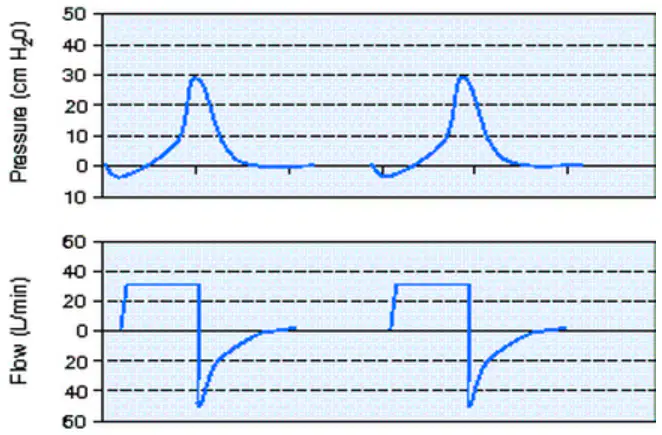
The respiratory therapist observes the following pressure-time and flow-time scalars following a patient being intubated and placed on a mechanical ventilator using volume ventilation. The most appropriate action is which of the following?
Increase the set flow rate.
Change to a decelerating flow pattern.
Increase the set tidal volume.
Switch to pressure control.
During a patient-ventilator system check the respiratory therapist notices that the pressure-volume loop begins at zero on the x-axis but does not return to zero during expiration. The cause of this is
Active exhalation
Decreased compliance
Inadequate sensitivity
Ventilator circuit leak
During mechanical ventilation which of the following generally is not displayed on mechanical ventilatory graphic displays?
work of breathing
ventilatory volumes
ventilatory pressures
ventilatory flows
Which of the following conditions causes a pressure-volume loop during volume-controlled continuous mandatory ventilation (VC-CMV) to extend farther to the right and flatten out?
Asthma
Pneumonia
Bronchitis
Emphysema
NIV is initiated on spontaneous mode with an FiO2 of 0.40, IPAP 8 cm H2O, and EPAP of 2 cm H2O. ABGs reveal pH 7.29, PaCO2 54, PaO2 52 and HCO3 of 30. The respiratory therapist should recommend what change in regard to the carbon dioxide levels?
increase the respiratory rate setting
Increase the tidal volume setting
Increase the IPAP
Increase the EPAP
The middle bottle of a three-bottle chest drainage system is used for which of the following?
Water seal
Fluid collection
Means of applying vacuum to the chest
Measurement of improvement of the pneumothorax
A 42-year-old patient with a cervical spine injury is being mechanically ventilated in control mode. As you enter the room, the low-pressure alarm is sounding. The patient is connected to the ventilator, but you do not see his chest moving. Your first action would be to:
manually ventilate the patient with a resuscitation bag
check the alarm settings
observe the exhaled tidal volumes
manually ventilate the patient with the mechanical ventilator
The thick, muscular middle layer of the heart wall that contains the atrial and ventricular muscle fibers necessary for contraction is the _____
epicardium
pericardium
myocardium
endocardium
On the ECG, the T wave represents _____
atrial contraction
atrial repolarization
ventricular contraction
ventricular repolarization
Which part of the conduction system receives an impulse from the bundle of His and relays it to the Purkinje fibers?
SA node
AV node
Right and left atria
Right and left bundle branches
Which of the following correctly reflects the ECG criteria for a sinus rhythm?
More P waves than QRS complexes
P waves that look alike and upright in lead II, one before each QRS complex
Irregular atrial and ventricular rhythm
PR interval exceeding 0.20 second
Atrial fibrillation is characterized by _____
one P wave before each QRS and a regular ventricular rate of 60 to 100 beats/min
an erratic, wavy baseline and irregular ventricular rhythm
"saw-tooth"- or "picket-fence"-shaped waveforms preceding each QRS
P waves occurring before, during, or after the QRS complex; when seen, they are inverted
A beat originating from the AV junction that appears later than the next expected sinus beat is called a _____
junctional escape beat
period of SA block
premature junctional complex (PJC)
premature atrial complex (PAC)
In second-degree and third-degree AV blocks, _____
P waves occur regularly
every other P wave is dropped
P waves are periodically dropped
there are more QRS complexes than P waves
The ventricular rhythm is regular in second-degree AV block type I.
True
False
A pacemaker is a battery-powered device that delivers an electrical current to the heart to stimulate depolarization.
True
False
How are frequent PACs usually managed?
Defibrillation
Synchronized cardioversion
Correcting the underlying cause
Administration of medications such as atropine or epinephrine
Which of the following medications increases heart rate by accelerating the SA node discharge rate and blocking the vagus nerve?
Digitalis
Atropine
Amiodarone
Beta-blocker
The usual rate of nonparoxysmal junctional tachycardia is _____ beats/min.
50 to 80
100 to 120
120 to 140
150 to 300
Ultrasound imaging may be useful in the intensive care unit for:
placing invasive lines
draining of pleural fluid
identification of a pneumothorax
all the above
An accumulation of fluid in the peritoneal cavity caused by portal hypertension, infection, or inflammation that causes abdominal distention is termed:
ascites
hepatomegaly
splenomegaly
jaundice
On the ECG, the P wave represents atrial ______ and the QRS complex represents ventricular ______
depolarization, depolarization
repolarization, repolarization
repolarization, depolarization
depolarization, repolarization
The heart is divided into _______ chambers but functions as a _______ sided pump
two, four
four, two
six, two
two, two
The rate of an idioventricular rhythm is how many beats/min?
101-180
40-60
61-100
20 to 40
The rate of a sinus rhythm is ____ beats/min
80-120
< 60
60-100
> 100
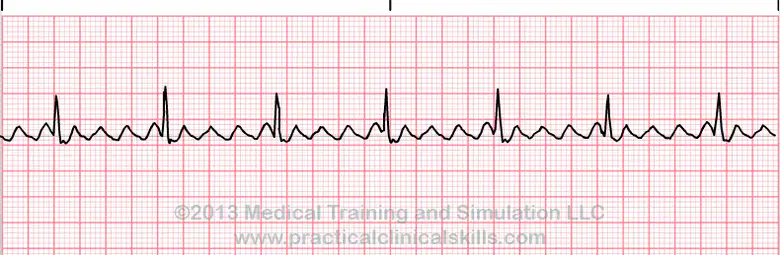
Identify the following rhythm
sinus bradycardia
atrial flutter
ventricular fibrillation
sinus rhythm
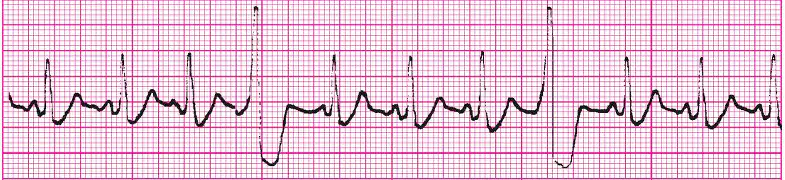
Identify the following rhythm
Uniform PVC
Multiform PVC
Sinus tachycardia
Idioventricular rhythm
Management of a patient with sinus tachycardia might include what?
administration of atropine
use of a pacemaker
identify and correct the underlying cause
vagal maneuvers such as carotid sinus pressure
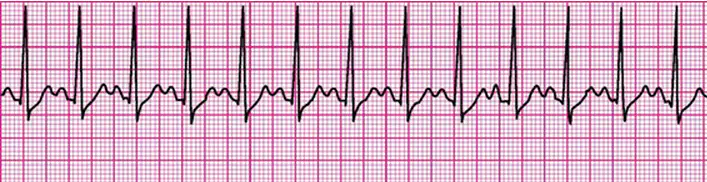
Identify the following rhythm
sinus bradycardia
sinus tachycardia
sinus rhythm
sinoatrial block
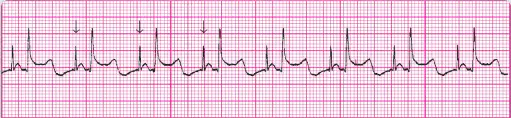
Identify where the pacing is taking place in the heart
right atrium
left atrium
right ventricle
left ventricle

Identify the rhythm
sinus tachycardia
ventricular tachycardia
sinus bradycardia
ventricular fibrillation
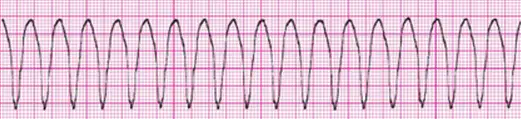
Identify the rhythm
multiform PVC
idioventricular rhythm
ventricular tachycardia
sinus tachycardia
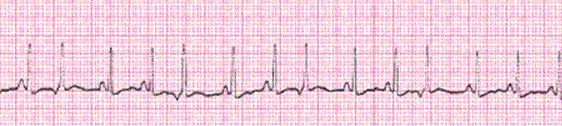
Identify the rhythm
sinus arrythmia
sinus tachycardia with premature junctional complexes
sinus tachycardia with premature atrial complexes
sinus rhythm with junctional escape beats
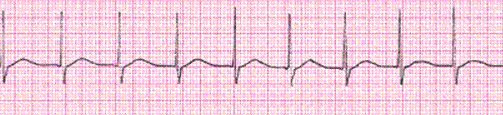
Identify the rhythm
sinus rhythm
junctional rhythm
accelerated junctional rhythm
sinus arrythmia
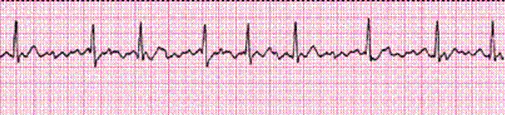
The P waves in this strip
are inverted before every QRS complex
vary in size and shape
are upright before every QRS complex
are not identifiable
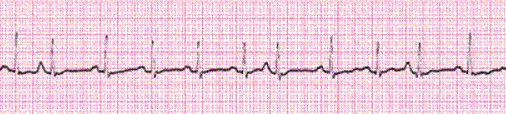
Identify the rhythm
sinus arrythmia
multifocal atrial tachycardia
atrial fibrillation
Sinus tachycardia with PACs
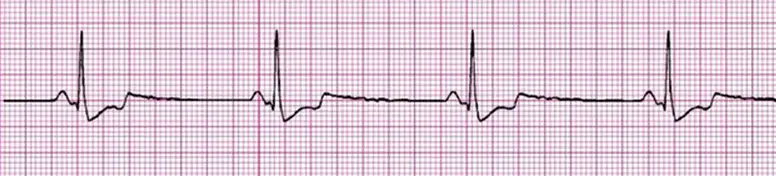
Identify the rhythm
sinus bradycardia
sinus arrest
sinus rhythm
sinoatrial block
A _____ is a vertical line on the ECG that indicates the artificial pacemaker has discharged
chamber pace
pacemaker spike
chamber sensed
mode of response
Most of the bundle branch tissue is supplied by what coronary artery?
right
left
Which of the following are possible causes of sinus tachycardia?
vomiting, vagal maneuvers
hypothermia, hypovolemia
hypoxia, calcium channel overdose
fever, pain and anxiety
Blood pressure is determined by ____ multiplied by _____
cardiac output; peripheral vascular resistance
stroke volume; peripheral vascular resistance
stroke volume; heart rate
heart rate; cardiac output
The apex of the heart is formed by what?
tip of the right ventricle
tip of the right atrium
left atrium and left ventricle
tip of the left ventricle
What is the term to specify flow, pressure, and volume waveforms that are graphed relative to time?
loop
scalar
waveform
hysteresis
Which lab study is used to test if hemoglobin has been exposed to abnormally high glucose levels for a long period of time?
complete blood count
oral glucose tolerance test
hemoglobin A1C
fasting plasma glucose level
Which major electrolytes are found in the plasma?
sodium and potassium
chloride
bicarbonate
all the above
Which of the following helps the clinician understand the overall health of the patient?
medical history
nursing progress notes
monitoring flowsheets
shift report
Which of the following calculations can be used to assess oxygen transfer across the lung?
PAO2-PaO2
PaO2/PAO2
PaO2/FiO2
all the above
What type of monitoring may be helpful in pts with head trauma?
ICP
response to stimuli
mental status monitoring
CSF assessment
Which of the following are indications for flexible bronchoscopy?
unexplained lung collapse
bronchogenic carcinoma
evaluate E-T related injury
all the above
What is meant by the term pulseless electrical activity (PEA)?
a flat line on the cardiac monitor
a slow rhythm with a wide QRS complex
an unorganized rhythm on the cardiac monitor (other than VT) although a pulse is not present
a chaotic rhythm that is likely to degenerate into cardiac arrest
What is the primary risk factor associated with spontaneous pneumothoraces?
urban living
cigarette smoking
obesity
heavy exercise
What is the most common cause of a hemothorax?
pulmonary embolism
surgery
malignancy
chest trauma
What is the challenge of using an ultrathin bronchoscope?
maintaining proper anatomical orientation in the peripheral airways
kinking during the procedure
the equipment is expensive
issues with CT guidance equipment
Which factors could affect the accuracy of a pulse ox reading?
motion artifact and abnormal hemoglobin
skin pigmentation
nail polish
all the above

