
 Worksheets
Philippine Qualification Framework: Introduction and Structure
Total questions: 95
Worksheet time: 48mins
Which statement best defines a qualification in the Philippine context?
A formal set of competencies for a job role
A temporary permit allowing short-term employment
A personal portfolio of achievements and hobbies
An exam score used for university admissions
What is the primary purpose of the Philippine Qualifications Framework (PQF)?
To replace all professional licensure exams
To reduce the number of education providers
To centralize all school admissions decisions
To describe and align national qualification levels
Which feature indicates the PQF is competency-based?
It requires identical curricula for all schools
It emphasizes seat time and class attendance
It relies solely on written examinations
It focuses on demonstrated skills and outcomes
Which law or order formally established the PQF?
Executive Order No. 83, series of 2012
Republic Act No. 7722, CHED Law
Republic Act No. 10931, Free Tuition
Executive Order No. 201, series of 2016
Which benefit of PQF most directly supports worker mobility internationally?
Recognition and comparability of qualifications
Unified global salary scales for nurses
Mandatory foreign language certification
Automatic visa issuance for professionals
Which statement best captures how PQF supports individuals?
Guarantees immediate employment after graduation
Restricts movement between training sectors
Eliminates the need for any formal training
Provides pathways for lifelong learning and progression
How does PQF assist employers?
Replaces internal performance appraisals entirely
Allows employers to set school curricula directly
Assures qualifications match job requirements and demand
Removes standards for on-the-job training
Which agency combination is tasked with detailing PQF descriptors across levels?
DepEd, TESDA, and CHED working jointly
DOH, PRC, and PhilHealth collaboration
DILG, DFA, and DOJ coordination
NEDA, DTI, and DOLE partnership
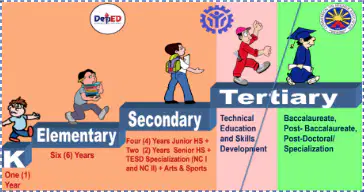
Which education stages are shown in the Philippine Education System diagram?
Junior, Senior, Doctoral continuum
Primary, Middle, Graduate sequence
Elementary, Secondary, Tertiary progression
Foundation, Intermediate, Advanced track

At which PQF levels are NC I to NC IV typically located?
Levels 3 to 7 in postgraduate
Levels 2 to 6 in basic education
Levels 5 to 8 in higher education
Levels 1 to 4 in TESDA tracks
Which outcome is a system-level benefit for authorities under PQF?
Direct control of international licensing bodies
Removal of accreditation requirements nationwide
Harmonized standards across education and training
Automatic funding for all private institutions
Which statement about assessment under PQF is accurate?
Assessment occurs solely at the tertiary level
Assessment is optional and replaced by attendance records
Only paper-based tests are permitted under PQF
Qualifications are recognized based on assessment outcomes
Which PQF level emphasizes manual or concrete skills with operational focus and minimal judgment due to close supervision?
Level 2 with substantial guidance and support
Level 3 with team coordination responsibilities
Level 1 with close support and supervision
Level 4 with leadership during organization
At PQF Level 2, application typically occurs in what kind of contexts?
Limited range of highly familiar contexts
Professional work or specialized research
Range of familiar and predictable contexts
Mostly unfamiliar and unpredictable contexts
Which qualification type corresponds to PQF Level 3?
National Certificate I
Diploma qualification type
National Certificate II
National Certificate III
Which statement best describes the degree of independence at PQF Level 3?
Very close support with minimum judgment
Substantial support and limited discretion
Individual autonomy and some responsibility for others
Broad guidance with strategic initiative
Which PQF level first introduces mainly theoretical or abstract knowledge with significant depth contributing to technical solutions of non‑routine issues?
Level 3 balancing theory and practice
Level 2 with practical operational focus
Level 4 with significant theoretical depth
Level 6 with broad coherent knowledge
At PQF Level 4, work often involves what when organizing activities of self and others?
Independent research tasks
Some leadership and guidance
Minimal supervision only
Routine procedures without variation
Which qualification type is linked to PQF Level 4?
National Certificate IV
Bachelor’s degree level
National Certificate I
Diploma qualification
PQF Level 5 requires application in activities that are supervisory, complex, and non‑routine. What is additionally required?
Following set rules and procedures
Extensive interpretation and adaptation or innovation
Minimal judgment under close supervision
Simple manual operational skills
Which descriptor fits PQF Level 5 knowledge, skills, and values?
Broad coherent knowledge for professional practice
Mainly theoretical with significant depth and wide‑ranging specialized skills
Balance of theory and technical practice
Manual practical skills with options
At PQF Level 5, degree of independence involves which of the following?
Limited discretion within substantial support
Close support with minimum discretion
Independent teams guided by set procedures
Broad guidance with planning judgment and strategic initiatives
Which qualification type corresponds to PQF Level 5?
National Certificate IV
National Certificate II
National Certificate III
Diploma
Graduates at PQF Level 6 demonstrate what kind of knowledge in their field?
Manual and operational skills
Broad and coherent knowledge and skills
Balance of technical and practical
Mainly theoretical with significant depth
Application at PQF Level 6 commonly occurs in which settings?
Limited range of predictable contexts
Supervisory complex non‑routine activities
Highly familiar routine procedures
Professional work or specialized research
What is the typical degree of independence at PQF Level 6?
Independent or in teams with minimal supervision
Substantial guidance with limited discretion
Very close support and guidance
Leadership with some guidance in organizing
Which progression correctly orders qualification types from PQF Levels 1 to 5?
NC I, NC II, Diploma, NC III, NC IV
NC I, NC III, NC II, NC IV, Diploma
NC I, NC II, NC III, NC IV, Diploma
NC II, NC I, NC III, Diploma, NC IV
Which qualification type corresponds to PQF Level 7 in the nursing leadership context?
Post-Doctoral Programs
Doctoral Degree
Post-Baccalaureate Degree
Baccalaureate Degree
At PQF Level 7, graduates demonstrate advanced knowledge and skills primarily for which purpose?
Professional practice or self-directed research
General education foundation building
Entry-level employment orientation
Community volunteer engagement only
Which statement best describes application at PQF Level 7?
Leadership and management in specialized professional work
Routine tasks under close supervision in basic settings
Introductory exposure without leadership responsibilities
Administrative clerical functions in nonclinical units
What is the degree of independence expected at PQF Level 7?
Independent or team-based with minimal supervision
Fully dependent with continuous supervision
Solo practice prohibited without oversight
Independence only after doctoral completion
Which qualification type is aligned with PQF Level 8?
Baccalaureate Degree
Secondary Education Certificate
Associate Degree
Post-Baccalaureate Degree
Graduates at PQF Level 8 are characterized by what kind of knowledge and skills?
Highly advanced systematic knowledge in complex fields
Basic foundational knowledge for general learning
Intermediate skills suitable for entry-level roles
Non-specialized knowledge for community outreach
How is application at PQF Level 8 typically manifested?
Observation-only roles without responsibility
Specialized or complex multidisciplinary professional work
Administrative assistance with limited scope
Simple routine tasks in single-discipline contexts
What level of autonomy and accountability is expected at PQF Level 8?
Significant expertise-based autonomy in complex settings
Autonomy only within nonclinical functions
Minimal autonomy with strict daily oversight
No autonomy until licensure renewal
Which statement best defines qualifications within the Philippine Qualifications Framework context?
Certificates showing completed course units
Certifications expressing recognized knowledge, skills, competencies
Licenses issued solely by professional councils
Diplomas granted only by higher education bodies
What is the primary purpose of a qualifications framework?
To rank schools by performance metrics
To develop, classify, and recognize competencies across levels
To replace technical education with university pathways
To standardize tuition across education sectors
Which agencies comprise the tri-focal Philippine education system?
TESDA, PRC, CHED
CHED, PRC, DepEd
DepEd, TESDA, CHED
DepEd, PRC, TESDA
Which sequence aligns with key milestones in PQF development?
1998 TVET start; 2003 formal PTQF; 2004 EO 358; 2012 EO 83; 2014 RA 10647; 2018 RA 10968; 2019 IRR
1998 EO 83; 2003 RA 10968; 2004 PTQF; 2012 EO 358; 2014 IRR; 2019 ladderization
2003 TVET start; 1998 PTQF; 2012 RA 10647; 2018 EO 358; 2019 RA 10968
2004 ladderization; 2012 RA 10968; 2018 EO 83; 2019 PTQF
RA 10968 accomplished which of the following for the PQF?
Abolished the National Coordinating Council
Transferred PQF oversight to private accrediting bodies
Institutionalized the PQF and established the PQF-NCC
Limited PQF to higher education credentials only
Which are core PQF domains used to describe qualifications?
Theory, Practice, Ethics; Placement; Regulation
Knowledge, Skills, Values; Application; Degree of Independence
Learning Outcomes, Modules, Credits; Internship; Licensure
Curriculum, Assessment, Accreditation; Delivery; Funding
How does the PQF function as a national system for learners and workers?
By enforcing uniform curricula in all institutions
By assuring development, recognition, and award of qualifications based on standards
By delegating qualification outcomes to sectoral associations only
By prioritizing academic degrees over vocational awards
Which outcome best reflects the PQF Act’s aim of standardization and transparency in qualifications?
Unified criteria for awarding credentials
Institution-specific grading flexibility
Informal peer endorsements of skills
Ad hoc certification by private tutors
What recommendation for the PQF IRR strengthens alignment with national contexts?
Limiting consultation to tertiary schools
Prioritizing foreign industry representation
Creating global-only qualification standards
Enhancing relevance to local and regional needs
Which PQF IRR element improves balanced stakeholder input?
Government-only drafting authority
Exclusive academic committee membership
Economic and industry sector representation
Public polling for certification
In human resource development, which benefit addresses workforce mobility?
Time-bound licenses without transfer
Regional bans on skill recognition
Static roles within single institutions
Mobility of workers, students, and services
Which PQF-driven practice can help correct mismatches between education and industry needs?
Disallowing prior experiential learning
Fixed curricula without industry input
Mandatory uniform college diplomas
Recognition of learning outside formal systems
An industry player demystifies the college diploma by hiring based on competence. Which engagement best supports this approach?
Outsourcing all evaluation overseas
Favoring only university credentials
Ignoring certification assessments
Partnering with TESDA for training regulations
Which collaboration clarifies competencies for industry-oriented disciplines and SHS tracks?
Student-run certification councils
Consultations limited to employers
Exclusive deals with private tutors
Engagement with CHED and DepEd
Looking ahead, which future potential aligns with PQF’s vision for validation of skills?
Industry-accredited certification units
Unverified on-the-job experience logs
Self-declared competency portfolios
Open badges without assessment
Which best describes the typical Filipino organizational structure in many institutions?
Matrix, project-based, flexible
Networked, team-driven, autonomous
Hierarchical, line, centralized
Flat, decentralized, egalitarian
In Filipino management, which value emphasizes belonging and group harmony across peers?
Hiya, shame and delicadeza
Kapwa, being part of others
Utang na loob, debt of gratitude
Dangal, personal honor and dignity
What social framework highlights elderly concern where leaders act like responsible elders?
Familism in group decisions
Personalism in interactions
Paternalism in leadership
Emotionalism in expression
Foreign management techniques are often described as which in Filipino contexts?
Academically attractive, seldom suited
Highly practical, widely suited
Emotionally resonant, always suited
Legally mandated, universally suited
Which practice typically starts Filipino meetings and aids relationship-building?
Extended small talk, rapport first
Immediate agenda, strict timing
Formal presentations, data-heavy
Silent review, written updates
Which item reflects constrained conformity noted in Filipino cultural orientation?
Preference for solitary decision-making
Rigid adherence to group norms
Formal protests against leadership
Encouraging open dissent publicly
Which statement captures the concept of reciprocity in Filipino cultural themes?
Social obligations are optional favors
Moral obligation must be repaid
Respect is given without conditions
Authority is obeyed without question
What does "kayod" signify in the Filipino manager style taxonomy?
Hybrid reconciler, highly adaptable
Sweating it out, realist hard work
Playing by ear, opposite of libro
Capitalizing on loopholes, extrovert
A manager who literally goes by the book and seeks quality results is labeled as what style?
Manager by UGNAYAN
Manager by LUSOT
Manager by LIBRO
Manager by OIDO
Which leadership style is passive, friendly, and fails to provide needed guidance?
Takutan, oppressive and hostile
Pakiramdam, passive and friendly
Pa tsamba-tsamba, trial and error
Kulit, micromanaging subordinates
Which Filipino cultural value involves shame, propriety, and delicadeza?
Damdamin, emotional standard
Kapwa, social harmony focus
Dangal, personal honor duty
Hiya, social propriety cues
What is a common communication tendency among Filipinos in professional contexts?
Silence indicates clear dissent
Say yes while meaning no
Use technical jargon exclusively
Direct refusals with firm tone
Which management approach emphasizes consultation, persuasion, and consensus?
Transactional reward mechanisms
Participatory management process
Bureaucratic rules enforcement
Authoritarian unilateral directives
Which manager style seeks easy settlements through shaky deals and avoids hard work?
Manager by LUSOT
Manager by LIBRO
Manager by OIDO
Manager by UGNAYAN
What does "barkada/peer group" signify within Filipino organizational themes?
Economic status and resource control
Prestige and acceptance in community
Formal authority and hierarchy
Primary unit of kinship obligations
Which value underscores responsibility, respect, and a sense of honor?
Hiya and amor propio
Utang na loob
Dangal and galang
Kapwa and pakikisama
Which manager style is hybrid, reconciles different approaches, and is highly adaptable?
Manager by OIDO
Manager by UGNAYAN
Manager by KAYOD
Manager by LIBRO
In Filipino workplace culture, which trait reflects emotionalism?
Avoiding facial expressions
Suppressing all emotions
Using logic exclusively
Displaying emotion freely
Executives must familiarize themselves with which to manage Filipino teams effectively?
Basic cultural orientations
Only technical procedures
Foreign corporate statutes
Strict Western dress codes
Which description fits the "Manager by OIDO" style?
Hybrid reconciler, contingency
Loophole seeker, informal extrovert
Formal training, by the book
Practical experience, plays by ear
Which behavior illustrates personalism in Filipino social framework?
Avoiding interpersonal contact
Prioritizing face-to-face ties
Relying solely on emails
Delegating to anonymous teams
Which term describes kinship obligation to assist in times of need?
Personal loyalties to barkada
Social reciprocity expectation
Kin group counter-on support
Collectivity ideal belonging
Which statement best defines a nurse entrepreneur in the health sector?
A public health nurse coordinating government vaccination drives
A proprietor offering nursing services directly to clients as self-employed
A salaried nurse leading internal projects within a hospital
A clinician providing bedside care under physician supervision
Which term describes a salaried nurse who develops and delivers innovative programs within an organization?
Nurse entrepreneur
Nurse consultant
Nurse intrapreneur
Clinical specialist
Which role typically includes correspondence and record keeping in a nursing enterprise?
Employer
Receptionist
Secretary
Accountant
In a nursing business, which function most closely aligns with financial accountability including taxes and benefits?
Teacher
Market analyst
Clinician
Accountant
Which activity is most central to the market analyst role in a nurse-led business?
Direct nursing care for chronically ill clients
Market research and business presentation development
Preliminary contacts and triage for potential clients
Bookkeeping and tariff or fee development
Which service falls under the clinician role in entrepreneurial nursing practice?
Health assessments and direct nursing care
Corporate branding and stationery preparation
Family planning education only
Human resources planning consultancy
Which teaching focus is commonly offered by nurse entrepreneurs as part of health promotion?
High-level biomedical equipment calibration
International trade compliance policies
Stress reduction and nutrition programs
Advanced surgical techniques for physicians
Which consultant service is within the scope of a nurse entrepreneur?
Occupational health consultancy and infection control
Civil engineering safety inspections and audits
Pharmaceutical drug formulation and synthesis
Advanced radiology interpretation and reporting
Which therapy service could a nurse entrepreneur legally offer within nursing practice?
Respiratory therapy and psychotherapy
Advanced orthopedic surgery procedures
Prescription of all controlled substances
Diagnostic radiography interpretation
Which business opportunity is realistic for Filipino nurse entrepreneurs?
Operating air ambulance pilot services
High-frequency currency trading and hedging
Developing proprietary cardiac stents
Independent or private practice and consultancies
Which question is essential when establishing a nurse-led business?
Who are the customers and competitors involved
What are the latest celebrity health trends
Which hospital has the most floors available
How many years nurses have been licensed locally
Which item fits under operations in a business plan for a clinic?
Description of facilities, equipment, and personnel
Philosophical arguments about health ethics
Historical overview of nursing in the 1800s
Personal reflections on clinical placements
Which Filipino initiative promoted nurse entrepreneurship starting in 2010?
Project EntrepreNurse with DOLE and partners
Universal Health Care Act implementation
Philippine Disaster Risk Reduction Plan
K-12 Basic Education Curriculum rollout
Which statement best distinguishes debt from equity when financing a nursing startup?
Equity involves short-term loans with fixed schedules
Debt requires repayment with interest by a set date
Equity must be repaid in full like principal loans
Debt sells ownership shares to outside investors
In sponsorship for intrapreneurs, what is the sponsor’s primary role?
Negotiate loan terms and interest rates
Own shares and control strategic decisions
Handle external marketing and client acquisition
Provide trusted resources and moderate internal concerns
Which action is essential before marketing nursing services to potential clients?
Define the service being offered clearly
Secure equity from investor partners
Hire clinical nurse specialists immediately
Draft advertisements as the first step
Which task is included in effective marketing for nursing services?
Focus solely on bedside clinical procedures
Avoid brochures to limit printing expenses
Develop a strategic business plan with budget
Delay workplace setup until after launch
A nurse entrepreneur chooses equity financing. What does this involve?
Selling part of the business for investment
Borrowing principal with identified interest
Taking a short-term loan with fixed dates
Seeking sponsorship to moderate staff fears
Which communication channels align with effective marketing calls?
Face-to-face meetings exclusively
Internal memos for staff training
Radio only, avoiding digital platforms
Printed paper, email, SMS, social media
An advanced practice nurse engaging in entrepreneurship most likely holds which roles?
NPs, nurse midwives, CNSs, APNs
Hospital administrators and accountants
Pharmacists, dietitians, social workers
Medical technologists and radiographers
Which purpose best describes the Comprehensive Nursing Specialty Program under BON Article IV Sec. 31?
Upgrade skills and competence of specialty nurses
Mandate hospital marketing campaigns nationwide
Define equity regulations for private investors
Provide loan subsidies for nurse entrepreneurs
Which clinical areas are indicated for specialty program development?
Pediatrics, dermatology, psychiatry
Orthopedics, obstetrics, neurology
Community health, geriatrics, trauma
Critical care, oncology, renal
A nurse-led clinic plans marketing. Which sequence shows strategic planning at DoK 3?
Buy equipment, then decide target audience
Estimate clients, set budget, furnish workplace
Print brochures first, define services later
Launch ads, then create a business card

