
 Worksheets
Stroke
Total questions: 63
Worksheet time: 32mins
What is the definition of a stroke?
Cerebrovascular accident which is an interruption of blood flow to any part of the brain.
A sudden increase in blood pressure causing headache.
A condition where the heart stops beating suddenly.
A chronic disease affecting the lungs.
Which of the following is NOT a main type of stroke?
Ischaemic Stroke
Haemorrhagic Stroke
Cardiac Stroke
Subarachnoid Stroke
Ischaemic stroke is caused by blockage of which artery?
Pulmonary artery
Cerebral artery
Coronary artery
Femoral artery
Which subtype of ischaemic stroke involves a clot forming outside of the brain and traveling through the bloodstream to block an artery?
Embolic
Thrombotic
Intracerebral
Subarachnoid
Which of the following is a risk factor for both ischaemic and haemorrhagic stroke?
Smoker
Drug use (cocaine)
Family history of polycystic kidney disease
Dyslipidaemia
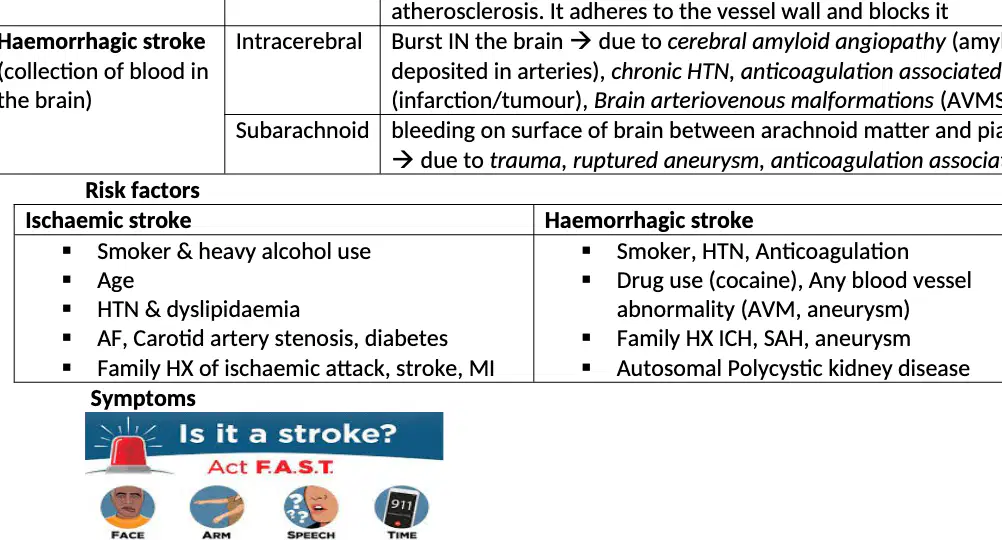
According to the diagram, what does the acronym F.A.S.T. stand for in stroke recognition?
Face, Arm, Speech, Time
Feet, Ankle, Shoulder, Thumb
Fingers, Abdomen, Spine, Thigh
Forehead, Ankle, Stomach, Toe
Which artery, when affected by stroke, most commonly results in weakness/paralysis, sensory loss, and speech impairment?
Middle cerebral artery
Anterior cerebral artery
Posterior cerebral artery
Basilar artery
Diagnosis of stroke requires mandatory imaging. Which of the following is used?
X-ray
MRI or CT
Ultrasound
PET scan
Aneurysm is the weakening of blood vessels resulting in a bulging artery which can burst.
True
False
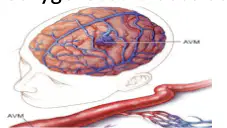
What is the definition of Arteriovenous malformation (AVM)?
Tangle of abnormal blood vessels connecting arteries, veins, oxygenated and deoxygenated blood. Usually present at birth and can present anywhere in the body.
Temporary blockage of blood supply to the brain.
Bleeding within the brain tissue.
Blockage of a coronary artery.
What is the definition of Transient Ischaemic Attack (TIA)?
A) Blood supply to the brain is temporarily blocked (clot removed by fibrinolysis). During the temporary blockage, the cells in the brain stop functioning and the person knows something is wrong.
B) Permanent blockage of blood supply to the brain.
C) Bleeding within the brain tissue.
D) Blockage of a coronary artery.
According to the ABCD2 score, what is considered a high risk of stroke after TIA?
0-3 points
4-5 points
6-7 points
8-10 points
Fill in the blank: In the ABCD2 score, age over ___ years gives 1 point.
60
50
65
70
Which clinical feature in the ABCD2 score gives 2 points?
Speech impairment without weakness
Unilateral weakness
Duration longer than 60 minutes
Diabetes
Fill in the blank: In the ABCD2 score, blood pressure over ___/___ gives 1 point.
140/90
130/80
120/70
150/100
Which of the following is a contraindication for thrombolysis?
Controlled hypertension
Severe hepatic disease
Mild headache
Normal platelet count
What is the loading dose of aspirin recommended for antiplatelet therapy in stroke management?
300mg on day 1
75mg on day 1
500mg on day 1
150mg on day 1
What is the contraindication for antiplatelet therapy in stroke management?
Thrombolysis in the past 24 hours
History of hypertension
Diabetes mellitus
Age above 65 years
Which of the following is preferred for antihypertensive therapy after the acute phase of stroke?
ACEI + Diuretic
Beta-blocker
Calcium channel blocker
Nitrate
What is the main goal for systolic blood pressure (SBP) in the long-term management of intracranial haemorrhagic stroke?
Under 120mmHg
Under 100mmHg
Under 160mmHg
Under 200mmHg
Surgical evacuation of haematoma should always be considered in the treatment of intracranial haemorrhagic strokes.
True
False
Which of the following is NOT a step in the treatment of subarachnoid haemorrhagic stroke?
Supportive care & monitoring
Stop and consider reversal of anticoagulant
Immediate use of antihypertensive drugs
Possible surgery to secure aneurysm and prevent rebleeding
Prevention of cerebral artery vasospasm
What is the main purpose of using Nimodipine (CCB) in patients with subarachnoid haemorrhagic stroke?
To prevent ischaemic neurological deficit associated with cerebral vasospasm following subarachnoid haemorrhage.
To control blood pressure in hypertensive emergencies.
To reduce intracranial pressure directly.
To promote clot dissolution in the subarachnoid space.
Which of the following is a contraindication for Nimodipine?
CYP3A4 inducers
Hypertension
Diabetes
Asthma
Headache is the disease itself in which type of headache?
Primary headache
Secondary headache
Which of the following is NOT a type of migraine?
Migraine with aura
Migraine without aura
Vestibular migraine
Cluster headache
Menstrual migraine
Fill in the blank: The prodromal phase (premonitory) of migraine includes symptoms such as fatigue, difficulty concentrating, irritability/mood changes, yawning, food cravings, photophobia and _________?
phonophobia
tachycardia
rash
hypertension
Which hypothesis about the pathophysiology of migraines is supported by the fact that vasoconstrictors improve migraine symptoms and vasodilators bring on migraines?
Aura is primary initiator of migraine
Vascular Hypothesis
Neuropeptides are mediators of migraines
Migraine is due to chronically low 5HT levels
Which neuropeptide increases during a migraine attack and normalizes after triptan use, acting as both a mediator and therapeutic target?
Serotonin
Calcitonin gene-related peptide (CGRP)
Dopamine
Acetylcholine
Which of the following is NOT a red flag for referral in migraine patients?
A) Stiff neck, rash, blurred vision
B) Aura with headache
C) Recent head/neck trauma
D) Persistent headache (3+ days)
Headache on waking that is worsened by laying down and does not improve throughout the day is a red flag for referral in migraine patients.
True
False
Which of the following drugs is used for the prevention of migraines?
Amitriptyline
Paracetamol
Triptans
Ibuprofen
What is the mechanism of action (MOA) of triptans in the treatment of migraines?
Constrict cranial vessels by acting on 5HT1B/1D receptors and inhibit abnormal activation of trigeminal nociceptors.
Block dopamine receptors in the brain to reduce migraine symptoms.
Inhibit acetylcholine release at neuromuscular junctions.
Increase GABAergic activity to suppress neuronal firing.
List two older first line options for pharmacological prophylaxis of migraines.
Antidepressants (TCA), Antiepileptics (topiramate, valproate)
Beta blockers, Calcium channel blockers
NSAIDs, Triptans
Monoclonal antibodies, CGRP antagonists
Which of the following is a contraindication for triptan use?
Controlled hypertension
History of myocardial infarction (MI)
No history of stroke
Use of triptan less than 10 times a month
What is a common adverse effect (AE) of triptan overuse?
Dependence with overuse resulting in rebound headaches
Weight loss and increased appetite
Permanent vision loss
Chronic cough
Epilepsy involves important connections between complex electrical networks via excitatory postsynaptic responses (EPSPs).
True
False
Define seizure.
Abnormal, excessive, and synchronised electrical discharge in the grey matter of the cortex, temporarily interrupting normal brain function.
A sudden drop in blood pressure causing fainting.
A progressive loss of memory and cognitive function.
A chronic inflammatory condition affecting the joints.
What is the most common cause of epileptic seizures?
Idiopathic and no apparent structural abnormalities
Brain tumor
Head trauma
Infections such as meningitis
Which of the following is NOT a common trigger for seizures?
Fever/infection
Excessive caffeine
Head injury
Regular exercise
Alcohol withdrawal
Fill in the blank: Defective ________ inhibition is a mechanism of decreased neuron inhibition in epilepsy.
GABA-A or GABA-B
glutamate
dopamine
acetylcholine
Fill in the blank: Seizures often start in the ________, where neurons become hyperexcitable.
cortex
cerebellum
thalamus
medulla
Which of the following is NOT a triggering factor for seizures?
Abnormal response to thalamic input
Subcortical triggers
Sensory inputs like sound and light
Regular sleep patterns
Disruption from trauma of structural damage
Fill in the blank: Seizure spreads like a wave from cortex to subcortex to ________ to brainstem to spinal cord.
thalamus
cerebellum
hippocampus
amygdala
How does the brain stop seizures?
Inhibitory signals come from the thalamus using GABA and potassium channels
Excitatory signals from the cortex
Increased NMDA receptor activation
Defective GABA-B inhibition
What is an Absence Seizure?
Brief & abrupt episode of impaired consciousness (<20 seconds) often occurring at rest +/- non-convulsive muscular movement. Can happen multiple times a day. Strong genetic link and more common in children.
Sudden loss of muscle tone leading to collapse, usually without warning and with quick recovery.
Prolonged convulsive episode lasting more than 5 minutes, often requiring emergency intervention.
Seizure characterized by repetitive jerking movements of a single limb or muscle group, usually lasting several minutes.
What is a Tonic seizure (excitatory)?
Sustained contraction of axial muscles that spreads to proximal muscles (limbs) but does develop gradually, lasts 10-15 seconds, often during sleep. Most common in childhood.
Brief loss of awareness with no postural change, often seen in adults.
Sudden jerking movements of the limbs, usually lasting less than a second.
Loss of muscle tone causing sudden collapse, typically without warning.
What is a Clonic Seizure (inhibitory)?
Rhythmic, motor jerking with or without the loss of consciousness, duration varies and can appear like partial seizures.
Sudden loss of muscle tone resulting in collapse without warning.
Brief, sudden lapses in attention without motor symptoms.
Continuous muscle contraction without relaxation, often lasting several minutes.
What are the symptoms of a Tonic-clonic seizure (general mal seizure)?
Symptoms begin as outcry, followed by loss of consciousness, tonic symptoms and then clonic symptoms including involuntary muscle movements (tongue, teeth) and smooth muscle (urinary incontinence). Symptoms of confusion, amnesia or fatigue often occur post seizure. Lasts for 1-2 minutes and can get secondary tonic clonic seizure.
Sudden onset of chest pain, shortness of breath, and radiating pain to the left arm, often associated with sweating and nausea.
Gradual onset of headache, visual disturbances, and sensitivity to light, often accompanied by nausea and vomiting.
Persistent cough, fever, night sweats, and weight loss, commonly seen in chronic lung infections.
What is a Myoclonic seizure?
Clonic seizure + arrhythmia. Lasts 1-2 seconds and may be restricted to several muscle groups (commonly upper body and bilateral) can be used as an umbrella term for juvenile myoclonic epilepsy, lennox-gastaut syndrome, progressive myoclonic epilepsy.
A seizure characterized by prolonged loss of consciousness and tonic stiffening of the entire body.
A seizure that only affects the facial muscles and is always unilateral.
A seizure that is always associated with visual hallucinations and occurs only during sleep.
What is an Atonic seizure?
Brief loss of postural tone → sudden fall and often associated with neurological abnormalities.
Sudden onset of muscle rigidity and jerking movements.
Prolonged confusion and memory loss after a seizure.
Episodes of staring and unresponsiveness without loss of posture.
What are the symptoms of a Simple partial seizure (only 1 side of the brain)?
Abnormal motor, sensory or psychomotor symptoms without any loss of consciousness, lasts a few minutes and aura is common. Symptoms depend on the location of the focal area (e.g., seizure in insula = abnormal tastes, seizure in posterior temporal lobe = hallucination).
Complete loss of consciousness with generalized muscle rigidity and convulsions.
Sudden, brief loss of awareness with no motor symptoms and no aura.
Progressive memory loss and confusion over several months.
What are the symptoms of a Complex partial seizure?
Abnormal motor, sensory or psychomotor symptoms with altered consciousness, lasts 1-2 minutes and aura is common → post seizure confusion is common and can lead to the patient being unaware of symptoms and can develop into secondary seizure.
Sudden loss of consciousness with tonic-clonic movements lasting several minutes, followed by immediate full recovery.
Brief episodes of muscle weakness or paralysis affecting one side of the body, with no alteration in consciousness.
Sudden, brief lapses in awareness without motor symptoms, typically lasting less than 10 seconds.
What is Status epilepticus?
Involves at least one of the below: Tonic seizure lasting 5-10 minutes; 2 seizure episodes between which the patient does not fully regain consciousness; Prolonged episode of partial seizure results in change of mental status. Neurological emergency.
A mild headache that resolves without intervention.
A condition characterized by a single brief episode of dizziness.
A chronic disorder with no acute neurological symptoms.
What is Lennox-Gastaut Syndrome?
Combination of different seizure types (tonic, myoclonic, atypical absent and tonic-clonic seizure), Onset is usually early childhood (1.5-3) and usually very difficult to control. Topiramate and levetiracetam is treatment.
A rare metabolic disorder characterized by progressive muscle weakness and vision loss.
A genetic disorder causing abnormal bone growth and frequent fractures.
A viral infection that primarily affects the respiratory system and is treated with antivirals.
What is a Febrile seizure?
Commonly associated with children under 6, with a temperature over 38 degrees, usually lasts less than 15 minutes, genetic link and treatment involves supportive care for fever, identifying the underlying cause and consider benzodiazepine.
A seizure disorder that only occurs in adults and is unrelated to fever.
A chronic neurological condition characterized by recurrent seizures without any relation to temperature.
A type of seizure caused by low blood sugar levels in elderly patients.
What are the aims/principles of anti-epileptic therapy?
Use appropriate first line therapy. Increase dose gradually. Ensure compliance (non-compliance is main reason for lack of seizure control).
Start with the highest possible dose immediately. Avoid monitoring compliance. Use only one type of therapy for all patients.
Discontinue therapy after the first seizure regardless of cause. Use medications only when seizures are frequent.
Focus only on symptomatic relief without considering long-term control. Change medications frequently without titration.
Fill in the blank: Carbamazepine, phenytoin, valproate, and lamotrigine (Excitatory pathway) reduce electrical excitability of cell membranes through the use-dependent block of ______ channels.
NA+ channels
K+ channels
Ca2+ channels
Cl- channels
Fill in the blank: Ethosuximide (absence seizure only) inhibits ______ type Calcium channels.
T
L
N
P/Q
Which of the following drugs is preferred for partial seizures?
Sodium valproate
Carbamazepine
Ethosuximide
Vigabatrin
Which of the following is a common risk factor for developing an ischaemic stroke?
Hypothyroidism
Asthma
Osteoporosis
Hypertension
Which medication is most commonly used as first-line acute treatment for migraine attacks?
Triptans
Beta blockers
Calcium channel blockers
Antiepileptics
What is the primary difference between a TIA and a stroke?
TIA symptoms resolve within 24 hours, while stroke symptoms persist or cause permanent damage.
TIA always causes loss of consciousness, stroke does not.
Stroke only affects the spinal cord, TIA affects the brain.
TIA is caused by bleeding, stroke is caused by a clot.

