Worksheets
ORGANIC CHEMISTRY PRACTICE EXAM
Total questions: 55
Worksheet time: 30mins
Which one of the following is an example for reducing sugar
sucrose
glucose
starch
cellulose

What is the parent name of this structure?
nonane
pentane
heptane
cyclohexane
What is the prefix used when referring to ring structures?
Pyro-
Aro-
Cyclo-
None of the above

What is the common name for alkyl branch A in the image?
sec-butyl
propyl
neopentyl
isopropyl

What is the common name given to this alkyl branch?
Propyl
Methyl
Isopropyl
Ethane
Which of the following is the most saturated hydrocarbon?
Alkanes
Alkenes
Alkynes
Arenes

Triple bonded carbons are called ________.
Alkanes
Alkenes
Alkynes
Arenes

Single bonded carbons are called _________.
Alkanes
Alkynes
Alkenes
Arenes
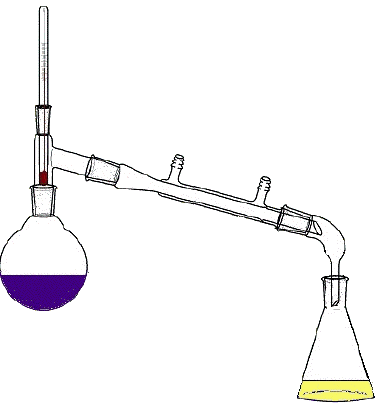
Erlenmeyer flask is primarily used in distillation. Stirring rod is used to guide liquid when transferring it to other container.
First statement is true, second statement is false
Both statements are true
First statement is false, second statement is true
Both statements are false
What is the structure of methyl alcohol?
H2C=CH2
CH3OH
CH3CH2CH2CH3
CHCl3
Which term describes the formation of acetic acid from ethyl alcohol?
addition
esterification
netralization
oxidation
Which physical property of compounds are you taking advantage of when purifying a liquid mixture by distillation?
Melting point
Boiling point
Freezing point
Sublimation point
Which of the following purification methods involves heating the compound and allowing it to go directly from the solid phase to the gas phase, followed by condensation of the pure compound back to a solid upon cooling?
Recrystallization
Sublimation
Chromatography
Distillation
Which of the following has the highest boiling point?
CH3CH2CH2CO2H
CH3CH2CH2CHO
CH3CH2COCH3
CH3CH2CO2CH3
Which of the following has the highest boiling point?
CH3CH2CH2CH2CH3
CH3CH2CH2CHO
CH3CH2CH2CH2OH
A. CH3CH2OCH2CH3
What are the 4 main types of organic compounds?
carbon, hydrogen, sodium, fats
carbohydrates, lipids, protein and nucleic acid
fats, glycerol, wax, fructose
monosaccharides, disaccharides, polysaccharides and oligosaccharides
Which of the following alkyl halides would you expect to give the highest yield of substitution product with CH3CH2O-Na+ ?


None of them will give substitution products

The correct IUPAC name for the following compound is:
(1R, 3R)-1-chloro-3-methylcyclohexane
(1R, 3S)-1-chloro-3-methylcyclohexane
(1S, 3S)-1-chloro-3-methylcyclohexane
(1S, 3R)-1-chloro-3-methylcyclohexane

What is the relationship between the two compounds?
enantiomers
diastereomers
structural isomers
identical
Which of the following alkyl halides would you expect to undergo a reaction with water in acetone most rapidly?


They will give same yield of substitution products

What is the expected product of the following reaction sequence?


What compound did Friedrich Wöhler synthesize to disprove Vitalism?
A. Benzene
B. Methane
C. Urea
D. Protein
Which chemist's experiment is most associated with disproving Vitalism?
A. Friedrich Wöhler
B. Dmitri Mendeleev
C. Antoine Lavoisier
D. Archibald Couper
IUPAC name of Ciprofloxacin
1-cyclopropyl-6-fluoro-1,4-dihydro-4-oxo-7(1-piperazinyl)-3-quinolone carboxylic acid
1-cyclopropyl-6-fluoro-1,4-dihydro-4-oxo-7(1-Pyrrolidinyl)-3-quinolone carboxylic acid
1-cyclopropyl-6,8-difluoro-1,4-dihydro-4-oxo-7(1-piperazinyl)-3-quinolone carboxylic acid
1-ethyl-6-fluoro-1,4-dihydro-4-oxo-7(1-piperazinyl)-3-quinolone carboxylic acid
Isoniazid inhibits the mycolic acid synthesis by acting on which enzyme ?
DNA dependent RNA Polymerase
DNA gyrase
Mycolase synthatase
RNA polymerase
Pyrimethamine has the following IUPAC name:
2, 4-diamino-6-ethyl-5-(p-chlorophenyl) pyrimidine
2, 4-diamino-6-ethyl-5-(p-chlorophenyl) pyridine
2, 4-diamino-6-ethyl-5-(m-chlorophenyl) pyrimidine
2, 4-diamino-6-ethyl-5-(o-chlorophenyl) pyrimidine
Which below is the general structural formula for hydroxyl group?


Classify the compound based on the functional group present.
a. ketone
b. alcohol
c. carboxyl
d. aldehyde
Which compound is a structural isomer of Z-but-2-ene?
butane
E-but-2-ene
cyclobutane
methylbut-2-ene
Used to separate a dissolved solid from its solution
Filtration
Evaporation
Crystallisation
Sublimation
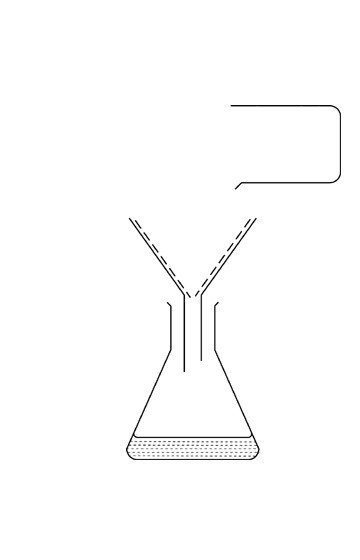
What is the name of this separation technique?
distillation
filtration
evaporation
chromatography
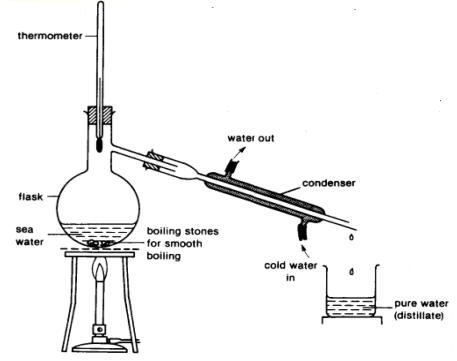
What is the name of this separation technique?
Simple distillation
Fractional distillation
Boiling
Evaporation
What is the function of degasser?
To add gas into the system of HPLC
To prevent gas into the system of HPLC
To change liquid into gas
To change gas into liquid
Which of these techniques is often considered a suitable "polishing" step in a protein purification strategy?
Affinity chromatography (AC)
Ion-exchange chromatography (IEX)
Hydrophobic interaction chromatography (HIC)
Size-exclusion chromatography (SEC)
What is the starting point for selection of a suitable IEX matrix for purification of a recombinant protein?
Prediction of isoelectric point (pI) from the amino acid sequence
Test protein binding to an IEX matrix at a range of pHs and salt concentrations
Test protein binding to a selection of anion and cation exchange matrices
Pass your sample through a preparative column and elute with a salt gradient

What type of chromatography is depicted by the illustration?
Gel Filtration Chromatography
Column Chromatography
HPLC
Thin Layer Chromatography
Which of the following spectroscopy techniques is associated with molecular emission?
UV-Visible spectroscopy
IR spectroscopy
Fluorescence spectroscopy
X-ray diffraction
What is the purpose of High Performance Liquid Chromatography in pharmaceutical industries?
To make a cupcake.
To Separate the solvent from the sample
separation of compounds
To detect the presence of something in compounds.
What is the mechanism for HPLC?
I. The mobile phase
II. Auto sampler
III. Atomizer
IV. UV detector
I, II
III, IV
III
IV
Which one of these that is not the common detector in HPLC?
Infra Red
Ultraviolet light
Flourescent
Mass Spectroscopy
Which one of these do not associate with the HPLC component?
UV detector
Pump
Degasser
Atomizer
I Size/weight
II Polarity
III melting point
Also known as Emission Spectrochemical Analysis and is the original scientific method of charting and analyzing the chemical properties of matter.
Chromatographic Analysis
Spectra Analysis
Spectrum analysis
Spectro analysis
Increase in the intensity of absorp in UV-Visible spectrum is called
Hypsochromic
Bathochromic
Hyperchromic
Hypochromic
Which of the following shift leads to the decreased intensity of absorption?
Hypochromic
Hyperchromic
Hypsochromic
Bathochromic
Which of the following is not an auxochrome group?
–OH
–SH
–OR
–O2
Which electromagnetic waves have the shortest wavelengths and highest frequencies?
Gamma Rays
Radio Waves
X-Rays
Ultraviolet Rays
Which of the following is NOT true for electromagnetic waves?
they consist of changing electric and magnetic fields
they transport energy
they can be reflected
they travel at different speeds in vacuum, depending on their frequency
Which of the following alkyl halides would undergo SN2 reaction most rapidly?
CH3CH2-Br
CH3CH2-Cl
CH3CH2-I
CH3CH2-F
they react at the same rate
What is the expected product of the following reaction sequence?
Wavelength range corresponding to UV - visible region is
400-800 nm
2.5 μm - 5.3 μm
200-800 nm
3.6 μm - 1nm