wayground logo

Free Printable Worksheets

Font size

S
M
L
XL
Worksheets

S. I Unit Conversions and Force and Motion Quiz

Total questions: 87

Worksheet time: 2hrs 56mins

Name
Class
Date
1.

In the movie Poltergeist a 68 kg boy is watching the rain hit his window. His dad walks in and tells him that if he sees a flash of lightning, to count the seconds until he hears the thunder. They begin to count and when they get to 8.7 seconds they hear the thunder. Assuming the speed of sound in air at this location is 342.5 m/s, how far away was the lighting bolt in meters?

a)

2383.8 meters

b)

2979.75 meters

c)

4171.65 meters

d)

5065.58 meters

2.

A new pitch speed sensor was installed at the local school. During baseball practice, a 75 kg pitcher decides to see how fast she can throw a strike. If she throws the baseball 153 meters and its speed was measured by the new sensor to be 126.5 m/s, how long was the baseball in the air?

a)

1.21 s

b)

0.83 s

c)

19354.5 s

d)

1.57 s

3.

Suppose dinosaurs shot a laser beam at a highly reflective asteroid headed straight for them. The laser beam reflects back to them and the whole trip for the laser was measured to be 3.543.54 s. If the speed of light is 3×1083\times10^8 m/s, what was the current distance between the dinosaurs and the asteroid?

a)

5.31 × 10^8 m

b)

8.47 × 10^7 m

c)

1.06 × 10^9 m

d)

4.19 × 10^8 m

4.

If you are given the velocity of light and the time, what is the formula to find the distance light travels, considering the signal travels to a point and back?

a)

distance = (velocity of light * time) / 2

b)

distance = velocity of light * time

c)

distance = velocity of light / time

d)

distance = time / velocity of light

5.

What is the formula to calculate the time taken to descend at a constant speed?

a)

time = speed / height

b)

time = height / speed

c)

time = speed × height

d)

time = height + speed

6.

A base jumper goes to the top of a skyscraper and jumps with a brand new parachute. The top speed they have been known to reach as they are falling is 75.7 m/s, which is roughly 169.34 miles per hour. If the building is 133 m high, how much time do they have to pull their parachute before they hit the ground, assuming they fall with a constant speed?

a)

0.18 s

b)

2.99 s

c)

2.64 s

d)

1.76 s

7.

On an expedition, Jessica sees a Giant Tortoise moving across the path she is on. Giant Tortoise’s aren’t that fast and have an average speed of about 1.8×10²m/s1.8 \times 10^{-2} m/s . With this information, how many seconds would it take a Giant Tortoise to go 12 meters?

a)

1200 seconds

b)

333.33 seconds

c)

266.67 seconds

d)

666.67 seconds

8.

How do you calculate velocity if you are given distance in kilometers and time in hours?

a)

velocity = time / distance

b)

velocity = distance / time

c)

velocity = distance * time

d)

velocity = distance + time

9.

If a student measures the echo’s time and wants to find the speed of sound, what should they do?

a)

Multiply the echo’s time by 2, then divide by 340 m/s

b)

Divide the echo’s time by 2, then multiply by 340 m/s

c)

Multiply the echo’s time by 340 m/s, then divide by 2

d)

Divide the echo’s time by 340 m/s, then multiply by 2
10.
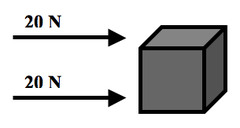
You and your dad are moving the couch from one side to another. Your dad pushes with a force of 35 N to the right and you push with a force of 25 N right. What is the net force on the couch?
a)
60 N right
b)
10 N left
c)
60 n right
d)
50 N left
11.
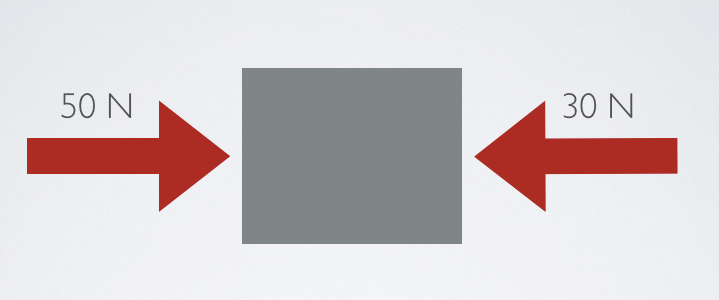
What is the net force?
a)
40 N left
b)
0 N Balalnced
c)
400 N right
d)
40 N right
12.
What is the net force?
a)
400 N Up
b)
400 N Down
c)
- 400 N Down
d)
800 N Down
13.

Which of the following is an example of an unbalanced force?

a)
b)
c)
d)
14.
How will this object move? 
a)
It won't move. 
b)
It will move to the right. 
c)
It will move to the left. 
d)
It will move up. 
15.
The unit for force is a called a: 
a)
Galileo
b)
Newton
c)
Aristotle
16.
When the resulting force is greater than zero what type of force is acting on the objects? 
a)
balanced force
b)
unbalanced force
17.

The sum of all forces acting on an object is

a)

balanced.

b)

unbalanced.

c)

friction.

d)

the net force.

18.
What is a force?
a)
the PUSH or PULL on an object 
b)
The MOTION an object creates
c)
The objects HITTING one another
d)
Going REALLY FAST
19.
If there are two forces going in the same direction how would you find the net force?
a)
Subtract
b)
Add
c)
Neither
d)
Multiply
20.
You push on a tree with 20 N of Force. If the tree doesn't move, the tree is pushing back on you with _____of Force.
a)
20 N 
b)
40 N 
c)
10 N 
d)
0 N
21.
What are balanced forces?
a)
forces of the same size, in opposite directions
b)
the same size in the same direction
c)
forces in opposite directions
d)
forces at right angles to each other
22.
What is the net force?
a)
17 N Right
b)
3 N Right
c)
3 N Left
d)
17 N Left
23.

If these teams are pulling with the same amount of force what will happen?

a)

The boy in blue will win.

b)

They will not move at all.

c)

The boy in red will win.

d)

Both will fall down.

24.

A card sliding across a table.

a)

Unbalanced force

b)

Balanced force

25.

A cat shoving a glass off a table

a)

Unbalanced force

b)

Balanced force

26.

An airplane taking off

a)

Unbalanced force

b)

Balanced force

27.

When Izzy and Zoe pull on the rope with the same amount of force, the forces are _____.

a)

increased

b)

unbalanced

c)

balanced

d)

decreased

28.

Waving a flag

a)

Unbalanced force

b)

Balanced force

29.

A person standing still while leaning on a wall

a)

Unbalanced force

b)

Balanced force

30.
There are ___ meters in 25 kilometers (km)
a)
250 m
b)
2500 m
c)
25,000 m
d)
.025 m
31.

1,000 meter = ___________kilometer(s)

a)

0.001

b)

0.1

c)

1

d)

10

32.
6 L = ? mL
a)
60
b)
600
c)
6000
d)
6
33.
What is 2 kg in grams?
a)
2,000 g
b)
4,000 g
c)
6,000g
d)
1 g
34.
3 cm = ? mm
a)
30
b)
300
c)
3000
d)
0.3
35.

Convert 3 meters to centimeters:

a)

300 cm

b)

0.3 cm

c)

30,000 cm

d)

3 cn

36.

68 cm = ___________ mm

a)

0.68

b)

6.8

c)

68

d)

680

37.
Convert from meters to cm:  9 meters
a)
900 cm
b)
90 cm
c)
0.9 cm
d)
0.09 cm
38.
Convert 17 m to cm:
a)
0.17 cm
b)
0.017 cm
c)
1,700 cm
d)
170 cm
39.
Convert 8 kilometers to meters
a)
800 m
b)
80,000 m
c)
8,000 m
d)
.008 m
40.
Convert 5 cm to mm:
a)
5,000mm
b)
0.5 mm
c)
0.05 mm
d)
50 mm
41.
Convert 300 cm to m:
a)
3 m
b)
30 m
c)
0.3 m
d)
0.03 m
42.
A force is a push or a pull on an object that results from its interaction with another object.
a)
True
b)
False
43.
Only large objects with mass have gravity.
a)
True
b)
False
44.
The combined force of all forces acting on an object is the  ___ force.
a)
net
b)
big
c)
bad
d)
use
45.
Velocity is an objects speed and ___________
a)
quickness
b)
mass
c)
acceleration
d)
velocity
46.
When the forces acting upon an object are UNBALANCED , the object will ____
a)
stay still
b)
move
c)
bounce
d)
fly
47.
Acceleration is a change in _____
a)
velocity
b)
cars
c)
school
d)
me
48.
Newton's second law is applied as the formula _____
a)
Force = Mass X Acceleration
b)
Speed = distance / time
c)
a + b = c
d)
huh?
49.
The formula for average speed is ______
hint: Miles/hour
a)
Speed = Distance / time 
b)
Speed = Distance X time
c)
Speed = ??? 
d)
something fast
50.
The SI units for force are...
a)
Kilograms
b)
Newtons
c)
Meters per second
d)
Pounds
51.
Which of the following explains the difference between speed and velocity?
a)
One has motion, and the other does not.
b)
One has direction, and the other does not.
c)
One involves time, and the other does not.
d)
One involves acceleration, and the other does not.
52.
Acceleration is caused by a force acting on a mass.
a)
Newton’s first law of motion
b)
Newton’s second law of motion
c)
Newton’s third law of motion
53.
For a force on an object there is an equal and opposite force.
a)
Newton’s first law of motion
b)
Newton’s second law of motion
c)
Newton’s third law of motion
54.
A(n) __________ is a push or pull.
a)
newton
b)
acceleration
c)
force
d)
momentum
55.
In order to be ____ forces, their effects must cancel each other out and not cause a change in an object's motion.
a)
balanced
b)
strong
c)
weak
d)
normal
56.
____ is the rubbing force that acts against motion between two touching surfaces.
a)
Acceleration
b)
Normal force
c)
Momentum
d)
Friction
57.
Forces always act in equal and opposite pairs.
a)
Newton's 1st Law
b)
Newton's 3rd Law
58.
If there is a big mass, it would need a stronger force to accelerate it.  Which law does this describe?
a)
Newton's 1st Law
b)
Newton's 2nd Law
c)
Newton's 3rd Law
59.
In a football game, two players tackle each other so hard that they both fly in opposite directions after they hit each other.  What law of motion is this an example of?
a)
Newton's 2nd Law
b)
Newton's 3rd Law
60.
A student leaves a pencil on a desk and it stays there until I pick it up. 
a)
1st Law
b)
2nd Law
61.
What is Newton's First Law known as? The Law of
a)
Inertia
b)
Mass
c)
Gravity
62.

Force is measured in.....

a)

kg, mg or g

b)

m/s 2

c)

m/s

d)

N

63.
If you increase the mass on an object, its acceleration
a)
decreases
b)
stays the same
c)
also increases
d)
stops
64.
How much force is needed to accelerate a 3kg skateboard at 5m/s2. 
a)
8N
b)
1.6N
c)
0.6N
d)
15N
65.
How much force is needed to accelerate a 25kg bowling ball at 2m/s2
a)
50N
b)
5N
c)
12.5N
d)
100N
66.
If a 2kg bird is pushed by the wind with a force of 2N, how fast does the bird accelerate?
a)
1 m
b)
2 m/s2
c)
4m/s2
d)
1 m/s2
67.
For an object to remain at rest, which of the following must be true? 
a)
The forces on it are balanced
b)
There is no friction
c)
Gravity does not act on it
d)
The object has no mass
68.
In a car accident, a passenger not wearing a seat belt may crash through a windshield because of his or her inertia.
a)
False
b)
True
69.
An object will remain at rest unless a balanced force acts upon it.
a)
False
b)
True
70.
What are Newton's 3 Laws? 
a)
Law of Action-Reaction, Law of Inertia and Law of Velocity
b)
Law of Speed, Law of Action-Reaction, Law of Force and Acceleration
c)
Law of Inertia, Law of Force and Acceleration, and Law of Action-Reaction
d)
Law of Mass and Acceleration, Law of Action-Reaction, and Law of Inertia
71.
Newton's law of motion describes the relationship of force, mass, and acceleration. Write the equation.
a)
M=F/A
b)
F=MA
c)
A= F/M
d)
All of the above
72.
If you increase the force on an object, its acceleration? 
a)
decreases
b)
stays the same
c)
also increases
d)
stops
73.
Look at this scenario, which law does this represent? 
a)
Law of Inertia
b)
Law of Force and Acceleration
c)
Law of Action-Reaction
74.
What is the magnitude (size) and direction of the net force?
a)
15 N to the left
b)
15 N to the right
c)
1 N to the left
d)
1 N to the right
75.

Acceleration is measured ....

a)

kg, mg, g

b)

N

c)

meter

d)

m/s 2

76.

Which equation expresses acceleration

a)
b)

0.10 N x 500 kg

c)
d)

500 kg. x 0.10 N

77.

When calculating motion the only time you multiply is when you are finding ......

a)

Acceleration

b)

Mass

c)

Force

d)

Speed

78.

Calculation of acceleration

a)

N/ kg

b)

kg / N

c)

N x kg

d)

S / T

79.

Calculation for acceleration

a)

kg. x g

b)

Kg / N

c)

N/ g

d)

g x N

80.

Calculation for mass

a)

kg x m/s 2

b)

g / m/s 2

c)

N / ms 2

d)

kg + ms 2

81.

Which grocery basket would have greater acceleration

a)
b)
c)
d)
82.

Which grocery basket would have less acceleration?

a)
b)
c)
d)
83.
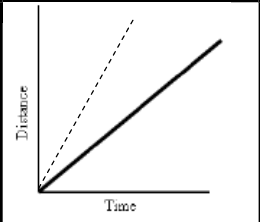
What does this graph represent?
a)
Constant Speed
b)
Acceleration
c)
Not moving
84.
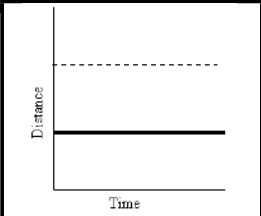
What does this graph represent?
a)
Constant speed
b)
Acceleration
c)
Not moving
85.
This graph demonstrates an object that is -
a)
At a constant speed
b)
Increasing speed
c)
Decreasing speed
d)
Stationary
86.

The graph below shows the motion of the runner over time. Based on the information in the graph, which of the following statements best describes the motion of the runner?

a)

The runner's speed was less at 4 seconds than at 2 seconds.

b)

The runner's speed was decreasing for the last 4 seconds.

c)

The runner's speed was increasing for all 10 seconds.

d)

The runner's speed was constant for all 10 seconds

87.

Which graph represents an object that is decreasing in speed?

a)
b)
c)
d)