
NEW
Font size
 Worksheets
Concepts 1 & 3 Review
Total questions: 70
Worksheet time: 58mins

Which diagram represents an element?
Diagram (a)
Diagram (b)
Diagram (c)
None of the diagrams represent the parts of an element.

Which of the following represents a compound?
Diagram (a)
Diagram (b)
Diagram (c)
All of the diagrams represent the parts of a compound.
Which diagram represents a mixture?
Diagram (a)
Diagram (b)
Diagram (c)
None of the diagrams represent the parts of a mixture.
A substance that consists of just one type of atom.
atom
mixture
element
matter
Anything that has mass and takes up space.
atom
mixture
element
matter
Which item is a pure substance?
aluminum (Al)
apple juice
muddy water
brass
The individual substances that make up a ________are not evenly mixed.
compound
homogeneous mixture
heterogeneous mixture

What type of material is the lemonade in this glass?
Heterogeneous mixture
Homogeneous mixture
Element
Compound

What type of material is pictured?
Element
Compound
Heterogeneous mixture
Homogeneous mixture

What type of material is pictured?
Heterogeneous mixture
Homogeneous mixture
Element
Compound

What type of matter is shown in this particle diagram?
Element
Compound
Mixture of Elements
Mixture of Compounds
Mixture of Elements and Compounds

What type of matter is shown in this particle diagram?
Element
Compound
Mixture of Elements
Mixture of Compounds
Mixture of Elements and Compounds

What type of matter is shown in this particle diagram?
Element
Compound
Mixture of Elements
Mixture of Compounds
Mixture of Elements and Compounds

What type of matter is shown in this particle diagram?
Element
Compound
Mixture of Elements
Mixture of Compounds
Mixture of Elements and Compounds

What type of matter is shown in this particle diagram?
Element
Compound
Mixture of Elements
Mixture of Compounds
Mixture of Elements and Compounds

What type of matter is shown in this particle diagram?
Element
Compound
Mixture of Elements
Mixture of Compounds
Mixture of Elements and Compounds
A combination of substances that can be physically separated from one another
mixtures
compound
element
molecule
A material with a particular chemical makeup
mixture
pure substance
hetogeneous
homogeneous
a substance in which the parts are clearly different shapes and colors; different throughout
mixture
homogeneous
heterogeneous
element
a substance in which all of the parts are the same throughout
homogeneous
element
heterogeneous
pure substance
A characteristic that can be observed (intensive), such as texture, color, odor, melting point, boiling point, density, or measured (extensive) such as mass, length, volume, that is used to describe matter and can be observed or measured without changing its composition
physical property
element
pure substance
chemical property
A characteristic of a substance that is measurable or observable during a chemical reaction; includes pH, heat of combustion, reactivity, etc.
physica property
chemical property
compound
mixture
A characteristic of a substance that is measurable or observable during a chemical reaction; includes pH, heat of combustion, reactivity, etc.
physica property
chemical property
compound
mixture
The ability of a substance to be dissolved in a liquid
dissolvent
solubility
combustion
disappearing
The variable that is changed on purpose in an investigation is called the ...
The variable that is being tested, counted, or measured and is what you look at the end of an investigation is called ...
A variable that is used for comparison, does not get any change, and there can be many of these variables in an investigation.
Angel wants to know if the type of soap has an effect on how clean her clothes get. What is the independent variable?
type of soap
how long the laundry takes
Zach wants to determine if the amount of time spent on social media has an effect of grades. What is the independent variable?
time on social media
computer skills
Zach wants to determine if the amount of time spent on social media has an effect of grades. What is the dependent variable?
popularity
grades
Maddie wants to determine if the weight of the dog will determine the number of puppies in a litter. What is the independent variable?
weight of dog
number of puppies
Maddies wants to determine if the weight of the dog will determine the number of puppies in a litter. What is the dependent variable?
type of dog
number of puppies
Beth wants to know if increasing her exercise will decrease the time it takes her to run a mile. What is the independent variable?
distance
amount of exercise
Beth wants to know if increasing her exercise will decrease the time it takes her to run a mile. What is the dependent variable?
time to run a mile
amount of exercise
The information you collect while doing your experiment is called
conclusions
data
hypotheses
procedures
The variable that is being measured or observed is called the _______________. Hint: this is the variable that is the result or effect
independent variable
dependent variable
control variable
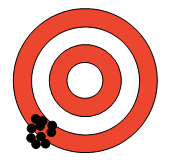
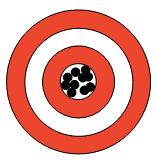
This bullseye demonstrates...
High Accuracy & High Precision
High Accuracy & Low Precision
Low Accuracy & High Precision
Low Accuracy & Low Precision
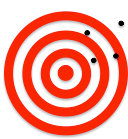
Describe the accuracy and precision of the image
Very accurate and somewhat precise
Very accurate but not precise at all
Not accurate at all but very precise
not accurate and not very precise
32℉ is What in Celsius?
32℉
32℃
57℃
0℃
133℉ is what in Celsius?
57℃
113℃
45℃
0℃
140℉ is what in Fahrenheit?
60℃
140℉
10℃
4.44℃
40°C=?
104 F
100 F
130 F
96 F


All alloys are mixtures.
True
False
Mixtures that do NOT behave as a pure substance have a melting range, not a melting point.
True
False
A combination of substances that can be physically separated from one another
mixtures
compound
element
molecule
A material with a particular chemical makeup
mixture
pure substance
hetogeneous
homogeneous
a substance in which the parts are clearly different shapes and colors; different throughout
mixture
homogeneous
heterogeneous
element
a substance in which all of the parts are the same throughout
homogeneous
element
heterogeneous
pure substance
A characteristic that can be observed (intensive), such as texture, color, odor, melting point, boiling point, density, or measured (extensive) such as mass, length, volume, that is used to describe matter and can be observed or measured without changing its composition
physical property
element
pure substance
chemical property
A characteristic of a substance that is measurable or observable during a chemical reaction; includes pH, heat of combustion, reactivity, etc.
physica property
chemical property
compound
mixture
A substance that can be dissolved by a solvent to create a solution.
solvent
solute
solution
mixture
The ability of a substance to be dissolved in a liquid
dissolvent
solubility
combustion
disappearing

