
 Worksheets
chapter 2 test practice
Total questions: 73
Worksheet time: 40mins
phase of matter
The different forms that matter can take depending on its temperature and pressure; typically solid, liquid, or gas
A term used to describe the chemical composition of a substance
The process by which matter changes from one state to another
A measurement of the density of a substance
solid
Has a fixed shape and volume
Can change shape and volume
Has no definite shape but a definite volume
Is always liquid at room temperature
element
A pure substance that cannot be broken down into simpler substances by physical or chemical means and still maintain its original properties
A mixture of two or more substances that can be separated by physical means
A compound formed by the chemical combination of two or more elements
A substance that can be broken down into simpler substances by chemical means
gas
Fills the shape and volume of the container it is in
Has a definite shape and volume
Is incompressible and rigid
Has a fixed volume but no fixed shape
product
A substance formed during a chemical reaction
A type of chemical bond
A catalyst that speeds up reactions
A reactant that is consumed
matter
Anything that has volume and mass
A substance that can be seen and touched
A type of energy that can be measured
A concept that describes the absence of substance
reactant
A starting substance in a chemical reaction
A product formed after a chemical reaction
A catalyst that speeds up a chemical reaction
A substance that inhibits a chemical reaction
liquid
Has a fixed volume, but takes the shape of the container it is in
Has a fixed shape and volume
Takes the shape of the container but has no fixed volume
Is compressible and has no fixed volume
volume
The amount of two-dimensional (2D) space matter occupies
How much three-dimensional (3D) space matter occupies
The weight of an object in a gravitational field
The density of a substance in a given volume
mass
The measure of an object’s resistance to any type of force
The amount of space an object occupies
The speed at which an object moves
The temperature of an object
Physical Property
A characteristic of a substance that can be observed without changing its chemical identity.
A change that alters the chemical composition of a substance.
A property that can only be measured at high temperatures.
A characteristic that is only visible under a microscope.
Precipitate
A gas that escapes from a liquid during boiling.
A solid that forms from a solution during a chemical reaction.
A liquid that evaporates when heated.
A color change that indicates a chemical reaction.
Physical Change
A change that results in the formation of new substances.
A change in which no new substances are formed and the material retains its original properties.
A change that alters the chemical composition of a substance.
A change that occurs only at high temperatures.
Chemical Change
A change that results in the formation of new chemical substances.
A change that only affects the physical properties of a substance.
A change that can be easily reversed.
A change that does not involve any new substances being formed.
Solution
A heterogeneous mixture of different substances.
A homogeneous mixture composed of two or more substances.
A pure substance with a uniform composition.
A mixture that cannot be separated by physical means.
Chemical Property
A characteristic of a substance that is observed during a chemical reaction.
A measure of how much a substance can dissolve in water.
A property that can be observed without changing the substance's identity.
A characteristic that describes the physical state of a substance.
Everything you can touch is made of _____.
Matter
Solids
Liquid
Mass
What is the name of the element with the symbol 'Fe'?
Gold
Copper
Iron
Silver
Element Li is in which period on the Periodic Table
7
2
5
3
What is the process of a gas turning into a liquid?
Freezing
Sublimation
Condensation
Evaporation
What is the name of the process where a solid turns into a liquid?
Evaporation
Condensation
Freezing
Sublimation
1 A substance made up of two or more chemically combined elements is —
an element
mixture
compound
solution
Brass is a metal that is bright red and gold. It is formed by combining, not chemically, two elements, zinc and copper. Based on the information, how would brass be classified?
an element
compound
mixture
suspension


This picture represents which of the following?
A single element
Mixture of molecules
mixture of atoms
mixture of compounds

What does this illustrate
Elements
Compunds
Mixture of Elements and Compunds
Mixture of Compounds
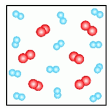

Which compound is best represented by this particle diagram?
NH3
H2O
CH4
HCl

Which compound is best represented by this particle diagram?
C2H6
C6H12O6
CO2
NaCl
How many types of atoms are in K₂SO₄
7
3
2
4
The substances in this mixture are so evenly distributed that you cannot see the different parts.
Mixture
Homogeneous Mixture
Heterogeneous Mixture
This is a pure substance that is in its simplest form and cannot be broken down with physical or chemical means.
Molecule
Compound
Element
The different parts CAN be seen in this mixture
Mixture
Heterogeneous Mixture
Homogeneous Mixture
A combination of two or more substances that can be easily separated in some physical way
mixture
solution
liquid
Define Pure Substance
A substance that has definite physical and chemical properties
State of matter with the most tightly packed particles
A homogeneous mixture of two or more metals
Water (H2O) is an example of a(n)
element
compound
mixture
What kind of mixture is a combination of substances that has uniform composition and appearance?
colloid
heteregenous
homogeneous
Which statement describes a heterogeneous mixture?
A chemical reaction takes place.
It has a uniform composition and appearance.
It does not have a uniform composition and appearance.
One pure substance boils, escapes, condenses, and gets collected as a liquid.
Distillation
Filtration
Decantation
Recrystallization
Smaller particles pass through a filter paper, larger particles get trapped.
Distillation
Filtration
Decantation
Recrystallization

Distillation
Centrifugation
Filtration
Chromatography

Distillation
Recrystallization
Centrifugation
Filtration

If I pour sand and water onto a filter, what will happen?
water and sand will go through the filter
sand will get caught in the filter, water will pass through
both sand and water will get caught in the filter
How does a balanced chemical equation satisfy the Law of Conservation of Mass?
During a chemical reaction, the total amount of matter stays the same.
During a chemical reaction, matter is destroyed.
During a chemical reaction, one or more new substances are formed
During a chemical reaction, the total number of atoms increases.
If a chemical reaction such as photosynthesis begins with 8 atoms of carbon (C), how many atoms of carbon (C) should be in the products?
12
8
6
2
Which best explains why the total mass of the product(s) would be less than the total weight of the reactant(s) after a chemical reaction?
A physical change occurred.
Atoms involved in the reaction lost mass.
Precipitates were created in the new solution.
Gases were released into the atmosphere.
Max recorded the notes below as he completed an experiment in science class.
20 grams of a solute was added to 100 grams of a liquid substance. The solute completely dissolved. The total mass of the resulting solution was 120 grams after the experiment was complete.
Which best explains how the law of conservation of mass was demonstrated in the experiment?
The solute completely dissolved in the liquid.
The liquid was chemically changed by the addition of the solute.
Some of the mass of the solute was lost during the experiment.
The mass of the resulting solution was equal to the mass of the solute and liquid.

The law of definite proportions states that a given chemical compound always contains the same _ in the exact same _ by mass.
elements, compounds
elements, molecules
elements, proportions
proportions, elements

The percentage of copper and oxygen in samples of “CuO” obtained by different methods were found to be the same. This illustrates the law of:
Definite proportions
Conservation of mass
Multiple proportions
Reciprocal proportions

The percent by mass formula used in the law of proportions is _.
%me = 100% x me / mc
%me = me / mc / 100%
%me = me / (mc x 100%)
%me = mc / me x 100%

Carbon 's mass is _.
6
12.01
+/- 4
2

The mass of the compound CO2 is _.
16
28.01
44.01
56.02

The percent by mass of carbon to oxygen in CO2 is _.
100%
33.3%
72.7%
27.3%
What is the definition of multiple proportions?
Principle in chemistry that states the ratio of the masses of elements in compounds can be expressed in large whole numbers.
Principle in chemistry that states the ratio of the masses of elements in compounds can be expressed in small whole numbers
Principle in chemistry that states the ratio of the masses of elements in compounds can be expressed in decimal numbers.
Principle in chemistry that states the ratio of the masses of elements in compounds can be expressed in fractions.
What are the key principles of the law of multiple proportions?
Elements combine in fixed ratios and the ratios can be expressed as decimals.
Elements combine in fixed ratios and the ratios can be expressed as small whole numbers.
Elements combine in variable ratios and the ratios can be expressed as fractions.
Elements combine in random ratios and the ratios can be expressed as large whole numbers.
A physical property that measures mass per unit volume
density
flammability
physical property
element
reactivity
characteristic/trait that can be seen through direct observation of a substance.
mixture
physical property
physical change
chemical property
chemical change
an example of a physical change
flammability
fireworks exploding
rust
melting
an example of a chemical change
breaking glass
boiling water
stretching copper into wire
rusting
transforms one type of matter into another type of matter
physical change
physical property
chemical change
chemical property
a change to a substance that does NOT change the identity of the substance
physical change
physical property
chemical change
chemical property
Which of the following is an example of an extensive property?
Temperature
Color
Length
Boiling Point
What is an intensive property?
A property that depends on the quantity of matter
A property that does not depend on the quantity of matter
A property that changes according to conditions
A property that is additive for subsystems
What is an extensive property?
A property that depends on the quantity of matter
A property that does not depend on the quantity of matter
A property that changes according to conditions
A property that is additive for subsystems
Zoe, Maya, and Charlotte are studying for their chemistry exam. They come across a question asking for an example of an extensive property. Which of the following options should they choose?
Refractive Index
Melting Point
Weight
Hardness
Which of the following is an example of an intensive property?
Luster
Ductility
State of Matter
Odor
Which of the following is an example of an intensive property?
Volume
Mass
Temperature
Length
Which of the following is an example of an extensive property?
Color
Temperature
Mass
Boiling Point

