
Font size
 Worksheets
5th staar science 2018
Total questions: 139
Worksheet time: 3hrs 40mins
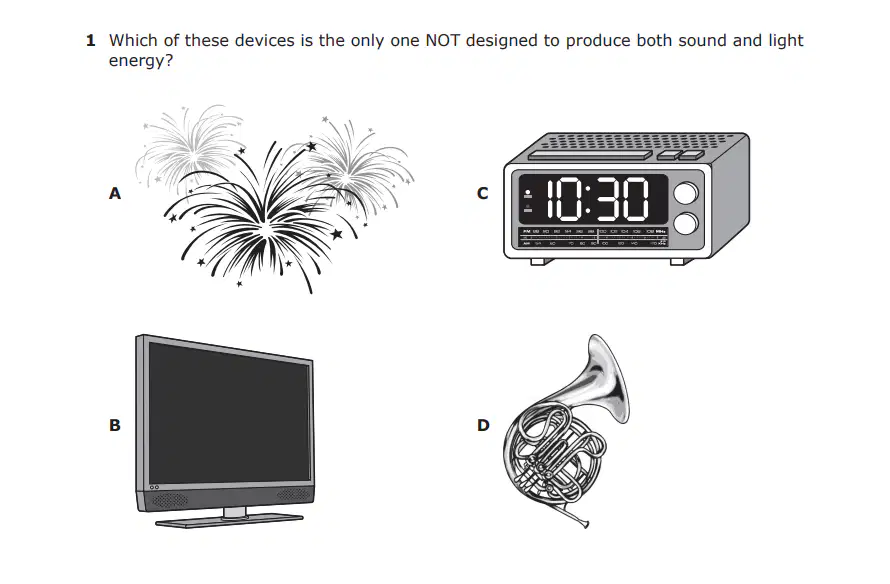
Which of these devices is the only one NOT designed to produce both sound and light energy?
A. (Image of fireworks)
B. (Image of a television)
C. (Image of a clock radio)
D. (Image of a French horn)

A guitar transfers energy from (a) to (b)

A solar panel transfers energy from (a) to (b) energy.

A flashlight transfers energy from (a) to (b) to (c) energy.

Photosynthesis transfers energy from (a) to (b) energy.

A wind turbine transfers energy from (a) to (b) energy.

A lamp transfers energy from (a) to (b) energy.

A lawnmower transfers energy from (a) to (b) energy.

Eating an apple is (a) energy to (b) energy.

A hair dryer transfers energy from (a) to (b) to (c) energy.

A MP3 player transfers energy from (a) to (b) to (c) energy.

A campfire transfers energy from (a) to (b) energy.

Electrical energy is transferred to _____ Energy.
Solar
Thermal
Chemical
Electrical

Solar energy is transferred to _____ energy.
Mechanical
Solar
Sound
Electrical

Electrical energy is transferred to _____ energy.
Thermal
Solar
Electrical
None

When you eat pizza, chemical energy is transferred to _____ energy in your body.
Solar
Electrical
Mechanical
Chemical

Chemical energy in the car is transferred to _____ energy in the car.
Thermal
Solar
Mechanical
Chemical

Is the energy in a battery, chemical or electrical (Not connected to any devices)?
electrical
chemical
thermal
thermal
A bright-red male cardinal comes to a school bird feeder every morning. Like other cardinals, this bird makes a sharp chirping sound as it hops around the bird feeder.
Having red feathers
Eating seeds during the day
Coming to the bird feeder each morning
Making a chirping sound
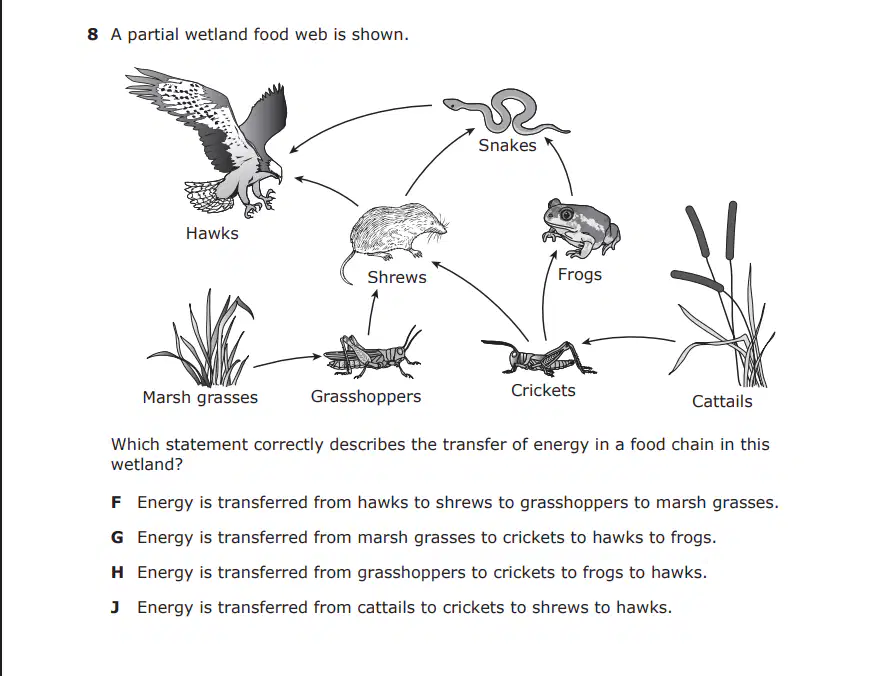
A partial wetland food web is shown. (Refer to the diagram of the food web with hawks, shrews, snakes, frogs, marsh grasses, grasshoppers, crickets, and cattails.) Which statement correctly describes the transfer of energy in a food chain in this wetland?
Energy is transferred from hawks to shrews to grasshoppers to marsh grasses.
Energy is transferred from marsh grasses to crickets to hawks to frogs.
Energy is transferred from grasshoppers to crickets to frogs to hawks.
Energy is transferred from cattails to crickets to shrews to hawks.
Which of these describes one or more living organisms that depend on another living organism to survive?
Bacteria living in the mouth of a horse
Ivy plants growing up a fence to obtain more sunlight
Mold living on a hard, rocky surface
An angelfish releasing carbon dioxide into pond water
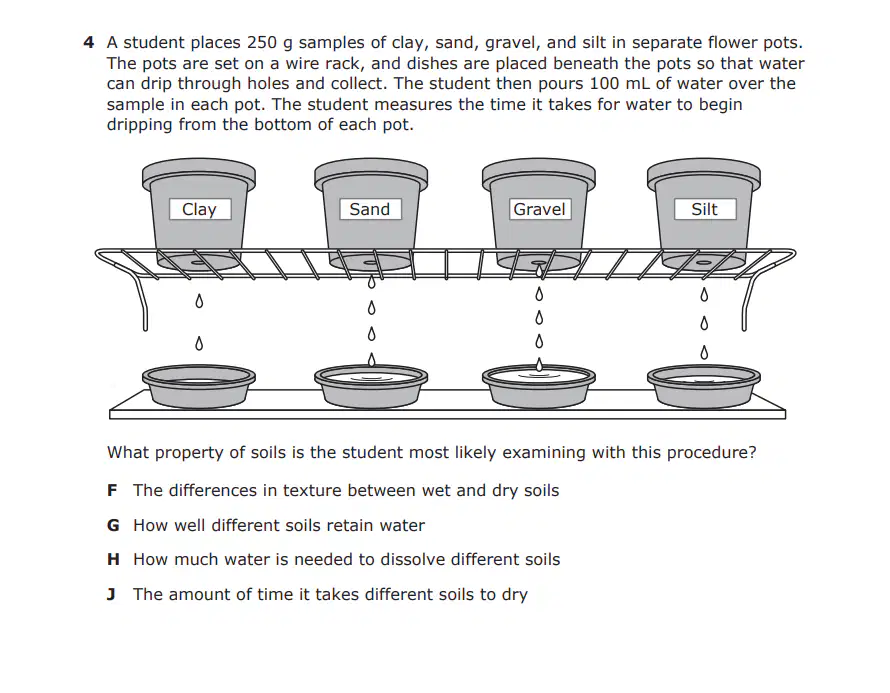
A student places 250 g samples of clay, sand, gravel, and silt in separate flower pots. The pots are set on a wire rack, and dishes are placed beneath the pots so that water can drip through holes and collect. The student then pours 100 mL of water over the sample in each pot. The student measures the time it takes for water to begin dripping from the bottom of each pot.
The differences in texture between wet and dry soils
How well different soils retain water
How much water is needed to dissolve different soils
The amount of time it takes different soils to dry
Rock that has low permeability allows water to move (a) . Rock that has (b) porosity holds a lot of water.

Which soil retains the most water?
soil 1
soil 2
soil 3
soil 4

Which soil type will retain the most water?
sandy soil
clay
silt
gravel

If 100 mL is poured through each weathered rock, which retained the most water?
clay
gravel
sand
silt

Which type of soil retains water the best?
sand
potting soil
gravel
clay

What does this sponge have to make it soak up water?
It's porous
It's an aquifer
It's permeable
It's impermeable

Rain will infiltrate the ground if the soil is
Permeable
Impermeable
Saturated
Unsaturated

During a heavy rainstorm, soil samples A and B both became saturated with water. However, 10 minutes after the storm ended, the soils appeared as shown.
Which statement best explains the observed change in the water content of the soil samples?
The permeability of B is greater than the permeability of A.
The porosity of B is greater than the porosity of A.
The capillarity of B is greater than the capillarity of A.
The surface runoff at B is greater than the surface runoff at A

These containers have the same volume of beads which are representing soil particles. What is the relative porosity and permeability of each?
The container on the left has the higher permeability and porosity
The container on the right has the higher permeability and porosity
The container on the left has the higher permeability, but they both have the same porosity
The container on the right has the higher permeability, but they both have the same porosity
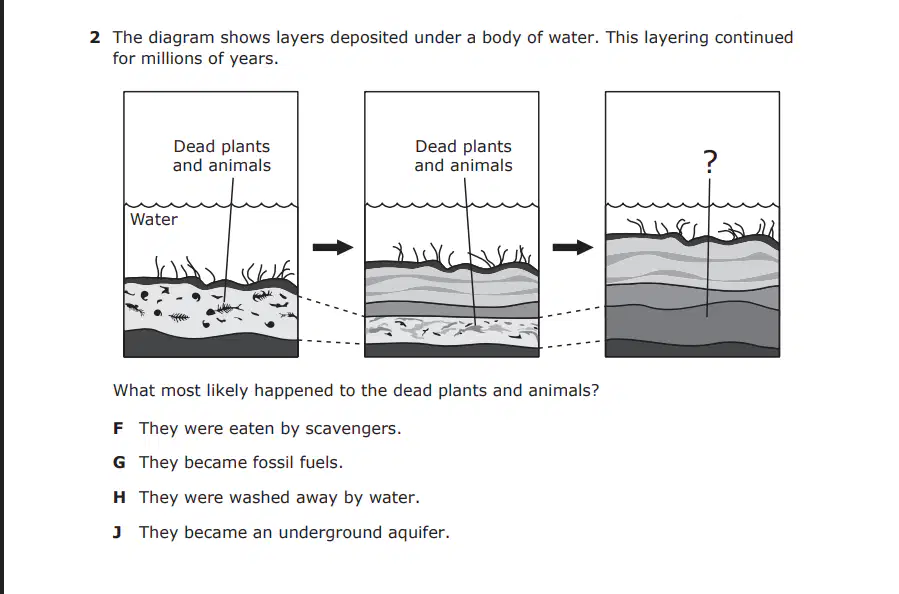
The diagram shows layers deposited under a body of water. This layering continued for millions of years. What most likely happened to the dead plants and animals?
They were eaten by scavengers.
They became fossil fuels.
They were washed away by water.
They became an underground aquifer.

The pictures show layers deposited on dead plants and animals. If millions of years past, what will most likely happen to the dead plants and animals?
They were eaten by scavengers
They become fossil fuels
They are washed away by water
They dissolve into the water
How can plant from a pond form fossil fuels?
The dead plants sink to the bottom of the pond and get buried by sediments for millions of years.
The dead plants get compacted then cemented for millions of years.
The dead plants sink to the bottom of the pond and are consumed by decomposers
The dead plants produce carbon which forms fossils

The model below shows layers of sediment on the floor of an ocean. Which of the following best explains how these layers can become rock over many years?
Sand in the sediment melts and turns into rock
The weight of the water compacts the sediment into rock
Changing water temperatures turn sand in the sediment into rock
Pollution caused by humans turns the sediment into rock
A student creates a model of the formation of fossil fuels by first placing a layer of leaves, representing organic matter, in the bottom of a cup. What step will come next in making the model?


What needs to be present in the peat for fossil fuels to form?
Sand and small pieces of wood
Mostly decaying plants
Mostly lava and sedimentary rocks
Mostly minerals
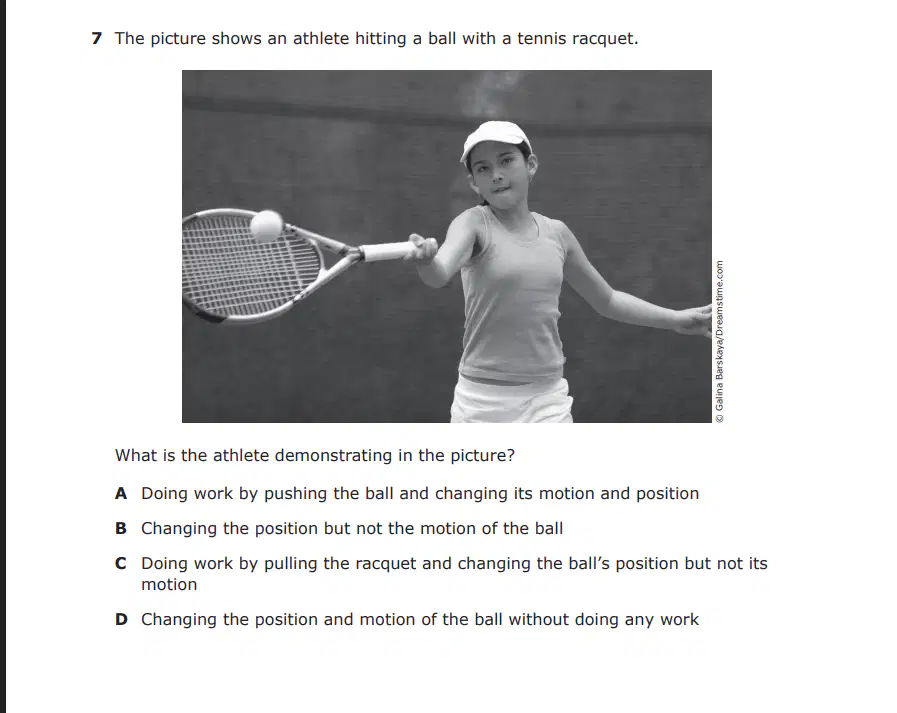
The picture shows an athlete hitting a ball with a tennis racquet. What is the athlete demonstrating in the picture?
Doing work by pushing the ball and changing its motion and position
Changing the position but not the motion of the ball
Doing work by pulling the racquet and changing the ball’s position but not its motion
Changing the position and motion of the ball without doing any work

This experiment can be best used to determine....
how the force used to pull a dictionary affects the mass of a box of marbles
how mass affects the force needed to move objects
how the mass of a box of marbles affect the mass of a dictionary
how mass affect the force needed to move objects

When looking at image 2, is working being done?
Yes
No

When looking at image 4, is working being done?
Yes
No
A group of students is performing an investigation to measure how much liquid water is produced from a 10 L sample of snow. What must occur in order for the students to perform this investigation?
The sample must be kept in a freezer.
The temperature of the sample must change.
The investigation must be performed outside.
The physical state of the sample must remain the same.
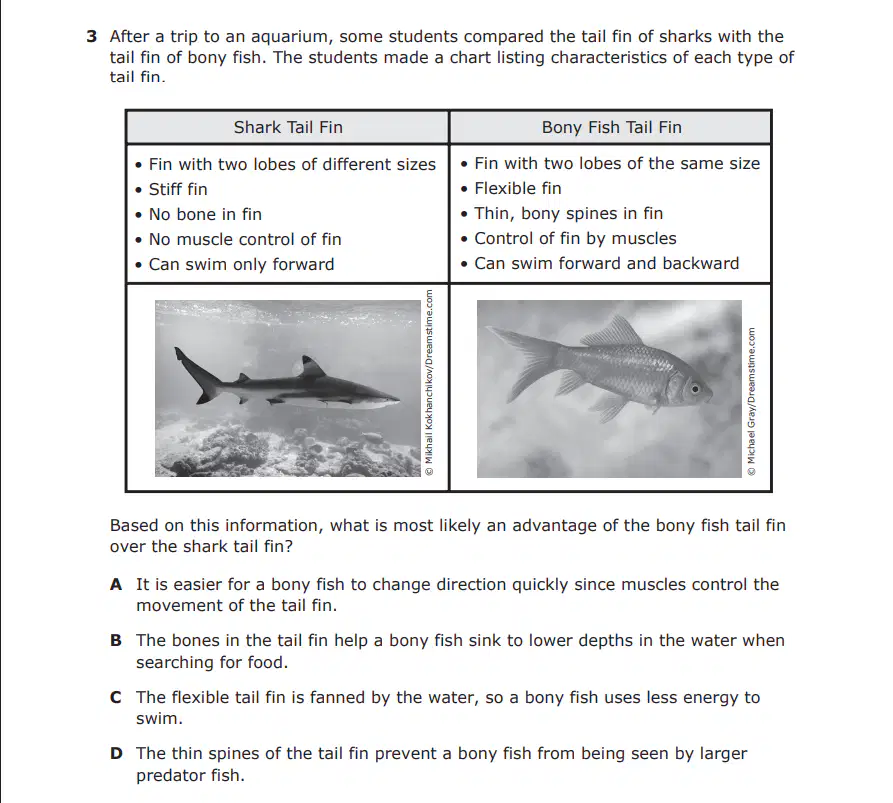
After a trip to an aquarium, some students compared the tail fin of sharks with the tail fin of bony fish. The students made a chart listing characteristics of each type of tail fin. Based on this information, what is most likely an advantage of the bony fish tail fin over the shark tail fin?
It is easier for a bony fish to change direction quickly since muscles control the movement of the tail fin.
The bones in the tail fin help a bony fish sink to lower depths in the water when searching for food.
The flexible tail fin is fanned by the water, so a bony fish uses less energy to swim.
The thin spines of the tail fin prevent a bony fish from being seen by larger predator fish.
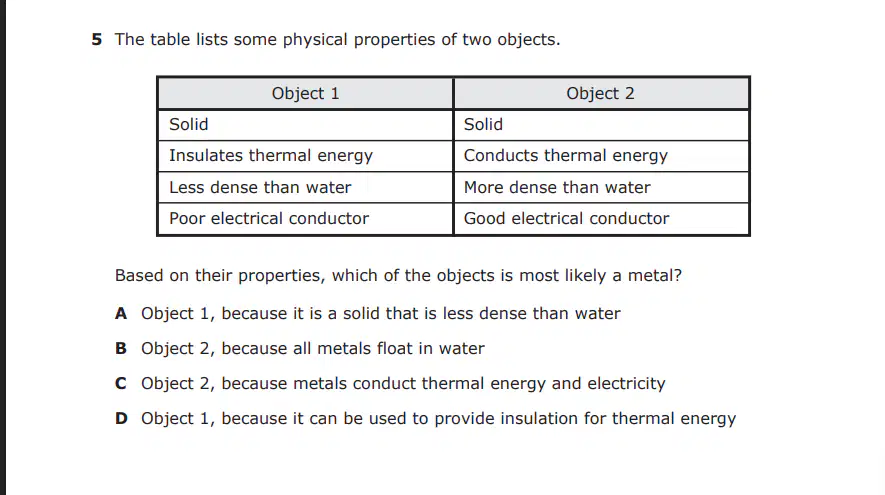
Based on their properties, which of the objects is most likely a metal?
Object 1, because it is a solid that is less dense than water
Object 2, because all metals float in water
Object 2, because metals conduct thermal energy and electricity
Object 1, because it can be used to provide insulation for thermal energy
The ability of a substance to allow the flow of energy or electricity.
Conductivity
Odor
Hardness
Ductility
________ conductivity is how well an electrical current can move through a substance.
Electrical
Thermal
Physical
Chemical
Drag and drop the correct term that belongs in the blank space within the table:
Wool (fabric)
Wood
Iron
Plastic
Match the following conductors and insulators
copper wire
electrical conductor
glass
thermal conductor
oven mitt
thermal insulator
rubber cord
electrical insulator
Match the following objects:
Rubber band
Insulator
Iron nail
Conductor
Gold
Conductor
Glass
Insulator
Plastic
Insulator
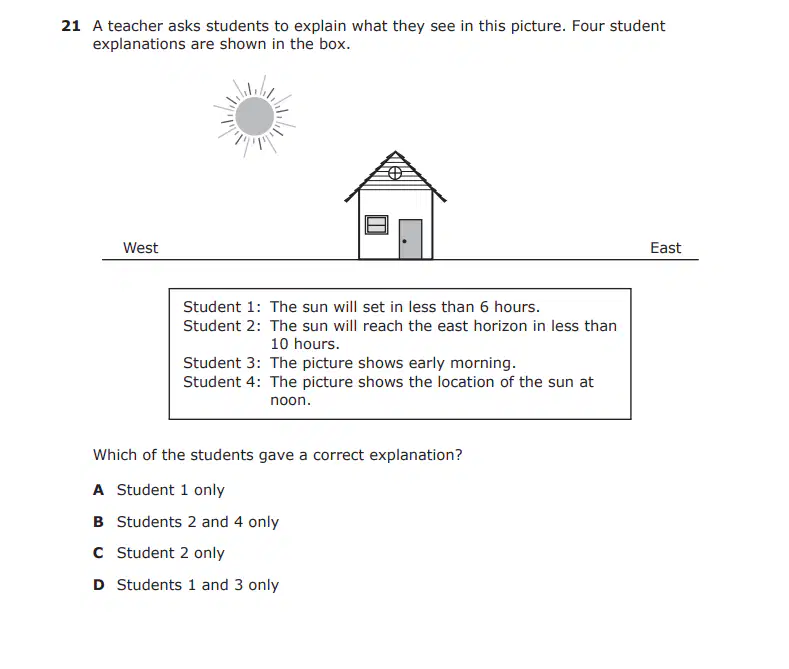
A teacher asks students to explain what they see in this picture. Four student explanations are shown in the box. Which of the students gave a correct explanation?
A. Student 1 only
B. Students 2 and 4 only
C. Student 2 only
D. Students 1 and 3 only

The diagram shows the sun at different places in the sky during the summer.
Where is the most likely location of the sun at 7:00 a.m.?
Location 2
Location 3
between Locations 1 and 2
between Locations 2 and 3
Where is the sun positioned to create the tree's shadow in the picture?

Where will the tree's shadow be?
A
B
C
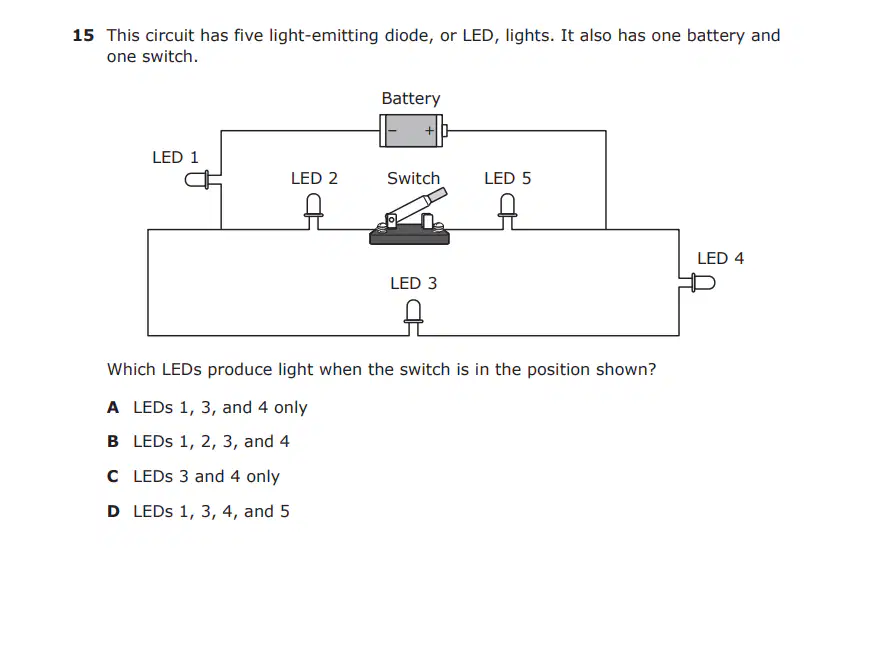
This circuit has five light-emitting diode, or LED, lights. It also has one battery and one switch. Which LEDs produce light when the switch is in the position shown?
A. LEDs 1, 3, and 4 only
B. LEDs 1, 2, 3, and 4
C. LEDs 3 and 4 only
D. LEDs 1, 3, 4, and 5
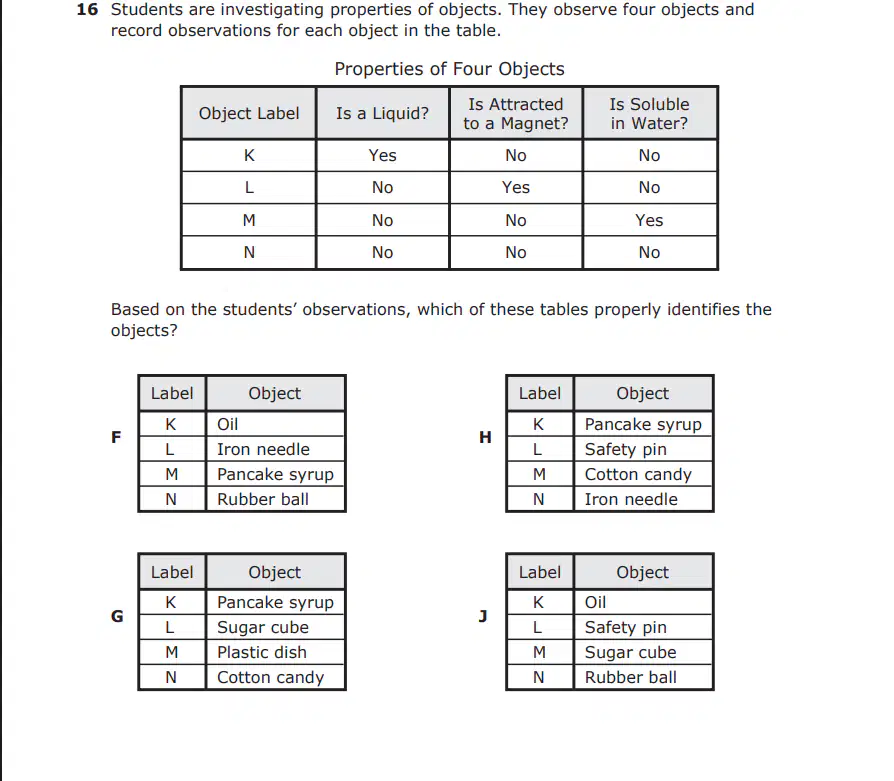
Students are investigating properties of objects. They observe four objects and record observations for each object in the table. Properties of Four Objects | Object Label | Is a Liquid? | Is Attracted to a Magnet? | Is Soluble in Water? | |--------------|-------------|--------------------------|---------------------| | K | Yes | No | No | | L | No | Yes | No | | M | No | No | Yes | | N | No | No | No | Based on the students’ observations, which of these tables properly identifies the objects?
F | Label | Object | |-------|--------------| | K | Oil | | L | Iron needle | | M | Pancake syrup| | N | Rubber ball |
G | Label | Object | |-------|--------------| | K | Pancake syrup| | L | Sugar cube | | M | Plastic dish | | N | Cotton candy |
H | Label | Object | |-------|--------------| | K | Pancake syrup| | L | Safety pin | | M | Cotton candy | | N | Iron needle |
J | Label | Object | |-------|--------------| | K | Oil | | L | Safety pin | | M | Sugar cube | | N | Rubber ball |
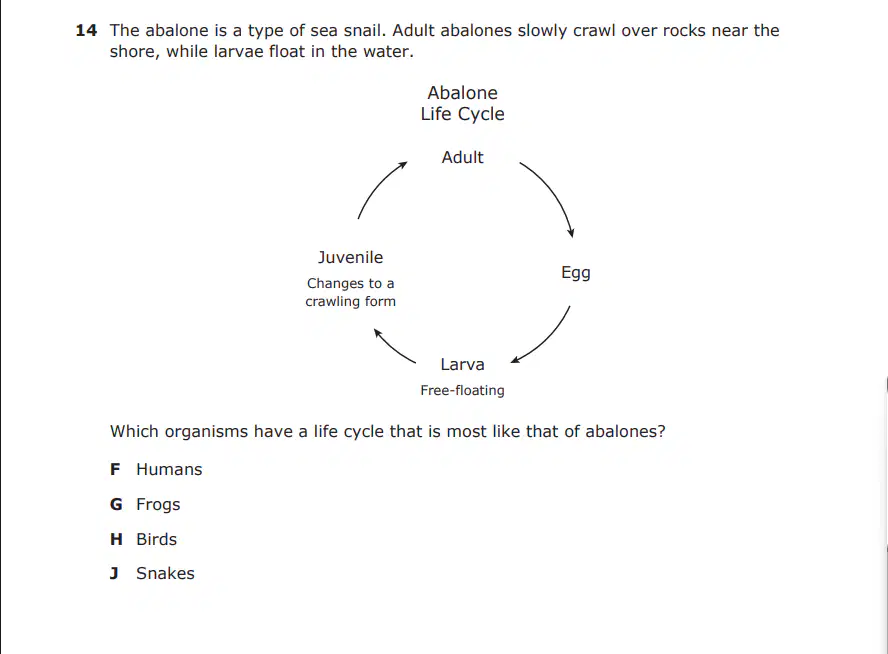
Which organisms have a life cycle that is most like that of abalones?
Humans
Frogs
Birds
Snakes

F
G
H
J

What stage comes before the given picture?
eggs
tadpole with legs
froglet
Legs begin to grow and lungs form during __________.
Migration
Hibernation
Metamorphosis
Pollination
Which animal is born with gills but grows lungs when it gets older?


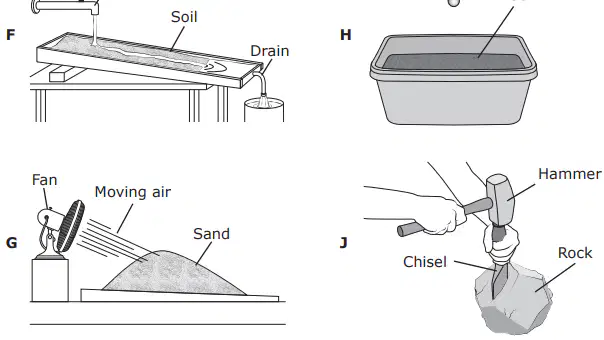
The Grand Canyon is more than 400 km long and in some places almost 2 km deep. Which model best represents the main process that formed the Grand Canyon?
F (Water faucet, Soil, Drain)
G (Fan, Moving air, Sand)
H (Marble, Mud)
J (Hammer, Chisel, Rock)
Choose the arrow(s) that represent WEATHERING AND EROSION.
Select the area on the stream table were DEPOSITION is occurring.

Match the following
Material is dropped to make a new landform.
deposition
Breaking down of materials.
weathering
Carrying small broken pieces to a new location
erosion

The landform shown is a (a) . It was formed by (b) .

(a) storms are a from of (b) (c) because it moves earth materials
Label the image
Weathering
Erosion
Compaction

A root that cracks a rock as it grows is an example of
(a)
Mechanical Weathering
Chemical Weathering
Label the correct locations of
Deposition
Erosion
Weathering
Deposition
Erosion
Weathering

Match the term to the definition:
Weathering
Breaking rock
Erosion
Moving rock
Deposition
dropping off, building up rock

Match each description to the correct formation found in the cave.
stalactite
forms on ceiling of caves
stalagmite
forms on the bottom of caves
cave
a large underground chamber
Label this image
Ash and gas
Crater of volcano
Flank of volcano

Rain washing away soil from a hillside is an example of (a)
erosion
deposition
weathering
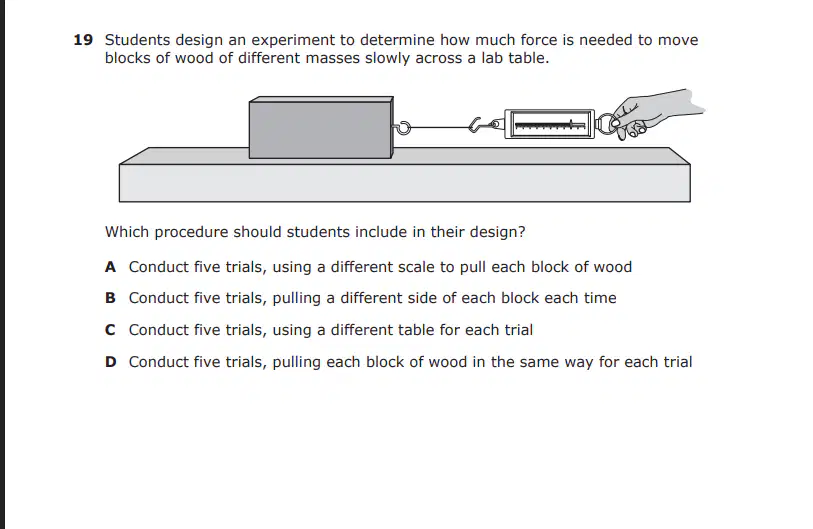
Students design an experiment to determine how much force is needed to move blocks of wood of different masses slowly across a lab table. Which procedure should students include in their design?
Conduct five trials, using a different scale to pull each block of wood
Conduct five trials, pulling a different side of each block each time
Conduct five trials, using a different table for each trial
Conduct five trials, pulling each block of wood in the same way for each trial

A spring scale measures the amount of (a) it takes to move an object. The spring scale measures with a (b) .
The unit of force is (a)
newtons
Joules
Watts
m/s

A ball moves from X to Y on the floor. Which best explains the change in the ball? The ball-
was observed.
is made of rubber.
was pushed.
is very heavy.

Units of force are...
Newtons
Grams
Joules
Meters
One type of fuel was used for thousands of years before other fuels were commonly used. Which fuel is an alternative resource that was most likely the first fuel used by humans?
Coal
Natural gas
Petroleum
Wood
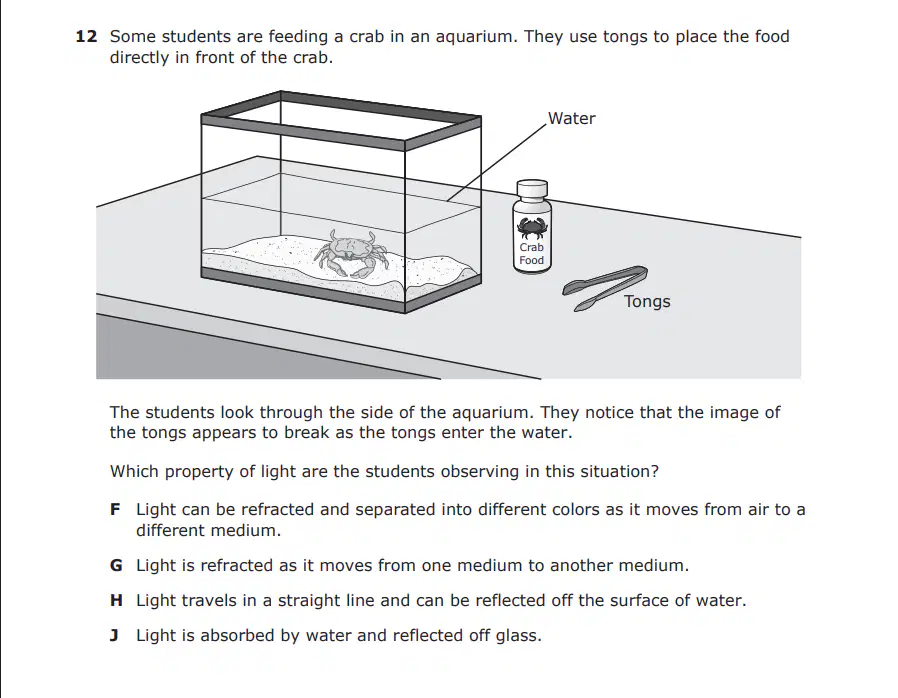
Some students are feeding a crab in an aquarium. They use tongs to place the food directly in front of the crab. The students look through the side of the aquarium. They notice that the image of the tongs appears to break as the tongs enter the water. Which property of light are the students observing in this situation?
Light can be refracted and separated into different colors as it moves from air to a different medium.
Light is refracted as it moves from one medium to another medium.
Light travels in a straight line and can be reflected off the surface of water.
Light is absorbed by water and reflected off glass.
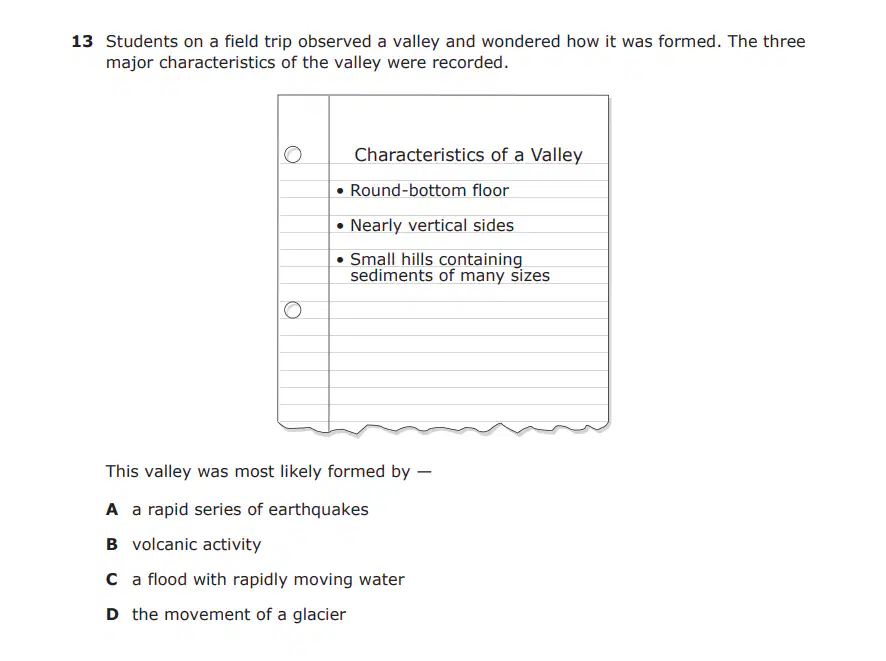
Students on a field trip observed a valley and wondered how it was formed. The three major characteristics of the valley were recorded. Characteristics of a Valley: • Round-bottom floor • Nearly vertical sides • Small hills containing sediments of many sizes This valley was most likely formed by —
a rapid series of earthquakes
volcanic activity
a flood with rapidly moving water
the movement of a glacier
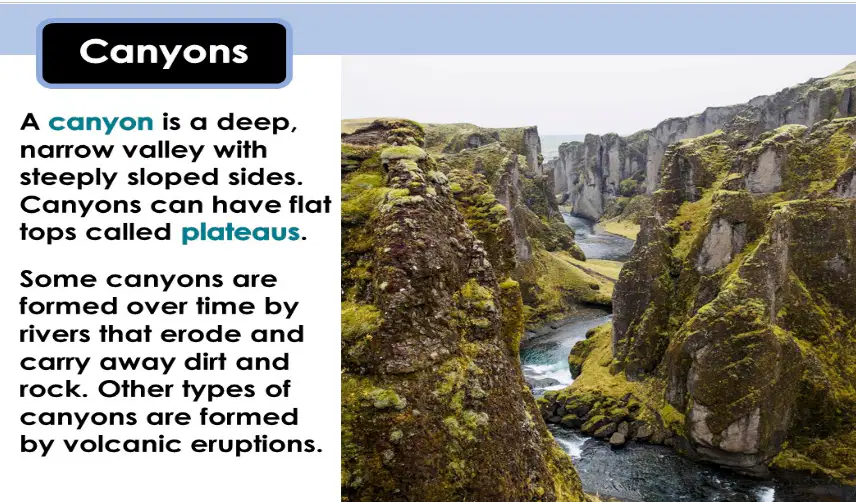
Canyons can be formed by
(a) eruptions.
Match each landform to how it is formed.
water deposition
delta
wind deposition
sand dune
ice weathering and erosion
U-shaped valley
water weathering and erosion
V-shaped valley
Match the landforms to how they were made.

glacier

river; weathering and erosion

river; deposition

wind; erosion

The diagram shows a landform on Earth. How did the movement of Earth’s plates form the landform?
Two oceanic plates slid past each other.
Two continental plates collided.
One continental plate slid past an oceanic plate.
One continental plate subducted beneath an oceanic plate.

Which student correctly identified the geologic process that formed the Himalayan mountains?
1
2
3
4

This landform is formed by
water erosion
wind erosion and deposition
glaciers
weathering

delta
canyon
cave
sand dune

A deep gorge in the surface of Earth formed by the erosion of moving water and sand.
delta
valley
cliff
canyon

landslide
u shaped valley
sand dune
canyon

aolian arch
river delta
v shaped valley
u shaped valley

Both are formed by the movement of glaciers.
Both are formed by water eroding sediments.
Both are formed by wind weathering rocks.
Both are formed be deposition of sediments.

tornadoes
glacial movement
flash flooding
deposition by the wind

Water is found in many places on Earth. Consider the rivers, streams, and ocean in the illustration.
What landform will be created when sediments carried by the river are deposited near the river’s mouth?
an alluvial fan
delta
a sea cave
a sea cliff

a slow moving glacier
a thunderstorm
heavy winds
moving water


When a continental plates collide what may be formed?
islands
mountains
volcanoes
rift valleys


flooding
wind
massive glaciers
volcanic activity

Students constructed a model using a cardboard box, clay, and numbers on spikes, What are the students trying to demonstrate with this model?
The model represents a delta formed by erosion of sediments onto the ocean.
The model represents a delta formed by the deposition of sediments at the mouth of the ocean
The model represents a canyon formed by a moving river
The model represents sand dunes located near a beach

When a divergent boundary occurs under a continent what is formed?
pillow lava
volcano
earthquake
rift valley

When plates collide we get ________.
crumbles
volcanos
trenches
mountain ranges
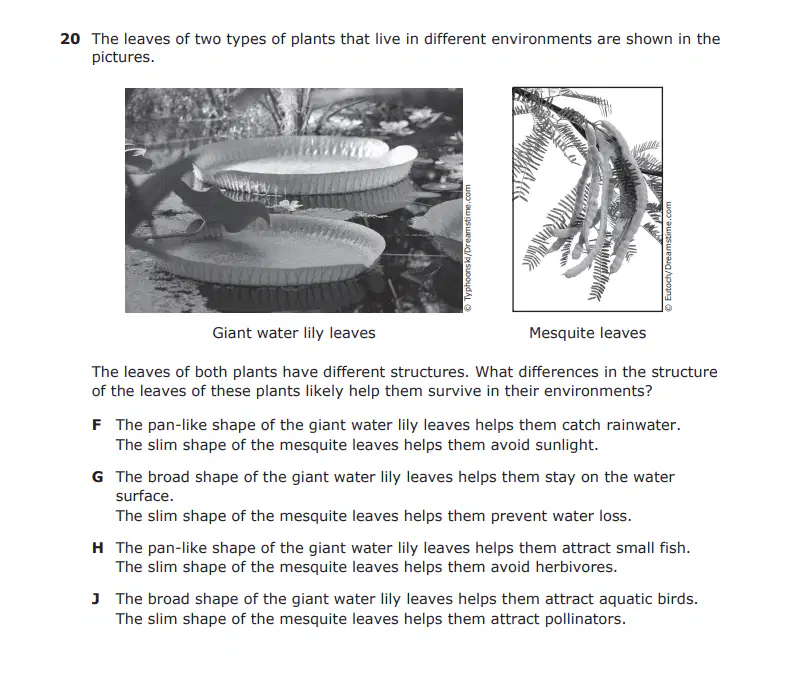
The leaves of two types of plants that live in different environments are shown in the pictures. The leaves of both plants have different structures. What differences in the structure of the leaves of these plants likely help them survive in their environments?
The pan-like shape of the giant water lily leaves helps them catch rainwater. The slim shape of the mesquite leaves helps them avoid sunlight.
The broad shape of the giant water lily leaves helps them stay on the water surface. The slim shape of the mesquite leaves helps them prevent water loss.
The pan-like shape of the giant water lily leaves helps them attract small fish. The slim shape of the mesquite leaves helps them avoid herbivores.
The broad shape of the giant water lily leaves helps them attract aquatic birds. The slim shape of the mesquite leaves helps them attract pollinators.
Examine the diagram to the right. On your answer sheet, place the appropriate stage next to each letter based on this picture. Use the wordbank provided on your answer sheet.
Infiltration
Transpiration
Evaporation
Precipitation
Runoff
Condensation
Label the visible parts of the water cycle.
Runoff
Evaporation
Transpiration
Condensation
Precipitation

Which type of plant leaf loses the least amount of water?
Grass
Wide leaves
Heart-shaped leaves
Needles

What function is served by plant structures such as stinging hairs, thorns, and briars?
Pollination
Photosynthesis
Protection
Disease prevention

Pine needles are covered by a thick coat of wax. What benefit does the wax coating provide?
The wax helps needles take in gas from the air.
The wax helps needles take in water droplets.
The wax helps keep water inside the needles.
The wax provides food for the needle during the winter.

The diagram below shows a food web in an ecosystem. Select TWO parts of the ecosystem that would be affected if the lizard population died off due to a disease.
Owl and snake
Rabbit and grass
Hawk and tree
Frog and fish
What is the primary role of chlorophyll in plants?
To absorb sunlight
To store water
To protect from insects
To support the plant structure
What adaptation helps cacti survive in arid environments?
Shallow roots
Thick, waxy skin
Brightly colored flowers
Large leaves

Leaves on the surface of water plants are ________.
flat
curled

Water lilies live in lakes and ponds. The lilies have very long stems. The picture above shows a water lily in a pond. How do long stems help water lilies live in ponds?
They absorb food for the plant.
They absorb water from the pond.
They enable the pads and flower to reach sunlight.
They help the plants float away.

An adaptation that helps a cactus live in the desert is its
wide, flat leaves to catch water
bright green color
thin, spiny needles
tall stems

Many plants have bright, sweet smelling flowers. How would this adaptation help the plant?
It warns away predators
It attracts bees and other pollinators
It helps the plant store water
It gives the plant shade.

Desert plants have a coat of wax on their leaves to
keep water from escaping
protect them from animals eating them
absorb water from the air
release scent to attract animals

Which plant structure is the arrow pointing to? What is the function?
leaves, helps the plant attract pollinators
leaves, helps the plant soak up rain water
leaves, provides pollen for other pollinators to spead.
leaves, helps the plant with the process of photosynthesis
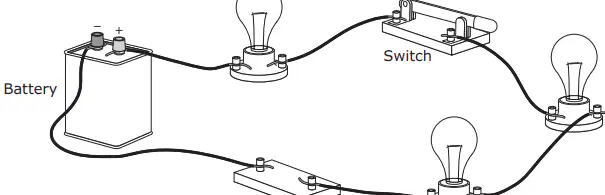
The circuit below does not work. Which procedure would most likely allow the bulbs to light?
Open the switch and then connect the two wires that are attached to the wood block
Switch the positions of the two wires that are connected to the battery and then open the switch
Move the switch closer in the circuit to the battery
Connect the two wires that are attached to the wood block
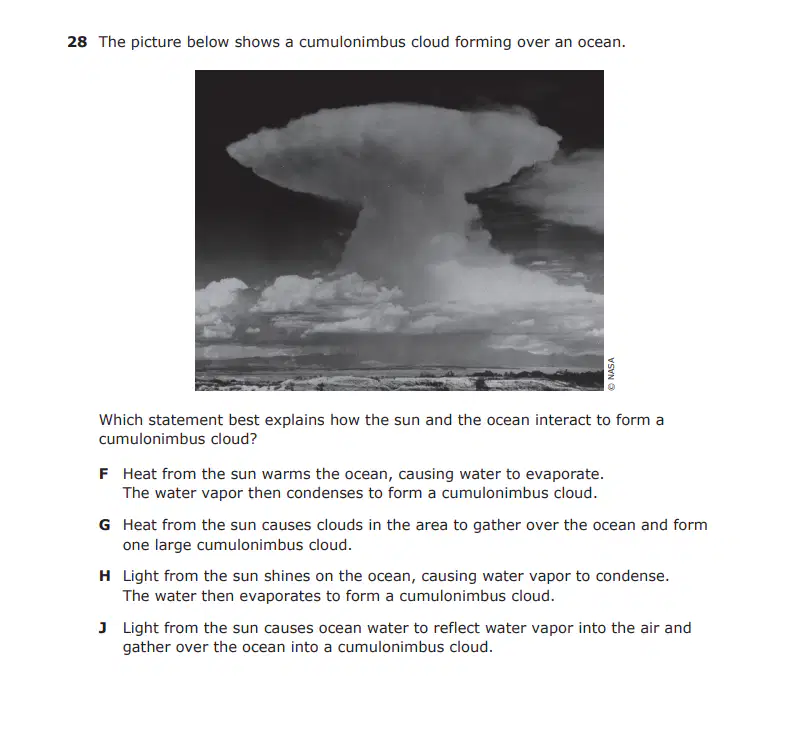
Which statement best explains how the sun and the ocean interact to form a cumulonimbus cloud?
Heat from the sun warms the ocean, causing water to evaporate. The water vapor then condenses to form a cumulonimbus cloud.
Heat from the sun causes clouds in the area to gather over the ocean and form one large cumulonimbus cloud.
Light from the sun shines on the ocean, causing water vapor to condense. The water then evaporates to form a cumulonimbus cloud.
Light from the sun causes ocean water to reflect water vapor into the air and gather over the ocean into a cumulonimbus cloud.
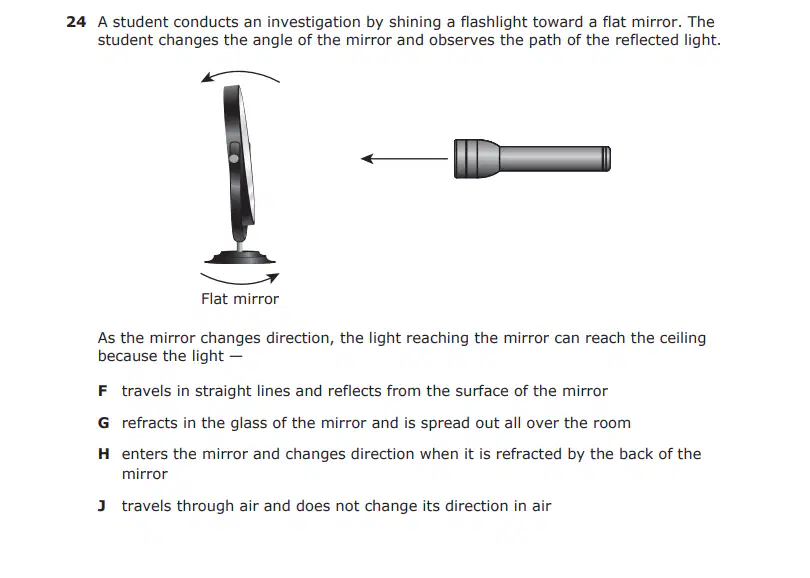
A student conducts an investigation by shining a flashlight toward a flat mirror. The student changes the angle of the mirror and observes the path of the reflected light. As the mirror changes direction, the light reaching the mirror can reach the ceiling because the light —
travels in straight lines and reflects from the surface of the mirror
refracts in the glass of the mirror and is spread out all over the room
enters the mirror and changes direction when it is refracted by the back of the mirror
travels through air and does not change its direction in air
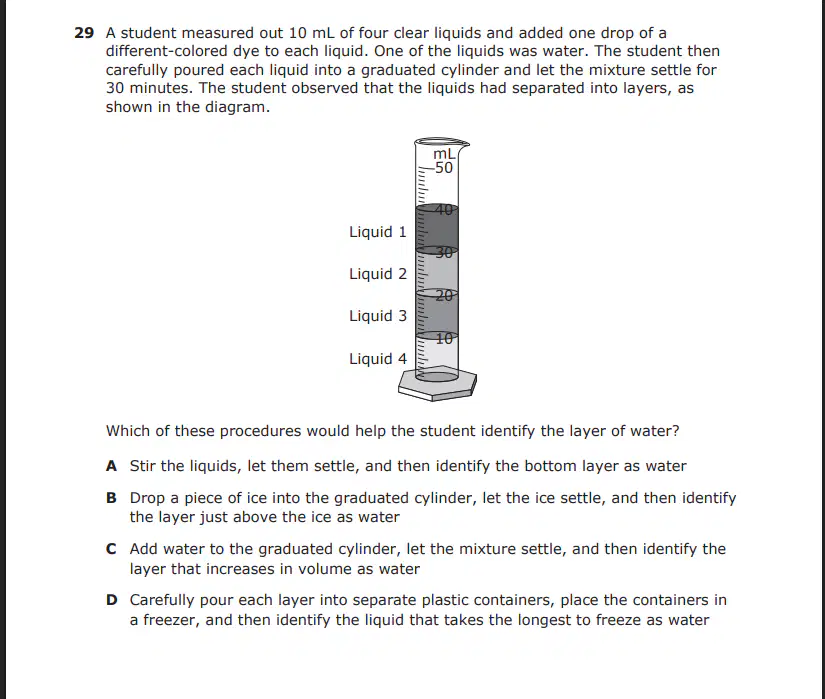
A student measured out 10 mL of four clear liquids and added one drop of a different-colored dye to each liquid. One of the liquids was water. The student then carefully poured each liquid into a graduated cylinder and let the mixture settle for 30 minutes. The student observed that the liquids had separated into layers, as shown in the diagram. Which of these procedures would help the student identify the layer of water?
A. Stir the liquids, let them settle, and then identify the bottom layer as water
B. Drop a piece of ice into the graduated cylinder, let the ice settle, and then identify the layer just above the ice as water
C. Add water to the graduated cylinder, let the mixture settle, and then identify the layer that increases in volume as water
D. Carefully pour each layer into separate plastic containers, place the containers in a freezer, and then identify the liquid that takes the longest to freeze as water
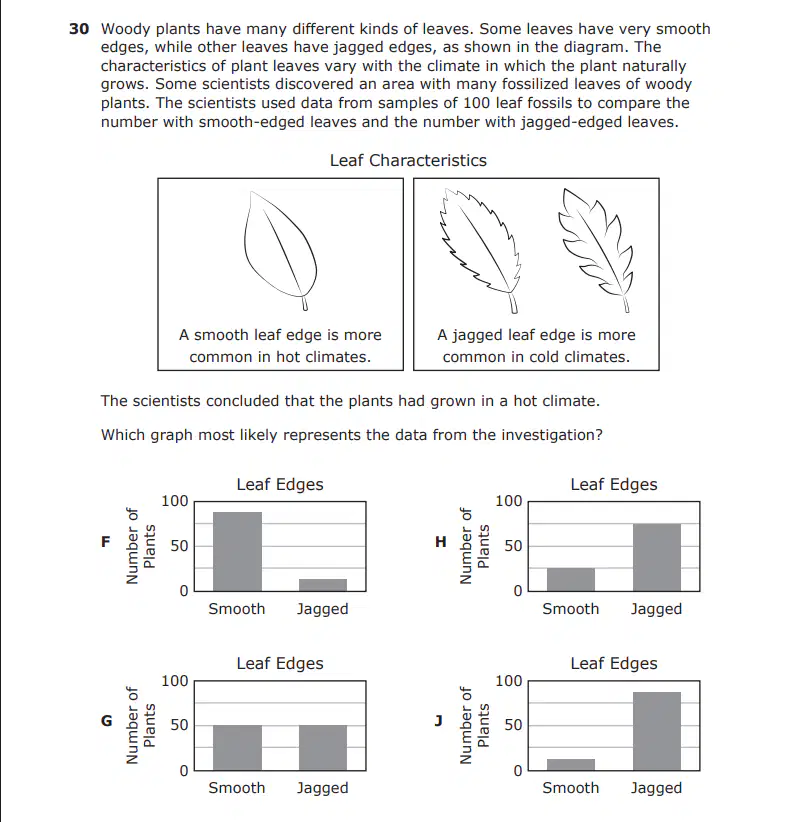
Woody plants have many different kinds of leaves. Some leaves have very smooth edges, while other leaves have jagged edges, as shown in the diagram. The characteristics of plant leaves vary with the climate in which the plant naturally grows. Some scientists discovered an area with many fossilized leaves of woody plants. The scientists used data from samples of 100 leaf fossils to compare the number with smooth-edged leaves and the number with jagged-edged leaves. A smooth leaf edge is more common in hot climates. A jagged leaf edge is more common in cold climates. The scientists concluded that the plants had grown in a hot climate. Which graph most likely represents the data from the investigation?
F. [Graph: Smooth > Jagged]
G. [Graph: Smooth = Jagged]
H. [Graph: Jagged > Smooth]
J. [Graph: Jagged >> Smooth]
A family takes a group picture in a park where bluebonnets are blooming. The family notices that some of the blooms are white and others are blue. The color of the blooms is most likely determined by —
F air temperature
G the age of the plant
H the types of consumers that eat the plant
J inheritance from parent plants
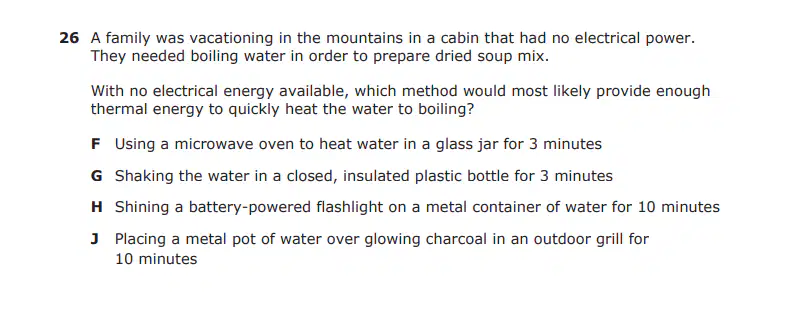
A family was vacationing in the mountains in a cabin that had no electrical power. They needed boiling water in order to prepare dried soup mix. With no electrical energy available, which method would most likely provide enough thermal energy to quickly heat the water to boiling?
Using a microwave oven to heat water in a glass jar for 3 minutes
Shaking the water in a closed, insulated plastic bottle for 3 minutes
Shining a battery-powered flashlight on a metal container of water for 10 minutes
Placing a metal pot of water over glowing charcoal in an outdoor grill for 10 minutes
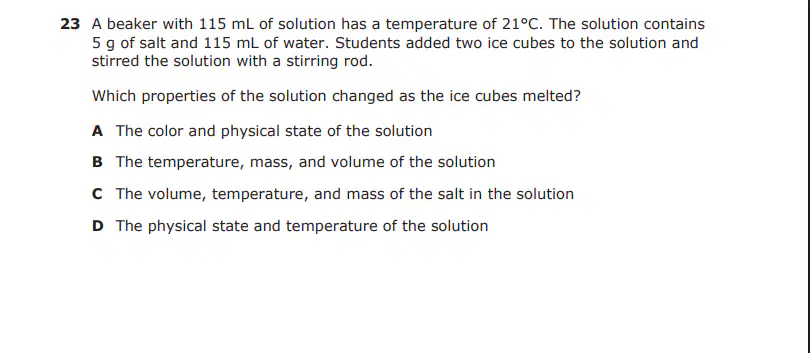
A beaker with 115 mL of solution has a temperature of 21°C. The solution contains 5 g of salt and 115 mL of water. Students added two ice cubes to the solution and stirred the solution with a stirring rod. Which properties of the solution changed as the ice cubes melted?
The color and physical state of the solution
The temperature, mass, and volume of the solution
The volume, temperature, and mass of the salt in the solution
The physical state and temperature of the solution
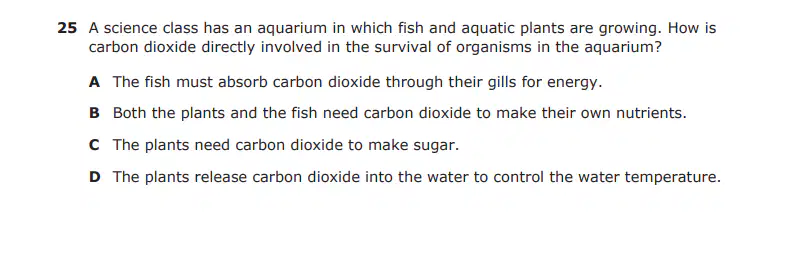
A science class has an aquarium in which fish and aquatic plants are growing. How is carbon dioxide directly involved in the survival of organisms in the aquarium?
The fish must absorb carbon dioxide through their gills for energy.
Both the plants and the fish need carbon dioxide to make their own nutrients.
The plants need carbon dioxide to make sugar.
The plants release carbon dioxide into the water to control the water temperature.
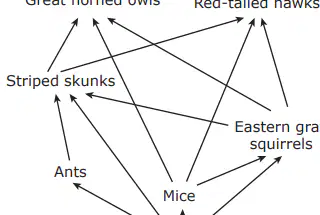
How many types of organisms in this food web obtain energy directly from producers?
Two
Three
Four
Five
Aquatic plants have adaptations that help them live in water. For example, the structures needed for making food are located on the tops of floating plant leaves. This adaptation helps the plants —
absorb sunlight
stay anchored
avoid predators
capture fish
Which statement best describes the processes of weathering and erosion?
Weathering and erosion are directly responsible for the breakdown of any type of rock into smaller particles and the carrying away of the loose sediments.
Weathering and erosion are directly responsible for depositing loose sediments on the bottom of the ocean, forming layers of sediment.
Weathering and erosion are directly responsible for the amount of water in a river that transports sediments to the sea.
Weathering and erosion are directly responsible for the transportation, deposition, and compaction of loose sediments on the seafloor.
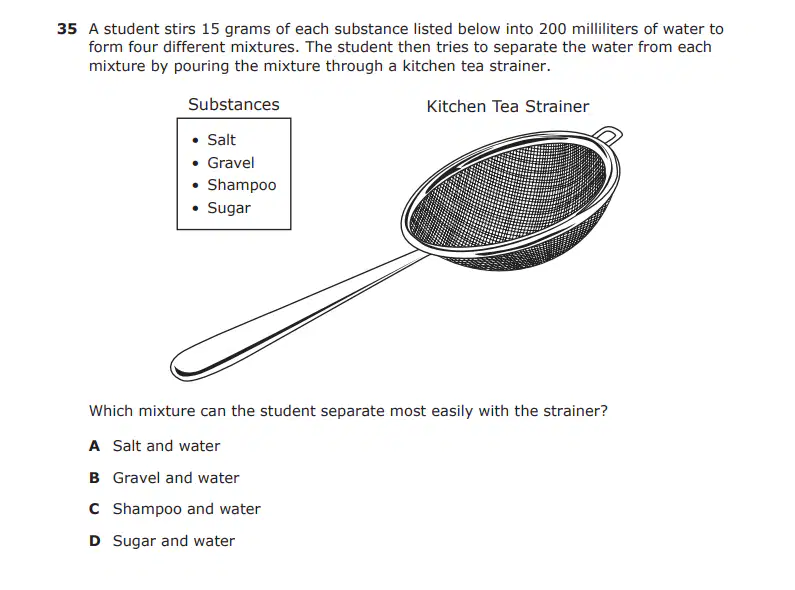
A student stirs 15 grams of each substance listed below into 200 milliliters of water to form four different mixtures. The student then tries to separate the water from each mixture by pouring the mixture through a kitchen tea strainer. Which mixture can the student separate most easily with the strainer?
Salt and water
Gravel and water
Shampoo and water
Sugar and water
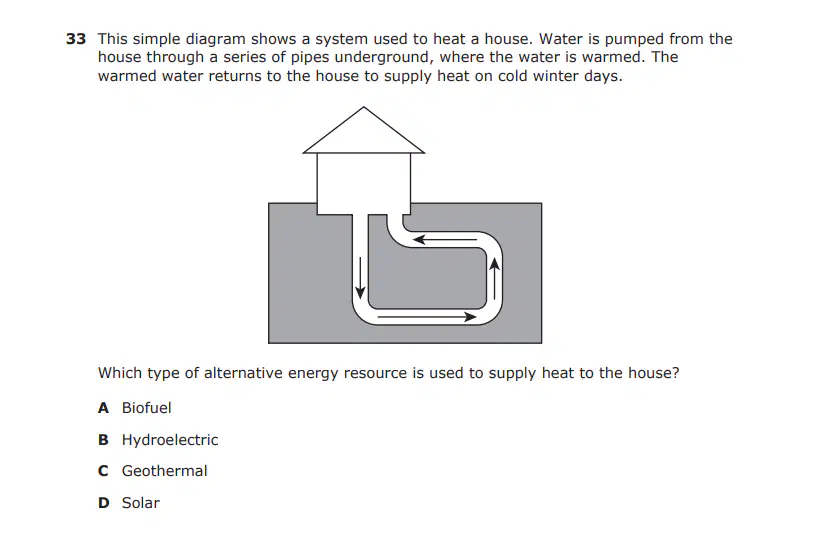
This simple diagram shows a system used to heat a house. Water is pumped from the house through a series of pipes underground, where the water is warmed. The warmed water returns to the house to supply heat on cold winter days.
Biofuel
Hydroelectric
Geothermal
Solar
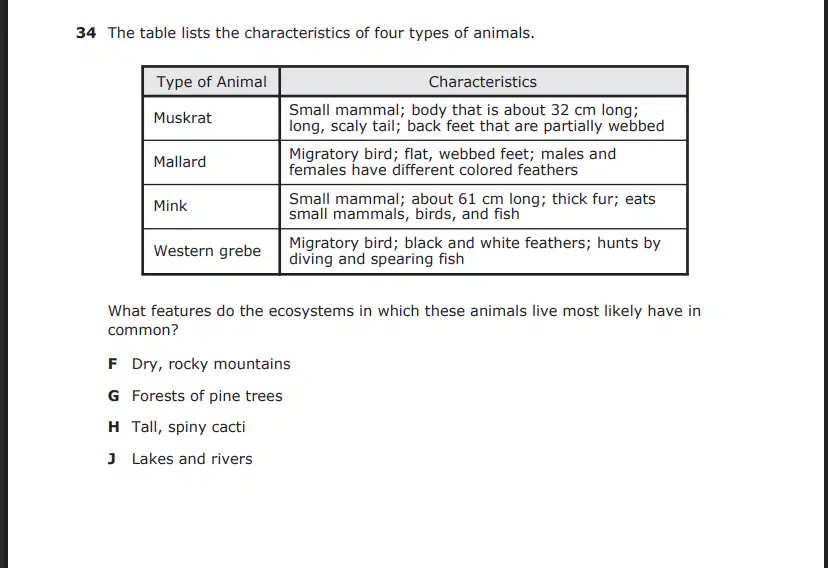
The table lists the characteristics of four types of animals. Type of Animal | Characteristics Muskrat | Small mammal; body that is about 32 cm long; long, scaly tail; back feet that are partially webbed Mallard | Migratory bird; flat, webbed feet; males and females have different colored feathers Mink | Small mammal; about 61 cm long; thick fur; eats small mammals, birds, and fish Western grebe | Migratory bird; black and white feathers; hunts by diving and spearing fish What features do the ecosystems in which these animals live most likely have in common?
Dry, rocky mountains
Forests of pine trees
Tall, spiny cacti
Lakes and rivers

