
 Worksheets
MEDL 201: Innate Immunity
Total questions: 71
Worksheet time: 37mins
Fill in the blank: The external defense system includes physical, chemical, and ________ barriers.
biological
mechanical
thermal
magnetic
Which of the following is NOT a component of the internal defense system?
Pattern-recognition receptors
Acute-phase reactants
Physical barriers
Inflammation
Fill in the blank: ________ is a process in which a cell eats another cell.
Phagocytosis
Osmosis
Photosynthesis
Transpiration
Fill in the blank: Innate lymphoid cells are a component of the ________ defense system.
internal
external
adaptive
chemical
Fill in the blank: The innate immune system consists of defenses that act immediately when a host is attacked by a ________.
pathogen
vitamin
hormone
enzyme
Which of the following best describes the innate immune system?
Specific
Nonspecific
Adaptive
Delayed response
Which of the following is a function of the internal defense system in the innate immune system?
Producing antibodies
Cellular responses that recognize specific molecular components of pathogens
Memory cell formation
Hormone production
What are the three types of barriers that prevent infectious agents from entering the body according to the External Defense System?
Physical, chemical, and biological barriers
Mechanical, enzymatic, and hormonal barriers
Thermal, electrical, and magnetic barriers
Genetic, metabolic, and sensory barriers
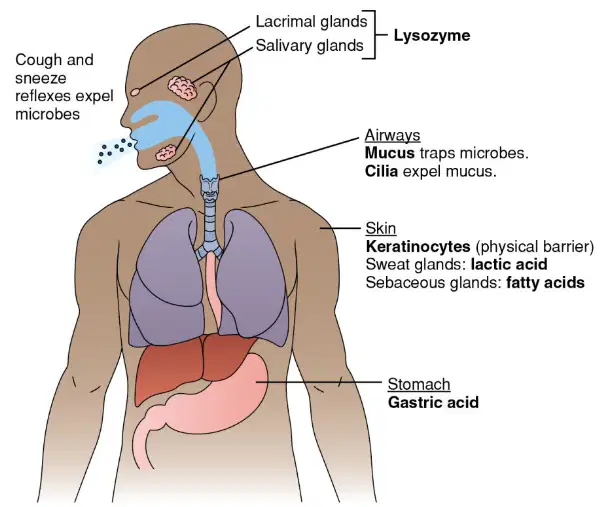
Match the following body parts or substances with their defense mechanisms:
Lysozyme
Lacrimal glands/Salivary glands
Mucus and Cilia
Airways
Keratinocytes, lactic acid, fatty acids
Skin
Gastric acid
Stomach
What is the main function of the skin in the external defense system?
Absorb nutrients
Physical barrier to pathogen entry
Produce hormones
Store fat
Which layer of the skin is made up of tightly packed epithelial cells coated in keratin?
Epidermis
Dermis
Hypodermis
Subcutaneous layer
Which of the following is NOT found in the dermis?
A) Blood vessels
B) Hair follicles
C) Sweat glands
D) Keratin-coated epithelial cells
Lactic acid and fatty acids maintain the skin at a pH of approximately _____?
5.6
7.0
4.0
6.5
Proteins with antibacterial effects in the skin include ________.
psoriasin
melanin
collagen
elastin
Mucous membranes line which tracts in the body?
Respiratory, digestive, and genitourinary tracts
Circulatory and nervous tracts
Muscular and skeletal tracts
Endocrine and lymphatic tracts
Mucous secretions contain surfactants that block bacteria from adhering to ______ cells.
epithelial
muscle
nerve
connective
Fill in the blank: The stomach's hydrochloric acid keeps the pH as low as ____, prohibiting microorganism growth.
1
4
7
9
Which enzyme in tears and saliva attacks cell walls of gram-positive bacteria?
Amylase
Lysozyme
Pepsin
Lipase
What keeps the vagina pH at approximately 5?
Hydrochloric acid
Lactic acid
Lysozyme
Bile
Normal microbiota in the body play a role in protecting against the colonization of ________.
pathogens
vitamins
enzymes
antigens
Which of the following is a component of the Internal Defense System?
Pattern-recognition receptors
Red blood cells
Platelets
Antibodies
Pattern Recognition Receptors (PRRs) recognize molecules unique to infectious organisms called _________
pathogen-associated molecular patterns (PAMPs)
major histocompatibility complexes (MHCs)
antigen-presenting cells (APCs)
complement proteins
What happens when Pattern Recognition Receptors (PRRs) bind to a pathogen?
They activate phagocytic cells.
They produce antibodies directly.
They destroy the pathogen immediately.
They cause the pathogen to mutate.
Which of the following are examples of Pattern Recognition Receptors (PRRs)?
TLRs
CLRs
RLRs
NLRs
All of the above
How many types of Toll-Like Receptors (TLRs) are found in humans?
5
7
10
12
Where are some Toll-Like Receptors (TLRs) located in human cells?
Only on cell surfaces
Only in the nucleus
Some on cell surfaces and some in cytoplasm
Only in mitochondria
Toll-Like Receptors (TLRs) are glycoproteins that bind to microbial substances, activating ______ and chemokine production and other processes.
cytokine
lipid
glucose
antibody
Phagocytosis is enhanced and adaptive immunity is triggered by Toll-Like Receptors (TLRs), destroying pathogens before disease sets in.
True
False
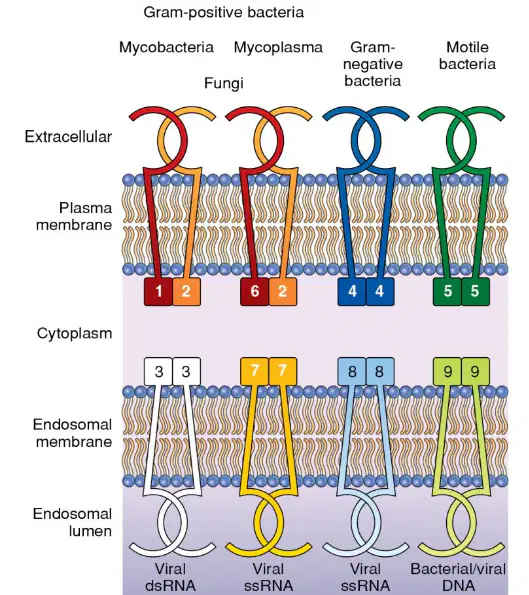
According to the diagram, which TLR is associated with recognizing viral dsRNA?
TLR 3
TLR 4
TLR 5
TLR 9
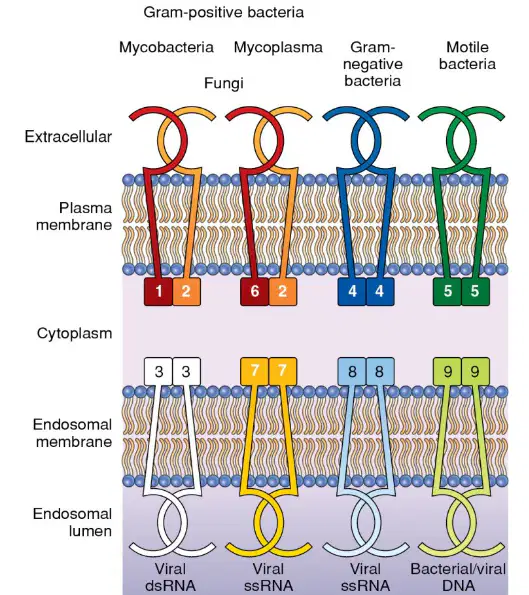
According to the diagram, TLR 4 is found in which cellular location?
Endosomal membrane
Plasma membrane
Cytoplasm
Nucleus
Fill in the blank: C-type lectin receptors (CLRs) bind to ______ and β-glucans in fungal cell walls to activate cytokine and chemokine.
mannan
lipopolysaccharide
peptidoglycan
chitin
Which type of receptor recognizes RNA from RNA viruses and induces production of inflammatory cytokines/type I interferons?
C-type lectin receptors (CLRs)
Retinoic acid-inducible gene-I-like receptors (RLRs)
Nucleotide-binding oligomerization domain (NOD)-like receptors (NLRs)
Fill in the blank: Nucleotide-binding oligomerization domain (____)-like receptors (NLRs).
NOD
TIR
LRR
CARD
Acute-phase reactants are ______ normally found in serum.
soluble factors
insoluble proteins
cellular enzymes
membrane receptors
Acute-phase reactants increase rapidly in response to which of the following?
Infection
Injury
Tissue trauma
All of the above
Acute-phase reactants facilitate contact between microbes and phagocytic cells by way of what process.
opsonization
selection
normalization
recognition
What do acute-phase reactants limit during phagocytosis?
Host tissue destruction caused by proteolytic enzyme release
Bacterial replication within phagosomes
Antibody production by B cells
Oxygen consumption by neutrophils
During inflammation, acute-phase reactants bind to, and recycle, important ______ and minerals.
proteins
carbohydrates
lipids
vitamins
What is the response time (in hours) for C-reactive protein?
24
4-6
48-72
200-400
What is the normal concentration (mg/dL) of Serum amyloid A?
0.5
5
200-400
40-290
Alpha1-antitrypsin has a normal concentration of ______ mg/dL.
200-400
20-40
400-600
1000-1200
Which protein is responsible for clot formation?
C-reactive protein
Fibrinogen
Haptoglobin
Ceruloplasmin
Haptoglobin binds _______.
hemoglobin
albumin
bilirubin
fibrinogen
What is the increase factor for Ceruloplasmin during the acute-phase response?
1,000X
2-5X
2-10X
2X
Complement C3 is involved in which functions?
Opsonization, complement activation
Activates monocytes and macrophages
Opsonization, lysis
Binds copper and oxidizes iron
What is the body's overall reaction to injury or invasion by an infectious agent called?
Inflammation
Digestion
Respiration
Osmosis
Which of the following is a cardinal sign of inflammation?
Redness (erythema)
Numbness
Itching
Bruising
Which of the following is a cardinal sign of inflammation?
Swelling (edema)
Bleeding
Rash
Stiffness
Which of the following is a cardinal sign of inflammation?
Heat
Cold
Tingling
Weakness
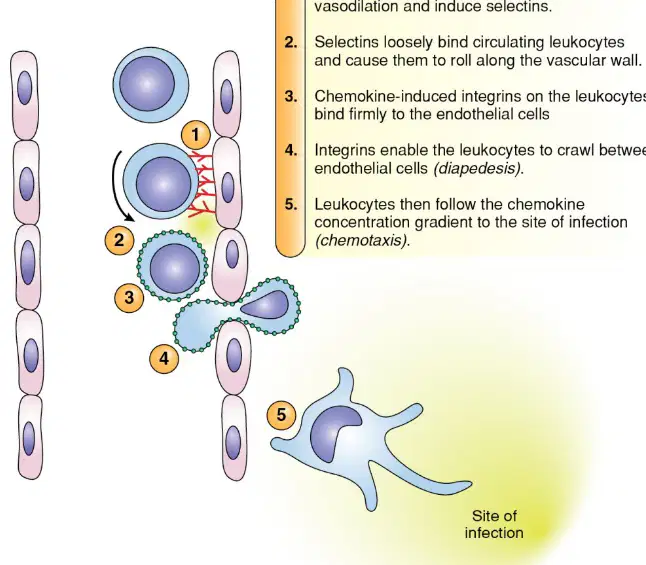
Major Events Involved in Acute Inflammation: Fill in the blank: Resident macrophages and mast cells at the site of infection release _______ that cause vasodilation and induce selectins.
chemokines
antibodies
lymphocytes
platelets
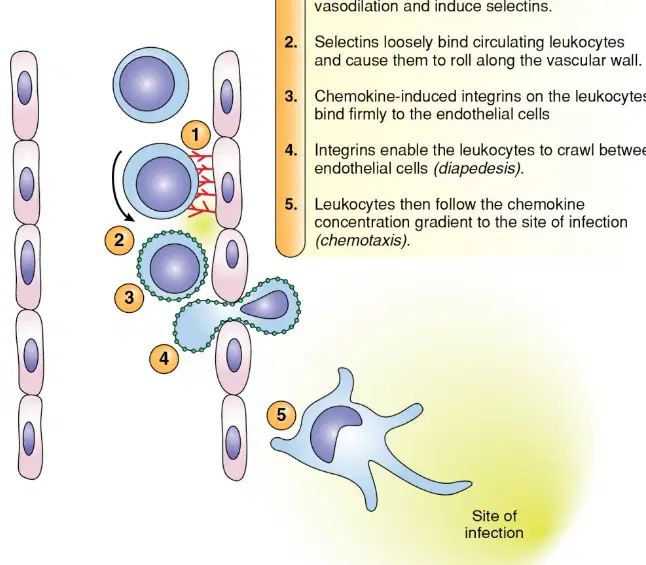
Fill in the blank: Integrins enable the leukocytes to crawl between endothelial cells, a process called _______.
diapedesis
phagocytosis
apoptosis
chemotaxis
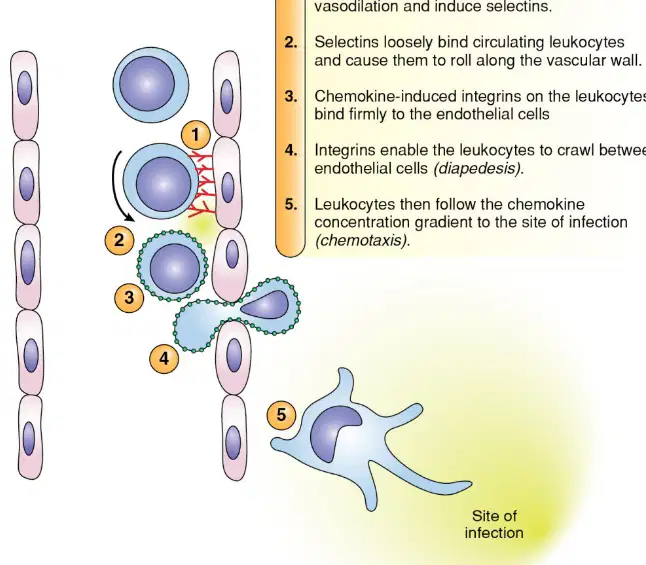
Leukocytes then follow the chemokine concentration gradient to the site of infection, a process called _______.
chemotaxis
phagocytosis
apoptosis
osmosis
Which of the following is a type of phagocytic cell attracted to the site of inflammation?
Neutrophils
Erythrocytes
Platelets
Basophils
Which of the following is NOT a phagocytic cell attracted to the site of inflammation?
Monocytes
Macrophages
Dendritic cells
Lymphocytes
Fill in the blank: The process of phagocytosis is enhanced by opsonins like _____
CRP
Albumin
Fibrinogen
Transferrin
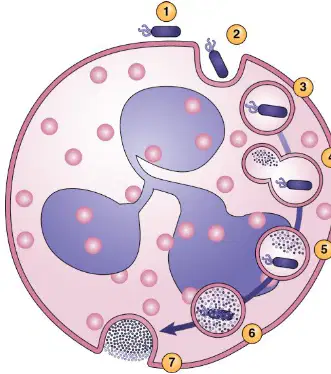
Which step in the process of phagocytosis involves the outflowing of cytoplasm to surround the microorganism?
Adherence
Engulfment
Digestion
Excretion
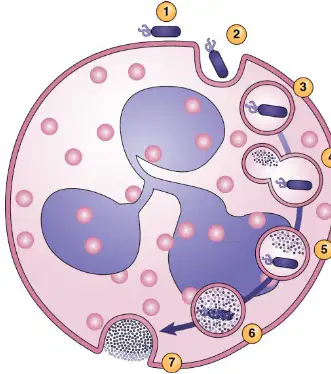
Match the step number with the correct description from the process of phagocytosis:
Physical contact between the phagocytic cell and the microorganism
Adherence
Outflowing of cytoplasm to surround the microorganism
Engulfment
Microorganism is completely surrounded by a part of the cell membrane
Formation of phagosome
Lysosomal granules contact and fuse with the phagosome
Granule contact
Contents of the lysosome are emptied into the phagosome
Formation of the phagolysosome
What is the role of the HMP shunt in the oxidative burst during the killing of pathogens?
Converts NADP to NADPH
Converts O2 to H2O2
Activates lytic enzymes
Alters pH of the cell
In the O2 independent pathway, what change leads to the activation of lytic enzymes such as defensins?
Increase in NADPH
Alteration of cell pH
Conversion of O2 to H2O2
Production of OH-
Fill in the blank: During the oxidative burst, O2 is converted to O2- ; O2- to _______ and OH-.
O2-
H2O2
CO2
H2O
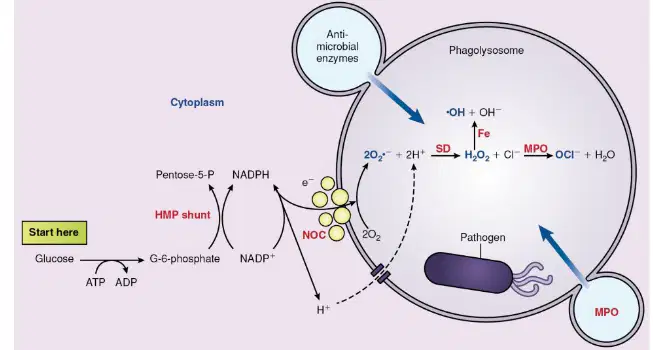
Which enzyme is involved in the conversion of H2O2 and Cl- to OCl- and H2O in the phagolysosome?
MPO (Myeloperoxidase)
Catalase
Superoxide dismutase
Glutathione peroxidase
Natural Killer (NK) cells are the first line of defense against cells that are ______ infected, cells infected with other intracellular pathogens, and tumor cells.
virally
bacterially
mechanically
chemically
Natural Killer (NK) cells recognize altered structures on damaged cells and can eliminate them without prior ______.
exposure
activation
division
migration
NK activity is enhanced by certain ______.
cytokines
antibodies
hormones
enzymes
NK cells produce other cytokines that recruit T cells and aid in development of ______ and macrophages.
granulocytes
erythrocytes
neurons
hepatocytes
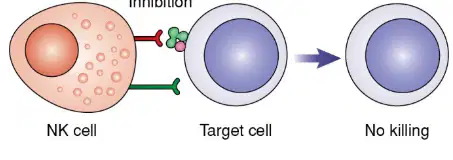
Based on the diagram, what is the result when inhibition occurs between an NK cell and a target cell?
No killing of the target cell occurs.
The target cell is immediately destroyed.
The NK cell releases cytokines to activate the target cell.
The target cell undergoes apoptosis due to NK cell action.
NK cells can induce apoptosis in which of the following types of target cells?
Bacterial cells
Virally infected cells
Antibody-coated target cells
Both Bacterial cells & Virally infected cells

What is the main purpose of a vaccine?
To cure diseases
To diagnose diseases
To prevent diseases
To treat symptoms

