
 Worksheets
Senior Check Off
Total questions: 98
Worksheet time: 49mins
According to the instructions for phone note documentation, what must every note start with?
Patient's address
Date, time, name, DOB
Reason for call
Final outcome
Which of the following is NOT listed as relevant information to gather during phone note documentation?
Name of who called
Reason for call
Patient's insurance provider
Final outcome
Fill in the blank: The phone note should end with the ______ and credentials.
name
date
address
phone number
The reason for the call and all relevant information, including a call back number, should be documented in the phone note.
True
False
In the example provided, what medication was requested for a 30-day refill?
Metformin
Lisinopril
Atorvastatin
Amoxicillin
According to the instructions, what should be included if the caller is not the patient?
The relation to the patient should be included if the caller is not the patient.
The caller's occupation should be included if the caller is not the patient.
The caller's favorite color should be included if the caller is not the patient.
The caller's previous medical history should be included if the caller is not the patient.
What does 'NKDA' stand for in medical abbreviations?
No Known Drug Allergies
Non-Ketotic Diabetic Acidosis
No Known Dietary Allergies
Neuro-Kinetic Diagnostic Assessment
What is the difference between 'None' and 'N/A' when filling out the patient history form?
'None' means the condition or item does not apply to the patient. 'N/A' means the question is not applicable to the patient.
'None' means the patient has not answered the question. 'N/A' means the patient refused to answer.
'None' means the patient has all conditions. 'N/A' means the patient has some conditions.
'None' and 'N/A' can be used interchangeably with no difference.
What should you do if you make an error while filling out the patient history form?
Draw a line through the error and initial it.
Erase the error completely and rewrite it.
Use correction fluid to cover the error.
Ignore the error and continue filling out the form.
Each page of the patient history form must have the patient's name and ________.
date of birth (DOB)
address
insurance number
phone number
What does 'Gravida' mean in the context of the patient history form?
Total number of pregnancies
Number of live births
Number of miscarriages
Number of twins
What does 'Para' mean in the context of the patient history form?
Total number of living births
Number of pregnancies regardless of outcome
Number of miscarriages
Number of stillbirths
What does 'Abs' mean in the context of the patient history form?
Abortion, miscarriage, D&C
Abscess, infection, swelling
Absent, not present, missing
Abstinence, no sexual activity
When filling out the patient history form, should you leave any blanks?
True
False
Which of the following is NOT a proper medical abbreviation?
NKDA
DOB
ABCD
N/A
If a patient has no known drug allergies, which abbreviation should be used on the form?
N/A
NKDA
None
DOB
What does the 'A' in AIDET stand for?
Acknowledge
Announce
Ask
Arrange
What does the 'I' in AIDET stand for?
Inquire
Introduce
Inform
Instruct
What does the 'D' in AIDET stand for?
Duration
Diagnosis
Discussion
Decision
What does the 'E' in AIDET stand for?
Evaluate
Explanation
Example
Examine
What does the 'T' in AIDET stand for?
Thank You
Test
Treat
Tell
What is the systolic blood pressure?
The first sound/top number when the heart contracts
The last sound/bottom number when the heart relaxes
The normal adult range
The reading is always an even number
What is the diastolic blood pressure?
The first sound/top number when the heart contracts
The last sound/bottom number when the heart relaxes
The normal adult range
The reading is always an even number
Fill in the blank: The blood pressure reading is always an ______ number.
even
odd
prime
negative
What is the normal adult blood pressure range?
120/80 below
130/80 above
140/90 above
110/70 below
High blood pressure is known as ________.
Hypertension (HTN)
Hypotension
Bradycardia
Arrhythmia
Low blood pressure is known as ________.
Hypotension
Hypertension
Anemia
Bradycardia
HTN1 is defined as blood pressure of ______ mmHg above.
130/80
120/70
140/90
150/95
HTN2 is defined as blood pressure of ______ mmHg above.
140/90
120/80
160/100
130/85
The instructor will use a dual stethoscope to check BP, and the reading should not be more than 4 points off.
True
False
What is the normal pulse rate in beats per minute (BPM)?
60-100 BPM
30-50 BPM
110-140 BPM
150-180 BPM
What is tachycardia?
Slow heart rate below 60 BPM
Fast heart rate 100 BPM or above
Normal pulse 60-100 BPM
What is bradycardia?
Slow heart rate below 60 BPM
Fast heart rate 100 BPM or above
Normal pulse 60-100 BPM
Pulse is recorded as ______ = beats per minute.
BPM
RPM
KPH
MPH
If there is an abnormal pulse, you should count for how long?
A whole minute
10 seconds
20 seconds
30 seconds
What is the normal respiration rate for adults?
12-20
20-30
8-14
25-35
What is dyspnea?
Difficulty or painful breathing
Excessive sweating
Loss of appetite
Frequent urination

The best way to check respiration is by:
Only listening to the patient
Watching, listening, or feeling the movement at the patient’s chest, stomach, back, or shoulders
Only feeling the patient’s pulse
List the 5 sites to check temperature: i. Oral (sublingually in mouth) ii. Rectal (anus) iii. Temporal (forehead) iv. Tympanic (ear) v. Axillary (armpit)
Oral, Rectal, Temporal, Tympanic, Axillary
Oral, Nasal, Temporal, Tympanic, Axillary
Oral, Rectal, Temporal, Tympanic, Inguinal
Oral, Rectal, Buccal, Tympanic, Axillary
Temperature can be measured in degrees ______ (°F) or degrees ______ (°C).
Fahrenheit, Celsius
Celsius, Fahrenheit
Kelvin, Rankine
Newton, Réaumur
What is the normal adult temperature?
98.6°F
100.4°F
97.0°F
95.5°F
Anything over ______ is considered a fever.
100°F
98°F
97°F
99°F
Febrile means:
with fever
no fever
exceptionally high fever
Afebrile means:
with fever
no fever
exceptionally high fever
Hyperpyrexia means:
with fever
no fever
exceptionally high fever
What device is used to check O2 and document it with a percentage?
Oximeter
Thermometer
Sphygmomanometer
Stethoscope
What is the normal O2 reading range according to the oximeter?
80%-90%
95%-100%
70%-80%
100%-110%
The highest O2 reading on an oximeter is _______.
100%
80%
95%
60%
An O2 reading of 95% or below is considered:
Normal
Concerning
Highest
Safe
If a patient's O2 reading is concerning, what should you do?
Notify doctor and have patient take deep breaths
Ignore the reading and continue as normal
Ask the patient to sleep it off
Increase the room temperature
What is hypoxemia?
Low blood oxygen
High blood sugar
Excessive sweating
Low blood pressure
Cyanosis is the condition of turning blue due to _______.
inadequate supply of oxygen
excessive supply of carbon dioxide
high blood sugar levels
dehydration
How many pounds (lb) are equivalent to 1 kilogram (kg)?
2.2 lb
1.0 lb
0.5 lb
5.0 lb
To convert kilograms (kg) to pounds (lb), you should:
Divide by 2.2
Multiply by 2.2
Add 2.2
Subtract 2.2
To convert pounds (lb) to kilograms (kg), you should:
Divide by 2.2
Multiply by 2.2
Add 2.2
Subtract 2.2
What should you always do before checking the height or weight on a scale?
Calibrate the scale. The scale must be balanced.
Ask the patient to remove their shoes.
Record the previous measurement.
Turn off the scale and restart it.
Height can be recorded in which units?
Feet, inches, or centimeters
Liters, grams, or seconds
Watts, volts, or ohms
Miles, gallons, or pounds
To convert feet to inches, you should multiply by what number?
12
10
6
3
If a person's height is 5 feet 2 inches, what is their height in inches?
62 inches
52 inches
60 inches
64 inches
What is an intradermal injection?
An intradermal injection is an injection administered into the dermis, just below the epidermis of the skin.
An intradermal injection is an injection administered into the muscle tissue, deep below the skin.
An intradermal injection is an injection administered into the subcutaneous fat layer beneath the skin.
An intradermal injection is an injection administered directly into the bloodstream.
What is a subcutaneous injection?
A subcutaneous injection is an injection administered into the tissue layer between the skin and the muscle.
A subcutaneous injection is an injection administered directly into the bloodstream.
A subcutaneous injection is an injection administered into the bone marrow.
A subcutaneous injection is an injection administered into the joint cavity.
What is an intramuscular deltoid injection?
An intramuscular deltoid injection is an injection administered into the deltoid muscle of the upper arm.
An intramuscular deltoid injection is an injection given into the thigh muscle.
An intramuscular deltoid injection is an injection administered into the abdominal region.
An intramuscular deltoid injection is an injection given into the gluteal muscle.
What is an intramuscular ventrogluteal injection?
An intramuscular ventrogluteal injection is an injection administered into the ventrogluteal muscle of the hip.
An intramuscular ventrogluteal injection is an injection administered into the deltoid muscle of the upper arm.
An intramuscular ventrogluteal injection is an injection administered into the vastus lateralis muscle of the thigh.
An intramuscular ventrogluteal injection is an injection administered into the subcutaneous tissue of the abdomen.
What is an intramuscular dorsogluteal injection?
An intramuscular dorsogluteal injection is an injection administered into the dorsogluteal muscle of the buttocks.
An intramuscular dorsogluteal injection is an injection administered into the deltoid muscle of the upper arm.
An intramuscular dorsogluteal injection is an injection administered into the subcutaneous tissue of the abdomen.
An intramuscular dorsogluteal injection is an injection administered into the vastus lateralis muscle of the thigh.
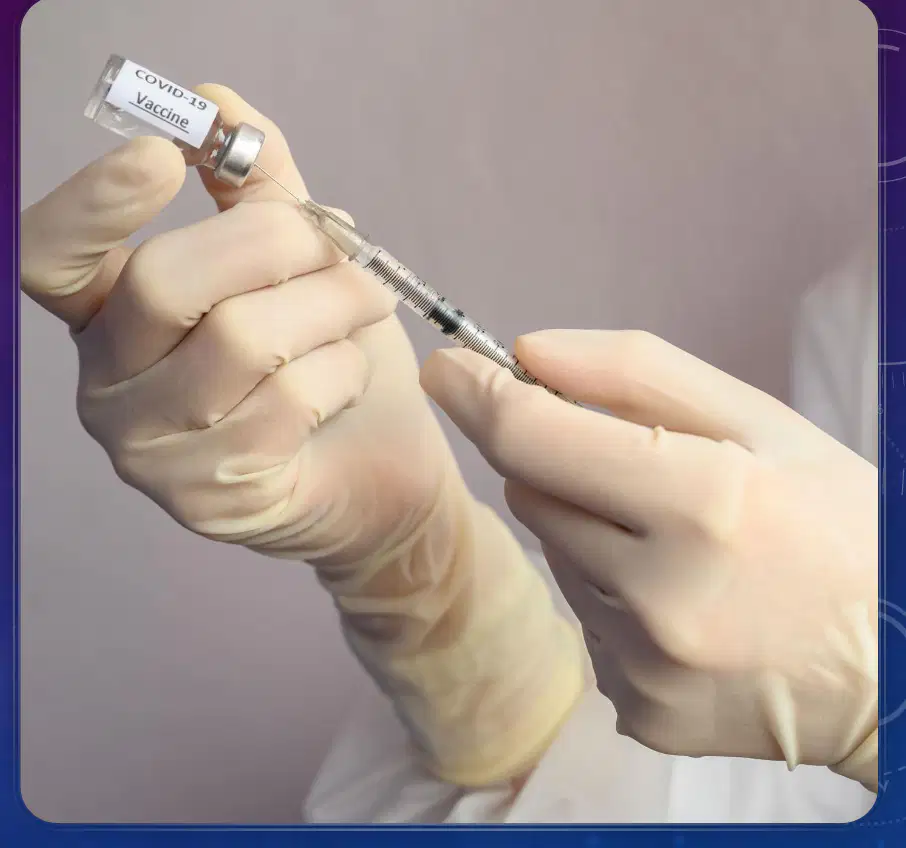
What is documentation on injection?
Documentation on injection refers to the process of recording details about the injection administered, such as type, site, dosage, and time.
Documentation on injection refers to the process of sterilizing injection equipment before use.
Documentation on injection refers to the method of preparing medication for injection.
Documentation on injection refers to the process of monitoring patient reactions after injection.
What is dosage calculation in the context of injections?
Dosage calculation is the process of determining the correct amount of medication to administer via injection based on patient-specific factors.
Dosage calculation is the process of selecting the injection site based on patient preference.
Dosage calculation is the process of preparing the injection equipment for use.
Dosage calculation is the process of recording the time of injection in the patient's chart.
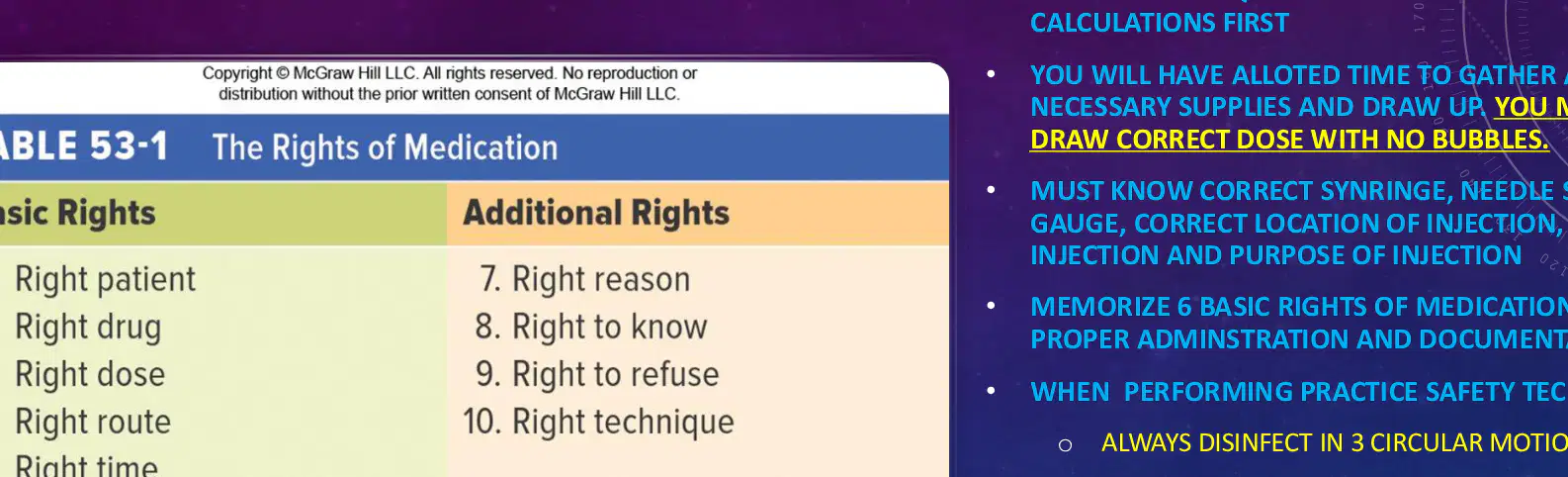
What is one of the 6 basic rights of medication for proper administration and documentation? Fill in the blank: Right ________.
patient, drug, dose, route, time, documentation
temperature, color, size, shape, smell, taste
location, equipment, lighting, sound, air, water
speed, direction, pressure, volume, frequency, density

Which of the following is NOT one of the 6 basic rights of medication?
Right patient
Right drug
Right location
Right documentation
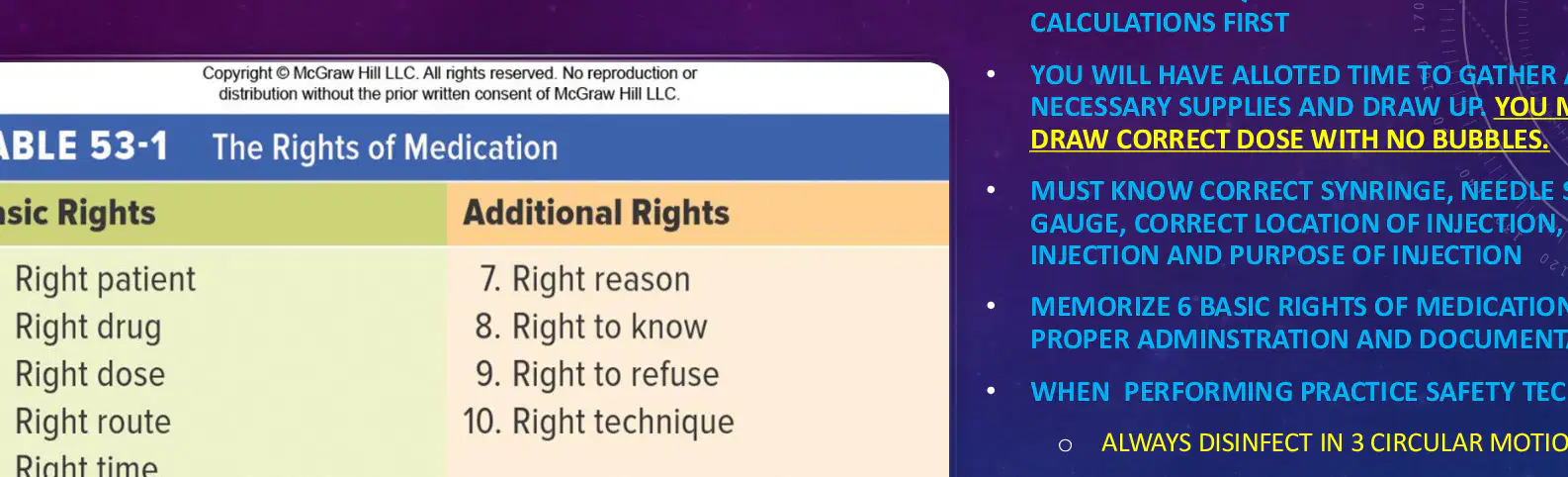
Fill in the blank: The right to refuse medication is considered an ________ right of medication.
additional
absolute
conditional
temporary
Which of the following is a safety technique to follow when performing injections?
Recap used needle
Disinfect in 3 circular motion
Switch hands when holding needle
Insert needle halfway
You must draw the correct dose with no bubbles when preparing an injection.
True
False
Fill in the blank: You must know the correct syringe, needle size, gauge, correct location of injection, angle of injection, and ________ of injection.
purpose
color
brand
expiration date
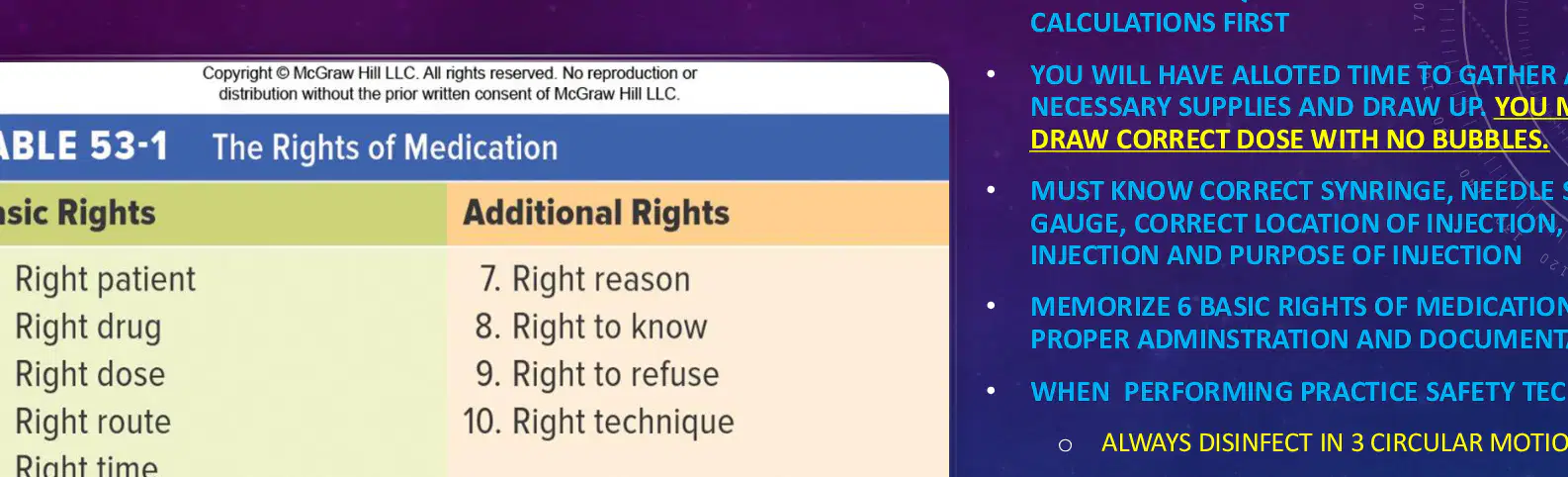
Which of the following is an additional right of medication?
Right time
Right documentation
Right reason
Right route
You should have a sharps container nearby when performing injections.
True
False
Fill in the blank: Safety lock with ________ and dispense needle immediately.
thumb
elbow
knee
chin
Which of the following is NOT a recommended practice safety technique for injections?
Do not recap used needle
Needle must be inserted all the way
Switch hands when holding needle
Always disinfect in 3 circular motion
Dr has ordered 300mg of Zantac to be taken daily. The medication we have available is Zantac 150mg. How many tablets should be given?
2 tablets
1 tablet
3 tablets
4 tablets
Order: 7,000 units IM of a medicine. The vial is labeled as 10,000 units in 2 mL. Desired = 7,000 units. Have = 10,000 units. Quantity = 2 mL. How many mL should be given?
1.4 mL
0.7 mL
2 mL
0.2 mL
What is the abbreviation for Intramuscular injection?
IM
IV
SC
ID
At what degree and location is an Intramuscular (IM) injection given?
90 degree given in deltoid or muscle
45 degree given in subcutaneous tissue
15 degree given in epidermis
30 degree given in vein
What is the correct syringe size and aspiration method for an Intramuscular (IM) injection?
3CC, Aspirate
1CC, No Aspiration
5CC, No Aspiration
10CC, Aspirate
What is the correct needle length and gauge for an Intramuscular (IM) injection?
25 gauge, 1-1 ½ inch
18 gauge, ½ inch
30 gauge, ⅝ inch
22 gauge, 3 inch
What is the purpose of an Intramuscular (IM) injection?
Rapid absorption
Slow absorption
To deliver medication to the skin surface
To avoid absorption
What is the abbreviation for Subcutaneous injection?
SQ
IM
IV
ID
At what degree and location is a Subcutaneous (SQ) injection given?
45 degree given in back of arm the fatty area
90 degree given in the deltoid muscle
15 degree given in the forearm
10 degree given in the gluteal muscle
What is the correct syringe size and aspiration method for a Subcutaneous (SQ) injection?
3CC, Aspirate
1CC, Do not aspirate
5CC, Aspirate
10CC, Do not aspirate
What is the correct needle length and gauge for a Subcutaneous (SQ) injection?
25 gauge, 5/8 inch
18 gauge, 1 1/2 inch
22 gauge, 1 inch
27 gauge, 1/2 inch
What is the purpose of a Subcutaneous (SQ) injection?
Slow absorption
Immediate effect
Intravenous delivery
Topical application
What is the abbreviation for Intradermal injection?
ID
IM
IV
SC
At what degree and location is an Intradermal (ID) injection given?
10-15 degree given in forearm
45 degree given in gluteal region
90 degree given in deltoid muscle
25 degree given in abdomen
What is the correct syringe size and aspiration method for an Intradermal (ID) injection?
1CC, No Aspiration
3CC, With Aspiration
5CC, No Aspiration
10CC, With Aspiration
What is the correct needle length and gauge for an Intradermal (ID) injection?
27 gauge, ½ inch
22 gauge, 1 inch
25 gauge, 1½ inch
21 gauge, 2 inch
What is the purpose of an Intradermal (ID) injection?
To check reaction of allergy and TB test. Advise patient not to scratch, rub or touch it. Return to clinic in 48-72 hours for results to be read.
To administer large volumes of medication quickly into the bloodstream.
To provide long-term medication through slow absorption in the muscle.
To deliver vaccines directly into the subcutaneous tissue.
What is the abbreviation for Ventrogluteal injection?
VG
IM
IV
SC
At what degree and location is a Ventrogluteal (VG) injection given?
90 degree given in lateral thigh area
45 degree given in deltoid muscle
30 degree given in upper arm
15 degree given in abdomen
What is the correct syringe size and aspiration method for a Ventrogluteal (VG) injection?
3CC, Aspirate
1CC, No aspiration
5CC, No aspiration
10CC, Aspirate
What is the correct needle length and gauge for a Ventrogluteal (VG) injection?
25 gauge, 1 ½ inch
22 gauge, 1 inch
18 gauge, 2 inch
27 gauge, ½ inch
What is the purpose of a Ventrogluteal (VG) injection?
Rapid absorption
To administer oral medication
To measure blood pressure
To check blood sugar levels

