
 Worksheets
Immunoassays CH5 MEDL 214
Total questions: 65
Worksheet time: 34mins
In an immunoassay, an antibody molecule recognizes and binds to a(n) _______.
antigen
enzyme
hormone
vitamin
Binding in an immunoassay is related to which of the following?
Concentration of each reactant
Specificity of antibody for antigen
Affinity and avidity for pair
Environmental conditions
All of the above
Binding in an immunoassay is related to the concentration of each _______.
reactant
enzyme
substrate
antibody
Binding in an immunoassay is related to the specificity of _______ for antigen.
antibody
enzyme
substrate
hormone
Binding in an immunoassay is related to environmental _______.
conditions
colors
shapes
distances
Fill in the blank: In immune precipitation, ______ is dilute agarose dissolved in aqueous buffer.
gel
serum
antibody
precipitate
What happens in the prozone during immune precipitation in gel?
Maximal precipitation is formed
No precipitation is formed because the amount of Ag exceeds the amount of Abs supplied by the test kit, and cross-linking is decreased
The gel dissolves in water
Antibody concentration is zero
Fill in the blank: The zone of equivalence is the optimal ratio of concentration of antibody to concentration of ______ that results in maximal precipitation.
antigen
enzyme
hormone
lipid
What is the simplest and least sensitive passive method in unlabeled immunoassays?
Double diffusion
ELISA
Radioimmunoassay
Western blot
Which method in unlabeled immunoassays quantifies protein using a passive method?
Single diffusion
Enzyme-linked immunosorbent assay
Radioimmunoassay
Fluorescence polarization immunoassay
Immunoelectrophoresis is also known as:
Immunofixation electrophoresis
Double diffusion
Rocket technique
Single diffusion
What does turbidimetry measure?
Light scattered
Light transmitted
Heat produced
Color change
What does nephelometry measure?
Light transmitted
Light scattered
Heat produced
Color change
Fill in the blank: Complexes act as particles in suspension that can ______ light.
scatter
absorb
reflect
transmit
In nephelometry, most instruments measure forward light scattered at less than ______ because the sensitivity is increased.
90°
180°
120°
60°
The reagent (antigen or antibody) in labeled immunoassays is labeled by attaching a ________.
particle or molecule
liquid crystal
fiber optic cable
magnetic field
What is the main benefit of labeling in immunoassays?
It increases the cost
It improves analytic sensitivity
It reduces specificity
It makes the process slower
General Considerations: Immunoassays are used almost exclusively, with two exceptions. Which of the following is NOT an exception?
A) Estrogen and progesterone receptor assays
B) Thyroid hormone–binding ratio (thyroxine-binding globulin)
C) Blood glucose monitoring
D) Both A and B
General Considerations: Immunoassay design has many variables, leading to ________.
diverse arrays
uniform results
limited choices
predictable outcomes
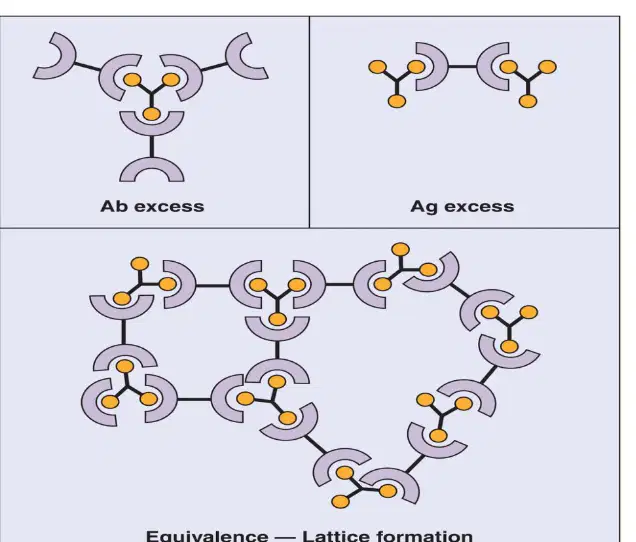
Which condition is represented by the diagram labeled 'Ab excess'?
ProZone
PostZone
Equivalence — Lattice formation
None of the above
What is the name of the condition where lattice formation occurs in immunoassays?
Equivalence — Lattice formation
Prozone — No lattice formation
Postzone — No lattice formation
Agglutination — No lattice formation
What are the most common enzyme labels used in immunoassays?
horseradish peroxidase, alkaline phosphatase, glucose-7-phosphate dehydrogenase
lipase, amylase, trypsin
DNA polymerase, RNA ligase, helicase
catalase, urease, lactase
Enzymes are biologic catalysts that increase the rate of conversion of substrate to product and are not consumed by reaction.
True
False
Enzymes can catalyze many substrate molecules.
True
False
Enzyme activity may be monitored by the amount of product or effect of product on coupled reaction.
True
False
What are fluorescent labels also known as?
Fluorochromes or fluorophores.
Chromatophores.
Photophores.
Phycobilins.
What do luminescent labels emit as a result of electrical, biochemical, or chemical reaction?
A photon of light
A magnetic field
A stream of electrons
A burst of heat
What was the first chemiluminescent label used in immunoassays?
Luminol
Horseradish peroxidase
Alkaline phosphatase
Fluorescein
Luminol is a cyclic diacylhydrazide that emits what type of energy?
Light energy
Sound energy
Thermal energy
Electrical energy
Acridinium esters are what type of organic molecule?
Triple-ringed organic molecule
Linear-chain hydrocarbon
Single-ring aromatic compound
Branched aliphatic compound
Acridinium esters are linked by what type of bond to an organic chain?
Ester bond
Amide bond
Ether bond
Ionic bond
What does a radiolabeled antigen (Ag*) compete with for binding sites in a competitive immunoassay?
Unlabeled antigen (Ag)
Radiolabeled antibody (Ab*)
Enzyme substrate
Buffer solution
In a competitive immunoassay, as the amount of Ag increases, what happens to the binding of Ag* to the antibody?
Less Ag* binds to the antibody.
More Ag* binds to the antibody.
Binding of Ag* to the antibody remains unchanged.
Ag* and Ag bind equally to the antibody.
In a one-step competitive immunoassay, which components are simultaneously incubated together?
Ag* and Ag only
Ag* and Ab only
Ag*, Ag, and reagent antibody (Ab)
Ag and Ab only
In the sequential step of a competitive immunoassay, which component is incubated with Ab first?
A) Ag
B) Ag*
C) Both Ag and Ag*
D) Ab
In a competitive immunoassay, Ag* is constant and limited.
True
False
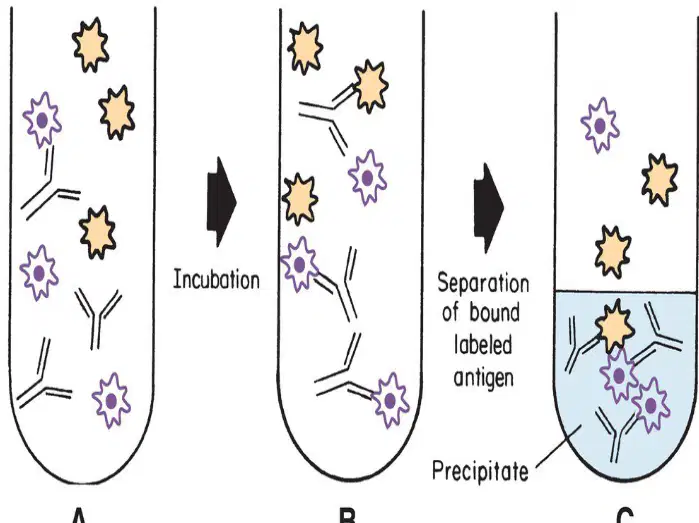
What is the main principle of a competitive labeled immunoassay?
The labeled antigen competes with the unlabeled antigen for binding to the antibody.
The labeled antibody binds only to the labeled antigen.
The labeled antigen binds to all available antibodies without competition.
The labeled antigen is not separated from the bound antigen.
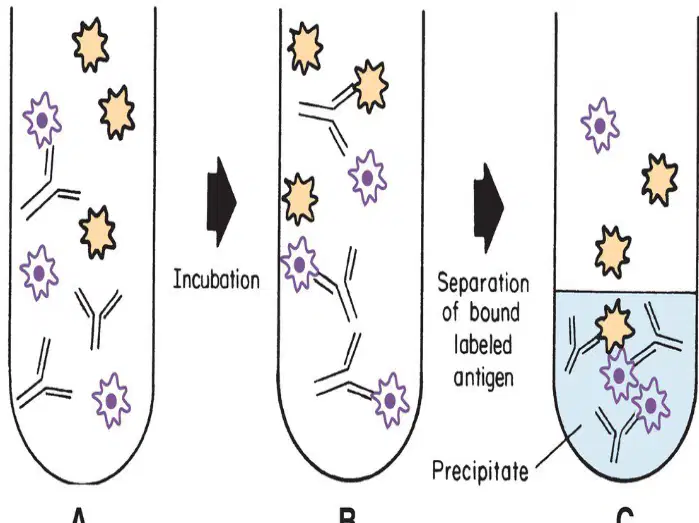
In the competitive labeled immunoassay shown in the figure , what is formed after the separation step?
Only free labeled antigen
Precipitate containing bound labeled antigen
Only free unlabeled antigen
No precipitate is formed
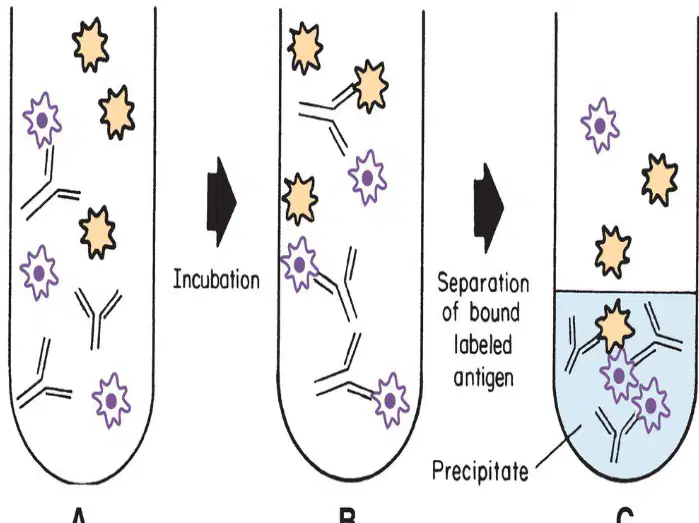
Fill in the blank: The immunoassay shown in the figure is called a __________ labeled immunoassay.
competitive
direct
sandwich
indirect
What is used to detect antigen in noncompetitive immunoassays?
Labeled reagent antibody
Unlabeled antigen
Buffer solution
Enzyme substrate
Why is excess labeled antibody required in noncompetitive immunoassays?
To ensure that labeled antibody reagent does not limit reaction.
To increase the background noise in the assay.
To reduce the sensitivity of the assay.
To prevent the binding of antigen to the antibody.
The concentration of antigen is directly proportional to what in noncompetitive immunoassays?
Bound-labeled antibody
Free-labeled antibody
Total antibody concentration
Enzyme substrate concentration
The relationship between antigen concentration and bound-labeled antibody is linear up to a limit, then is subject to what effect?
High-dose hook effect
Prozone effect
Competitive inhibition
Allosteric modulation
Precipitation occurs when the environment is altered, affecting the _______ of protein.
solubility
color
temperature
density
Solid phase in labeled immunoassays is used to immobilize reagent antibody or antigen and separate free from ________ after washing.
bound-labeled reactant
unlabeled buffer
enzyme substrate
washing solution
Which of the following is an advantage of using solid-phase separation in immunoassays?
It is more difficult to automate
It requires more manipulation and time
It is easier to perform and to automate and requires less manipulation and time
It is less accurate than other immunoassays
What is an advantage of sandwich-type immunoassays?
The production of linear calibration curves.
They require no antibodies.
They are not specific to the target analyte.
They do not require any labeling reagents.
What is a disadvantage of sandwich-type immunoassays?
These assays are subjected to false-positive and false-negative interferences.
They require no antibodies for detection.
They are only used for detecting nucleic acids.
They cannot be automated.
Heterophile Abs are formed from patients who have which type of diseases?
Autoimmune disease and other disorders.
Genetic disorders only.
Nutritional deficiencies only.
Congenital heart diseases only.
Although the principle is different, the 'hook' effect is similar to which effect?
The prozone effect.
The Bohr effect.
The Tyndall effect.
The Pasteur effect.
What does PETINIA stand for in the context of labeled immunoassays?
Particle-enhanced turbidimetric inhibition immunoassay
Protein-enhanced time-resolved immunoassay
Polymer-enzyme triggered immunoassay
Photometric enzyme-tagged immunoassay
What does ELISA stand for in the context of labeled immunoassays?
Enzyme-linked immunosorbent assays
Electrolyte-linked immunosorbent analysis
Enzyme-labeled immunospecific assay
Erythrocyte-linked immunosorbent assay
What does EMIT stand for in the context of labeled immunoassays?
Enzyme-multiplied immunoassay technique
Electro-magnetic immunoassay test
Enzyme-mediated immunoassay technology
Enhanced-molecule immunoassay tool
What does CEDIA stand for in the context of labeled immunoassays?
Cloned enzyme donor immunoassays
Competitive enzyme detection immunoassay analysis
Chemiluminescent enzyme detection immunoassay
Covalent enzyme donor immunoassay
What does MEIA stand for in the context of labeled immunoassays?
Microparticle capture enzyme immunoassay
Monoclonal enzyme immunoassay
Multiple enzyme immunoassay analysis
Micro-enzyme immunoassay
What does the abbreviation FETI stand for in labeled immunoassays?
Fluorescence excitation transfer immunoassay
Fluorescent enzyme tracer immunoassay
Fast enzyme tagging immunoassay
Formaldehyde enhanced test immunoassay
What does the abbreviation FPIA stand for in labeled immunoassays?
Fluorescence polarization immunoassay
Fluorescent protein immunoassay
Fixed phase immunoassay
Formalin precipitation immunoassay
Which of the following is NOT a characteristic of Rapid Immunoassay, POC Testing?
Easy to use
Requires complex instrumentation
Simple and fast
Site-neutral
Fill in the blank: Rapid Immunoassay, POC Testing is ______ to use, simple, fast, site-neutral, requiring no instrumentation.
easy
difficult
expensive
dangerous
Which of the following describes a change that can occur in Rapid Immunoassay, POC Testing following binding?
Changes in a physical or chemical property
Change in temperature only
Change in color only
No change occurs
When activated B cells multiply, what do they produce?
Plasma cells
Antigens
Histamines
T lymphocytes
4.) During the ELISA test, the secondary antibody was attached to an enzyme. What happens when that enzyme becomes attached to the substrate?
a.) The enzyme and the substrate reacted with the primary antibody and caused a color change.
b.) The enzyme and the substrate work worked together to destroy the antigen, resulting in a color change.
c.) The enzyme caused the substrate to change, resulting in a color change.
d.) The substrate caused the enzyme to change, resulting in a color change.
Select all the answers that are characteristics of antibodies.
This molecule is produced by white blood cells
These molecules give the body immunity
A vaccine causes the body to produce these
These are part of the pathogen
This molecule triggers an immune response

