
 Worksheets
OCE 2001 Chapter 5 Practice
Total questions: 114
Worksheet time: 2hrs 39mins
Which of the following is a property of water?
Water is a Universal Solvent
Water is nonpolar
Water is a bad insulator
Water is only found in two of three states of matter on Earth
What distinguishes chemical elements from each other?
Number of protons
Number of electrons
Number of neutrons
Number of atoms
What charge do electrons have?
Negative
Positive
Neutral
No charge
What is the charge of neutrons?
Neutral
Positive
Negative
Double positive
What causes the attraction between water molecules or other ions?
Attraction between positive and negative ends of molecules
Repulsion between like charges
Attraction between neutral ends of molecules
Which process describes the change from liquid water to water vapor?
Vaporization (evaporation/boiling)
Condensation
Freezing
Deposition
Molecular energy (a) as water changes from solid to gas.
How do the freezing and boiling points of water compare to those of similar compounds?
They are unusually high
They are unusually low
They are about the same
They are not measurable
What is the definition of heat capacity?
The amount of heat required to raise the temperature of 1 gram of any substance by 1°C.
The amount of heat required to melt 1 gram of a substance.
The amount of heat required to boil 1 liter of water.
The amount of heat required to freeze 1 gram of a substance.
Latent heat is (a) .
How many calories per gram are required for the latent heat of vaporization?
100 calories/gram
540 calories/gram
250 calories/gram
1000 calories/gram
Why does a lower temperature of surface water not at boiling point require more hydrogen bonds to break during evaporation?
Because the water is already at boiling point
Because lower temperature means more hydrogen bonds are intact
Because higher temperature means fewer hydrogen bonds
Because hydrogen bonds do not affect evaporation
Match each process with its correct description regarding heat transfer during phase changes.
Cooled water vapor turns to liquid and releases heat to the environment
Condensation
Cooled water vapor turns to ice and absorbs heat from the environment
Deposition
Liquid water turns to vapor and absorbs heat from the environment
Evaporation
Liquid water turns to ice and releases heat to the environment
Freezing

What is the primary effect of heat being carried from tropical oceans to higher latitudes, as depicted in the diagram?
It moderates Earth's climate
It increases ocean salinity
It causes earthquakes
It decreases atmospheric pressure
What is the main characteristic of the marine effect on global thermostatic effects?
Oceans moderate temperature changes from day to night and during different seasons
Land areas have greater range of temperatures from day to night
Oceans increase temperature fluctuations
Land areas have stable temperatures throughout the year

Why does ice float on water?
Ice is heavier than water
Ice has a higher density than water
Ice has a widely spaced, open lattice structure giving it low density
Ice is warmer than water
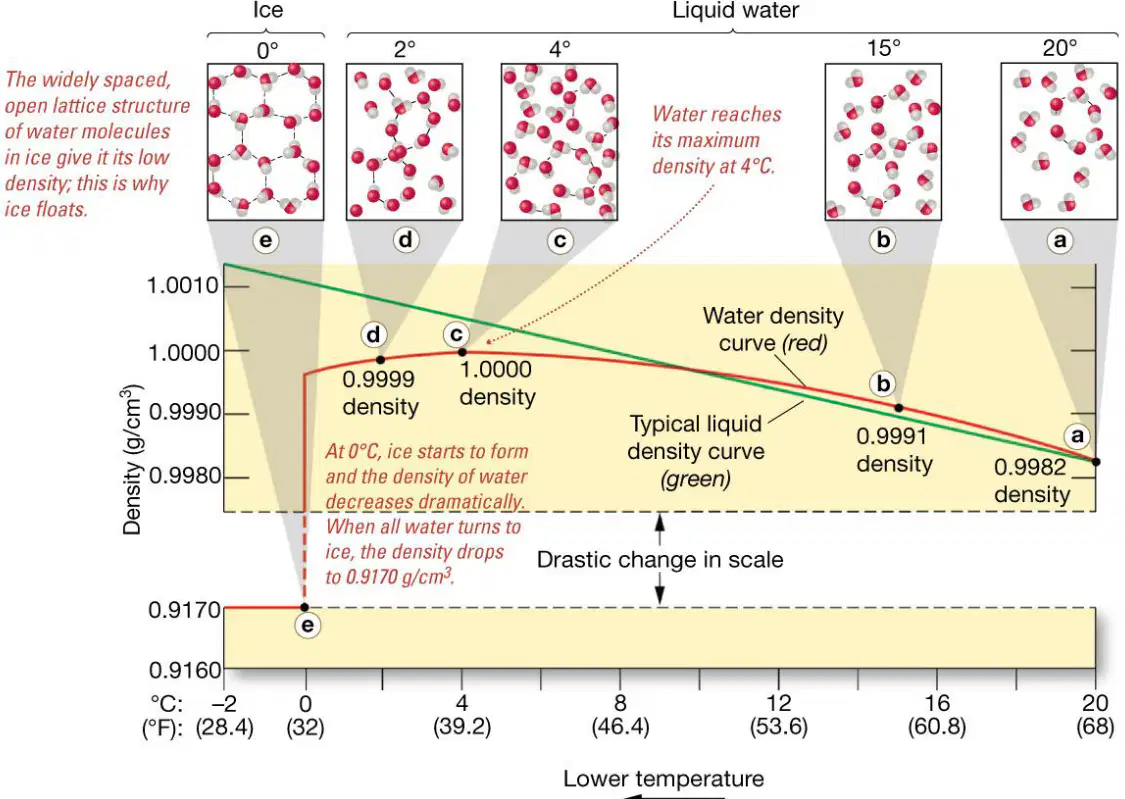
What happens to the density of water as it cools from 20°C to 4°C?
The density decreases
The density increases
The density remains constant
The density drops to zero
Why does most seawater never freeze?
Because it is always in motion.
Because it contains dissolved solids that lower its freezing point.
Because it is exposed to sunlight.
Because it is less dense than freshwater.
How is salinity commonly expressed in terms of a water sample?
Ratio of mass of dissolved substances to mass of water sample
Ratio of temperature to volume of water
Ratio of organic matter to inorganic matter
Ratio of gas to liquid in the sample

Question 6: Water Quality
Lamar is studying water quality in his science class. He learns that salt water is seeping into his neighboring town’s water supply and makes the water dangerous to drink. Lamar’s teacher challenges his class to investigate ways to identify salt water without tasting it.
Part A: Lamar has one glass of pure water and one glass of salt and water. The two liquids look exactly alike. What investigation can Lamar perform, without tasting the water, to find out which glass contains the salt water?
Lamar couldn’t do it. A chemical change has taken place.
Lamar could evaporate the water to see which cup leaves salt behind.
Lamar couldn’t do it. It is not possible to identify clear liquids without tasting them.
Lamar could shine a light into the water and check for salt conductivity.
Match each description with the correct property of water related to surface tension.
water molecules at the surface tend to stick together.
Surface tension causes this effect at the water's surface.
water spills easily.
This describes water's low viscosity, not surface tension.
water tends to be see-through.
This describes water's transparency, not surface tension.
water molecules stick to the bottom
This describes adhesion, not surface tension.
water molecule defy gravity
This describes capillary action, not surface tension.
Which of the following is a result of the high surface tension of water?
Water droplets forming spherical shapes
Water easily mixing with oil
Water freezing at higher temperatures
Water boiling at lower temperatures
What is the primary cause of water's high surface tension compared to most other liquids?
Its high boiling point
The hydrogen bonds between water molecules
Its molecular weight
The covalent bonds within water molecules
In the context of water molecules, what does the term "hydrogen bonding" specifically refer to?
The bond between two hydrogen atoms
The bond between a hydrogen atom and an oxygen atom within the same molecule
The attractive force between a hydrogen atom of one water molecule and an oxygen atom of another water molecule
The repulsive force between hydrogen atoms of adjacent water molecules
In general, substances with stronger intermolecular forces have ________ boiling points than those with weaker forces
Higher
Lower
The same
Water is liquid at room temperature, but carbon dioxide is not. Why is that?
CO2 is straight, while H2O is bent.
H2O has weaker intermolecular forces due to dipole-dipole interactions.
H2O has stronger intermolecular forces due to hydrogen bonding.
CO2 has less mass than H2O.
The amount of saltwater on the earth’s surface is vastly larger than the amount of freshwater.
True
False
A spring tide is known for having very (a) tides.
A neap tide is known for having very ___________ tides.
Extreme
High
Moderate
Low
A reef running parallel to the shore but separated from it by a channel of deep water.
fringing reef
barrier reef
atoll
archipelago

Which type of tide occurs on the side of the Earth closest to the moon?
High Tide
Low Tide
Match the following oceans with their correct description.
Pacific Ocean
The largest ocean on Earth
Atlantic Ocean
The second largest ocean, located between the Americas and Europe/Africa
Indian Ocean
The third largest ocean, located mainly between Africa, Asia, and Australia
Arctic Ocean
The smallest and shallowest of the world's oceans, located around the North Pole
Which of the following is the major constituent of seawater?
Calcium carbonate
Sodium chloride
Potassium nitrate
Magnesium sulfate
How do ocean currents influence the climate of coastal regions?
They make coastal regions colder by bringing cold water from the poles.
They can moderate temperatures by bringing warm water from the equator.
They have no effect on coastal climates.
They only affect the climate of inland areas.
What is the conceptual definition of density?
mass divided by volume
the amount of mass in a specific space
the force exerted on the mass of a body by gravity
the amount of matter in a specific space
The math formula to calculate density is
D = M x V
D = M / V
D = V / M
D = M - V
The label for mass is
grams (g)
milliliters (mL)
ounces (oz)
grams per milliliter (g / mL)
The label for volume of a liquid
centimeters (cm)
millimeters (mm)
milliliters (mL)
grams (g)
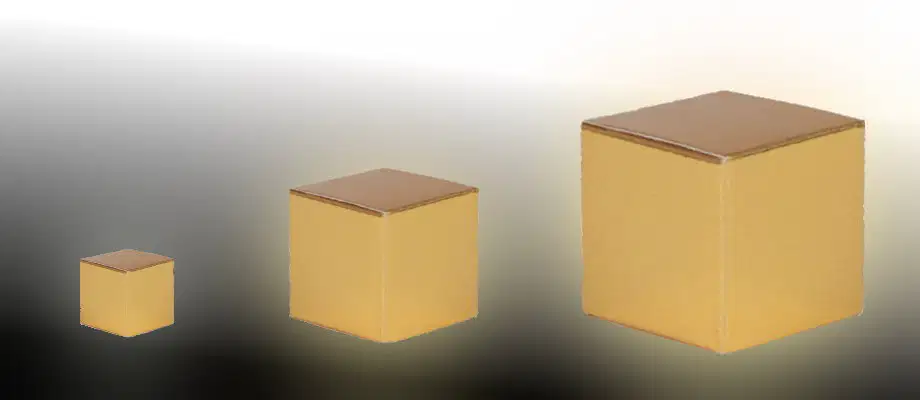
These 3 solid cubes were all made from the same type of wood. Which statement is true about the cubes?
density is different
volume is the same
density is the same
mass is the same

You have a 25g sample of aluminum. What is it's density if you were to cut it in half?
Density does not depend on size. It stays the same.
Density does depend on size. It would decrease.
Density does depend on size. It would increase.

(a) has a higher density.
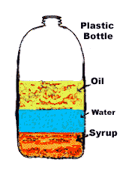
Ice floats on water because it is (a) than water.
Match the following salinity levels with their descriptions.
35 parts per thousand (ppt) or 35‰.
Average salinity of ocean water.
30 parts per thousand (ppt) or 30‰.
Salinity of brackish water.
40 parts per thousand (ppt) or 40‰.
Salinity of the Dead Sea.
25 parts per thousand (ppt) or 25‰.
Salinity of freshwater.
What is chemical equilibrium in the context of ocean water?
A state where the chemical composition of ocean water remains constant over time.
A point where ocean water becomes acidic.
A condition where ocean water evaporates completely.
A situation where ocean water freezes.
List the sources of ions in the ocean.
River runoff, Volcanic eruptions, Hydrothermal vents, Atmospheric deposition (dust and gases).
Photosynthesis, Respiration, Decomposition, Evaporation.
Sedimentation, Erosion, Precipitation, Condensation.
Tidal forces, Ocean currents, Wind patterns, Solar radiation.
Match the factors with their contribution to ocean layer formation.
Temperature, Salinity, Density.
Factors affecting water stratification.
Wind patterns, Moon phases, Tides.
Factors influencing ocean currents.
Marine life, Coral reefs, Algae.
Factors related to ocean biodiversity.
Sunlight, Moonlight, Starlight.
Factors affecting ocean illumination.
The pH of the ocean is (a)
The salinity is low at the Equator because (a)
Salinity is high at the Tropics because:
there is more evaporation than precipitation.
there is more precipitation than evaporation.
there are more rivers flowing into the sea.
there is less sunlight.
Match the following water types with their densities from least to most dense.
Ice, Warm fresh water, Cold fresh water, Cold salt water
Rank: 1. Ice, 2. Warm fresh water, 3. Cold fresh water, 4. Cold salt water
Warm fresh water, Ice, Cold fresh water, Cold salt water
Rank: 1. Warm fresh water, 2. Ice, 3. Cold fresh water, 4. Cold salt water
Cold salt water, Cold fresh water, Warm fresh water, Ice
Rank: 1. Cold salt water, 2. Cold fresh water, 3. Warm fresh water, 4. Ice
Cold fresh water, Cold salt water, Warm fresh water, Ice
Rank: 1. Cold fresh water, 2. Cold salt water, 3. Warm fresh water, 4. Ice
A liquid has a volume of 100 mL and a mass of 80 grams. What is its density?
0.8 g/mL
1.25 g/mL
0.5 g/mL
1.0 g/mL

The density of ocean water is affected by temperature and (a) .
What is the primary reason for the variation in salinity levels in different parts of the ocean?
Wind patterns
Temperature differences
Evaporation and precipitation rates
Ocean currents
Which of the following factors does NOT significantly affect the density of seawater?
Salinity
Temperature
Color
Pressure
What is the primary reason the ocean is becoming more acidic?
Burning of fossil fuels releasing more CO2
Oil spills from offshore drilling and transport
CO2 seepage from deep seafloor vents
Runoff from chemical plants in coastal areas
Ocean acidification is related to...
climate change
human impact
fossil fuels
all of the above
What do we call the amount of dissolved salts in a sample of ocean water?
salt
salty water
salinity
calcium
Select two reasons as to why salinity can INCREASE
Evaporation because water is changing into water vapor leaving salt behind.
Freshwater is added to ocean at the mouths of large rivers as they empty freshwater into oceans.
Freshwater is added by rain, snow, and melting ice.
Surface water freezes into ice, leaving salt behind.

A map of a body of water showing depth is called a (a) .
What is the average salinity of ocean water?
25 parts per thousand
35 parts per thousand
45 parts per thousand
55 parts per thousand

A salinometer is used to measure (a) .
What is the main reason why coastal areas generally have milder climates than inland areas?
Oceans are at a higher elevation
Oceans reflect more sunlight than land
Oceans have less salt than land
Oceans absorb and release heat more slowly than land
What is ocean acidification?
The process of lowering the pH of the oceans
The process of lowering the salinity of the oceans
The process of increasing the pH of the oceans
The process of increasing the salinity of the oceans
Why are atmospheric CO2 levels increasing?
Due to increased burning of fossil fuels
Due to decreased deforestation
Due to increased deforestation
Due to decreased burning of fossil fuels
Describe how the addition of carbon dioxide can lower the pH of sea water.
It forms carbonic acid which releases hydroxide ions, raising the pH
It forms sulfuric acid which releases hydrogen ions, lowering the pH
It forms sulfuric acid which releases hydroxide ions, raising the pH
It forms carbonic acid which releases hydrogen ions, lowering the pH
Describe one way that a drop in pH can harm marine life in the oceans.
It can increase the growth of marine organisms
It can break down the calcium carbonate exoskeleton of many marine creatures
It can decrease the growth of marine organisms
It can enhance the formation of calcium carbonate exoskeletons in marine creatures
What is the relationship between the CO2 levels in the atmosphere and the pH levels in the ocean?
As CO2 levels increase, pH levels increase
As CO2 levels increase, pH levels decrease
As CO2 levels decrease, pH levels increase
As CO2 levels decrease, pH levels decrease
Describe the chemistry that explains the data in the ALOHA graph.
CO2 reacts with water to form carbonic acid which releases hydroxide ions, raising the pH
CO2 reacts with water to form carbonic acid which releases hydrogen ions, lowering the pH
CO2 reacts with water to form sulfuric acid which releases hydroxide ions, raising the pH
CO2 reacts with water to form sulfuric acid which releases hydrogen ions, lowering the pH
During what season is there a peak in CO2?
Winter
Fall
Summer
Spring
Explain the peak in CO2 during the winter season.
Increased photosynthesis and reduced fossil fuel use
Increased photosynthesis and increased fossil fuel use
Decreased photosynthesis and reduced fossil fuel use
Decreased photosynthesis and increased fossil fuel use
During what season is there the lowest level in CO2 within each year on the graph?
Winter
Summer
Spring
Fall
Explain the lowest level in CO2 during the summer season.
Increased photosynthesis and reduced fossil fuel use
Decreased photosynthesis and increased fossil fuel use
Increased photosynthesis and increased fossil fuel use
Decreased photosynthesis and reduced fossil fuel use
A(n) ______ is a substance with a pH less than 7.
Pure Water
A base is a substance...
That releases OH- ions when dissolved in water
That releases H+ ions when dissolved in water
Does not release any ions when dissolved in water
None of the above
Water has a neutral because...
it has more H+ ions than OH-
it has more OH- ions than H+
it does not produce any ions
it has an equal amount of H+ and OH- in solution

Carbon dioxide and seawater combine to form...
An example of a marine organism that needs calcium carbonate is...
a jellyfish
What happens to 1/4 of the greenhouse gases in the atmosphere?
It is released into space.
It gets absorbed by the ocean.

This image demonstrates that...
There is a direct correlation with the atmospheric CO2 and the CO2 in seawater
That pH of the ocean increases as the atmospheric CO2 increases
That there is no correlation between pH of the ocean and atmospheric CO2
As the ocean becomes more acidic, the pH of the water...
What do some marine creatures do with the carbonate ion?
use it as a food source
use it as a defense mechanism
use it to build shells and exoskeletons
use it to cool body temperatures
In a more acidic ocean, the shells of organisms do not grow as easily.
True
False
Which is the product of this reaction: CO2 + H20 -->
H2CO3
CO3
CO2
H3O+
Match the vocab term to the correct definition.
Ocean Acidification
When oceans become acidic as CO2 rises.
pH
Measure of how acidic a substance is.
Acidic
Low pH
Basic
High pH
Carbon Sink
Anything that absorbs carbon.
Match the vocabulary word to the correct definition.
Process by which carbon is cycled through living and non living things
Carbon Cycle
Marine organisms with shells
Calcifiers
Acidic water breaks down an organism´s shell
Corrosive
The process where coral expels the algae living in them, making them white.
Coral Bleaching
Carbon is taken deep into the ocean by organisms.
Biological Carbon Pump
Select the part of the pH scale that represents an acidic solution.
Select the part of the pH scale that represents an basic (alkaline) solution.
Select the part of the pH scale that represents a NEUTRAL solution.
Complete the diagram to create the 3 steps of ocean acidification.
Carbon Dioxide
Carbonic Acid
Carbonate Ion
What is the average pH of Earthś oceans?
6.9
7.0
8.1
8.2

How is ocean water becoming more acidic?
Marine calcifiers are dying, making more acid
The ocean is mixing with CO2 in the air to produce acid
The ocean is getting too hot, which makes it acidic
Humans are dumping large amount of acid in the ocean

When water mixes with CO2 in the air, this creates...
Carbonic acid
Citric acid
Lactic acid
Acetic acid

Which of the following describes why the pH of the ocean decreases in the middle depths as seen in this pH/depth profile.
There is more photosynthesis than respiration
There is more carbon dioxide present from respiration and less photosynthesis
There is less respiration and less photosynthesis
less Carbon dioxide is available so far from the surface
Which of the following best describes the role of the carbonate buffering system in ocean water?
It increases the salinity of ocean water
It removes all dissolved gases from the water
It maintains a stable pH by neutralizing acids and bases
It causes the evaporation of water
What is the main chemical reaction involved in the carbonate buffering system?
CaCO3 → Ca2+ + CO32-
CO2 + H2O ↔ H2CO3 ↔ HCO3- + H+
NaCl → Na+ + Cl-
O2 + H2 → H2O
What would most likely happen to ocean pH if the carbonate buffering system were disrupted?
The pH would remain unchanged
The ocean would freeze
The pH would become more basic
The pH would become more acidic
Label the correct subatomic particles
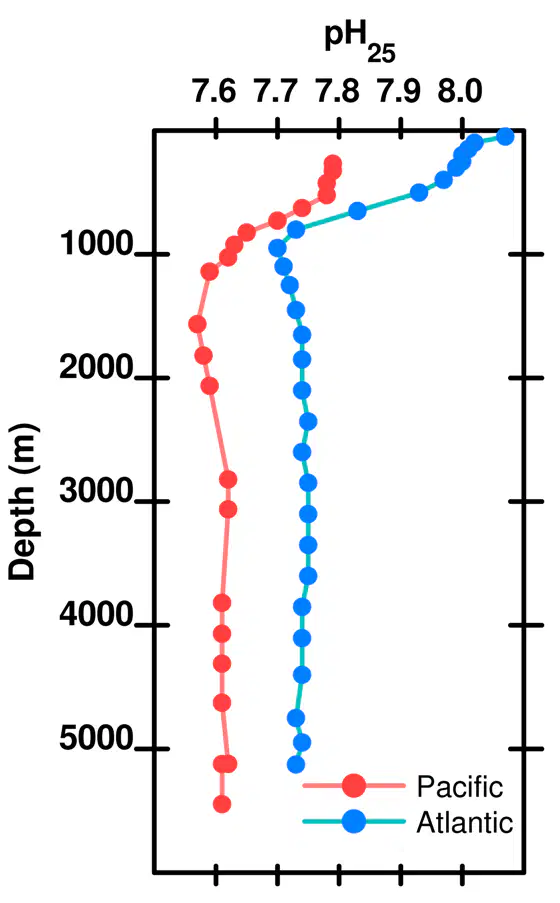
What trends does this figure show?
what is latent heat release
When water vapor is converted back to liquid, water, releases energy on the form of heat
Why does ocean water have more buoyancy than fresh water?
It contains more dissolved oxygen.
It has a lower temperature.
It has a higher density.
It contains less dissolved salts.
What is the "water column"?
A measure of ocean salinity
The vertical section of ocean water from surface to floor
A unit of pressure measurement
A type of underwater plant life
What happens to the temperature as you descend through the water column?
It increases steadily.
It decreases.
It stays the same.
It fluctuates randomly.
What happens to the salinity as you descend through the water column?
It increases steadily.
It decreases.
It stays the same.
It fluctuates randomly.
Salinity
decreases with depth at (a)
Salinity
Increases with depth at (a)
The salinity of water along a depth profile was measured. Which of the following salinity results would most likely be found at the deepest point of the profile.
15ppt
38ppt
20ppt
26ppt

As oceans become deeper, the water pressure ___________________.
increases
decreases
stays the same
The principle of Constant Proportions states that ____
The relative concentrations of major ions in seawater does not change
ocean salinity varies w/ geographical location
the % of sodium varies w/ ocean depth
the % of chloride varies with geographical location
(a) Salinity = Adding fresh water to ocean
(a) Salinity = removing water from ocean
____ is the abrupt change of density with depth
thermocline
pycnocline
halo cline
___ is what separates ocean layers of different salinity
halocline
thermocline
pycnocline
____ is the abrupt change of temperature with depth
pycnocline
thermocline
halocline

