
 Worksheets
Chemistry of Carbon
Total questions: 62
Worksheet time: 39mins
The element present in all organic molecules is
Carbon
Hydrogen
Nitrogen
Oxygen
How many electrons does one atom of carbon share to complete its valence shell?
3
6
2
4
If a carbon atom has 6 electrons why is its valency is 4?
This is because the carbon atom shares its 2 electrons and bonds with another atom
This is because the carbon atom donates its 2 electrons to another atom
This is because the carbon atomhas 4 electrons in its first shell and 2 in the second shell
This is because the carbon atom has only 2 electrons in its first shell and 4 in the second shell
In an ethane (C2H6) molecule, each carbon atom is bonded to how many hydrogen atoms?
3
4
6
2
A carbon atom is most likely to form what kind of bond(s) with other atoms?
hydrogen bonds
covalent
ionic
all bond types (covalent, ionic, and hydrogen)
Which of the following statements correctly describes cis-trans isomers?
They have the same chemical properties.
They have variations in arrangement around a double bond.
They have different molecular formulas.
They have an asymmetric carbon that makes them mirror images.
What does each bond (by itself) in the carbon dioxide molecular drawing represent?
O = C = O
a pair of protons
one resonating electron
two pairs of shared electrons
a pair of shared electrons
Research indicates that ibuprofen, a drug used to relieve inflammation and pain, is a mixture of two enantiomers; that is, molecules that
differ in the location of their double bonds
have identical chemical formulas but differ in the branching of their carbon skeletons
differ in the arrangement of atoms around their double bonds
are mirror images of each other
What is the complexity and variety of organic molecules is due to?
the chemical versatility of carbon atoms
the diverse bonding patterns of nitrogen
their interaction with water
the variety of rare elements in organic molecules

How can you best describe the two molecules shown in the figure?
chain length isomers
structural isomers
cis-trans isomers
enantiomers
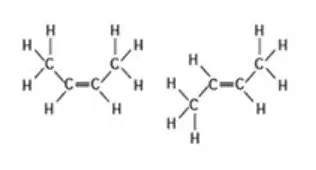
How can you best describe the two molecules shown in the figure?
chain length isomers
structural isomers
cis-trans isomers
enantiomers
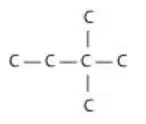
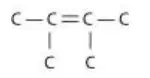
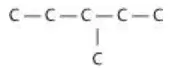
Which of the following illustrations is not a structural isomer of an organic compound with the molecular formula C6H14?
For clarity, only the carbon skeletons are shown; hydrogen atoms that would be attached to the carbons have been omitted.

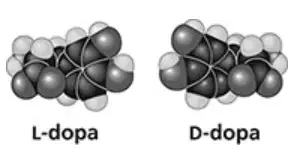
Thalidomide and L-dopa are examples of pharmaceutical drugs that occur as enantiomers. L-dopa is the effective drug used to treat Parkinson's disease. The other enantiomer, D-dopa, is biologically inactive. Which of the following correctly describes enantiomers?
have identical three-dimensional shapes allowing both to be effective in treating Parkinson's disease
are mirror images of one another, causing one to become inactive and not function properly due to incorrectly facing functional groups
are cis-trans isomers, caused by a double bond
are mirror images of one another and have the same biological activity
Amino acids are acids because they always possess which functional group?
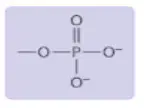
phosphate

carboxyl group
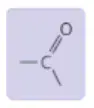
carbonyl
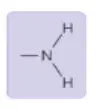
amino
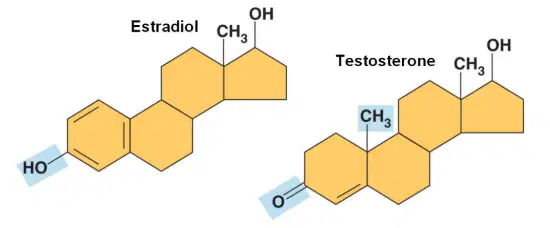
Testosterone and estradiol are male and female sex hormones, respectively, in many vertebrates. In what ways do these molecules differ from each other?
Testosterone and estradiol have different functional groups attached to the same 4-carbon skeleton
Testosterone and estradiol are enantiomers of the same organic molecule
Testosterone and estradiol are cis-trans isomers but have the same molecular formula
Testosterone and estradiol are structural isomers but have the same molecular formula
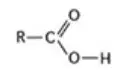
What is the name of the functional group shown in the figure?
carboxyl
carbonyl
ketone
aldehyde
Which molecule shown contains a carboxyl group?
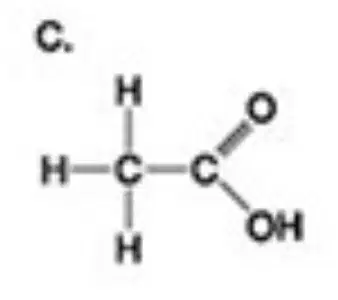
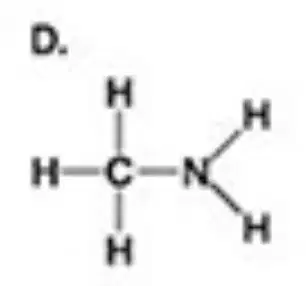
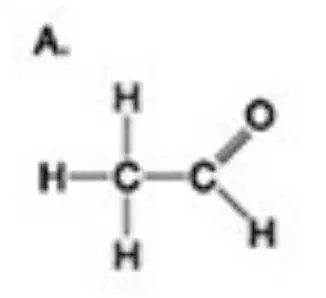
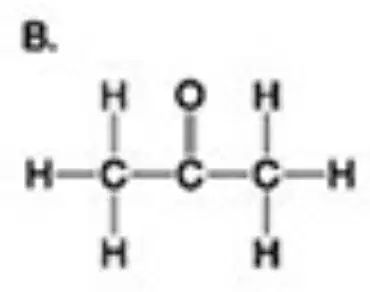
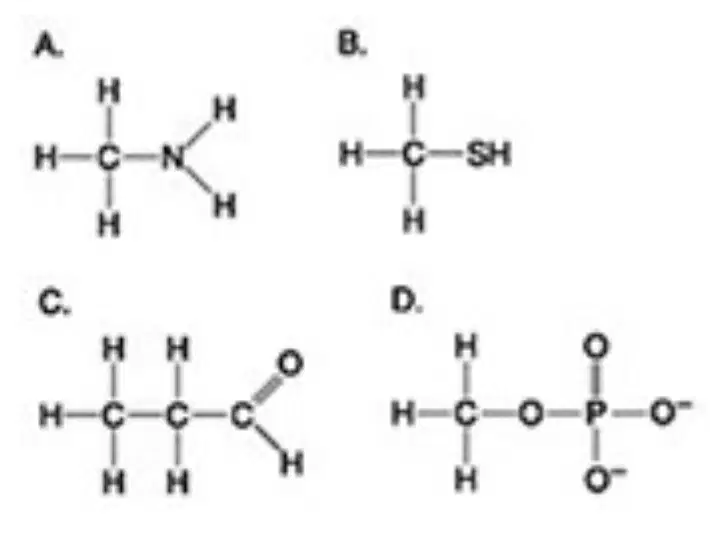
Which molecule shown is a thiol?
Image A
Image B
Image C
Image D
Which molecule shown above contains a functional group that is a part of the molecule known as the "energy currency of living organisms"?
Image A
Image B
Image C
Image D
Which of the following molecules is a part of ATP?
adenosine
cytosine
guanine
uracil
What does the kind and number of bonds an atom can form depends on?
the number of particles in its nucleus
its atomic number
its electron configuration
its atomic mass
Why is carbon so important in biology?
It is a common element on Earth.
It bonds to only a few other elements.
It can form a variety of carbon skeletons and host functional groups.
It has very little electronegativity, making it a good electron donor.
Organic chemistry is currently defined as
the study of compounds made only by living cells.
the study of carbon compounds.
the study of natural (as opposed to synthetic) compounds.
the study of hydrocarbons.
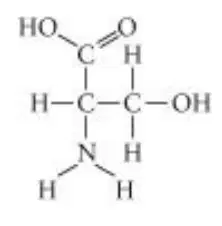
Which functional group is not present in this molecule?
amino
sulfhydryl
carboxyl
hydroxyl
Visualize the structural formula of each of the following hydrocarbons. Which hydrocarbon has a double bond in its carbon skeleton?
C2H2
C3H8
C2H4
C2H6
Which two elements do all organic compounds contain?
Carbon and hydrogen
Carbon and oxygen
Oxygen and hydrogen
Carbon and nitrogen
Organic compounds made only of the elements carbon and hydrogen are called...
Hydrocarbons
Carbohydrogens
Carbohydrates
Hydrocarbonates
Which type of bonding is present within organic molecules?
Covalent bond
Ionic bond
Metallic bond
Hydrogen bond
____________ groups are atoms, groups of atoms or bond that determine the characteristic of an organic compound.
Aliphatic
Aromatic
Functional
Hydrocarbon
What type of covalent bonds can carbon form? (check all that apply)
single
double
triple
none
What are the three basic types of structures that can form with another carbon atom? (check all that apply)
straight -chain
branched- chain
cyclic(ring)
triangular
Which structure is correctly drawn


Isomers are molecules that have the _________molecular formula (contain the same number of atoms) but ______ structurally (having different arrangement of the atoms in space).
differ, differ
same, differ
same, same
differ, same

What is the molecular formula for structure showed?
C8H18
C3H3
C8H3
C3H2(CH3)3
What is a functional group?
Atoms or group of atoms that give specific characteristics to a molecule
Group of molecules that make up a group of atoms
Group of molecules that give specific characteristics to an atom
Group of atoms that give specific characteristics to an element

What functional group is shown?
amino
hydroxyl
carboxyl
sulfhydryl

What functional group is shown?
hydroxyl
carboxyl
methyl
carbonyl

What functional group is shown?
carboxyl
carbonyl
hydroxyl
amino

What functional group is shown?
carbonyl
hydroxyl
carboxyl
amino

sulfhydryl
hydroxyl
amino
phosphate

What functional group is shown?
carboxyl
phosphate
hydroxyl
amino

What functional group is shown?
hydroxyl
amino
carboxyl
sulfhydryl
hydroxyl group


methyl group


carbonyl group


carboxyl group


amino group


phosphate group


sulfhydryl group


What is the functional group of alcohols?
–NH2
–COOH
–CHO
–OH
–NO2
The four most common elements in living things are
carbon, hydrogen, sulfur, iron
cobalt, helium, nitrogen, oxygen
carbon, hydrogen, nitrogen, oxygen
calcium, lithium, nitrogen, oxygen

glucose and fructose have the same chemical formula but different shapes. This makes them
tricky
isomers
functional groups
the same molecule
In a stereoisomer, ________ means "on the same side" and ______ means "across from."
cis; trans
cis; L
D; L
trans; cis
Which formulas represent compounds that are isomers of each other?


Given the compound:
Which structural formula represents an isomer?


This figure relate to
Enantiomers
Diastereomers


An example of a Hydrogen Bond is the bond between
the two hydrogen atoms in a molecule of hydrogen gas (H2)
Na+ and Cl- in salt
the H of one water molecule is attracted to the O of another water molecule
C and H bonded in Methane (CH4)
Which compounds contain only Carbon and Hydrogen atoms, making them extremely hydrophobic?
Sucrose
Hydrocarbons
Ethanol
Fatty Acids

