
Font size
 Worksheets
🤗HW13: 9.21
Total questions: 100
Worksheet time: 55mins

Which of the following is the best strategy to use when you are unsure of an answer on a multiple-choice test?
Skip the question and never return to it
Eliminate obviously wrong answers and make an educated guess
Always choose option C
Leave the answer blank

If you have 60 minutes to complete a 30-question test, what is the best way to manage your time?
Spend equal time on each question
Spend more time on the first 10 questions
Answer the hardest questions first
Spend all your time on the last question

When reading a multi-select question, what should you do first?
Select all the options quickly
Read the question and all options carefully before choosing
Choose the first two options
Skip the question

Which of the following is a good way to check your answers before submitting a test?
Change all your answers to different choices
Review only the questions you found easy
Review all your answers and make sure you answered every question
Submit the test without reviewing

If a question asks for the "best" answer, what should you do?
Choose the first answer that seems correct
Read all options and select the most complete and accurate one
Pick the longest answer
Choose the answer that is most similar to the question

What is the most effective way to approach a reading comprehension question on a test?
Read the questions first, then the passage
Read the passage first, then the questions
Guess the answers without reading
Only read the first and last sentences of the passage

If you encounter a math problem you do not understand, what should you do?
Skip it and never return
Try to break it into smaller parts and solve what you can
Copy the answer from a friend
Leave it blank

Which of the following is a good test-taking strategy for multi-select questions?
Select all options to increase your chances
Only select options you are sure are correct
Select options at random
Always select the first and last options

If you finish your test early, what should you do?
Submit it immediately
Use the extra time to review your answers
Leave the room
Change all your answers

When you see the word "not" in a test question, what should you do?
Ignore it
Pay special attention because it changes the meaning of the question
Always choose the first answer
Skip the question

You are given a multi-select question: "Select all prime numbers from the list below." What is the best approach?
Select every number
Use your knowledge of prime numbers to eliminate non-primes, then double-check your choices
Only select the first number
Choose numbers at random

If you notice a pattern in the answer choices (e.g., two answers are very similar), what should you do?
Ignore the pattern
Carefully compare the similar answers to find subtle differences and choose the most accurate one
Choose both similar answers
Pick the answer that is different

A question asks: "Which of the following is NOT a property of water?" How should you approach this question?
Look for the answer that is true about water
Identify all properties of water you know, then eliminate those from the options
Choose the answer you are unsure about
Select the first option

You are running out of time on a test. What is the best strategy to maximize your score?
Leave the remaining questions blank
Quickly answer all remaining questions, making educated guesses if necessary
Spend all your time on one question
Submit the test immediately

If you are unsure about the meaning of a word in a test question, what should you do?
Skip the question
Use context clues from the question or passage to infer the meaning
Guess randomly
Ask a friend

A math test question gives you a word problem. What is the best way to solve it?
Ignore the story and look for numbers to add
Read the problem carefully, identify what is being asked, and plan your solution before solving
Guess the answer
Only solve the first part of the problem

If you notice that you are spending too much time on one question, what should you do?
Continue working on it until you solve it
Move on to the next question and return if you have time
Leave the test
Guess and never return

A test question asks you to "justify your answer." What does this mean you should do?
Write any answer you want
Provide reasons or evidence to support your answer
Leave the answer blank
Only write the answer without explanation

If you are allowed to use scratch paper during a test, what is the best way to use it?
Doodle or draw pictures
Organize your thoughts, work out problems, and keep track of important information
Ignore it
Write your name repeatedly

What are examples of chemical formulas?
H2O
C12H22O11
Salad
Milk
Lemonade

Which state change is shown in BOX 1 (Hint: The arrow head points to the end state)?
Sublimation
Condensation
Melting
Freezing
Boiling

During a phase change, the temperature _____.

Which two phases changes absorb energy (heat enters)?
(a)
Freezing, Melting
Condensation, Evaporation
Freezing, Condensation

Which two phases changes take away energy (heat exits)?
(a)
Freezing, Melting
Condensation, Evaporation
Melting, Evaporation

Match each term with its definition.
Solid
Definite Shape and Definite Volume
Liquid
Indefinite Shape and Definite Volume
Gas
Indefinite Shape and Indefinite Volume
Matter
Anything with Mass and Volume
Mass
Amount of Atoms

Which of these statements is TRUE of Liquids?
Molecules are tightly packed.
Takes the shape of its container.
Constantly keeps its shape.
Molecules are spread far apart.

The slower particles of a substance moves, _____ (Select all that apply).
the colder the particles are.
the warmer the particles are.
the more energy it has.
the less energy it has.

Which statement is CORRECT about matter when the temperature increase?
Speed Up and Move Closer
Speed Up and Move Farther Apart
Slow Down and Move Farther Apart
Slow Down and Move Closer

Which of these statements is NOT Correct?
They are made of atoms and molecules.
Particles are in constant motion.
Particles are always moving in the same speed.
Particles are too small to see.

Match each state of matter with its particle arrangement.

Solid

Liquid

Gas
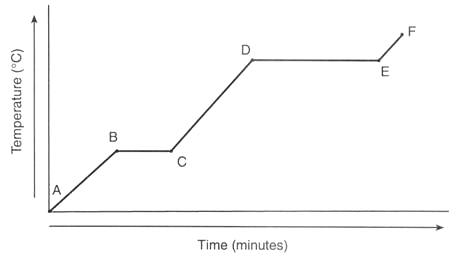
What state/phase is the object likely from points A to B?
Solid
Liquid
Gas

Where on the graph are phase changes taking place?
1
2
3
4
5

What phase of matter exists in part D of the graph?
Gas
Liquid
Solid
What phase of matter exists in part E of the graph?
Gas
Liquid
Solid
What phase of matter exists in part C of the graph?
Gas
Liquid
Solid
What term goes on the x-axis? (B)
Heat(Energy)
Temperature
Phase
Type of Matter
What phase change occurs when you start at D and end at E?
Freezing
Melting
Condensing
Evaporation
What phase change occurs when you start at D and end at C?
Freezing
Melting
Condensing
Evaporation
What phase change occurs when you start at C and end at D?
Freezing
Melting
Condensing
Evaporation

Which has more than 1 type of atom?
During a phase change, the temperature _____.

At higher temperatures, ________.

Compared to the other states of matter, the slower the particles in a substance move, _____ (Select all that apply).
the colder it is.
the warmer it is.
the more energy it has.
the less energy it has.

What does the subscript in a chemical formula tell you?
How many molecules are present
How many atoms are present
How many elements are present
How many neutrons are present

How many elements are in this chemical formula?
HCl
1
2
3
4
Labeling the Heating Curve.
Indicate the parts of this Heating Curve.
Place your Label on each numbered part.
L -> G (Boiling)
Solid
Liquid
Gas
S -> L (Melting)

Identifying the States of Matter.
Accurately select characteristics of each State of Matter.
Defintion: Definite, Definite
Definition: Indefinite, Definite
Definition: Indefinite, Indefinite
Particles: Packed Close
Movement: Vibrates
Intermolecular Force: Strongest

Temperature: Coolest
Particles: Loosely Touching
Movement: Slide Past One Another
Intermolecular Forces: Medium

Particles: Farthest apart
Movement: Zippy Bumper Cars
Intermolecular Forces: Weakest

Temperature: Warm
Temperature: Hottest
Labeling the State Change Triangle.
Indicate the parts of this State Change Triangle.
Place your Label on each numbered part.
Freezing
Sublimation
Deposition
Boiling/Evaporation
Condensation
Melting

Mg2As3COHNi2

What is the Law of Conservation of Mass?
It states that no matter can be created or destroyed.
It states that no energy can be created or destroyed.
It states that matter can be created or destroyed.
It states that no sound can be created or destroyed.

Match each term with its definition.
Solid
Definite Shape and Definite Volume
Liquid
Indefinite Shape and Definite Volume
Gas
Indefinite Shape and Indefinite Volume
Matter
Anything with Mass and Volume
Mass
Amount of Atoms

Symbols must have at least
1 cap. letter
2 cap. letters
2 lower case letters
any letter you want


Match each of these terms with its definition.
The amount of atoms in an object.
Mass
The amount of space something takes up.
Volume
The distance measured between two points.
Length
A description of matter.
Property
An action of matter.
Change

Match each of the states of matter with its definition.
Definite Shape and Definite Volume.
Solid
Indefinite Shape and Definite Volume.
Liquid
Indefinite Shape and Indefinite Volume.
Gas

What happens to the movement of the particles in a substance when the thermal energy is decreased (Select all that apply)?
Speed Up
Slow Down
They Spread Out.
They Get Closer Together.

What happens to the movement of the particles in a substance when the thermal energy is increased (Select all that apply)?
Speed Up
Slow Down
They Spread Out.
They Get Closer Together.


Match each image with its meaning.

Solid Particles

Liquid Particles

Gas Particles

Graduated Cylinder

Triple Beam Balance


The mass number of an element that has
18 protons, 18 electrons, and 19 neutrons is _____.


An atom with atomic number 6 would have how many protons?
6
12
3
cannot be determined

Classify:
Sulfur, S
metal
non-metal
metalloid

An element can be identified by its unique number of ____.
ions
electrons
protons
neutrons

Most of the elements on the Periodic Table are classified as?
metalloids
nonmetals
metals

Is Helium (He) metal, non-metal, or metalloid?
metal
non-metal
metalloid
Is Helium (He) metal, non-metal, or metalloid?
metal
non-metal
metalloid

What is the atomic number for an element with 3 protons?
2
1
3
6

In the modern periodic table, elements are arranged by:
atomic mass
atomic number
valence electrons
number of isotopes

If an atom has 10 protons, 10 neutrons, and 10 electrons, what is the mass of the atom?
10
20
30

Electrons are___________
Extremely small even in comparison to protons.
part of the nuclues.
Super Positive, like cheerleaders!
very large

An atoms overall charge is
positive
depends on its mood
neutral
negative

Isotopes are elements with a different amount of ___.


Identify the shaded region.
Metalloids

Identify the shaded region.
Metalloids

The atoms along the staircase are called ___.


The horizontal row on the periodic table is
called a ___.

The vertical (up and down) columns in the Periodic Table are called ___.
groups
towers
periods
atomic numbers

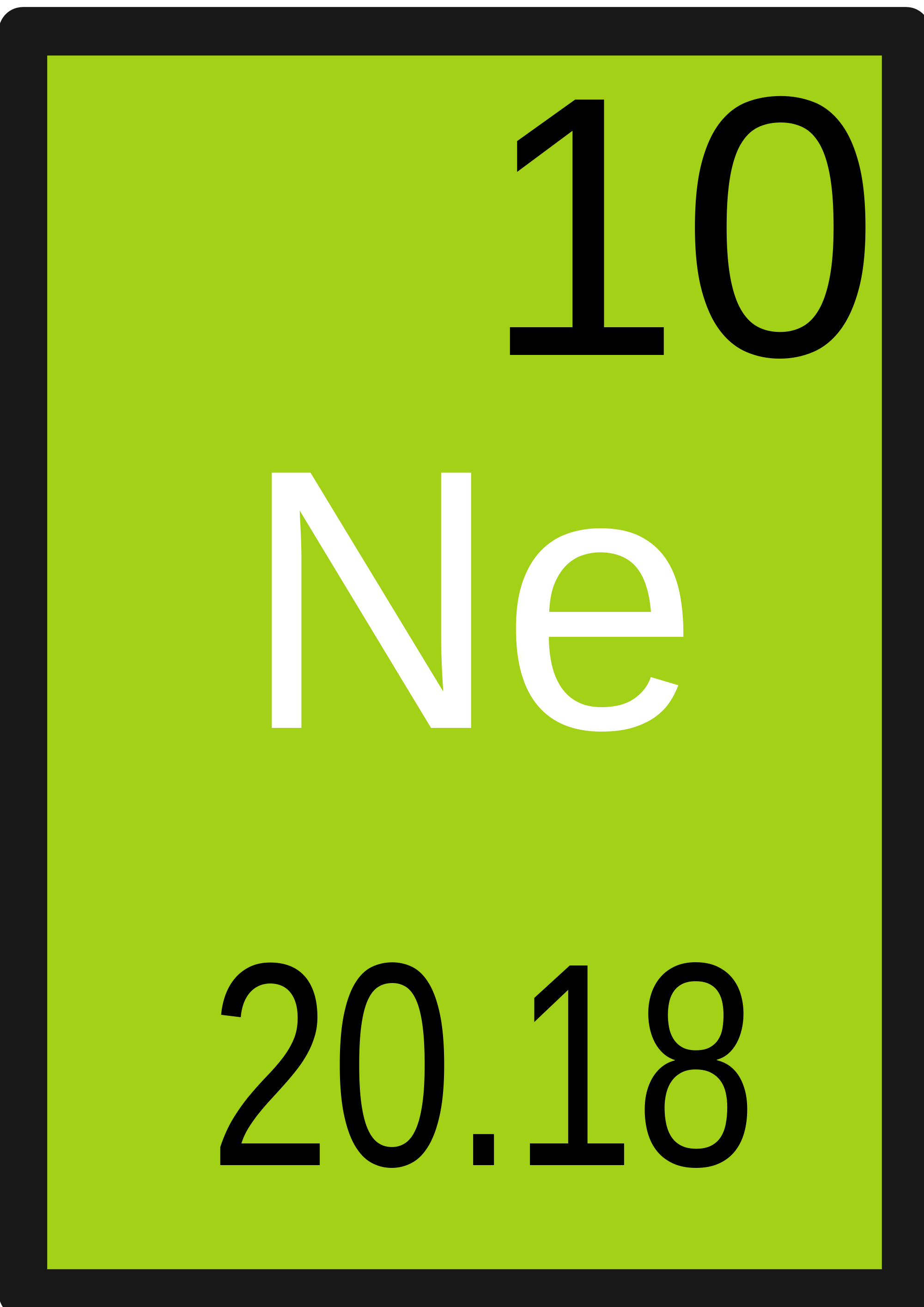
What is the mass number of Neon?
10
20.18
10.18
30.18

Describe an Electron Cloud.
the mist outside of an atom
home of the protons
where electrons are located
nucleus

At the center of every atom lies a small, dense ______ that is positively charged.
neutron
cloud
nucleus
orbital

Mass Number + Atomic Number= Neutrons
Mass Number x Atomic Number = Neutrons
Mass Number - Atomic Number = Neutrons
Mass Number + Number of Protons = Neutron

Match the following.
Subatomic particle with +1 Charge.
Proton
Subatomic particle with -1 Charge.
Electron
Subatomic particle with 0 Charge.
Neutron
Center Region of Atom, Positively Charged.
Nucleus
Outer Region of Atom, Negatively Charged.
Electron Cloud
Match the following.
Center Region of Atom, Positively Charged.
Nucleus
Outer Region of Atom, Negatively Charged.
Electron Cloud
The Number of Protons.
Atomic Number
The amount of Nucleons.
Mass Number
Occurs with different amounts of Neutrons.
Isotope
Match the following.
Class of Element, Shiny, Ductile, Malleable, and Great Electrical Conductor.
Metal
Class of Element, Dull, Brittle and Poor Electrical Conductor.
Non-Metal
Class of Element, Properties in Between M+ and NM-, Semi-Conductors.
Metalloid
Small number in chemical formula, indicates the number of atoms present for the element it follows.
Subscript
Large number in FRONT of chemical formula, used as a multiplier for the ENTIRE compound.
Coefficient

Identify each element as Metal (M+), Non-Metal (NM-) or Metalloid (ML).
B
ML
Ca
M+
He
NM-
Identify each element as Metal (M+), Non-Metal (NM-) or Metalloid (ML).
Si
ML
H
NM-
K
M+
Identify each element as Metal (M+), Non-Metal (NM-) or Metalloid (ML).
O
NM-
Al
M+
Po
ML
Match each Element with its correct atomic number.
Ne
10
Na
11
N
7
Ti
22
F
9
Match each Element with its correct atomic number.
Rh
45
Xe
54
Mg
12
He
2
Kr
36

Determine the number of neutrons for this element. Use the mass number (round to the nearest whole number), minus the atomic number.
17
18
35.453
35

Determine the number of neutrons for this element. Use the mass number (round to the nearest whole number), minus the atomic number.
1
0
1.0079
2

Determine the number of neutrons for this element. Use the mass number (round to the nearest whole number), minus the atomic number.
136
87
223
223.020

