
 Worksheets
Unit 2 Test Review
Total questions: 81
Worksheet time: 3hrs 31mins
which statement below about cells is true?
all things are composed of cells
all cells come from other cells
all cells have a cell nucleus
all cells contain organs and tissues
which statement below about cells is true?
all things are composed of cells
all cells come from other cells
all cells have a cell nucleus
all cells contain organs and tissues
An organism made of only one cell is called _____ .
Eukaryotic
Mutlicellular
Monocellular
Unicellular

A nucleus is found within...
Eukaryotic cells
Prokaryotic cells
You can distinguish a prokaryote apart from a nucleus by--
The presence of a ribosome
The presence of a cell membrane
The presence of DNA
The presence of a nuclear membrane

Your cell is running out of ATP, even though you have plenty of glucose! What organelle is malfunctioning?
Mitochondria
Vacuole
Chloroplast
Cell Membrane
Harmful things that shouldn't be were entering the cell and finding their way through because this structure was breaking down
Cell Membrane
Chloroplast
Nucleus
Your cell is running out of ATP, even though you have plenty of glucose! What organelle is malfunctioning?
Mitochondria
Vacuole
Chloroplast
Cell Membrane
Harmful things that shouldn't be were entering the cell and finding their way through because this structure was breaking down
Cell Membrane
Chloroplast
Nucleus
Humans who have disorders of these organelles often feel lethargic, as though they have no energy
Mitochondria
Cell Membrane
Cytoplasm
Cell Wall
Your cell is trying to move around, but its propeller isn't working. What part of the cell isn't working properly?
Flagella
Chloroplast
Cell Membrane
Nucleus
Times are tough, and your cell needs to get some nutrients and proteins out of storage, but unfortunately nothing has been stored. Which organelle failed to act as storage?
Vacuole
Cell Membrane
Nucleus
Chloroplast
Without the direction of this main organelle, the cell would be out of control and wouldn't be able to divide.
Nucleus
Cell Membrane
Vacuole
Cytoplasm
Some bacteria damage plants by releasing enzymes that break down this protective, strong outer barrier.
Cell Wall
Nucleus
Vacuole
Mitochondria
If these organelles are absent or malfunctioning, the plant cell will be unable to produce food for itself.
Chloroplast
Cell Membrane
Cytoplasm
Vacuole
My Cell Analogy Project is done and I'm ready to move on to Cell Transport
Of course!
No, I'll have to work on an alternate assignment.
Select the organelle that creates ATP


Which TWO organelles are found ONLY IN PLANT CELLS?
nucleus
chloroplast
mitochondria
cytoplasm
cell wall
Which of the following describes homeostasis?
keeps variables exactly at the set point
organism's ability to maintain steady (stable) internal conditions
acts to keep values outside of a desired range
operates through positive feedback
Check all that apply. Which of the following are examples of an organism maintaining homeostasis?
Shivering when cold
Sweating when hot
Fever - an immune response when sick
Vomiting - releases toxins and wastes

Osmosis is the diffusion of ______________ molecules.
salt
glucose
water
protein
Osmosis is the diffusion of ______________ molecules.
salt
glucose
water
protein
When molecules are spread evenly across the cell membrane, _______________ is reached.
difference
equilibrium
solution
transportation
Passive transport is called “passive” because it occurs WITHOUT:
Energy
cause
a cell wall
a concentration gradient
Which of the following is NOT a type of passive transport?
osmosis
diffusion
endocytosis
facilitated diffusion
In passive transport, particles move from and area of ____ concentration to _____ concentration.
High to low
low to high
high to high
low to low
What type of solution causes the blood cells to swell and burst?
Hypertonic
Isotonic
Hypotonic
Not a tonic
What type of solution causes the blood cells to shrink?
Hypertonic
Isotonic
Hypotonic
Not a tonic
If a cell allows some things in but doesn’t allow other things in, this is known as:
Permeable
Picky
Impermeable
Selectively permeable


Passive Transport means
Energy is used
No energy is used
Energy is created
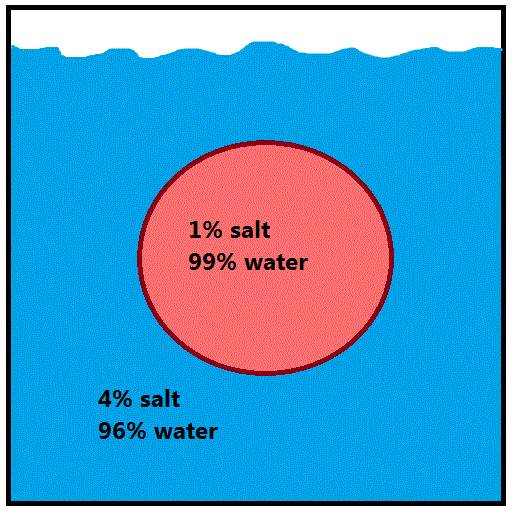

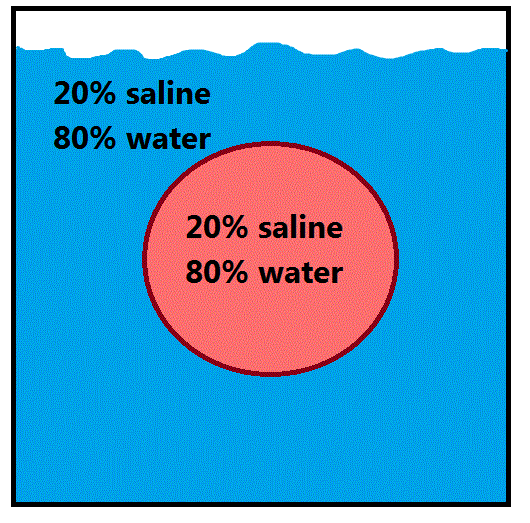


The head of phospholipids are
hypotonic
hydrophbic
hypertonic
hydrophilic
What is the plasma membrane made of?
sugars
phospholipids
nucleic acids
proteins


Active transport is movement of particles through the cell membrane from a region of ...1... to a region of ...2... using energy in the form of ...3...
1: lower concentration, 2: higher concentration, 3: NADPH
1: higher concentration, 2: lower concentration, 3: NADPH
1: higher concentration, 2: lower concentration, 3: ATP
1: lower concentration, 2: higher concentration, 3: ATP
Which one is the definition of active transport?
movement of particles through the cell membrane from a region of lower concentration to a region of higher concentration using energy in the form of ATP.
passage of water molecules from a region of their higher concentration to a region of their lower concentration through a partially permeable membrane
net movement of molecule from a region of higher concentration to region of lower concentration. Molecule down a concentration gradient
net movement of molecule from a region of lower concentration to region of higher concentration. Molecule down a concentration gradient


Which is an accurate description of the diagram below?
Na+ and Amino Acids are both transporting passively.
Na+ and Amino Acids are both transporting actively.
Na+ is diffusing passively, and Amino Acids are transporting actively.
Na+ is transporting actively, and Amino Acids are diffusing passively.

What might happen if a cell did not have any ATP/energy?
It would not have enough energy to do active transport
It's cell membrane would break
The transport proteins would not be needed.
Special transport proteins in the cell membrane carry out active transport. How are molecules transported through the protein pumps?
The molecules are sucked in automatically through the transport proteins.
The transport proteins change shape to push the molecules through the membrane of the cell.
The protein pumps have characteristics which attract molecules from the outside of the cell.
They just naturally occur without any efforts.

