
 Worksheets
digi mar chap 4 - part 1
Total questions: 99
Worksheet time: 50mins
What is the first step in developing an integrated digital marketing strategy according to the chapter?
Goal and objective setting
Strategy formulation
Situation analysis
Organisational issues of strategy implementation
Which of the following is considered an internal influence on digital marketing strategy?
Market structure and demand
Competitor strategies
Business objectives and strategy
Emerging opportunities and threats
What is a key external influence on digital marketing strategy mentioned in the chapter?
Business objectives
Multichannel marketing strategy
Personalisation and messaging
Competitor strategies
What is the primary aim of a digital marketing strategy in most modern organizations?
To reduce marketing costs
To align with marketing strategies for business growth
To eliminate traditional marketing channels
To focus solely on digital devices
Which framework is recommended for summarizing business models in digital strategy development?
SWOT Analysis
PESTLE Analysis
Business Model Canvas
Porter's Five Forces
What should a digital marketing strategy define for existing businesses?
General marketing objectives
Channel-specific objectives
Only traditional marketing methods
Sole focus on social media
What is one of the skills recommended for developing digital strategy?
Understanding traditional advertising methods
Understanding digital revenue and business model trends
Mastering print media techniques
Learning only about social media platforms
What is the primary focus of an omnichannel strategy?
To use only digital channels for marketing
To provide a seamless, integrated customer experience across all channels
To focus solely on traditional marketing methods
To reduce the number of customer touchpoints
Which of the following is a key area of focus for digital marketers according to the text?
Reducing the use of AI in marketing
Limiting customer interactions to in-store visits
Using marketing automation and AI tools for customer relationship development
Avoiding social media marketing
What role do digital channels play in a multichannel marketing strategy?
They are used to replace traditional channels entirely
They help companies stand out from the competition with relevant target audiences
They are only used for branding purposes
They are not significant in a multichannel strategy
What is meant by 'customer touchpoints' in the context of digital marketing?
Points where customers can physically touch products
Channels through which companies interact directly with prospects and customers
Locations where customers can pick up online orders
Only face-to-face interactions with customers
What is the primary focus of a new customer proposition in digital marketing strategy?
Enhancing digital capability to attract new customers
Innovative digital experiences related to new products or services
Investments to improve existing customer offers
Broader application of content marketing
Which digital marketing strategy initiative involves using content and inbound marketing to attract new customers?
Customer conversion initiatives
New business and revenue model
Customer acquisition
Social media and content marketing
What is the goal of customer conversion and customer experience initiatives?
To increase revenue through new sales channels
To enhance digital capability for new customers
To add functionality and increase conversion rates
To use celebrities as influencers
Which company used Big Data AI analysis to predict customer financial needs?
JD Wetherspoon
Volkswagen
ING
Abbott
What is the focus of social media and content marketing in digital strategy?
Enhancing digital capability for new customers
Improving the experience for existing customers
Broader application for acquisition, conversion, and retention
Adding functionality to increase conversion rates
What is a key reason for having a defined digital marketing strategy according to the text?
To reduce the cost of digital tools
To avoid wastage of resources and missed opportunities
To increase offline marketing efforts
To eliminate the need for marketing specialists
According to the research by Smart Insights (2021), what percentage of businesses have no digital marketing strategy?
12%
27%
48%
40%
What is one example of an enhanced marketing capability through site infrastructure improvements?
Process change
CRM or personalisation
Skills development
Team structure
Why might businesses be at a competitive disadvantage without a digital marketing strategy?
They may overspend on traditional marketing
They may not effectively use digital media and technology
They may focus too much on product development
They may rely solely on word-of-mouth marketing
What is a suggested approach for businesses with a digital strategy?
Integrate it with the marketing strategy
Keep it separate from all other strategies
Focus only on offline marketing
Avoid using digital tools
What does the term 'post-digital' refer to in the context of marketing?
A world where digital marketing is no longer relevant
A world where digital marketing activities are simply part of marketing
A world where traditional marketing is obsolete
A world where digital marketing is the only form of marketing
According to Paul Daugherty, what is the role of digital in the post-digital world?
It is the primary source of business differentiation
It is the price of admission for doing business
It is no longer necessary for business success
It is the only way to reach customers
What does Keith Weed suggest about digital marketing?
It is no longer needed in the modern world
It is still a separate entity from traditional marketing
We are marketing in a digital world, not doing digital marketing
It is the only way to achieve competitive advantage
What is the focus of digital technology use according to the text?
To replace traditional marketing completely
To achieve competitive advantage
To make marketing more complex
To eliminate the need for marketing strategies
What does the text suggest about digital channels?
They are only useful for large businesses
They offer opportunities for competitive advantage
They are becoming obsolete
They are less effective than traditional channels
What was the main issue with the organisation's initial approach to digital marketing?
Too many cooks in the kitchen
Lack of digital tools
Over-reliance on external consultants
Insufficient budget
What solution was proposed to improve the organisation's digital marketing efforts?
Increase the marketing budget
Create a digital marketing centre of excellence
Hire more external consultants
Focus on traditional marketing methods
Which of the following is a challenge in managing digital marketing?
Gaining buy-in and budget
Reducing the number of marketing channels
Eliminating digital marketing roles
Avoiding digital transformation
What is a feature of digital transformation programmes mentioned in the text?
Reducing investment in digital media
Gaining agreement of long-term digital marketing strategy
Eliminating the need for traditional marketing
Focusing solely on IT improvements
What does 'time to market' refer to in the context of digital marketing challenges?
The duration of a marketing campaign
The time taken to implement new functionality on a site
The speed of customer feedback
The time spent on market research
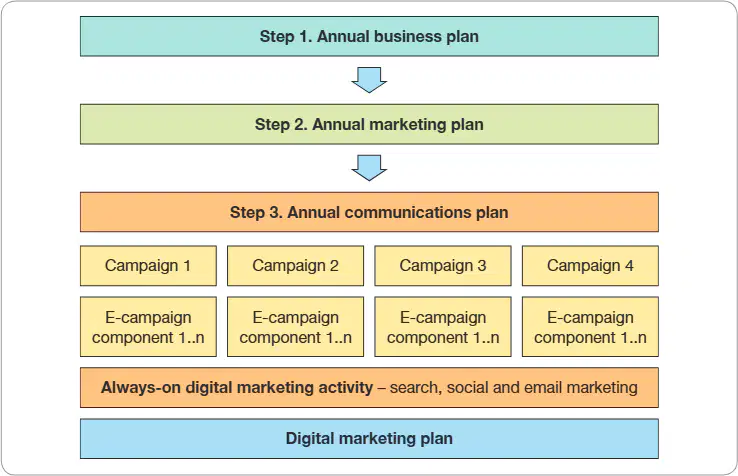
What is the first step in the hierarchy of organization plans including digital marketing plans?
Annual communications plan
Annual marketing plan
Annual business plan
Digital marketing plan
Which of the following is a potential solution for underestimated customer demand for online services?
Improve internal communications
Research demand, set objectives, allocate sufficient resources
Ensure budget and specific specialist digital skills
Measure and analyze regularly
What is a potential failure in digital marketing planning related to insufficient resources and capabilities?
Intense competition from existing and new market entrants
Underestimated customer demand for online services
Lack of control
Insufficient resources and capabilities
How can duplication of resources in digital marketing be addressed?
Research demand, set objectives, allocate sufficient resources
Improve internal communications
Ensure support for a long-term digital transformation plan
Measure and analyze regularly
What is one of the benefits of adopting a dedicated digital marketing strategy?
Increased complexity in business operations
Encouragement of digital disruption
Significant impact on brand exposure and revenues
Decreased need for new technologies
According to Michael Porter, what is the first principle for sustaining a distinctive strategic position?
Establish continuity
Define a value proposition
Start with the right goal
Create a distinctive value chain
What does a strategy process model provide in the context of digital marketing?
A list of potential competitors
A framework for approaching strategy development
A detailed financial plan
A guide to reducing marketing costs
Which principle involves tailoring a firm's activities to outperform rivals?
Establish continuity
Create a fit between company resources
Be prepared to make trade-offs
Define a value proposition
What question does Porter recommend companies ask due to increased competition and connectivity?
What is our marketing budget?
What business am I in?
Who are our main competitors?
How can we reduce costs?
What are the four areas a strategic digital marketing plan should emphasize according to McDonald (2003)?
Competitive forces, value propositions, integrated communications, governance changes
Product development, market research, customer feedback, sales strategies
Financial planning, human resources, supply chain management, risk assessment
Branding, advertising, public relations, customer service
What is the purpose of having a long-term roadmap in digital transformation activities?
To ensure immediate results and quick profits
To guide activities over 18 months to three years due to changes in structure, skills, and technology
To focus solely on short-term marketing campaigns
To eliminate the need for strategic planning
What does the 'Situation analysis' stage in the SOSTAC® planning framework involve?
Developing new products and services
Performing a digital marketplace SWOT analysis and reviewing the micro-environment
Creating financial forecasts and budgets
Designing marketing materials and advertisements
What does the 'Objectives' stage in the SOSTAC® planning framework focus on?
Setting up a new business model
Determining where the organization wants to be, including digital channels and numerical objectives
Analyzing past performance and failures
Developing a new product line
What is the purpose of digital analytics in the control phase of a marketing strategy?
To create new marketing channels
To assess whether strategic and tactical objectives are achieved
To develop new products
To increase social media followers
What is a key characteristic of a prescriptive strategy in digital marketing?
It is a top-down approach
It is a rigid and inflexible plan
It is a more agile approach to strategy planning
It focuses solely on traditional media
What is an emergent strategy approach in digital marketing?
A fixed annual plan with no adjustments
A more agile approach interrelating strategic analysis, development, and implementation
A strategy focusing only on long-term goals
A strategy that ignores marketplace dynamics
Which of the following is NOT a step involved in strategy development according to the text?
Situation analysis
Goal and objective setting
Strategy formulation
Financial auditing
What does a situation analysis in classic marketing planning involve?
Only external factors review
Only internal factors review
Review of both internal and external factors
Ignoring competitive environment
What is included in the internal audits of digital marketing?
Only offline sales analysis
Only customer service review
Review of current contribution of digital marketing activities
Ignoring web analytics
What is the definition of "unique visitors" according to Chaffey and Smith (2017)?
The total number of sessions or visits to the website
The number of separate, individual visitors to the site
The average length of time visitors spend on the site
The percentage of subscribers lapsing or unsubscribing
Which of the following is a key performance indicator (KPI) for reviewing an online presence?
Number of employees in the marketing team
Total number of social media posts
Conversion rates
Office location
What is the purpose of the digital marketing capability analysis developed by Dave Chaffey?
To create new social media platforms
To assess internal digital marketing capabilities in large organizations
To design new marketing logos
To develop new software for customer management
What is the purpose of conducting a situation analysis for an e-commerce business?
To increase product prices
To avoid digital strategy failures
To reduce employee turnover
To expand physical store locations
According to the text, what should customer research not be restricted to?
Qualitative analysis
Quantitative demand analysis
Financial analysis
Competitive analysis
What do classification variables help marketers identify?
Product prices
Target consumers and groups
Competitor strategies
Market trends
Which type of variables are more likely to change over time according to the text?
Classification variables
Character variables
Affinity variables
Demographic variables
How does age impact online marketing according to digital platforms like Facebook and Google?
It is used to determine the type of products shown.
It is used as an identifier for targeting specific age groups.
It influences the color scheme of advertisements.
It determines the language used in marketing.
What is the impact of education and literacy on digital channel usage?
It limits access to online shopping.
It is not relevant to online marketing.
It influences how digital channels are used for shopping and studies.
It only affects social media usage.
How does employment status affect online shopping behavior?
It has no impact on online shopping.
It determines the type of products available.
It places time constraints on when individuals can shop online.
It affects the color of advertisements.
What was the original trend regarding gender and online purchases?
Females made more purchases than males.
Males made more purchases and bought higher-ticket items online.
There was no difference between genders.
Females bought higher-ticket items online.
Why is geography important in online marketing?
It affects the language used in advertisements.
It determines the color scheme of websites.
It affects the potential size of the online market through geo-targeting.
It has no impact on online marketing.
How does household size influence online purchasing decisions?
It has no impact on purchasing decisions.
It affects the number of people involved and the direction of influence.
It only affects offline purchasing.
It determines the type of products available.
What is the impact of income on online shopping behavior?
It has no impact on shopping behavior.
It negatively affects the tendency to shop online.
It influences purchasing power and access to the internet.
It only affects offline shopping.
How does mobility affect online shopping?
It has no impact on online shopping.
It encourages mobile targets to shop online.
It only affects desktop users.
It determines the type of products available.
What is the role of race and ethnicity in access to technology and economic circumstances?
It has no impact on access to technology.
It only affects offline shopping.
It affects access to technology and economic circumstances.
It determines the language used in advertisements.
What is the significance of affinity and intent profiling in online marketing?
It has no significance in online marketing.
It reduces wastage by targeting people interested in a lifestyle.
It only affects offline marketing.
It determines the color scheme of advertisements.
What is the relationship between beliefs about the internet and attitudes towards online shopping?
Beliefs shape attitudes towards online shopping.
Attitudes shape beliefs about the internet.
Beliefs have no impact on online shopping intentions.
Attitudes are unrelated to online shopping experiences.
What is affinity profiling in digital marketing?
Grouping customers based on their purchase history.
Grouping customers according to their interests.
Grouping customers by their geographic location.
Grouping customers by their age and gender.
Why is resource analysis important in digital marketing?
To determine the best social media platform.
To assess the resources needed to improve capabilities.
To create more engaging advertisements.
To identify the most popular products.
What is the primary purpose of competitor analysis in digital marketing?
To increase product prices
To review current approaches and identify areas for improvement
To reduce marketing budgets
To eliminate competition
Which of the following is NOT a component of technology infrastructure resources in digital marketing?
Website hosting
Marketing clouds
Human resources
Analytics
What is the role of a SWOT analysis in digital marketing strategy?
To create new products
To summarize external opportunities and threats
To increase advertising costs
To eliminate competitors
In the context of intermediary analysis, what should an online retailer assess?
The cost of goods sold
The impact of intermediaries on buyer behavior
The number of employees
The design of their website
What is the purpose of a SWOT analysis in digital marketing?
To identify strengths, weaknesses, opportunities, and threats
To create a financial plan
To develop a new product
To hire new employees
Which of the following is considered a strength in a digital channel-specific SWOT analysis?
Existing brand
New entrants
Channel conflicts
Brand perception
What is the role of objectives in digital marketing strategy?
To provide clear direction and commercial targets
To increase the number of employees
To reduce production costs
To expand office space
What does the term 'vision' refer to in setting goals for digital marketing?
A high-level statement of how digital marketing will contribute to the organization
A detailed financial report
A list of potential customers
A description of the company's history
What is one of the strengths listed for an organization in a digital channel-specific SWOT analysis?
Brand perception
Existing customer base
New markets
Customer choice (price)
Which strategy is used to leverage strengths to maximize opportunities in a digital marketing context?
Countermediation strategy
Differential online pricing strategy
Migrate customers to web strategy
Create own social network/customer reviews
What is an example of a threat in a digital channel-specific SWOT analysis?
Existing distribution
New services
Channel conflicts
Intermediary use
In the context of digital marketing strategy, what does the 'WO' strategy aim to achieve?
Leverage strengths to minimize threats
Counter weaknesses through exploiting opportunities
Build strengths for attacking strategy
Create new Internet-only products
What is a key objective for digital marketing according to the text?
Increasing offline sales
Enhancing customer service
Online revenue contribution
Reducing production costs
Which of the following is considered a tangible benefit of digital marketing?
Enhanced brand
Improved customer service
Online sales
Feedback from customers
What does KPI stand for in the context of digital marketing?
Key Performance Indicators
Key Product Insights
Knowledge Process Integration
Key Profit Initiatives
What is the purpose of an allowable cost-per-acquisition in digital marketing?
To increase the number of products sold
To control the cost of attracting visitors
To enhance brand image
To improve customer feedback
Which of the following is an intangible benefit of digital marketing?
Reduced time in customer service
Meeting customer expectations to have a website
Reduced printing costs
Increased sales from new markets
What does the "S" in SMART objectives stand for?
Specific
Simple
Strategic
Standard
Which of the following is a measure of traffic in digital analytics systems?
Bounce rate
Unique visits
Duration
Pages per visit
What does a high bounce rate indicate about a website's traffic?
High-quality traffic
Poor-quality traffic
Increased sales
Longer duration on site
Which measure is arguably more useful than dwell time for assessing visitor engagement?
Bounce rate
Unique visits
Pages per visit
Duration
What is the purpose of assigning a value to a goal in digital marketing?
To compare different visitor sources' contributions
To increase the number of website visitors
To reduce the cost of marketing
To improve website design
What does CPA stand for in digital marketing?
Cost Per Acquisition
Customer Performance Analysis
Channel Performance Assessment
Cost Per Advertisement
Which objective aims to achieve a 10% cost reduction in marketing communications within two years?
Cost objective
Growth objective
Retention objective
Acquisition objective
What is the target increase in online service enquiries fulfilled online by 'web self-service'?
From 85% to 90%
From 70% to 80%
From 20% to 25%
From 50% to 60%
What is the focus of efficiency in digital marketing?
Doing the right thing
Increasing conversion rates and reducing costs
Expanding market reach
Enhancing customer satisfaction
What is a leading performance indicator?
A metric that indicates past performance
A metric that suggests future performance
A measure of current profitability
A measure of customer satisfaction
Which of the following is an example of a lagging performance indicator?
Shares of searches
Repeat sales metrics
Sales volume, revenue, and profitability
Customer satisfaction ratings
What does an increase in the proportion of brand searches indicate?
A decrease in market share
An increase in market share
A decline in customer satisfaction
A fall in sales volume

