
 Worksheets
Understanding Newton's Second Law
Total questions: 93
Worksheet time: 1hrs 10mins
What is the formula for Newton's Second Law of Motion?
F=m×v
F=m×a
F=m+a
F=am
Which unit is used to measure force in the International System of Units (SI)?
Kilogram
Newton
Meter
Joule
If the net force on an object is zero, what is the acceleration of the object?
Zero
One
Equal to its mass
Infinite
What does the "m" represent in the equation F=m×a ?
Mass
Momentum
Motion
Meter
If a 2 kg object experiences a net force of 10 N, what is its acceleration?
2m/s2
5m/s2
10m/s2
20m/s2
A force of 15 N is applied to a 3 kg object. What is the acceleration of the object?
3m/s2
5m/s2
45m/s2
0.2m/s2
If the mass of an object is doubled and the net force remains the same, what happens to the acceleration?
It doubles
It is halved
It stays the same
It becomes zero
A 4 kg object accelerates at 3m/s2 . What is the net force acting on it?
7N
12N
1.33N
0.75N
A 10 N force is applied to a 5 kg object. What is the acceleration?
0.5m/s2
2m/s2
5m/s2
50m/s2
If a 6 kg object accelerates at 2m/s2 , what is the net force acting on it?
3N
8N
12N
18N
A student pushes a box with a force of 20 N, causing it to accelerate at 4m/s2 . What is the mass of the box?
5kg
8kg
16kg
80kg
A 12 kg object is acted upon by a net force of 36 N. What is its acceleration?
3m/s2
0.33m/s2
48m/s2
432m/s2
A 2 kg cart is pushed with a net force of 8 N. If the force is suddenly doubled, what will be the new acceleration?
2m/s2
4m/s2
6m/s2
8m/s2
A 5 kg object is accelerating at 3m/s2 . If the net force is increased to 30 N, what will be the new acceleration?
3m/s2
5m/s2
6m/s2
15m/s2
A 10 kg sled is pulled with a net force of 50 N. Calculate its acceleration and explain how changing the mass would affect the acceleration if the force stays the same.
5m/s2 ; Increasing mass decreases acceleration
0.2m/s2 ; Increasing mass increases acceleration
5m/s2 ; Increasing mass increases acceleration
0.2m/s2 ; Increasing mass decreases acceleration
A student observes that when she pushes two boxes of different masses with the same force, the lighter box accelerates more. Use Newton's Second Law to explain why this happens.
The lighter box has less friction.
The lighter box has less mass, so for the same force, it has greater acceleration.
The heavier box is larger in size.
The force is not enough to move the heavier box.
A 3 kg object is acted upon by two forces: 10 N to the right and 4 N to the left. What is the acceleration and in which direction?
2m/s2 to the right
2m/s2 to the left
4.67m/s2 to the right
14m/s2 to the left
A 7 kg object is accelerated at 2m/s2 by a net force. If the mass is reduced to 3.5 kg and the same force is applied, what will be the new acceleration?
1m/s2
2m/s2
4m/s2
14m/s2
A 6 kg object is pulled with a net force of 18 N. If friction adds an additional 6 N in the opposite direction, what is the new acceleration?
2m/s2
3m/s2
4m/s2
6m/s2
A 4 kg object is acted upon by a net force of 16 N. If the force is reduced by half, what will be the new acceleration? Show your reasoning.
2m/s2
4m/s2
8m/s2
16m/s2
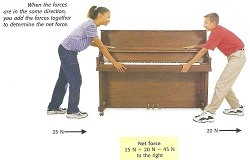
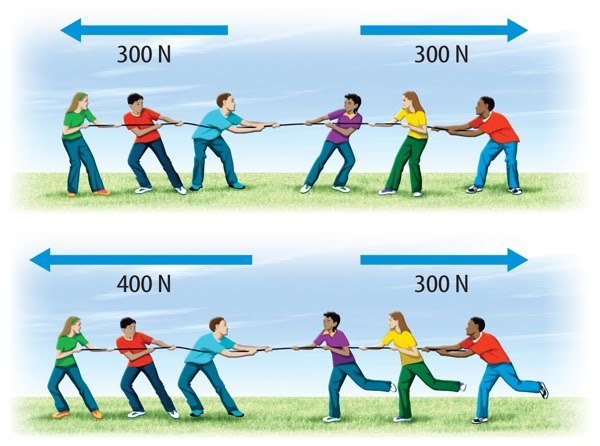
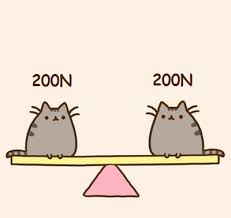
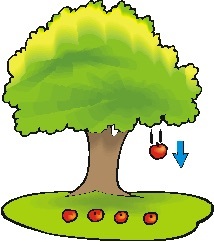
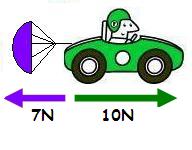


If there are two forces going in the opposite direction how would you find the net force?
Subtract
Add
Neither
Multiply

If both people are exerting a force of 30 N, what is the net force?
30 N
60 N
300 N
0 N

If the boy is pulling with a force of 10 N and the girl is pushing with a force 20 N, what is the net force on the box?
10 N
20 N
30 N
0 N
A pattern of disturbance that travels through a substance from one location to another location.
Wave
Amplitude
Wave Crest
Wave Trough
Wave Height
The distance from the wave crest or trough to the equilibrium Level
Wave
Amplitude
Wave Crest
Wave Trough
Wave Height
The highest part of a wave.
Wave
Amplitude
Wave Crest
Wave Trough
Wave Height

The lowest part of a wave.
Wave
Amplitude
Wave Crest
Wave Trough
Wave Height

The vertical distance between the wave trough and the wave crest.
Wave
Amplitude
Wave Crest
Wave Trough
Wave Height

distance between two consecutive wave crests or between two consecutive wave troughs.
Wave
Amplitude
Wave Length
Wave Trough
Wave Height

The number of waves passing a fixed point in a specified period of time
Wave Height
Wave Length
Wave Frequency
Wave Trough

The part of a wave that the particles are more pushed together.
Compression
Rarefaction
Particles
Wave

The part of a wave that the particles are pulled apart
Compression
Rarefaction
Particles
Wave

Are the small piece of matter that make up an object.
Compression
Rarefaction
Particles
Wave

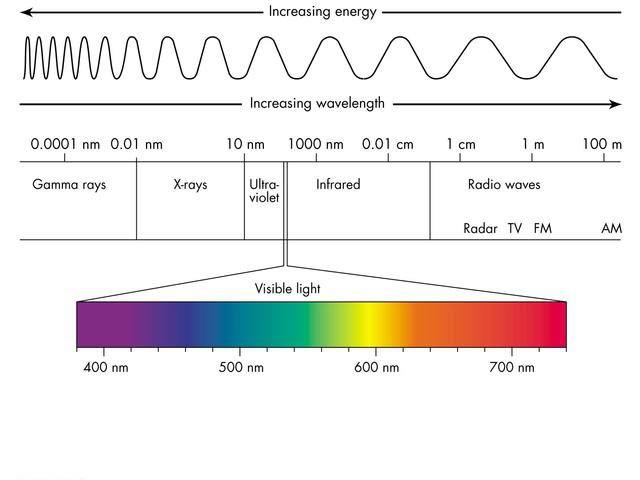
What is the correct order of the visible light spectrum starting with the longer wavelength?
Red, yellow, orange, blue, violet, indigo
Violet, indigo, blue, green, yellow, orange, red
Green, yellow, blue, indigo, red, orange
Red, orange, yellow, green, blue, indigo, violet


Which color has the longest wavelength?
Yellow
Red
Green
Purple

Quasars are extremely distant celestial bodies. Investigators using a special telescope determined that a certain quasar was emitting waves with a frequency of 1.41 x 10⁹ Hz. Using the electromagnetic spectrum provided, investigators were most likely using a telescope that detects -
microwaves
visible light
x-rays
gamma rays

Scientists observed a celestial object emitting a wavelength of 3 x 10⁻¹⁰m. What type of telescope did the scientists have to use to view this?
Radio wave
Infrared ray
X-ray
Gamma Ray
Scientists observed a celestial object emitting waves with a frequency of 1.41 x 10⁸ Hz. What type of telescope did the scientists have to use to view this object?
Radio wave
Microwave
X-ray
Ultraviolet wave
The frequency of an x-ray is --
1.41 x 10⁻¹⁰ Hz
1.41 x 10¹⁸ Hz
1.41 x 10¹⁰ Hz
1.41 x 10⁻¹⁸ Hz
The wavelength of an infrared ray is --
10-5 m
1012 Hz
105 m
10-12 Hz
Scientists observed a celestial object emitting a wavelength of 3 x 10³m. What type of telescope did the scientists have to use to view this?
Radio wave
Infrared ray
X-ray
Gamma Ray
H2O
H2SO4
Au
Ru
CF3CO2H
O2S(OH)2
As
Oxygen
NiSO4
Salt (NaCl)
H2SO4
Au
As
NiSO4
Salt (NaCl)


Element or Compound?
One capital letter
Element
Compound
Element or Compound?
C6H12O3
Element
Compound
Element or Compound?
2 or more capital letters
Element
Compound
How many elements?
He3
1
2
3
4
How many elements?
Cl2
1
2
3
4
How many elements?
BrO6
1
2
3
4
How many elements?
NaCl
1
2
3
4
How many elements?
SLi3BaO2
1
2
3
4
What is the difference between CO and Co?
They are the same.
CO is an element and Co is a compound.
CO is a compound and Co is an element.
All of the following are elements EXCEPT:
carbon
nitrogen
oxygen
water
Carbon (C) is considered an element while Carbon Dioxide (CO2) is considered a compound. That is because Carbon Dioxide is -
a gas
made of two elements
given off by plants
useful to us
How many atoms are there TOTAL in:
H2SO4
6
5
7
3
How many Carbon atoms are in this compound?
H2C3O4N5
2
3
4
5
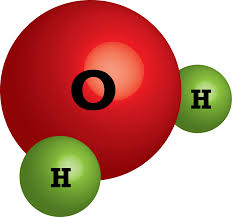
How many atoms of Hydrogen are in this compound
1
2
3
4

