
Font size
 Worksheets
Morphological Image Processing
Total questions: 65
Worksheet time: 1hrs 5mins
Fill in the blank: The element used to probe and interact with an image in morphological operations is called the _________.
Structuring Element
Kernel Matrix
Pixel Operator
Morph Mask
Fill in the blank: The morphological operation that removes pixels on object boundaries is called _________.
Erosion
Dilation
Opening
Closing
Fill in the blank: The morphological operation that adds pixels to the boundaries of objects in an image is called _________.
Dilation
Erosion
Thresholding
Segmentation
Fill in the blank: The morphological operation that consists of an erosion followed by a dilation is called _________.
Opening
Closing
Thinning
Thickening
Fill in the blank: The morphological operation that consists of a dilation followed by an erosion is called _________.
Closing
Opening
Thinning
Skeletonization
Fill in the blank: The outlook topics mentioned are Hit-and-miss Operation, Thinning, and _________?
Thickening
Sharpening
Smoothing
Blurring
Fill in the blank: A Structuring Element (SE) is a small binary matrix (usually of 1s and 0s) used to ______ or interact with an image during morphological operations.
probe
color
compress
encrypt
What is the purpose of a Structuring Element (SE)?
To define the color of an image
To define the neighborhood or shape used to analyze and process pixels in the input image
To increase the image resolution
To compress the image
Which of the following statements about structuring elements (kernels) is true?
Structuring elements can only have one size
Structuring elements can have varying sizes
Structuring elements always have the value 1
Structuring elements do not have an origin
Usually, element values in structuring elements are:
0, 1, and none
2, 3, and 4
Only 1
Only 0
Fill in the blank: Structural elements have an _______.
origin
end
color
weight
For thinning, other values are possible in structuring elements.
True
False
Empty spots in the structuring elements are called _________.
don't care's
pixels
holes
markers
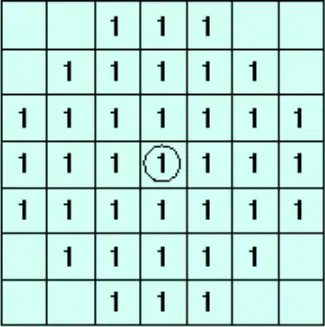
Refer to the diagram labeled 'Box'. What is the value at the origin of the structuring element?
1
0
2
-1
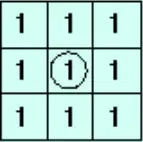
Refer to the diagram labeled 'Disc'. What is the value at the origin of the structuring element?
1
0
2
-1
Which of the following is a shape example?
Triangle
Square
Pentagon
Hexagon
Which of the following is a shape example?
Rectangle
Octagon
Ellipse
Trapezoid
Which of the following is a shape example?
Disk (circle)
Triangle
Parallelogram
Rhombus
Which of the following is a shape example?
Line
Pentagon
Star
Arrow
Which of the following is a shape example?
Cross
Heart
Diamond
Crescent
Which morphological operation removes pixels from object boundaries based on SE shape?
Erosion
Dilation
Opening
Closing
Which morphological operation adds pixels to object boundaries using the SE?
Dilation
Erosion
Opening
Closing
Which morphological operation is defined as erosion followed by dilation (smooths objects)?
Opening
Closing
Dilation
Erosion
Which morphological operation is defined as dilation followed by erosion (fills gaps)?
Closing
Opening
Erosion
Top-hat

What is the effect of the morphological operation 'Erosion'?
Grow
Shrink
Rotate
Blur

What is the effect of the morphological operation 'Dilation'?
Shrink
Grow
Blur
Rotate
Combining morphological operations to form 'Opening' keeps the general shape but smooths with respect to the _________.
object
background
intensity
color
Combining morphological operations to form 'Closing' keeps the general shape but smooths with respect to the _________.
background
object
edges
center
Erosion _______ foreground and _______ background. (Fill in the blanks)
shrinks foreground and enlarges background
enlarges foreground and shrinks background
enlarges foreground and enlarges background
shrinks foreground and shrinks background
Dilation _______ foreground and _______ background.
enlarges; shrinks
shrinks; enlarges
removes; adds
blurs; sharpens
What is erosion in image processing?
The set of all points in the image where the structuring element fits into
The set of all points in the image where the structuring element does not fit
The process of adding pixels to the image
The process of changing the color of the image
Fill in the blank: In erosion, if the structuring element fits in, write a "___" at the origin of the structuring element.
1
0
X
Y
Which of the following is a simple application of erosion in image processing?
Pattern matching
Color enhancement
Edge detection
Histogram equalization
What are the required inputs for erosion in image processing?
Binary Image (Gray value) and Structuring Element containing only 1s
Color Image and Structuring Element containing only 0s
Binary Image (Gray value) and Color Filter
Histogram and Structuring Element containing only 1s
Erosion is an important ________ operation. (Fill in the blank)
morphological
chemical
thermal
mechanical
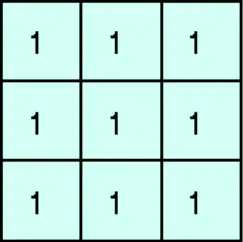
Which structuring element is applied in the given example of erosion?
1 0 1 0 1 0 1 0 1
1 1 1 1 1 1 1 1 1
0 1 0 1 1 1 0 1 0
1 1 1 1 0 1 1 1 1
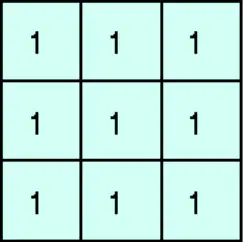
Which of the following is a set of coordinate points for the structuring element used in the erosion example?
{(-1, -1), (0, -1), (1, -1), (-1, 0), (0, 0), (1, 0), (-1, 1), (0, 1), (1, 1)}
{(0, 0), (1, 1), (2, 2)}
{(-1, 0), (0, 0), (1, 0)}
{(0, -1), (0, 0), (0, 1)}

What image processing operation is being demonstrated in the example with the input image: 1 0 0 0 1 1 1 0 1 1 and structuring element: 1 1 1?
Dilation
Erosion
Opening
Closing

Refer to the diagram titled 'Example for Erosion'. What is the structuring element used in the example?
1 1 1
0 1 0
1 0 1
0 0 1

What is the structuring element used in the example for erosion shown in the image?
1 1 1
0 1 0
1 0 1
0 0 0

Given the following input image for erosion: 1 0 0 0 1 1 1 0 1 1, fill in the blank for the structuring element used in this example. Structuring Element: [ _ _ _ ]
1 1 1
0 1 0
1 0 1
0 0 1
Given the input image: 1 0 0 0 1 1 1 0 1 1 and the structuring element: 1 1 1, fill in the blank for the output image after erosion. Output Image: [ _ _ _ 0 0 1 _ _ _ _ ]
0 0 0 0 1
1 1 0 0 1
0 1 1 0 0
1 0 0 1 1

What is the structuring element used in the given example for erosion?
1 1 1
0 1 0
1 0 1
0 0 1

Refer to the 'Example for Erosion' diagram. What is the structuring element used in the erosion operation?
1 1 1
0 1 0
1 0 1
0 0 1
Refer to the 'Example for Erosion' diagram. What is the output image after applying the structuring element to the input image?
0 0 0 0 1 0 0
1 1 1 0 0 1 1
0 1 0 0 1 1 0
1 0 0 1 0 0 1
What is the input image in the given example for erosion?
1 0 0 0 1 1 1 0 1 1
1 1 0 0 1 0 1 1 0 1
0 1 1 0 0 1 1 1 0 1
1 0 1 1 0 1 0 1 1 0

What is the structuring element used in the given example for erosion?
1 1 1
0 1 0
1 0 1
0 0 0
What is the output image after applying erosion in the given example?
0 0 0 0 1 0 0 0
0 1 1 0 1 1 0 0
1 1 0 0 0 0 1 1
0 0 0 1 0 0 0 0
What happens to the image as a result of erosion?
It gets lighter
It gets darker
It remains the same
It gets blurred

Fill in the blank: In the given example, white is represented by __ and black is represented by __.
white is represented by 0 and black is represented by 1
white is represented by 1 and black is represented by 0
white is represented by 1 and black is represented by 2
white is represented by 2 and black is represented by 1
Why is counting coins difficult according to the image?
Because they are different sizes
Because they touch each other
Because they are different colors
Because they are heavy
What is the solution mentioned in the image for separating touching coins?
Coloring
Binarization and Erosion
Addition
Subtraction

The process of ________ and ________ helps to separate touching coins, as shown in the images below.
Binarization, Erosion
Smoothing, Dilation
Thresholding, Blurring
Sharpening, Morphing
Determine the output image after performing erosion on the given input image. Input Image: 1011110110 Structuring element: 101
0011100000
1011100000
0001100000
0011110000
What is the meaning of the word 'DILATION'?
Dilation is a transformation that changes the size of a figure but not its shape.
Dilation is a transformation that changes the color of a figure.
Dilation is a transformation that rotates a figure.
Dilation is a transformation that reflects a figure over a line.

What is an important morphological operation shown in the example?
Erosion
Dilation
Opening
Closing
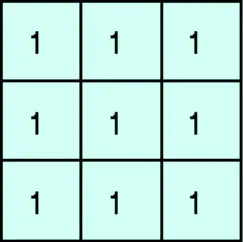
Fill in the blank: The applied structuring element for the dilation operation is a 3x3 matrix with all values as ___.
1
0
-1
2
What is dilation in image processing? Fill in the blank: Dilation is the set of all points in the image, where the structuring element '______' the foreground.
touches
ignores
removes
erases
Consider each pixel in the input image. If the structuring element touches the foreground image, what should you write at the origin of the structuring element?
Write a '1' at the origin of the structuring element.
Write a '0' at the origin of the structuring element.
Leave the origin unchanged.
Invert the value at the origin of the structuring element.
Which of the following are required as input for dilation in image processing?
Binary Image
Grayscale Image
Structuring Element containing only 1s
Color Image
Refer to the diagram titled 'Example for Dilation'. What is the input image sequence shown in the example?
1 0 0 0 1 1 1 0 1 1
1 1 0 0 1 1 1 0 1 1
1 0 0 0 1 1 1 1 0 1
1 0 0 0 1 1 1 0 1 1

What is the structuring element used in the dilation example shown in the image?
1 1 1
0 1 0
1 0 1
0 0 1

In the given example for dilation, what is the structuring element?
1 1 1
0 1 0
1 0 1
0 0 0

What is the structuring element used in the dilation example shown in the image?
[1 1 1]
[0 1 0]
[1 0 1]
[1 1 0]

What is the structuring element used in the dilation example shown in the image?
[1 1 1]
[0 1 0]
[1 0 1]
[1 1 0]

