
 Worksheets
Exploring Skeletal Medical Terminology
Total questions: 45
Worksheet time: 26mins
What is the term for the shaft of a long bone?
Epiphysis
Diaphysis
Metaphysis
Periosteum
Which mineral is most abundant in bone tissue?
Iron
Calcium
Potassium
Sodium
What is the name of the connective tissue that covers the outer surface of bones?
Endosteum
Periosteum
Synovium
Cartilage
Which type of joint is found in the shoulder and hip?
Hinge joint
Ball-and-socket joint
Pivot joint
Saddle joint
What is the medical term for the process of bone formation?
Hematopoiesis
Ossification
Calcification
Osteolysis
Which bone is part of the axial skeleton?
Femur
Sternum
Humerus
Scapula
What is the most common type of bone cell responsible for bone resorption?
Osteoblast
Osteoclast
Chondrocyte
Osteocyte
Which disorder is characterized by decreased bone mass and increased fracture risk?
Osteoarthritis
Osteoporosis
Scoliosis
Rickets
What type of fracture occurs when the bone breaks into several pieces?
Greenstick fracture
Comminuted fracture
Spiral fracture
Simple fracture
Which joint allows movement in only one plane, such as the elbow?
Ball-and-socket joint
Hinge joint
Pivot joint
Gliding joint
Which bone is NOT part of the appendicular skeleton?
Tibia
Clavicle
Mandible
Ulna
Which structure is responsible for the longitudinal growth of long bones during childhood?
Periosteum
Epiphyseal plate
Medullary cavity
Articular cartilage
Which of the following is a function of the skeletal system?
Producing hormones
Storing minerals
Digesting food
Filtering blood
Which bone disorder is caused by a deficiency of vitamin D in children?
Osteoporosis
Rickets
Scoliosis
Osteomyelitis
Which type of joint is found between the bones of the skull?
Synovial joint
Cartilaginous joint
Fibrous joint
Hinge joint
Which bone cell is primarily responsible for building new bone tissue?
Osteoclast
Osteoblast
Chondrocyte
Fibroblast
Which of the following best describes the function of red bone marrow?
Fat storage
Blood cell production
Mineral storage
Joint lubrication
A patient presents with a lateral curvature of the spine. What is the most likely diagnosis?
Kyphosis
Lordosis
Scoliosis
Osteoporosis
Compare the structure of compact bone and spongy bone.
Both have the same density and structure
Compact bone is dense and forms the outer layer; spongy bone is porous and found inside bones
Spongy bone is denser than compact bone
Compact bone is only found in children
Which type of synovial joint allows for rotation around a single axis, such as the joint between the atlas and axis vertebrae?
Hinge joint
Pivot joint
Saddle joint
Ball-and-socket joint
Explain why a greenstick fracture is more common in children than adults.
Children's bones are more brittle
Children's bones are more flexible and less likely to break completely
Adults have more cartilage in their bones
Adults have thicker periosteum
Which of the following best explains the role of osteocytes in bone tissue?
They break down bone matrix
They maintain bone tissue and communicate with other bone cells
They produce cartilage
They form the periosteum
A patient with osteoarthritis is most likely to experience which of the following symptoms?
Bone fractures
Joint pain and stiffness
Muscle weakness
Bone infection
Which process is responsible for the healing of a bone fracture?
Hematopoiesis
Bone remodeling
Synovial fluid production
Cartilage degeneration
A 16-year-old athlete sustains a fracture at the growth plate of the femur. What is the potential consequence if not properly treated?
Increased bone density
Impaired bone growth
Enhanced joint mobility
Decreased blood cell production
A patient presents with bowed legs and a history of poor nutrition. Which skeletal disorder is most likely, and what is the underlying cause?
Osteoporosis; excess calcium
Rickets; vitamin D deficiency
Scoliosis; genetic mutation
Osteomyelitis; bacterial infection
Given a patient with a comminuted fracture, what would be the most appropriate initial management step?
Immediate weight-bearing exercise
Immobilization of the affected limb
Application of heat
Encouraging movement of the joint
A 70-year-old woman has a history of multiple vertebral fractures and low bone mineral density. What is the most likely diagnosis, and what evidence supports this conclusion?
Osteoarthritis; joint pain
Osteoporosis; low bone mineral density and fractures
Scoliosis; spinal curvature
Rickets; vitamin D deficiency
A child is diagnosed with a greenstick fracture. What does this indicate about the nature of the bone and the mechanism of injury?
The bone is brittle and broke into several pieces
The bone bent and partially broke due to its flexibility
The bone was crushed under heavy weight
The bone was twisted and completely separated
A patient with rheumatoid arthritis is experiencing joint inflammation and pain. Based on your knowledge, what is the underlying cause of this disorder?
Degeneration of cartilage due to aging
Autoimmune attack on joint tissues
Bacterial infection of the bone
Vitamin D deficiency

What type of fracture is this?
Compound
Simple
Greenstick

The diagram shows a fracture that has two bones crushing into each other. What type of fracture is this?
Simple
Compound
Impacted
Comminuted

What type of fracture does not break through the skin?
Compound Fracture
Simple Fracture
Complete Fracture
Incomplete Fracture
A female patient is brought to the emergency room with an injury to her lower leg from an ATV accident. You notice a white tip of a bone protruding through the skin as you cut her pant leg off. Her injury is described as what kind of fracture.
Comminuted
Pathologic
Compound
Stress
When a bone is broken and a fragment of bone protrudes through an open wound in the skin it is __________.
Open Fracture
Closed Fracture
Simple Fracture
Compound Fracture


Which type of fracture is pictured here?
Greenstick
Comminuted
Open/Compound
Simple

What type of fracture is this?
Compound
Simple
Greenstick

What type of fracture is this?
Compound
Simple
Greenstick

Name the fracture:
comminuted
transverse
impact
spiral
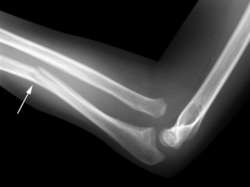

You recieve a patient that just fractured their sternum, clavicle and mandible from a football tackle accident? Explain their injury in "non-science terms, and reference the injury in terms of the skull [For example: a fracture to the pelvic girdle is an injury to the hips inferior to the skull.]

