
 Worksheets
Ch. 5.4- Joints
Total questions: 107
Worksheet time: 57mins
What is a more stable joint? (LESS MOVEMENT/Range of Motion)
Hip--> deeper acetabulum socket
Shoulder--> deeper glenoid fossa
Flexion is:
INCREASING the angle in the range of motion
DECREASING the angle in the range of motion
Extension is:
INCREASING the angle in the range of motion
DECREASING the angle the range of motion
What is the only bone that can participate in pronation and supination by crossing over another bone?
Femur
Radius
Tarsals
Tibia
What is the only part of your body that can perform opposition?
Hyoid
Pollex (Thumb)
Scapula
Hallux (Toe)
Select all the STRUCTURAL Joint Classifications: (REMEMBER WITH: what the joints are made of OR Funny, Crazy, Silly)
Fibrous Joints
Synarthroses
Synovial Joints
Cartilaginous Joints
Amphiarthroses
Select all the FUNCTIONAL Joint Classifications: (REMEMBER WITH: if you can't function you're SAD + arthr(o) means Joint/Articulation/MOVE which is the function)
Fibrous Joints
Synarthroses
Synovial Joints
Diarthroses
Amphiarthroses
Gomphosis are peg-in-socket fibrous/synarthroses joints found in:
Your SKULL because gomphosis sounds fancy like a skull :)
Your GUMS between each tooth and socket in jaw (GOMphosis it's in the name)
Between your TIBIA and FIBULA because it's gomphosis is the glue that keeps them together
Your metacarpophalangeal joint because it barely moves
What is a gomphosis joint?
A DIARTHROTIC joint that is peg-in-socket
A CARTILAGINOUS joint that is peg-in-socket
A FIBROUS joint that is peg-in-socket
A SYNOVIAL joint that is peg-in-socket
What's another word for HYALINE cartilage?
Intervertebral cartilage
Fibrocartilage
Articular cartilage
I really don't know :( But I will learn!
What is the STRUCTURAL classification of a joint that permits NO MOVEMENT AT ALL & is made of dense fibrous connective tissue
Synarthroses because it is a SYN to move (sin)
Cartilaginous
Fibrous
Amphiarthroses
What is the FUNCTIONAL classification of a joint that permits NO MOVEMENT AT ALL & is made of dense fibrous connective tissue
Synarthroses because it is a SYN (sin) to move
Cartilaginous
Fibrous
Amphiarthroses
What is the STRUCTURAL classification of a joint that permits SLIGHT DEGREE OF MOVEMENT
Synarthroses because it is a SYN (sin) to move
Cartilaginous (because the cartilage wiggles a little)
Fibrous
Amphiarthroses
What is the FUNCTIONAL classification of a joint that permits SLIGHT DEGREE OF MOVEMENT
Synarthroses because it is a SYN (sin) to move
Cartilaginous because the cartilage wiggles a little
Fibrous
Amphiarthroses (because amphi means both/2 sides & cartilage is on 2 sides/is the 2nd one in terms of motion)
What is the STRUCTURAL classification of a joint that permits free movement!
Synarthroses because it is a SYN (sin) to move
Cartilaginous because the cartilage wiggles a little
Synovial (because it moves around freely like an ovial ~oval)
Amphiarthroses (because amphi means both/2 sides & cartilage is on 2 sides/is the 2nd one in terms of motion)
What is the FUNCTIONAL classification of a joint that permits free movement!
Synarthroses because it is a SYN (sin) to move
Diarthroses (because I will die if I don't move around, I'm just dying to move)
Synovial (because it moves around freely like an ovial ~oval)
Amphiarthroses (because amphi means both/2 sides & cartilage is on 2 sides/is the 2nd one in terms of motion)
What is the STRUCTURAL classification of sutures, syndesmoses, gomphosis, interosseous membrane?
Synarthroses because it is a SYN (sin) to move
Fibrous
Synovial (because it moves around freely like an ovial ~oval)
Amphiarthroses (because amphi means both/2 sides & cartilage is on 2 sides/is the 2nd one in terms of motion)
What is the FUNCTIONAL classification of sutures, syndesmoses, gomphosis, interosseous membrane?
Synarthroses because it is a SYN (sin) to move
Fibrous
Synovial (because it moves around freely like an ovial ~oval)
Amphiarthroses (because amphi means both/2 sides & cartilage is on 2 sides/is the 2nd one in terms of motion)
What is the STRUCTURAL classification of synchondroses (hyaline) and symphyses (fibrocartilage)?
Synarthroses because it is a SYN (sin) to move
Cartilaginous (because cartilage wiggles a little)
Synovial (because it moves around freely like an ovial ~oval)
Amphiarthroses (because amphi means both/2 sides & cartilage is on 2 sides/is the 2nd one in terms of motion)
What is the FUNCTIONAL classification of synchondroses (hyaline) and symphyses (fibrocartilage)?
Synarthroses because it is a SYN (sin) to move
Cartilaginous (because cartilage wiggles a little)
Synovial (because it moves around freely like an ovial ~oval)
Amphiarthroses (because amphi means both/2 sides & cartilage is on 2 sides/is the 2nd one in terms of motion)
What is the STRUCTURAL classification of your shoulder, elbow, hip, knee, finger, and wrist joints?
Diarthroses (because I will die if I don't move around)
Cartilaginous (because cartilage wiggles a little)
Synovial (because it moves around freely like an ovial ~oval)
Amphiarthroses (because amphi means both/2 sides & cartilage is on 2 sides/is the 2nd one in terms of motion)
What is the FUNCTIONAL classification of your shoulder, elbow, hip, knee, finger, and wrist joints?
Diarthroses (because I will die if I don't move around)
Cartilaginous (because cartilage wiggles a little)
Synovial (because it moves around freely like an ovial ~oval)
Amphiarthroses (because amphi means both/2 sides & cartilage is on 2 sides/is the 2nd one in terms of motion)
What are the primary roles of the anterior-cruciate ligament (ACL)?
Stabilize knee joint
Prevent hyper-extension
Stops forward sliding of tibia
Limits rotational movement of knee joint
Which is the more FREELY MOVABLE ball and socket joint?
Hip
Shoulder
Which is the more STABLE ball and socket joint?
Hip
Shoulder
Select all the Rotator Cuff Tendon Muscles:
Subscapularis
Infraspinatus
Teres Minor
Teres Major
Supraspinatus
All hinge joints are SYNOVIAL joints
True
False
All ball-and-socket joints are DIARTHROTIC joints
True
False
Your elbow joint is:
Multiaxial (Allow movement in or around all 3 planes, the GREATEST amount of movement)
Biaxial (Allow movements in TWO planes)
Uniaxial (Allow movements in ONE plane ONLY)
Nonaxial (Allow SLIPPING movements only)
Your knee joint is:
Multiaxial (Allow movement in or around all 3 planes, the GREATEST amount of movement)
Biaxial (Allow movements in TWO planes)
Uniaxial (Allow movements in ONE plane ONLY)
Nonaxial (Allow SLIPPING movements only)
Your ankle joint is:
Multiaxial (Allow movement in or around all 3 planes, the GREATEST amount of movement)
Biaxial (Allow movements in TWO planes = dorsiflexion + plantarflexion AND inversion + eversion)
Uniaxial (Allow movements in ONE plane ONLY)
Nonaxial (Allow SLIPPING movements only)
Your hip joint is:
Multiaxial (Allow movement in or around all 3 planes, the GREATEST amount of movement)
Biaxial (Allow movements in TWO planes)
Uniaxial (Allow movements in ONE plane ONLY)
Nonaxial (Allow SLIPPING movements only)
Your shoulder joint is:
Multiaxial (Allow movement in or around all 3 planes, the GREATEST amount of movement)
Biaxial (Allow movements in TWO planes)
Uniaxial (Allow movements in ONE plane ONLY)
Nonaxial (Allow SLIPPING movements only)
Your carpal bones of your wrist joint are:
Multiaxial (Allow movement in or around all 3 planes, the GREATEST amount of movement)
Biaxial (Allow movements in TWO planes)
Uniaxial (Allow movements in ONE plane ONLY)
Nonaxial (Allow SLIPPING movements only)
Which of the following are SYNOVIAL/DIARTHROTIC joints:
Hinge
Plane/gliding & Pivot
Condyloid
Ball & Socket
Saddle
What tissue are tendons and ligaments made of?
Areolar connective
Hyaline
Dense irregular
Dense regular
Do synovial joints have a joint cavity?
YES
NO
Maybe yes, maybe no >:(
What movements do the SHOULDER and HIP joints allow?
Flexion/extension
Abduction/Adduction
Internal/External Rotation
Circumduction
What is the name of the motion where you move the foot in MEDIALLY?
Inversion
Eversion
Adduction
Internal rotation
What is the name of the motion where you move the foot out LATERALLY?
Inversion
Eversion
Adduction
Internal rotation
Which joint produces inversion and eversion motions?
Wrist Joint
Knee Joint
Ankle Joint
Shoulder Joint

What is the name of the synovial joint movement from position 3 to 4?
Shoulder Joint Adduction
Shoulder Joint Abduction
Elbow Joint Adduction
Elbow Joint Abduction
What is the name of the synovial joint movement from position 4 to 3?
Shoulder Joint Adduction
Shoulder Joint Abduction
Elbow Joint Adduction
Elbow Joint Abduction
What is the name of the synovial joint movement at position 5?
Shoulder Joint Adduction
Shoulder Joint Abduction
Shoulder Joint Circumduction
Elbow Joint Abduction

What synovial joint movement is indicated by arrow: A?
Hip Extension
Knee Flexion
Knee Extension
Shoulder Flexion
What synovial joint movement is indicated by arrow: B?
Hip Extension
Knee Flexion
Knee Extension
Shoulder Flexion
What synovial joint movement is indicated by arrow: C?
Shoulder Extension
Knee Flexion
Knee Extension
Shoulder Flexion
What synovial joint movement is indicated by arrow: D?
Shoulder Extension
Knee Flexion
Knee Extension
Shoulder Flexion

What synovial joint movement is indicated by arrow: A?
Wrist Flexion
Wrist Extension
Pronation
Supination
What synovial joint movement is indicated by arrow: B?
Wrist Flexion
Wrist Extension
Pronation
Supination

What synovial joint movement is indicated by arrow: 1?
Neck Extension
Neck Flexion
Neck Abduction
Neck Adduction
What synovial joint movement is indicated by arrow: 2?
Neck Extension
Neck Flexion
Neck Abduction
Neck Adduction

What synovial joint movement is indicated by arrow: 6?
Neck Extension
Neck Flexion
Depression
Elevation
What synovial joint movement is indicated by arrow: 7?
Neck Extension
Neck Flexion
Jaw Depression
Jaw Elevation

What synovial joint movement is indicated by arrow: A?
Plantarflexion
Dorsiflexion
Inversion
Eversion
What synovial joint movement is indicated by arrow: B?
Plantarflexion
Dorsiflexion
Inversion
Eversion

What synovial joint movement is indicated by the arrow?
Plantarflexion
Dorsiflexion
Inversion
Eversion

What synovial joint movement is indicated by the arrow?
Plantarflexion
Dorsiflexion
Inversion
Eversion

What joint is this?
Knee Joint
Elbow Joint
Shoulder Joint
Hip Joint

Which of the following are the EXTRACAPSULAR ligaments?
8- Lateral Collateral Ligament
3- Medial Collateral Ligament
11- Anterior Cruciate Ligament
12- Posterior Cruciate Ligament

Which of the following are the INTRACAPSULAR ligaments?
C- Lateral Collateral Ligament
M- Medial Collateral Ligament
K- Anterior Cruciate Ligament
(This is an Anterior View so the BACK of K) - Posterior Cruciate Ligament
What is the meniscus in your KNEE JOINT mostly made of?
Hyaline Cartilage
Fibrocartilage
Reticular cartilage
Which bones make up the SHOULDER/GLENOHUMERAL JOINT?
Scapula (glenoid fossa)
Clavicle (acromion process)
Humerus (head of humerus)
Sternum (clavicular notch)
Synovial Joints include:
Articular capsule
Joint Cavity
Synovial fluid (inside joint cavity)
Articular/Hyaline cartilage
Tendon sheaths
Is the knee a regular hinge joint or a modified hinge joint?
MODIFIED HINGE because it does flexion + extension AND some medial + lateral rotation
REGULAR HINGE because it doesn't do anything more special than the elbow joint
Articulations that allow only SLIGHT/SOME degree of movement:
Amphiarthroses
Cartilaginous
Synarthorses
Fibrous
Articulations that don't allow ANY degree of movement:
Amphiarthroses
Cartilaginous
Synarthorses
Fibrous

What joint is this?
Glenohumeral Joint
Elbow Joint
Coxal (Knee) Joint
Knee Joint

What joint is this?
Glenohumeral Joint
Elbow Joint
Coxal (Hip) Joint
Knee Joint

What joint is this?
Glenohumeral Joint
Elbow Joint
Coxal (Hip) Joint
Knee Joint

What joint is this?
Glenohumeral (Shoulder) Joint
Elbow Joint
Coxal (Hip) Joint
Knee Joint
Which ligament is #1?
Lateral Collateral Ligament
Intracapsular Ligament
Medial Collateral Ligament
Anterior Cruciate Ligament
Which ligament is #2?
Lateral Collateral Ligament
Intracapsular Ligament
Medial Collateral Ligament
Anterior Cruciate Ligament
Which bone is #3?
Humerus
Ulna
Radius
Scapula
Which bone is #4?
Humerus
Ulna
Radius
Scapula
Which bone is #5?
Humerus
Ulna
Radius
Scapula
Which process is #6?
Olecranon Process
Coracoid Process
Radius
Scapula

What is bone #1?
Femur
Pubis
Greater trochanter
Lesser trochanter
What is bone #2 (where my symphyses would be)?
Femur
Pubis
Greater trochanter
Lesser trochanter
What is bony landmark: #4?
Femur
Pubis
Greater trochanter
Lesser trochanter
What is bony landmark: #5?
Femur
Pubis
Greater trochanter
Lesser trochanter
What is bony landmark: #6?
Ilium
Ischial tuberosity
Greater trochanter
Iliac crest
What is bone: #7?
Ilium
Ischial tuberosity
Greater trochanter
Iliac crest
What is bony landmark: #8?
Ilium
Ischial tuberosity
Greater trochanter
Iliac crest

What is ligament #: 4?
Lateral Collateral Ligament
Medial Collateral Ligament
Greater trochanter
Iliac crest
What is ligament #: 5?
Lateral Collateral Ligament
Medial Collateral Ligament
Greater trochanter
Iliac crest
What is landmark #: 7 (where the quadriceps insert)?
Lateral Collateral Ligament
Medial Collateral Ligament
Patellar tendon
Patella
What is landmark #: 13? (Sesamoid bone)
Lateral Collateral Ligament
Medial Collateral Ligament
Patellar tendon
Patella
What bone is #: 12?
Tibia (Medial)
Fibula (Lateral)
Femur
Patella
What bone is #: 11?
Tibia (Medial)
Fibula (Lateral)
Femur
Patella
What bone is #: 10?
Tibia (Medial)
Fibula (Lateral)
Femur
Patella
Which meniscus (made of fibrocartilage) is #: 14?
Medial Meniscus
Anterior Cruciate Ligament (ACL)
Posterior Cruciate Ligament (PCL)
Lateral Meniscus
Which ligament is #: 9?
Medial Meniscus
Anterior Cruciate Ligament (ACL)
Posterior Cruciate Ligament (PCL)
Lateral Meniscus
Which bones truly make up the elbow joint?
Humerus (Olecranon Fossa, Trochlea, Coronoid Fossa)
Radius (Radial Tuberosity)
Ulna (Olecranon Process, Trochlear Notch, Coronoid Process)
Scapula (Glenoid Fossa)
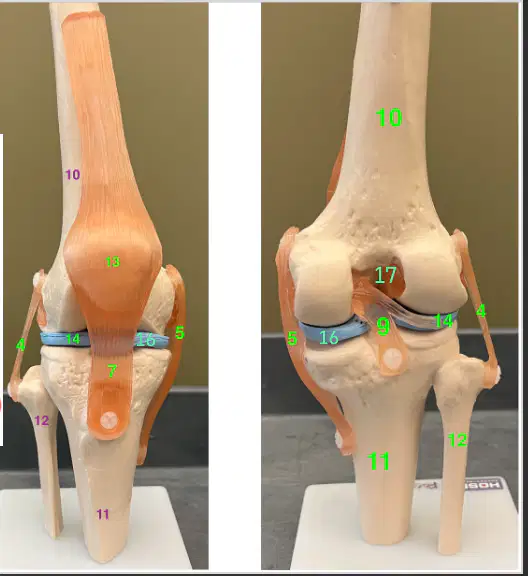
Which meniscus is #: 16?
Medial Meniscus
Anterior Cruciate Ligament (ACL)
Posterior Cruciate Ligament (PCL)
Lateral Meniscus
Which ligament is #: 17? (practically hidden because the image on the right is in posterior view)
Medial Meniscus
Anterior Cruciate Ligament (ACL)
Posterior Cruciate Ligament (PCL)
Lateral Meniscus

What is bone #: 1?
Spine of the Scapula
Humerus
Scapula
Clavicle
What is bone #: 2?
Spine of the Scapula
Humerus
Scapula
Clavicle
What is bone #: 6?
Spine of the Scapula
Humerus
Scapula
Clavicle
What is bony landmark #: 5?
Spine of the Scapula
Humerus
Scapula
Clavicle
What is bony landmark #: 3?
Coracoid Process
Humerus
Acromion Process
Subscapular fossa
What is bony landmark #: 4?
Coracoid Process
Humerus
Acromion Process
Subscapular fossa
What is bony landmark #: 10?
Coracoid Process
Humerus
Acromion Process
Subscapular fossa
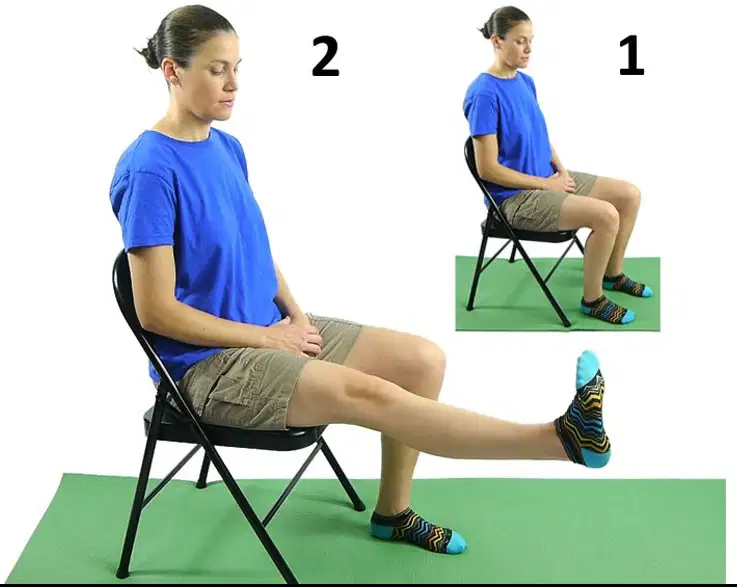
What is the joint movement from position #1 to position #2?
Hip Flexion
Hip Flexion
Knee Extension
Knee Flexion
What is the joint movement from position #2 to position #1?
Hip Flexion
Hip Flexion
Knee Extension
Knee Flexion
What is the prime mover for the movement from position #1 to position #2?
Quadriceps (Rectus Femoris, Vastus Lateralis, Vastus Intermedius, Vastus Medialis)
Iliopsoas
Hamstrings (Biceps Femoris, Semimembranosus, Semitendinosus)
Gluteus Maximus
What is the prime mover for the movement from position #2 to position #1?
Quadriceps (Rectus Femoris, Vastus Lateralis, Vastus Intermedius, Vastus Medialis)
Iliopsoas
Hamstrings (Biceps Femoris, Semimembranosus, Semitendinosus)
Gluteus Maximus

