
 Worksheets
Gilded Age Review
Total questions: 90
Worksheet time: 59mins
What was the primary reason Chinese immigrants came to the United States in the mid-19th century?
To escape religious persecution
To work on the transcontinental railroad and in gold mines
To become landowners in the Midwest
To fight in the Civil War
What was the main purpose of the Chinese Exclusion Act of 1882?
To encourage Chinese laborers to work in American factories
To grant citizenship to Chinese immigrants
To restrict Chinese immigration and prevent Chinese immigrants from becoming U.S. citizens
To limit Chinese land ownership
What was one major reason white workers opposed Chinese immigration?
Chinese immigrants refused to assimilate
Chinese workers were taking over political offices
Chinese laborers were willing to work for lower wages
Chinese immigrants supported anti-American policies
What was the main characteristic of the Gilded Age?
Government control over the economy
Rapid industrialization and economic growth
Decrease in immigration
Strong labor unions
Who coined the term "Gilded Age" to describe the period?
J.P. Morgan
Upton Sinclair
Andrew Carnegie
Mark Twain

Which industry was most associated with the rise of monopolies in the Gilded Age?
Steel and oil
Agriculture
Textiles
Automobiles
Which industrialist dominated the steel industry?
John D. Rockefeller
Andrew Carnegie
JP Morgan
Henry Ford
John D. Rockefeller was associated with which company?
U.S. Steel
General Electric
Standard Oil
Union Pacific Railroad
J.P. Morgan was known for his influence in which sector?
Railroads
Banking and finance
Agriculture
Mining
The term "robber baron" refers to:
Wealthy industrialists accused of exploiting workers
Railroad workers who went on strike
Farmers who supported bimetallism
Corrupt government officials
What was one effect of urbanization during the Gilded Age?
Increased rural population
Decline in immigration
Decrease in factory jobs
Increase of poor housing conditions in cities
Match the following wealthy owners to their industry.
Steel
Andrew Carnegie
Oil
John D. Rockefeller
Railroad
Cornelius Vanderbilt
Automobile
Henry Ford
Banking
JP Morgan
Practice where a single company controls every step of the process, from the raw materials to distribution.
Vertical Integration
Horizontal integration
Laissez-Faire
Agrarian
The time between 1870 and 1900 during which the population and economy grew quickly along with political and corporate corruption.
Laissez-Faire
American Foundations
Gilded Age
Monopoly
The process of moving to another country to take up permanent residence.
Immigration
Nativism
Urbanization
Philanthropy
Worker organizations who tried to collectively bargain for better pay and working conditions.
Labor Unions
Monopoly
Political Machine
Free Enterprise System
The exclusive possession or control of the supply or trade in a commodity or service.
Monopoly
Nativism
Political Machine
Corporation
An assembly line is...
a series of workers and machines in a factory by which a succession of identical items is progressively assembled.
Factories
movable parts
Define Ellis Island
An immigration station that opened in 1892, located at the mouth of the Hudson River between New York and New Jersey. It closed in 1954.
The location where the Central Pacific and Union Pacific Railroads met and the Transcontinental Railroad was completed. A Golden Spike Ceremony was held on May 10, 1869, to celebrate the event
Located in the San Francisco Bay, it was the primary immigration station for the West Coast from 1910-1940. It also served as a deportation station.
The policy of protecting the interests of native-born or established inhabitants against those of immigrants.
Define Tenements
Immigrants primarily from Southern and Eastern Europe: Italy, Asia, China, and Poland
Single family dwellings divided into multiple living spaces to accommodate the new growth of population in the United States. They were often poorly lit, cramped, and lacked plumbing and good ventilation
Federal law signed by President Chester Arthur in 1882 prohibiting all immigration of Chinese laborers.
Immigrants primarily from Northern and Western Europe: England, Ireland, and Germany
Population shift from rural areas to urban areas
Define Nativism
An immigration station that opened in 1892, located at the mouth of the Hudson River between New York and New Jersey. It closed in 1954.
A place where different people, styles, theories are mixed together.
Located in the San Francisco Bay, it was the primary immigration station for the West Coast from 1910-1940. It also served as a deportation station.
The policy of protecting the interests of native-born or established inhabitants against those of immigrants.

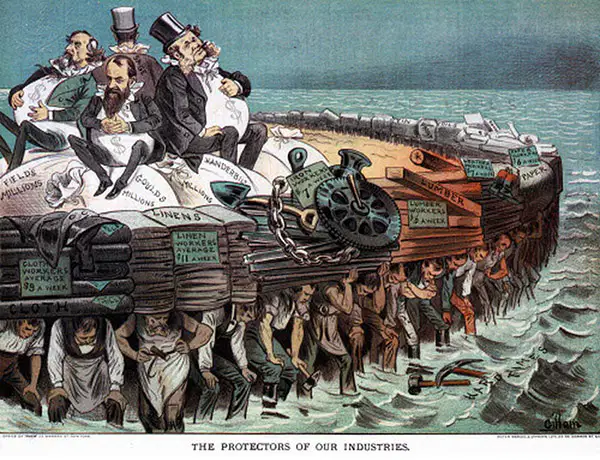
From this image, who is in control of the US lawmakers.
Large monopolies
small private business
political machines
labor unions

What concept does this image refer to?
political machines
nativisim
labor unions
graft
A shop or factory where workers work long hours at low wages under unhealthy conditions.
Sweatshop
Settlement House
Muckraker
Tenement

Which of the following is true of working conditions in the Gilded Age?
Political Machines took advantage of what major groups?
The Immigrants and the Poor
The Immigrants and Big Businesses
The Poor and the Chinese
The Chinese and the Big Businesses
Though jobs were plentiful, they didn't pay well. This caused what change in women and children's lives in the nineteenth century?
Women and children had to become wage earners
Women and children became business owners
Women and children became more educated
Women and children became leaders of organized labor
During the Gilded Age there was an increase in ____________________ and ___________________ as people moved to U.S. cities looking for economic opportunities.
Work and Infrastructure
Corruption and Laissez-Faire
Urbanization and Immigration
Monopolies and Political Bosses
Political Machines took advantage of what major groups?
The Immigrants and the Poor
The Immigrants and Big Businesses
The Poor and the Chinese
The Chinese and the Big Businesses
Civil Service Reform was a response to what?
Political Machines and the Spoils System
Chinese Immigrants
Indians (Native Americans)
The need to regulate State Governments
Americans who grew angry and resentful at the increased Immigrant migration into the country, especially those from Southern and Eastern Europe
Nativists
Populists
Philanthropists
Social Workers
Written by Andrew Carnegie; called on those who accumulated wealth to share their riches for the betterment of society
Dawes Act
Homestead Act
Interstate Commerce Act
Gospel of Wealth
Founder of Standard Oil, used ruthless business tactics to force competitors out of business. Created a monopoly
Nativists
Political Machines/Bosses
JD Rockefeller
Andrew Carnegie
A Scottish-born American industrialist and philanthropist who founded the Carnegie Steel Company in 1892. By 1901, his company dominated the American steel industry.
Nativists
Political Machines/Bosses
JD Rockefeller
Andrew Carnegie
U.S. citizens who opposed immigration because they were suspicious of immigrants and feared losing jobs to them
Nativists
Political Machines/Bosses
JD Rockefeller
Andrew Carnegie
During the Gilded Age, there was an increase in ________________ and _________________ as people moved to U.S. cities looking for economic opportunities.
Immigration / urbanization
capitalism / imperialism
communism / free enterprise
reform movements / civil rights

The government encourage Native Americans and immigrants to adopt white culture in a process called ____________.
cultural diffusion / globalization
acculturation / industrialization
assimilation / americanization
overspeculation / urbanization
Which of the following best characterizes the Gilded Age?
The discovery of goldfields in the West led to an increase in the amount of money issued for circulation.
Industrialists used their connection with corrupt government officials for material gain and political power
In the Deep South a sharp increase in immigration brought a boom in construction and industry
Small, family-owned farms were bought and consolidated to form large agricultural corporations
Which application of a new technology can attributed to an invention of Thomas Edison?
Refrigerated railroad cars allowed food to be transported long distances
Light bulbs made it efficient for factory workers to work at night
Diesel engines were used in production of airplanes
Sonar technology was used to track submarines
The Knights of Labor and the American Federation of Labor developed in response to the:
increased need to protect worker interests
decreased power of political machines
increased demand for skilled workers
decreased profitability of the agricultural sector
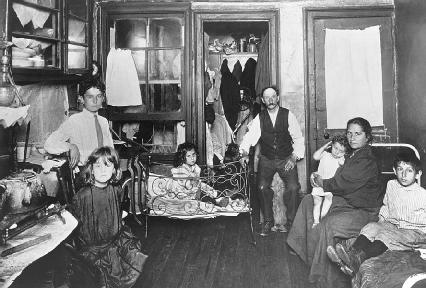
The growth of cities is called . . .
rural
technology
immigration
urbanization
During the Gilded Age, people moved from _____ areas to ______ areas.
Urban, rural
Western, eastern
Eastern, western
Rural, urban
The theory that government should not interfere in the operation of the free market.
Maslow
Bessemer Process
Free Enterprise
Laisez-Faire
These businessmen sometimes used ruthless tactics to destroy competition and keep workers wages low.
Captains of Industry
Philanthropists
Knights of Labor
Robber Barons
When there is complete control of a product or service; the elimination of fair competition.
Dictatorship
National Market
Opportunity Cost
Monopoly
Match the following Captains of Industry / Robber Barons with the industry they dominated.
Cornelius Vanderbilt
Railroads
Carnegie
Steel
Rockefeller
Standard Oil
JP Morgan
Finance
Match the following
A business strategy in which a company expands its presence and control over the production or distribution of similar products or services by acquiring or merging with competitors operating in the same industry.
Horizontal integration
A business strategy where a company extends its control over different stages of the production process or distribution chain of its products or services.
Vertical integration
A market structure in which a single seller or producer dominates the entire market for a particular product or service, giving it significant control over price and supply.
Monopoly
This allows a small group of owners to exert significant influence over prices, production, and competition within that industry.
Trust

Which two terms are often associated with ultra wealthy capitalist of the Gilded Age?
Robber barons
Titans of Business
Captains of Industry
Monarchs of Industry
During the late 19th and early 20th centuries, what ideology applied Charles Darwin's theory of natural selection to human society, often justifying social inequalities and laissez-faire capitalism?
Utilitarianism
Social Darwinism
Philanthropy
Anarchism
W.E.B. Du Bois
Which African American leader believed African Americans had already earned the rights of whites and demanded that they should be treated as equals?
W.E.B. Du Bois
Booker T. Washington
Marcus Garvey
Benjamin Singleton
Jim Crow Laws did what?
Disenfranchised African Americans and segregate society
Disenfranchised wealthy white planters and segregated society
Forced Republicans to become sharecroppers
Led to an increase in voting activity among African Americans
Which Civil Rights activist is associated with vocational education?
Ida B. Wells
W.E.B. Du Bois
Marcus Garvey
Booker T. Washington
Ohio State
True or False? : Ida B. Wells was born enslaved.
True
False.
This woman led a campaign against the lynching of African Americans
Margaret Sanger
Doroetha Dix
Ida B. Wells
Frances Willard
Who was the oil tycoon who created the Standard Oil Company
Carnegie
Morgan
Rockefeller
Vanderbilt
Company who Owns every step of production
Horizontal Integration
Vertical Integration
Lassiez faire
Corporation
Financier who made his money in the Banking industry
Rockefeller
Morgan
Carnegie
Vanderbilt

He invented the light bulb and helped "electrify America."
Alexander Graham Bell
George Westinghouse
Cyrus McCormick
Thomas Edison

Term that means the government will not regulate or interfere in industry.
Laissez Faire
Open Door Policy
Regulatory Restraint
Socialism

Andrew Carnegie's idea that the wealthy had a moral obligation to improve society for everyone.
Gospel of Wealth
Social Darwinism
American Dream
Principles of Scientific Management

Mark Twain coined this phrase to describe industrial America and the corruption in political America
Progressive Era
Imperial America
Era of Good Feelings
Gilded Age
Did children make a lot of money for their work?
Yes, they were paid like adults
No, they were paid little
Which of the following was a typical job worked by children?
Breaking up coal
Selling newspapers
Chimney sweeps
Working on Machines
All Listed Jobs
What was the main reason that businesses liked to hire children?
They were strong
They were educated
They worked for low wages
They worked fast

