wayground logo

Free Printable Worksheets

Font size

S
M
L
XL
Worksheets

FG Unit 2 Interactions of Hydrosphere and Atmosphere

Total questions: 67

Worksheet time: 2hrs 53mins

Name
Class
Date
1.

Which gas makes up the greatest percentage of Earth's atmosphere?

a)

Argon

b)

Nitrogen

c)

Nitrous oxide

d)

Carbon dioxide

2.

Which element makes up MOST of the air we breathe?

a)

Carbon

b)

Nitrogen

c)

Oxygen

d)

Argon

3.

The pie chart shows the mixture of gases that compose the atmosphere. Which gas composes 21% of the atmosphere?

a)

Argon

b)

Oxygen

c)

Nitrogen

d)

Carbon dioxide

4.
Where you will find the ozone layer.
a)
stratosphere
b)
thermosphere
c)
exosphere
d)
mesosphere
5.
Where weather occurs.
a)
stratosphere
b)
thermosphere
c)
troposphere
d)
mesosphere
6.
The two most common gases in the atmosphere.
a)
Nitrogen and Oxygen
b)
Oxygen and trace gases
c)
Carbon Dioxide and Nitrogen
d)
Nitrogen and trace gases
7.

What is the function of the ozone layer?

a)

to allow UV rays to get to Earth

b)

to block UV rays from getting to Earth

c)

To keep oxygen in

d)

to allow meteors to get to Earth

8.
This is the layer where meteors, or shooting stars, burn up.
a)
Troposphere
b)
Stratosphere
c)
Mesosphere
d)
Thermosphere
9.
The layers of the atmosphere are separated according to this change. 
a)
Altitude 
b)
Elevation
c)
Temperature
d)
Distance from the sun
10.
What are the two most common greenhouse gases?
a)
Water Vapor (H2O) and Methane (CH4)
b)
Carbon Dioxide COand Methane (CH4)
c)
Water Vapor (H2O) and Carbon Dioxide CO2
d)
Water Vapor (H2O) and Nitrous oxide (N2O)
11.
What is the greenhouse effect?
a)
The warming of a planet due to trapped radiation.
b)
The cooling of Earth due to air pollution.
c)
The heating of a solid, such as a rock.
12.
Without the Greenhouse Effect the Earth would be
a)
warm 
b)
cold
c)
dead
13.
What two elements make up water?
a)
Helium and oxygen
b)
Hydrogen and oxygen
c)
helium and carbon
d)
oxygen and carbon
14.
What word describes when water is attracted to other substances?
a)
cohesion
b)
adhesion
c)
capillary action
d)
surface tension
15.
Which end of the water molecule has a slightly positive charge?
a)
the oxygen end
b)
the hydrogen end
c)
both ends are slightly positive
d)
neither end is positive
16.
When a molecule has an opposite electrical charge on each end, it is known as what?
a)
cohesion
b)
polar molecule
c)
hydrogen bond
d)
solution
17.

Water has an unusually high specific heat. What does this mean?

a)

At its boiling point, water changes from liquid to vapor.

b)

A large amount of heat is required to raise the temperature of water.

c)

Ice floats in liquid water.

d)

Salt water freezes at a lower temperature than pure water.

e)

Floating ice can insulate bodies of water.

18.

What kind of charge is on hydrogen atoms?

a)

positive

b)

negative

c)

north

d)

south

19.

Polar molecules

a)

have even charge density

b)

are symmetric

c)

form hydrogen bonds

d)

have 10 atoms per molecule

20.

Why do coastal regions tend to be cooler?

a)

Due to high specific heat of water

b)

Due to low specific heat of water

c)

Due to high density of water

d)

Due to low density of water

21.

What is a hydrogen bond?

a)

A type of ionic bond

b)

An attraction between a partially positive hydrogen and a partially negative atom

c)

A type of covalent bond

d)

A bond between two hydrogen atoms

22.

What causes wind?

a)

differences in air pressure

b)

differences in gravity

c)

difference in oxygen

d)

differences in the thermosphere

23.

What causes differences in air pressure?

a)

even heating of the Earth

b)

Even cooling of the earth

c)

uneven heating of the earth

d)

global warming

24.
Which statement correctly defines wind?
a)
Wind is the movement of air from areas of low pressure to areas of high pressure
b)
Wind is the movement of air to a colder area in the atmosphere.
c)
Wind is the movement of air from areas of high pressure to areas of low pressure.
d)
Wind is the movement of air pushed around and bouncing off Earth's surface.
25.
How does the air move in a land breeze?
a)
From east to west
b)
From west to east
c)
From the land to the ocean
d)
From the ocean to the land
26.
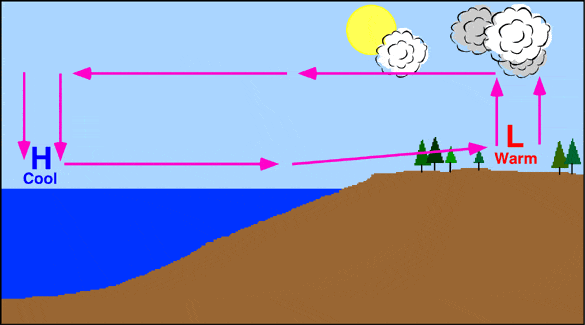
Is this a land or a sea breeze?
a)
land breeze
b)
sea breeze
27.
When warm air rises, ______ pressure forms at the surface of the land or sea.
a)
high
b)
some
c)
low
d)
none
28.
The strength of a sea breeze depends on
a)
the heat of the day
b)
the difference between the temperature of the sea and the land
c)
the wind speed
d)
the amount of precipitation that day
29.
In a sea breeze, the air is warmer above the _____.
a)
land
b)
ocean
c)
sky
d)
beach
30.
Where does the initial source of energy come from that creates winds?
a)
the moon
b)
the sun
c)
the Earth's surface
d)
the rotation of the Earth
31.
Why do land breezes occur at night?
a)
Land cools off slower than water, so the air above water is cooler.
b)
Water cools off faster than land, so the air above land is warmer.
c)
Land heats up slower than water, so the air stays cooler during the day.
d)
Water cools off slower than land, so the air above water is warmer.
32.
Which best describes why winds at the beach change direction between day and night? **
a)
because the temperatures over land and over water change 
b)
because warm air over land sinks and stays in place over land
c)
because cool air rises and is replaced by warm air from the ocean 
d)
because cool air sinks and stays in place over land 
33.
What occurs when cool air moves from the beach toward the ocean during the night? 
a)
a land breeze 
b)
prevailing winds 
c)
a sea breeze 
d)
updrafts
34.
What causes warm air to rise?
a)
the fact that it's less dense than cold air 
b)
The fact that it weighs more than cold air 
c)
The fact that it has higher pressure than cold
d)
the fact that its more dense than cold air 
35.
Wind blows from ______ pressure areas to _____ pressure areas.
a)
high; low
b)
warm; cool
c)
cool; warm
d)
low; high
36.
Water is _______ than land during the day, causing a sea breeze.
a)
more inviting
b)
larger
c)
cooler
d)
warmer
37.
  1. As you sit on the beach, you notice that the breeze, which had been blowing toward the water from the land, shifts so that it is blowing off the water toward land. What event has just occurred?

a)

Clouds have begun to form over the water.

b)

The temperature over the land has reached its highest point for that day.

c)

The temperature over the land has become higher than the temperature over the water.

d)

The temperature over the water has become higher than the temperature over the land.

38.

The table below gives air temperature data over land and over the sea for six successive hours labeled A through F. What weather event is occurring around time D?

a)

Clouds are forming over land.

b)

Clouds are dissipating over the ocean.

c)

The breeze is switching from a land breeze to a sea breeze.

d)

The breeze is switching from a sea breeze to a land breeze.

39.

Which Earth's surface heats quicker, sand or water?

a)

sand

b)

water

40.
If differences in air pressure produce winds, what can you conclude about temperature and air pressure based on the figure?
a)
As warm air rises, it creates an area of lower pressure, and cooler air flows in as wind
b)
Warm air is denser than cold air is, creating an area of high pressure the produces wind.
c)
Winds flow from areas of low pressure to areas high pressure when temperature is warmer
d)
Air pressure decreases at night because temperature is lower, producing land and sea breezes
41.

Warm, rising air creates _____ pressure zones.

a)

high

b)

low

c)

curved

d)

severe

42.

Cool, sinking air creates _____ pressure zones.

a)

high

b)

low

c)

curved

d)

severe

43.
Deep Ocean currents are a result of
a)
Global Wind Patterns
b)
Earth's Rotation
c)
Density
d)
All of the above
44.
The Coriolis Effect is caused by
a)
Earth rotating around the sun
b)
Earth rotating on its axis
c)
The tides
d)
Gravity
45.
What happens to a current when it comes in contact with a continent or landmass?
a)
It continues over the continent
b)
It stops
c)
It changes direction
d)
It is absorbed by the land
46.
A horizontal movement of ocean water that is caused by wind and that occurs at or near the ocean's surface.
a)
Gulf Stream
b)
Global Conveyor Belt
c)
Surface Current
d)
Gyre
47.
The large, circular surface-current pattern found in each ocean.
a)
California Current
b)
Surface Current
c)
Gyre
d)
Global Conveyor Belt
48.

What affects the density of water?

a)

Salt

b)

Temperature

c)

The seasons of the year

d)

Salt and Temperature

49.
When surface currents meet continents they ___?
a)
Stop moving
b)
Are deflected (change paths)
c)
Continue in the direction they were going
50.

What are a circular system of currents in the Earth's major oceans?

a)

ocean current

b)

gyre

c)

upwelling

d)

conveyor belt

51.
Ocean currents bring warm water from the equator towards Earth's
a)
Southern Hemisphere
b)
Continents
c)
Equator
d)
Poles
52.

______ causes deep ocean currents

a)

The Coriolis Effect

b)

gravity

c)

wind

d)

density differences

53.
Warm ocean currents generally come from
a)
The North Pole
b)
The South Pole
c)
The Equator
d)
Both A and B
54.

Why do the fisherman of Peru and South America not welcome a strong El Nino?

a)

El Nino poisons the fish

b)

El Nino causes strong winds and currents which move fish westward

c)

El Nino bring cold water to the surface which kills the base of the food chain

d)

El Nino shuts off upwelling and nutrients needed for the marine food chain do not rise to the surface

55.

During a(n) ____ event, trade winds are much stronger than usual.

a)

El Nino

b)

La Nina

c)

Normal

d)

Partly sunny

56.

During an El Nino, trade winds are typically...

a)

about average

b)

stronger

c)

weaker

57.
El Nino occurs when the tropical ocean waters are warmer in which ocean?
a)
Atlantic
b)
Indian
c)
Pacific
d)
Arctic
58.

What process is shown in this picture?

(a)  

59.

What is conduction?

a)

Movement of energy from one object in motion to another

b)

The transfer of energy through a liquid or a gas

c)

The transfer of energy through a solid substance or by direct contact

d)

The transmission of energy in electromagnetic waves

60.

What does convection refer to in the context of energy transfer?

a)

The transfer of energy through a solid substance or by direct contact

b)

The ability to do work, powers life processes

c)

The transfer of energy through a liquid or a gas

d)

Movement of electrical energy from one source to another

61.

Radiation is a method of thermal energy transfer. It refers to the transfer of heat energy that moves–

a)

through empty space.

b)

when objects touch.

c)

only through solids.

d)

in the motion of fluids.

62.

Conduction can only occur between two objects when–

a)

one object is less dense than the other.

b)

both objects are in physical contact with each other.

c)

one of the objects is made of a metal.

d)

both objects are exactly the same temperature.

63.

Transfer of energy through circular motion caused by heating and cooling in fluids (liquids and gases).

a)

Conduction

b)

Convection

c)

Radiation

d)

Conductors

64.

__________________ refer to when prevailing winds blow into or out of a set area such as India.

a)

Monsoons

b)

Hurricanes

c)

Cyclones

d)

Tornadoes

65.

Why are most beaches often considerably cooler than nearby inland locations on hot summer afternoons?

a)

A land breeze develops due to the lower specific heat of water and the higher specific heat of land.

b)

A sea breeze develops due to the higher specific heat of water and the lower specific heat of land.

c)

The beaches are closer to the Equator than the inland locations are.

d)

The beaches are farther from the Equator than the inland locations are.

66.
What kind of breeze is this & what time of day/night would it form?
a)
Land breeze - daytime
b)
Land breeze - nighttime
c)
Sea breeze - daytime
d)
Sea breeze - nighttime
67.
What kind of breeze is this and when would it form?
a)
Land breeze - daytime
b)
Land breeze - nighttime
c)
Sea breeze - daytime
d)
Sea breeze - nighttime