
 Worksheets
Newtons 3 Laws of Motion - Quick Review
Total questions: 68
Worksheet time: 2hrs 42mins


? = mass x acceleration
or
? = m x a
is used to find
1st
Law of Motion
2nd
Law of Motion
3rd
Law of Motion


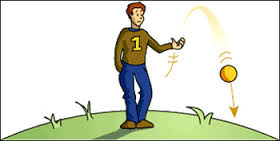

A squirrel sits on the ground and eats a donut. We know the forces on him must be balanced because...
Forces are always balanced
the squirrel is not accelerating
squirrels are projectiles
he's eating a donut


This equation goes with which law?
Newton's first law of motion
Newton's second law of motion
Newton's third law of motion

When the force on a car is doubled, the acceleration is doubled.
Newton's 1st Law
Newton's 2nd Law
Newton's 3rd Law

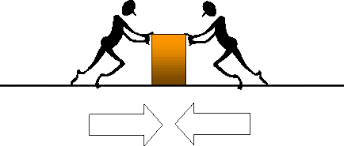
You push against a wall and the wall is pushing back on you.
Newton's 1st Law
Newton's 2nd Law
Newton's 3rd Law

You are carrying a lunch tray when you bump into the edge of a table. Although the tray did not tip, your milk falls off of the front of the tray.
Newton's
1st
Law of Motion
Newton's
2nd
Law of Motion
Newton's
3rd
Law of Motion

When the force on a car is doubled, the acceleration is doubled.
Newton's 1st Law
Newton's 2nd Law
Newton's 3rd Law
Which unit is used to measure speed?
Newtons (N)
Meters (m)
Meters per second (m/s)
Kilograms (kg)
What does Newton's first law state about an object's motion?
An object's motion can change without any force acting on it.
A force is needed to keep an object moving.
An object's motion cannot change unless a force acts on it.
Friction is the only force affecting an object's motion.
What force opposes the motion of an object in everyday situations?
Gravity
Friction
Magnetism
Electromagnetic Force
According to Newton's second law, what happens to the acceleration of an object if the force applied to it increases?
The acceleration decreases
The acceleration remains the same
The acceleration increases
The acceleration becomes negative
Newton's second law is summarized by which equation?
F=m×a
F=am
F=m+a
What does Newton's third law state about forces?
Forces act independently of each other
Forces always result in motion
Every force has an equal and opposite reaction force
Forces are directly proportional to mass
When one object exerts a force on another, what happens according to Newton's third law?
The object doesn't react
The other object applies an equal and opposite force
The other object applies a different sized force
The other object applies a force in the same direction
What is the unit used to measure force?
Newtons (N)
Kilograms (kg)
Meters per second (m/s)
Joules (J)
What force is responsible for slowing down a rolling ball on the ground?
Gravity
Magnetism
Friction
Electromagnetic Force
Which law of motion describes an object's resistance to a change in its motion?
Newton's 1st Law
Newton's 2nd Law
Newton's 3rd Law
None of these
What term describes the change in speed per unit of time?
Mass
Friction
Acceleration
Force
When forces acting on an object are balanced, what happens to the object's motion?
The object accelerates
The object moves in a circular path
The object slows down
The object's motion remains unchanged
Which law of motion states that the force required to accelerate an object is directly proportional to its mass?
Newton's 1st Law
Newton's 2nd Law
Newton's 3rd Law
None of these
What is the unit for measuring mass?
Newtons (N)
Kilograms (kg)
Meters per second (m/s)
Joules (J)
What type of force is needed to change an object's motion?
Balanced Forces
Frictional Forces
Gravitational Forces
Unbalanced Forces
According to Newton's 2nd Law, what happens to acceleration if force remains constant but mass increases? The acceleration will _____.
decrease
increase
remain constant
become zero
When forces on an object are unbalanced, what happens to the object's motion?
It remains unchanged
It decelerates
It accelerates
It moves in a circular path
Which of the following is a unit of acceleration?
Kilograms (kg)
Meters per second squared (m/s2)
Newtons (N)
Joules (J)
What is the effect of increasing mass on the gravitational force between two objects?
The gravitational force increases
The gravitational force decreases
The gravitational force remains unchanged
The gravitational force becomes zero
As more unbalanced force is applied to an object, its acceleration:
stays the same
decreases
increases
A 20 kg bike accelerates at 10 m/s2. What was the force?
30 Newtons
2 Newtons
200 Newtons
10 Newtons
An object in motion stops when.....
It falls of an edge.
it is acted upon by an outside force.
It is eaten
It never stops
The force that prevents a ball rolling on the ground from continuing on it's path forever is...
Friction
Gravity
Inertia


____ force is needed to move objects of larger mass.
less
equal
more
light
What explains a quantity that has BOTH speed and direction?
Inertia
Force
Speed
Velocity
A force is:
a push
a pull
both
neither

If the man pushes with an equal amount of force, which object will accelerate more?
Car because it has more mass
Lawnmower because it has less mass
Car because it has less mass
Lawnmower because it has more mass
A cotton ball and a iron ball are thrown from the same height. Which of the following will reach the ground first?
the cotton ball reaches first
the iron ball reaches first
both the balls reach same time
none of these
What happens to the mass of an object if you double the force pushing on it?
Mass will remain the same.
Mass will double in magnitude
Mass will decrease to 1/2 of its original.
Mass will decrease to 1/4 of its original.
What happens to the acceleration of an object if you double the force pushing on it?
Acceleration will remain the same.
Acceleration will double in magnitude
Acceleration will decrease to 1/2 of its original.
Acceleration will decrease to 1/4 of its original.
What happens to the acceleration of an object if you double the mass being pushed or pulled?
Acceleration will remain the same.
Acceleration will double in magnitude
Acceleration will decrease to 1/2 of its original.
Acceleration will decrease to 1/4 of its original.

The swimmer's arms and legs push and kick with a strong force. As a result, she moves faster through the water.
Newton's 1st Law
Newton's 2nd Law
Newton's 3rd Law
None of them



