
Font size
 Worksheets
Linear Equations in Two Variables
Total questions: 100
Worksheet time: 53mins
Write a linear equation in one variable.
x + 1 = 0 (or x + √2 = 0, or √2 y + √3 = 0)
x2+1=0
x + y = 2
x2+y2=1
Consider the equation: 2x + 5 = 0. What is the solution to this equation?
-5/2
5/2
2/5
-2/5
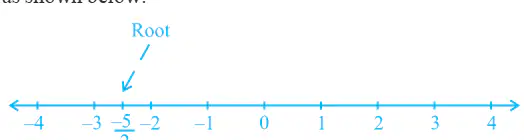
The solution to the equation 2x + 5 = 0 is -5/2. How can this solution be represented?
On a number line
On a bar graph
On a pie chart
On a histogram
Does a linear equation in one variable have a unique solution?
Yes
No
Write each of the following equations in the form ax + by + c = 0 and indicate the values of a, b and c in each case: (i) 2x + 3y = 4.37
2x + 3y - 4.37 = 0; a = 2, b = 3, c = -4.37
2x + 3y + 4.37 = 0; a = 2, b = 3, c = 4.37
2x - 3y - 4.37 = 0; a = 2, b = -3, c = -4.37
2x + 3y = 4.37; a = 2, b = 3, c = 4.37
Write each of the following equations in the form ax + by + c = 0 and indicate the values of a, b and c in each case: (ii) x - 4 = √3 y
x - √3y - 4 = 0; a = 1, b = -√3, c = -4
x + √3y + 4 = 0; a = 1, b = √3, c = 4
x - 4y - √3 = 0; a = 1, b = -4, c = -√3
x + 4y - √3 = 0; a = 1, b = 4, c = -√3
Write each of the following equations in the form ax + by + c = 0 and indicate the values of a, b and c in each case: (iii) 4 = 5x - 3y
5x - 3y - 4 = 0; a = 5, b = -3, c = -4
5x + 3y + 4 = 0; a = 5, b = 3, c = 4
-5x + 3y + 4 = 0; a = -5, b = 3, c = 4
5x - 3y + 4 = 0; a = 5, b = -3, c = 4
Write each of the following equations in the form ax + by + c = 0 and indicate the values of a, b and c in each case: (iv) 2x = y
2x - y = 0; a = 2, b = -1, c = 0
2x + y = 0; a = 2, b = 1, c = 0
2x - y = 1; a = 2, b = -1, c = 1
2x + y = 1; a = 2, b = 1, c = 1
The cost of a notebook is twice the cost of a pen. Write a linear equation in two variables to represent this statement. (Take the cost of a notebook to be ₹ x and that of a pen to be ₹ y).
x = 2y
x = y + 2
2x = y
x + y = 2
Express the following linear equation in the form ax + by + c = 0 and indicate the values of a, b and c in each case: (i) 2x + 3y = 9.35
2x + 3y - 9.35 = 0; a = 2, b = 3, c = -9.35
2x + 3y + 9.35 = 0; a = 2, b = 3, c = 9.35
2x - 3y - 9.35 = 0; a = 2, b = -3, c = -9.35
2x + 3y = 0; a = 2, b = 3, c = 0
Express the following linear equation in the form ax + by + c = 0 and indicate the values of a, b and c in each case: (ii) x - y/5 = 10
x - (1/5)y - 10 = 0; a = 1, b = -1/5, c = -10
x + (1/5)y + 10 = 0; a = 1, b = 1/5, c = 10
x - 5y - 10 = 0; a = 1, b = -5, c = -10
x - (1/5)y + 10 = 0; a = 1, b = -1/5, c = 10
Express the following linear equation in the form ax + by + c = 0 and indicate the values of a, b and c in each case: (iii) -2x + 3y = 6
-2x + 3y - 6 = 0; a = -2, b = 3, c = -6
-2x + 3y + 6 = 0; a = -2, b = 3, c = 6
2x - 3y + 6 = 0; a = 2, b = -3, c = 6
2x + 3y - 6 = 0; a = 2, b = 3, c = -6
Express the following linear equation in the form ax + by + c = 0 and indicate the values of a, b and c in each case: (iv) x = 3y
x - 3y = 0; a = 1, b = -3, c = 0
x + 3y = 0; a = 1, b = 3, c = 0
x - 3y = 3; a = 1, b = -3, c = -3
x + 3y = 3; a = 1, b = 3, c = -3
Express the following linear equation in the form ax + by + c = 0 and indicate the values of a, b and c in each case: (v) 2x = -5y
2x + 5y = 0; a = 2, b = 5, c = 0
2x - 5y = 0; a = 2, b = -5, c = 0
2x + 5y = 5; a = 2, b = 5, c = -5
2x + 5y = 10; a = 2, b = 5, c = -10
Express the following linear equation in the form ax + by + c = 0 and indicate the values of a, b and c in each case: (vi) 3x + 2 = 0
3x + 0y + 2 = 0; a = 3, b = 0, c = 2
3x + 2y + 0 = 0; a = 3, b = 2, c = 0
3x + 2y - 2 = 0; a = 3, b = 2, c = -2
3x - 2y + 0 = 0; a = 3, b = -2, c = 0
Express the following linear equation in the form ax + by + c = 0 and indicate the values of a, b and c in each case: (vii) y - 2 = 0
0x + y - 2 = 0; a = 0, b = 1, c = -2
x + y - 2 = 0; a = 1, b = 1, c = -2
x - y + 2 = 0; a = 1, b = -1, c = 2
y + 2 = 0; a = 0, b = 1, c = 2
Express the following linear equation in the form ax + by + c = 0 and indicate the values of a, b and c in each case: (viii) 5 = 2x
2x - 5 = 0; a = 2, b = 0, c = -5
2x + 5 = 0; a = 2, b = 0, c = 5
5x - 2 = 0; a = 5, b = 0, c = -2
2x + 0y + 5 = 0; a = 2, b = 0, c = 5
Find four different solutions of the equation x + 2y = 6.
(2, 2), (0, 3), (6, 0), and (4, 1)
(1, 2), (2, 1), (3, 0), and (0, 0)
(3, 2), (2, 3), (1, 1), and (0, 2)
(4, 2), (2, 4), (1, 3), and (3, 1)
Find two solutions for each of the following equations: (i) 4x + 3y = 12
(0, 4) and (3, 0)
(1, 2) and (2, 1)
(2, 2) and (4, 0)
(0, 3) and (4, 1)
Find two solutions for each of the following equations: 2x + 5y = 0
(0, 0) and (5, -2)
(1, 2) and (2, 1)
(2, 0) and (0, 2)
(3, 1) and (1, 3)
Find two solutions for each of the following equations: (iii) 3y + 4 = 0
(0, -4/3) and (2, -2)
(1, 0) and (2, 1)
(0, 4/3) and (2, 2)
(1, -4/3) and (2, -4/3)
y = 3x + 5 has
a unique solution
only two solutions
infinitely many solutions
Write four solutions for the following equation: 2x + y = 7
Sample answers: (0,7), (1,5), (2,3), (3,1)
Sample answers: (0,5), (1,3), (2,1), (3,0)
Sample answers: (0,7), (1,6), (2,5), (3,4)
Sample answers: (1,7), (2,6), (3,5), (4,4)
Write four solutions for the following equation: πx + y = 9
Sample answers: (0,9), (1,9-π), (2,9-2π), (3,9-3π)
Sample answers: (0,0), (1,1), (2,2), (3,3)
Sample answers: (0,π), (1,π+1), (2,π+2), (3,π+3)
Sample answers: (0,9π), (1,8), (2,7), (3,6)
Write four solutions for the following equation: x = 4y
(0,0), (4,1), (8,2), (12,3)
(1,0), (2,1), (3,2), (4,3)
(0,1), (4,2), (8,3), (12,4)
(0,0), (1,4), (2,8), (3,12)
Check which of the following are solutions of the equation x - 2y = 4 and which are not:
(0,2)
(2,0)
(4,0)
(√2, 4√2)
(1,1)
Find the value of k, if x = 2, y = 1 is a solution of the equation 2x + 3y = k.
k = 7
k = 5
k = 4
k = 9
The word 'geometry' comes from the Greek words 'geo', meaning the '_____', and 'metrein', meaning 'to measure'.
earth
sky
water
fire
Geometry appears to have originated from the need for measuring _____
land
time
weight
temperature
Which of the following ancient civilizations studied geometry?
Egypt
Babylonia
China
All of the above
The Egyptians used geometry for which of the following purposes?
Calculating simple areas
Constructing canals and pyramids
Computing volumes of granaries
All of the above
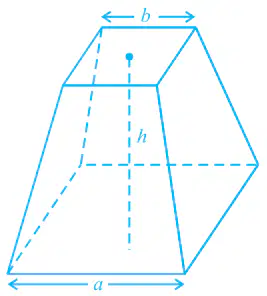
What is the name of the solid figure whose base can be a triangle, square, or other polygon, and whose side faces are triangles converging to a point at the top?
Pyramid
Cylinder
Prism
Sphere
What was the ratio of length : breadth : thickness of the bricks used for constructions?
4 : 2 : 1
3 : 2 : 1
5 : 3 : 1
2 : 2 : 1
During which period were the Sulbasutras written?
800 BCE to 500 BCE
1200 CE to 1300 CE
200 BCE to 100 BCE
1500 CE to 1600 CE
Which of the following statements is True or False: The Greeks were interested in establishing the truth of the statements they discovered using deductive reasoning.
True
False
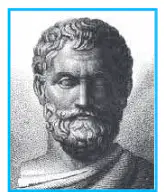
Who is credited with giving the first known proof that a circle is bisected by its diameter?
Thales
Euclid
Pythagoras
Archimedes
In which year was Pythagoras born?
572 BCE
490 BCE
600 BCE
530 BCE
Fill in the blank: A ______ is that which has no part.
point
line
angle
circle
Fill in the blank: A ______ is breadthless length.
line
circle
angle
point
Fill in the blank: The ends of a line are ______.
points
lines
angles
curves
Fill in the blank: A ______ is a line which lies evenly with the points on itself.
straight line
curved line
dotted line
broken line
Fill in the blank: A ______ is that which has length and breadth only.
surface
point
line
angle
Fill in the blank: The edges of a surface are ______.
lines
points
angles
curves
Fill in the blank: A ______ is a surface which lies evenly with the straight lines on itself.
plane surface
curved surface
rough surface
irregular surface
Fill in the blank: According to Euclid's axioms, things which are equal to the same thing are ______ to one another.
equal
opposite
parallel
greater
Fill in the blank: If equals are added to equals, the ______ are equal. (Euclid's axiom)
wholes
parts
differences
products
Fill in the blank: If equals are subtracted from equals, the ______ are equal. (Euclid's axiom)
remainders
sums
products
differences
Fill in the blank: Things which coincide with one another are ______ to one another. (Euclid's axiom)
equal
parallel
opposite
adjacent
Fill in the blank: The whole is ______ than the part. (Euclid's axiom)
greater
smaller
equal
lesser
Fill in the blank: Things which are double of the same things are ______ to one another. (Euclid's axiom)
equal
opposite
greater
less
Fill in the blank: Things which are halves of the same things are ______ to one another. (Euclid's axiom)
equal
parallel
opposite
adjacent
Postulate 1: Fill in the blank. A straight line may be drawn from any one point to any other _____
point
circle
angle
plane
Axiom 5.1: Given two distinct points, there is a unique _____ that passes through them.
line
circle
plane
angle
Postulate 2: Fill in the blank. A terminated line can be produced _____
indefinitely
for a short distance
with a ruler only
by joining two points
Postulate 3: Which of the following can be drawn with any centre and any radius?
Square
Triangle
Circle
Rectangle
Postulate 4: All _____ angles are equal to one another.
right
acute
obtuse
reflex
Postulate 5: If a straight line falling on two straight lines makes the interior angles on the same side of it taken together less than two right angles, then the two straight lines, if produced indefinitely, meet on that side on which the sum of angles is less than two right angles. Is this statement True or False?
True
False

If A, B and C are three points on a line, and B lies between A and C, then prove that
AB + BC = AC
AB + AC = BC
AC + BC = AB
AB = BC + AC
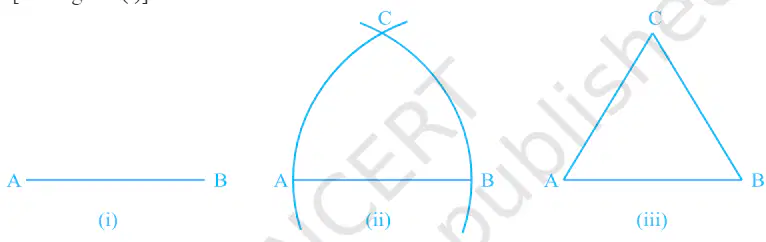
An equilateral triangle can be constructed on any given line segment.
True
False
Only if the segment is horizontal
Only if the segment is vertical
Fill in the blank: According to Euclid's Axiom (4), things which coincide with one another are ______ to one another.
equal
parallel
opposite
adjacent
Fill in the blank: In the construction of an equilateral triangle, AB = AC, since they are the ______ of the same circle.
radii
chords
diameters
tangents
In the construction of an equilateral triangle, AB = BC = AC.
True
False
Which of the following statements are true and which are false? Give reasons for your answers. (i) Only one line can pass through a single point.
True
False
Which of the following statements are true and which are false? Give reasons for your answers. (ii) There are an infinite number of lines which pass through two distinct points.
True
False
Which of the following statements are true and which are false? Give reasons for your answers. (iii) A terminated line can be produced indefinitely on both the sides.
True
False
Which of the following statements are true and which are false? Give reasons for your answers. (iv) If two circles are equal, then their radii are equal.
True
False
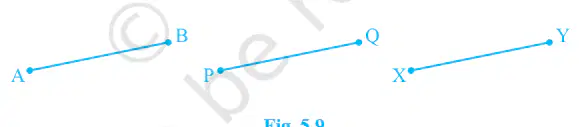
Which of the following statements are true and which are false? Give reasons for your answers. (v) In Fig. 5.9, if AB = PQ and PQ = XY, then AB = XY.
Give a definition for each of the following terms. Are there other terms that need to be defined first? What are they, and how might you define them? (i) parallel lines
Parallel lines are lines in a plane that do not meet; they are always the same distance apart. Other terms to define first: line, plane.
Parallel lines are lines that intersect at exactly one point. Other terms to define first: point, segment.
Parallel lines are lines that curve away from each other. Other terms to define first: curve, angle.
Parallel lines are lines that form a right angle with each other. Other terms to define first: angle, perpendicular.
Give a definition for each of the following terms. Are there other terms that need to be defined first? What are they, and how might you define them? (ii) perpendicular lines
Perpendicular lines are lines that intersect at a right angle (90 degrees). Other terms to define first: line, angle.
Perpendicular lines are lines that never meet, no matter how far they are extended. Other terms to define first: point, segment.
Perpendicular lines are lines that curve away from each other. Other terms to define first: curve, distance.
Perpendicular lines are lines that overlap completely. Other terms to define first: parallel, intersection.
Give a definition for each of the following terms. Are there other terms that need to be defined first? What are they, and how might you define them?
A line segment is a part of a line that is bounded by two distinct end points. Other terms to define first: line, point.
A line segment is a curve that extends infinitely in both directions. Other terms to define first: angle, circle.
A line segment is a region enclosed by two parallel lines. Other terms to define first: ray, plane.
A line segment is a point with no length or width. Other terms to define first: segment, vertex.
Give a definition for each of the following terms. Are there other terms that need to be defined first? What are they, and how might you define them?
The radius of a circle is the distance from the center of the circle to any point on its circumference. Other terms to define first: circle, center, circumference.
The radius of a circle is the length of the diameter. Other terms to define first: diameter, chord, arc.
The radius of a circle is the area inside the circle. Other terms to define first: area, sector, segment.
The radius of a circle is the distance around the circle. Other terms to define first: perimeter, tangent, secant.
Give a definition for each of the following terms. Are there other terms that need to be defined first? What are they, and how might you define them? (v) square
A square is a quadrilateral with four equal sides and four right angles. Other terms to define first: quadrilateral, side, angle.
A square is a triangle with three equal sides and three right angles. Other terms to define first: triangle, side, angle.
A square is a circle with a constant radius. Other terms to define first: circle, radius, diameter.
A square is a polygon with five equal sides and five right angles. Other terms to define first: polygon, side, angle.
Consider two ‘postulates’ given below: (i) Given any two distinct points A and B, there exists a third point C which is in between A and B. (ii) There exist at least three points that are not on the same line. Which of the following statements is correct regarding these postulates?
They contain undefined terms, are consistent, and do not follow from Euclid’s postulates.
They do not contain undefined terms, are inconsistent, and follow from Euclid’s postulates.
They contain undefined terms, are inconsistent, and follow from Euclid’s postulates.
They do not contain undefined terms, are consistent, and do not follow from Euclid’s postulates.
If a point C lies between two points A and B such that AC = BC, then what is the value of AC in terms of AB?
AC = 1/2 AB
AC = AB
AC = 2 AB
AC = AB/3
Every line segment has how many mid-points?
One and only one
Two
Three
None
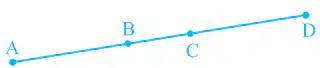
In Fig. 5.10, if AC = BD, then which of the following is true?
AB = CD
AB = AC
AB = BD
AC = CD
Axiom 5, in the list of Euclid’s axioms, is considered a ‘universal truth’ because:
it is accepted as self-evident and applies to all mathematical reasoning.
it is specific only to geometry and not other branches of mathematics.
it was proven using other axioms and postulates.
it is only relevant in non-Euclidean geometry.
State Euclid's axiom 1.
Things which are equal to the same thing are equal to one another.
The whole is greater than the part.
Parallel lines never meet.
A straight line can be drawn joining any two points.
State Euclid's axiom 2.
If equals are added to equals, the wholes are equal.
If equals are subtracted from equals, the remainders are equal.
Things which are double of the same things are equal to one another.
Things which coincide with one another are equal to one another.
State Euclid's axiom 3.
If equals are subtracted from equals, the remainders are equal.
If equals are added to equals, the wholes are equal.
Things which coincide with one another are equal to one another.
The whole is greater than the part.
State Euclid's axiom 4.
Things which coincide with one another are equal to one another.
The whole is greater than the part.
If equals are added to equals, the wholes are equal.
All right angles are equal to one another.
State Euclid's axiom 5.
The whole is greater than the part.
Things which are equal to the same thing are equal to one another.
If equals are added to equals, the wholes are equal.
If equals are subtracted from equals, the remainders are equal.
State Euclid's axiom 6.
Things which are double of the same things are equal to one another.
Things which are halves of the same things are equal to one another.
The whole is greater than the part.
If equals are added to equals, the wholes are equal.
State Euclid's axiom 7.
Things which are halves of the same things are equal to one another.
Things which are double of the same things are equal to one another.
The whole is greater than the part.
If equals are added to equals, the wholes are equal.
State Euclid's postulate 1.
A straight line may be drawn from any one point to any other point.
A circle can be drawn with any center and any radius.
All right angles are equal to one another.
If a straight line falling on two straight lines makes the interior angles on the same side less than two right angles, the two straight lines, if produced indefinitely, meet on that side on which the angles are less than two right angles.
State Euclid's postulate 2.
A terminated line can be produced indefinitely.
All right angles are equal to one another.
A circle can be drawn with any center and radius.
Parallel lines never meet.
State Euclid's postulate 3.
A circle can be drawn with any centre and any radius.
A straight line can be drawn joining any two points.
All right angles are equal to one another.
If a straight line falling on two straight lines makes the interior angles on the same side less than two right angles, the two straight lines, if produced indefinitely, meet on that side on which the angles are less than two right angles.
State Euclid's postulate 4.
All right angles are equal to one another.
A straight line can be drawn from any point to any other point.
A circle can be described with any center and distance (radius).
If a straight line falling on two straight lines makes the interior angles on the same side less than two right angles, the two straight lines, if produced indefinitely, meet on that side on which the angles are less than two right angles.
It is important to have a thorough knowledge of angles when making a model of a hut using bamboo sticks because:
it helps ensure the structure is stable and fits together correctly.
it makes the bamboo sticks look more colorful.
it allows the hut to be built faster without planning.
it helps to use fewer bamboo sticks.
According to the introduction, the properties of lines and angles are used in science, particularly in studying the properties of light, by:
analyzing how light rays reflect and refract
measuring the mass of objects
determining the chemical composition of substances
predicting weather patterns
An architect needs to know about intersecting lines and parallel lines when drawing a plan for a multistoried building because:
it helps ensure the structure is accurate and stable.
it allows them to use more colors in the design.
it makes the building taller.
it reduces the number of floors needed.
What is a line-segment?
A part (or portion) of a line with two end points is called a line-segment.
A line that extends infinitely in both directions.
A curve with no straight parts.
A point with no length or width.
What is a ray?
A part of a line with one end point is called a ray.
A line segment with two end points is called a ray.
A closed figure is called a ray.
A line with no end points is called a ray.
If three or more points lie on the same line, what are they called?
Collinear points
Concurrent points
Coplanar points
Non-collinear points
If three or more points do not lie on the same line, what are they called?
Non-collinear points
Collinear points
Concurrent points
Coplanar points
What is an angle formed by?
An angle is formed when two rays originate from the same end point.
An angle is formed when two lines are parallel to each other.
An angle is formed when a line intersects a circle.
An angle is formed when three points are collinear.
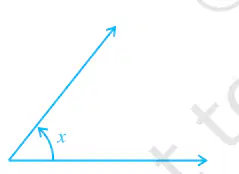
Which type of angle is shown in Fig. 6.1 (i)?
Acute angle
Right angle
Obtuse angle
Reflex angle
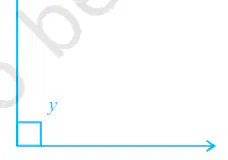
Which type of angle is shown in Fig. 6.1 (ii)?
Acute angle
Right angle
Obtuse angle
Reflex angle
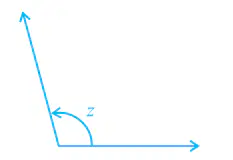
Which type of angle is shown in Fig. 6.1 (iii)?
Acute angle
Right angle
Obtuse angle
Reflex angle
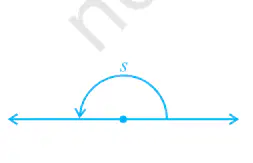
Which type of angle is shown in Fig. 6.1 (iv)?
Acute angle
Right angle
Straight angle
Reflex angle

