
 Worksheets
Unit 2: Earth Science Review
Total questions: 49
Worksheet time: 2hrs 38mins
Name
Class
Date
1.
What is the most important data type that has helped scientists determine the earth is made of layers?
a)
Caves
b)
Seismic waves
c)
Quarries
d)
Drilling into the earth
2.
What is not a type of seismic waves?
a)
P waves
b)
S waves
c)
T waves
d)
Surface Waves
3.
Which waves arrive first?
a)
P waves
b)
S waves
c)
T waves
d)
Surface waves
4.
Which waves don't travel through liquids?
a)
P waves
b)
S waves
c)
T waves
d)
Surface waves
5.
What is the Moho?
a)
The boundary between the mantle and core
b)
The boundary between the crust and the mantle
c)
The boundary between the inner and outer core
d)
The boundary between the lithosphere and the asthenosphere
6.
How do we know that the outer core is liquid?
a)
Because it is less dense than the mantle
b)
Because S waves don't travel through it
c)
Because P waves don't travel through it
d)
Because it has a magnetic field
7.
How do we know the inner core is made of iron and nickel?
a)
Because it is less dense than the mantle
b)
Because P waves don't travel through it
c)
Because S waves don't travel through it
d)
Because it has a magnetic field
8.
What does it mean when I say the mantle is plastic?
a)
It can flow or move
b)
It is chemically like the plastic in a bottle
c)
It is brittle and it can break easily
d)
It is really dense
9.
Why does the mantle move?
a)
Because it is transferring potential energy to kinetic energy
b)
Because it is repelled by the core's magnetic field
c)
Because it is transferring thermal energy from hot to cold areas
d)
Because it is attracted to the crust
10.
What is name of the type of crust that we live on?
a)
Oceanic
b)
Moho
c)
Continental
d)
Mantle
11.
How is oceanic crust different than continental crust?
a)
It is thicker and lighter
b)
It is plastic
c)
It is made of light-colored elements
d)
It is thinner and denser
12.
What type of deformation involves rocks bending but not breaking?
a)
Subduction
b)
Folding
c)
Faulting
d)
Divergent
13.
What is the difference between relative and absolute dating?
a)
Relative dating tells you the numerical age of a rock, while absolute dating tells you if a rock is older or younger than another.
b)
Relative dating uses radioactive isotopes to determine age, and absolute uses certain rules.
c)
Relative dating tells you if one rock layer is older or younger than another, while absolute dating give a numerical age.
d)
Relative dating is when you date your cousin, absolute dating is when you date a stranger
14.
What is the principle of superposition?
a)
If one rock contains fragments of another rock, it must be younger than the fragments.
b)
The oldest layer is at the bottom and the youngest is on top.
c)
Features that cut across rocks or other features are younger than the features they cut.
d)
Rocks are deposited horizontally. If they are bent or at an angle, that happened later.
15.
What is the principle of original horizontality?
a)
If one rock contains fragments of another rock, it must be younger than the fragments.
b)
The oldest layer is at the bottom and the youngest is on top.
c)
Features that cut across rocks or other features are younger than the features they cut.
d)
Rocks are deposited horizontally. If they are bent or at an angle, that happened later.
16.
What is the principle of cross cutting relationships?
a)
If one rock contains fragments of another rock, it must be younger than the fragments.
b)
The oldest layer is at the bottom and the youngest is on top.
c)
Features that cut across rocks or other features are younger than the features they cut.
d)
Rocks are deposited horizontally. If they are bent or at an angle, that happened later.
17.
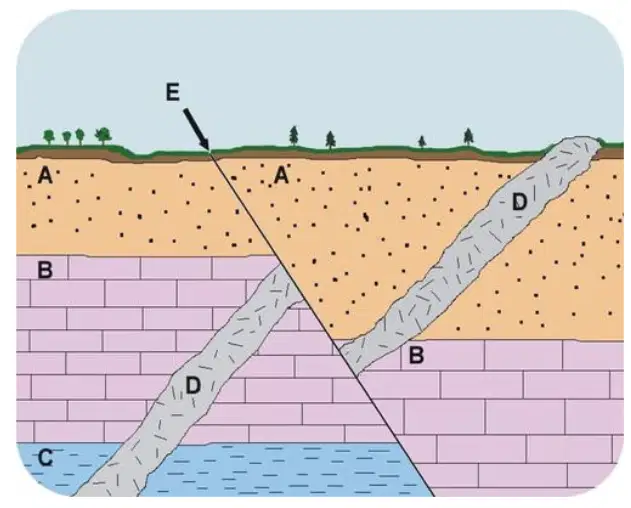
Look at this picture. What is the oldest rock layer?
a)
A
b)
B
c)
C
d)
D
e)
E
18.
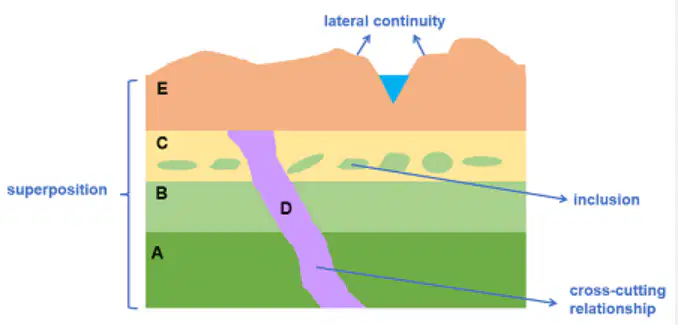
Which rock layer is younger, B or C? And why?
a)
C is younger than B since it cuts across B.
b)
C is younger than B since there are fragments of B in layer C.
c)
B is younger than C since there are fragments of C in layer B.
d)
B is younger than C because it is lower than layer C.
19.
What is the best definition for a fault?
a)
When stress is applied to rocks, causing them to bend
b)
When stress is applied to rocks, causing them to break
c)
When stress is applied to rocks and it deposits a layer above an older rock
20.
What causes faults to form?
a)
Erosion
b)
Magic
c)
Intense storms
d)
Earthquakes
21.
Why didn't other scientists believe Alfred Wegener's Continental Drift Theory?
a)
Because the theory was supported by fossil evidence
b)
Because the theory was supported by climate data
c)
Because the theory couldn't explain how the continents moved
d)
Because the theory was supported by geologic evidence
22.
How do the continents support the Continental Drift Theory?
a)
The shape of South America and Africa indicate they were together at one time
b)
The shape of the continents indicates the continents haven't moved over time
c)
The shape of the continents is random and no patterns can be seen
23.
How to the rocks in Europe and North America support the Continental Drift Theory?
a)
It doesn't support the theory. Similar rock types are found in far away locations all of the time.
b)
The rocks in Europe and North America are similar, which means they were once connected.
c)
The rocks in Europe and North American are very different, which means they've always been far away from each other.
24.
The fossil fern Glossopteris was found on South America, Africa, India, Antarctica and Australia. What does that mean?
a)
That the glossopteris can live in both cold and warm environments.
b)
That humans grew this fern and planted it on different continents.
c)
No patterns can be found by looking at Glossopteris.
d)
That the continents were once together, with the same climate and ecosystem.
25.
What records the direction of the North and South Poles?
a)
Silicon-rich rocks
b)
Iron-rich rocks
c)
Aluminum-rich rocks
d)
Calcium-rich rocks
26.
What features were discovered when scientists mapped the sea floor in the 1950s?
a)
Mountains in the middle of the sea floor
b)
Trenches near the continents
c)
All of the above
d)
None of the above
27.
Where were the youngest and oldest rocks found in the middle of the ocean?
a)
The youngest rocks were found in the middle and the oldest were found on the edges
b)
The rocks on the ocean floor all had the same age
c)
The oldest rocks were in the middle and the youngest were found on the edges
28.
What did seafloor spreading provide to the Theory of Continental Drift that was missing?
a)
Seafloor spreading provided fossil evidence that the continents were connected
b)
Seafloor spreading provided paleoclimate evidence that the continents were connected
c)
Seafloor spreading provided the explanation for why the plates moved.
d)
Seafloor spreading provided geologic evidence that the continents were connected
29.
Where do most of the plate interactions occur?
a)
At the center or middle of the plates
b)
The left side of the plate
c)
The right side of the plate
d)
At the edges or boundaries of the plates
30.
Why aren't there earthquakes in the middle of the pacific ocean?
a)
Because the plate isn't moving at this spot
b)
Because earthquakes only occur on continents
c)
Because there isn't a plate boundary at this spot
d)
Volcanoes cause earthquakes and there are no volcanoes here
31.
Where can I find a good example of an ocean plate divergent boundary?
a)
Mid-Atlantic Ridge
b)
Himalayan Mountains
c)
Great Rift Valley of East Africa
d)
Andes Mountains
e)
Aleutian Islands
32.
Where can I find a good example of a continent plate divergent boundary?
a)
Mid-Atlantic Ridge
b)
Himalayan Mountains
c)
Great Rift Valley of East Africa
d)
Andes Mountains
e)
Aleutian Islands
33.
What does subduction mean?
a)
When one tectonic plate hits another and forms mountains
b)
When one tectonic plate goes under another plate
c)
When tectonic plates move away from each other
d)
When one tectonic plate is older than another plate
34.
Where can I find a good example of an ocean-ocean plate convergent boundary?
a)
Mid-Atlantic Ridge
b)
Himalayan Mountains
c)
Great Rift Valley of East Africa
d)
Andes Mountains
e)
Aleutian Islands
35.
In an ocean-continent plate convergent boundary, which plate is always subducted?
a)
The oceanic plate
b)
The smaller of the two plates
c)
The continental plate
d)
The larger of the two plates
36.
Where can I find a good example of an ocean-continent plate convergent boundary?
a)
San Andreas Fault
b)
Himalayan Mountains
c)
Great Rift Valley of East Africa
d)
Andes Mountains
e)
Aleutian Islands
37.
What is absent in a continent-continent plate convergent boundary?
a)
Earthquakes
b)
Mountains
c)
Volcanoes
d)
Metamorphic rocks
38.
Where can I find a good example of an continent-continent convergent plate boundary?
a)
San Andreas Fault
b)
Himalayan Mountains
c)
Great Rift Valley of East Africa
d)
Andes Mountains
e)
Aleutian Islands
39.
What happens in a transform-fault boundary?
a)
One continental plate is subducted beneath the other
b)
Two continental plates collide with each other
c)
Two continental plates move away from each other
d)
Two continental plates slide past each other
40.
Where can I find a good example of an transform-fault plate boundary?
a)
San Andreas Fault
b)
Himalayan Mountains
c)
Great Rift Valley of East Africa
d)
Andes Mountains
e)
Aleutian Mountains
41.
What is a good definition of a natural hazard?
a)
A naturally occurring event that causes minor inconviences
b)
A naturally occurring event that causes positive impacts
c)
A human-caused event that causes negative impacts
d)
A naturally occurring event that causes negative impacts
42.
What is the percentage of earthquakes that occur at plate boundaries?
a)
30%
b)
90%
c)
10%
d)
60%
43.
What type of faults would you expect at a convergent boundary?
a)
Strike-Slip
b)
Normal
c)
Reverse
d)
All three types occur at this boundary
44.
Where would I find a shield volcano?
a)
At transform-fault boundaries
b)
At convergent boundaries
c)
At divergent boundaries
d)
At any plate boundary
45.
Where would I find a composite volcano?
a)
At transform-fault boundaries
b)
At convergent boundaries
c)
At divergent boundaries
d)
At any plate boundary
46.
Where do tsunamis form?
a)
At earthquakes on continents
b)
At volcanic island arcs
c)
At earthquakes underwater
d)
At earthquakes on unstable hills and slopes
47.
Why are tsunamis dangerous?
a)
Because they cause flooding
b)
Because they cause destruction of homes
c)
Because they cause loss of life
d)
All of the above
48.
What is a landslide?
a)
A large wave caused by an earthquake underwater
b)
The movement of rock or soil down a slope
c)
The movement of one tectonic plate under the other
d)
The movement of tectonic plates slide past each other
49.
What is not a cause of landslides?
a)
Excess rain and snow
b)
Earthquakes
c)
Plant overgrowth
d)
Volcanoes
100 %

